Innovation Policy
Adoption Readiness Levels
for Energy Technologies
A standardized framework for assessing commercial readiness and guiding targeted public intervention across the energy technology landscape.
View Our Assessments ↓Energy abundance requires innovation. From fracking to large-scale batteries and solar panels, bringing new technologies to the market has increased our energy supply and made energy markets more competitive.
But technology doesn't mature by accident. It requires a deliberate process to move from an idea to a widespread solution.
Targeted public interventions can smooth and speed commercialization. By reducing risk, expanding markets, and speeding up learning, government actions make room for private firms to compete, invest, and innovate.
The real struggle is figuring out:
- What should those public actions be for each technology?
- How do we know if they are working from an implementation standpoint?
To answer these questions, we need tools like the Department of Energy's Adoption Readiness Levels (ARL) framework. Think of it as a standardized "scorecard" for how ready a technology is for the real world.
← Scroll to see full diagram
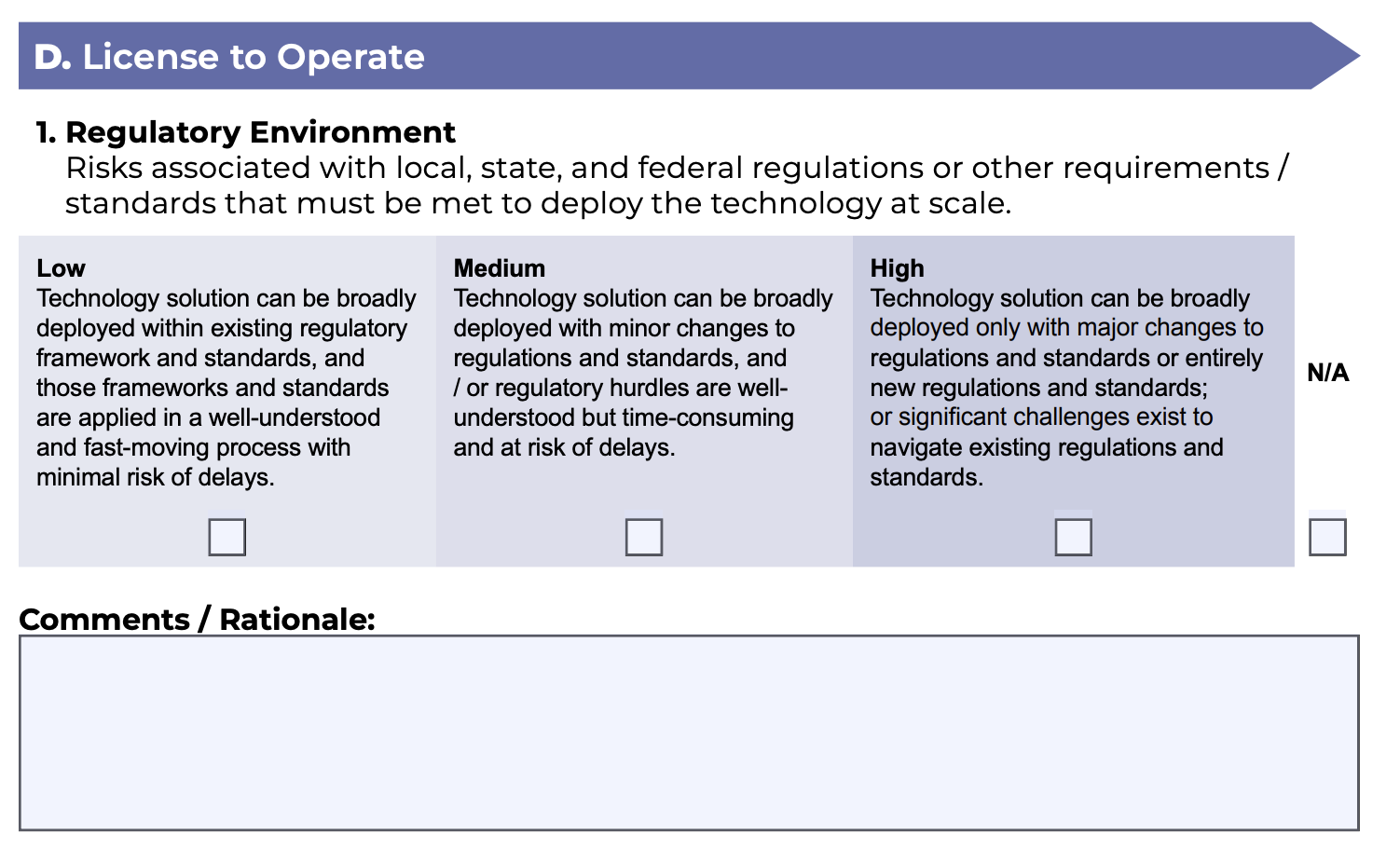
ARLs also enable comparisons across technologies that can guide innovation policy through a non-partisan lens. This open, evidence-based approach naturally enables policy consensus—making ARLs an essential tool for achieving energy abundance in the coming years.
Inventing ARLs: from NASA to DOE
In the 1970s, NASA created the technology readiness levels (TRL) concept to measure the maturity of space technology. The space agency and others such as the Department of Defense further developed and applied TRL into the now widely-adopted nine-level scale for technical maturity. But this framework only considers how thoroughly a technology has been tested in lab and operating environments. It doesn't account for market considerations or commercial risks.
Those commercial risks have become the focus of more recent legislation and DOE activity. For example:
- The Energy Policy Act of 2005 established the Loan Programs Office to provide capital to energy projects that the private sector will not finance;
- the America COMPETES Act of 2007 created ARPA-E, modeled on DARPA to enable high-risk but potentially game-changing tech that would otherwise not be funded;
- and the DOE formed the Office of Technology Commercialization in 2015 to "move innovations from the labs into the marketplace."
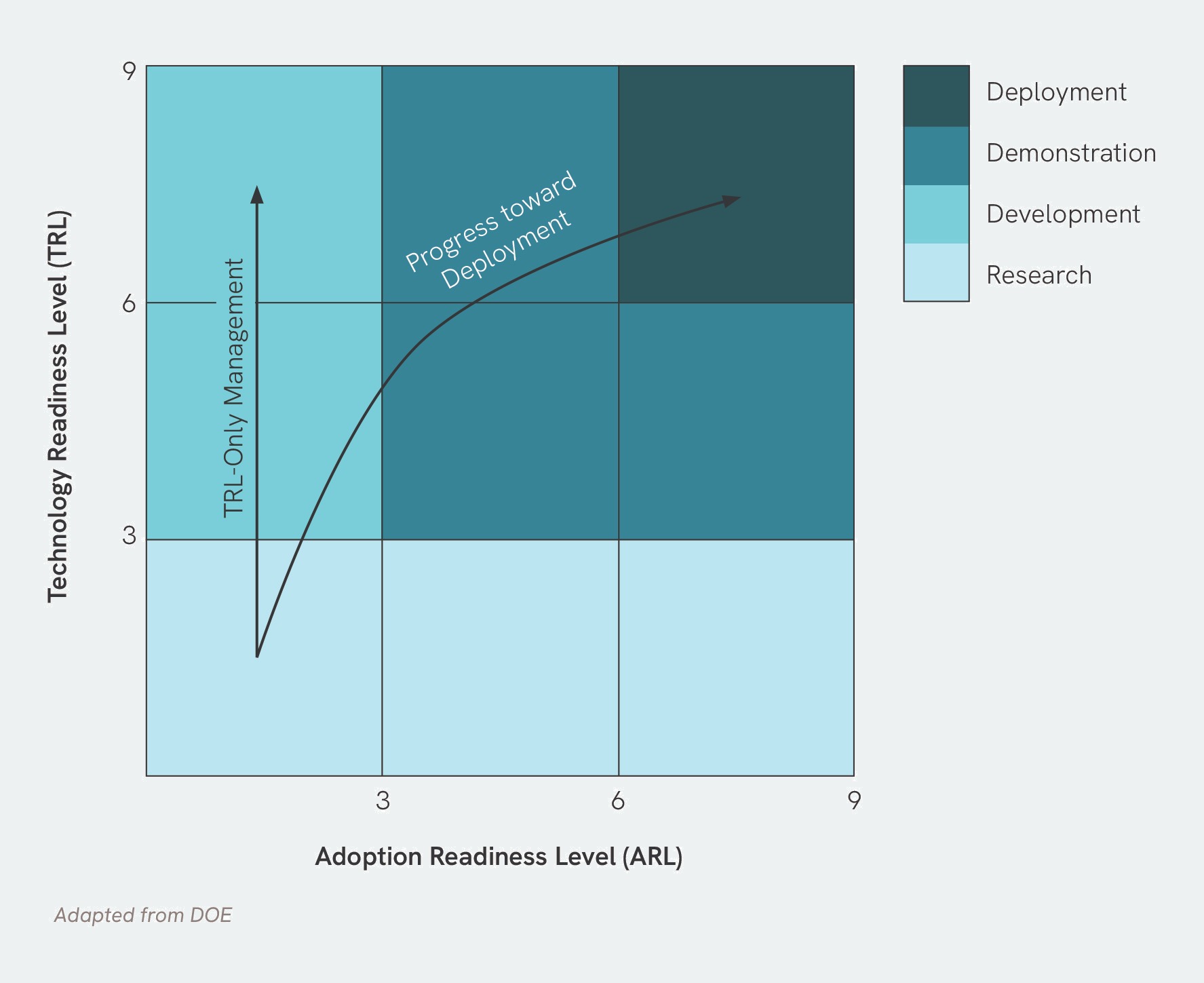
With this wider market-oriented perspective, DOE has taken inspiration from the TRL approach to create the ARL framework. This is a complementary tool designed to capture all of the commercial elements essential to energy markets and deployment that TRL does not cover.
The figure below illustrates that as technologies mature, research and development activities progress to demonstration projects and ultimately deployment, which requires both TRL and ARL management.
← Scroll to see full diagram
Deconstructing ARLs: How do they work?
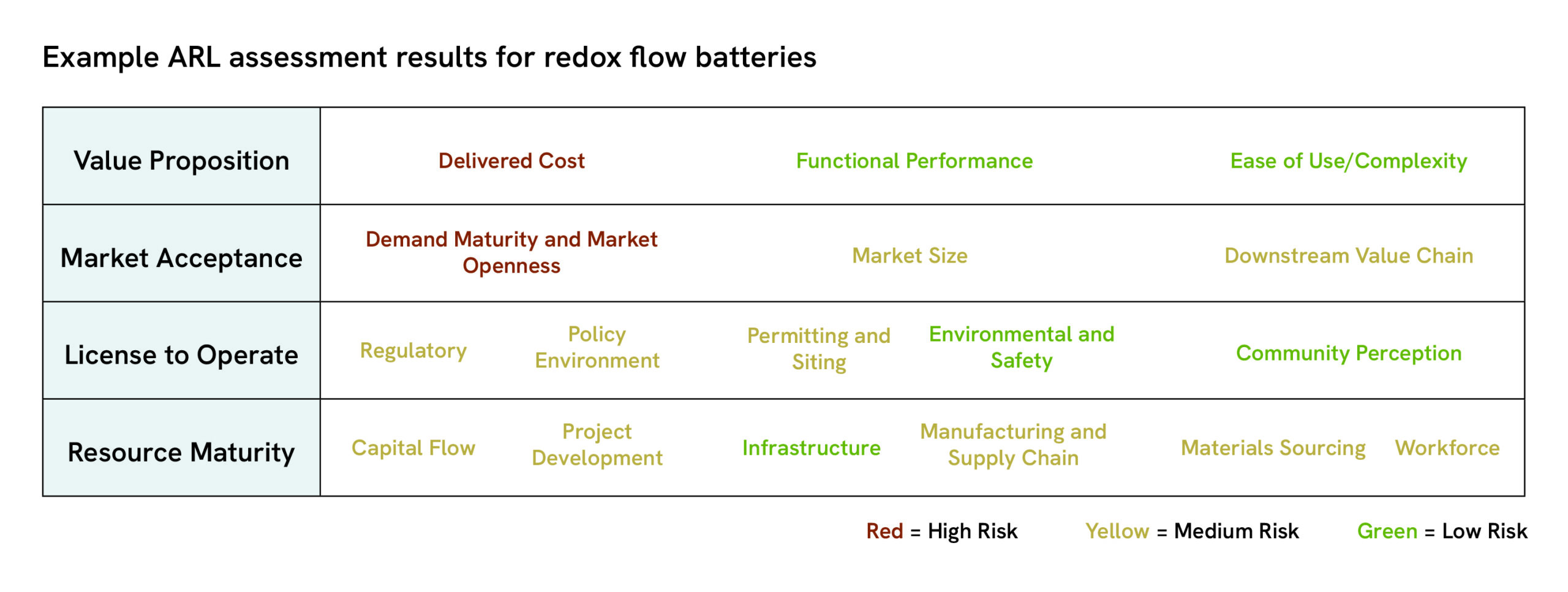
ARLs use evidence to evaluate 17 types of commercialization risk that technologies face. These fall under 4 broad categories:
- Value proposition to energy users
- Acceptance in the marketplace
- Social license to operate
- Maturity of supply-side inputs for completing a project
The graphic below lays out the 17 risk dimensions within the 4 categories, and shows the results that the Pacific Northwest National Laboratory (PNNL) arrived at in an ARL assessment for redox flow batteries: a score of low, medium, or high for each dimension. The full report transparently details the evidence underpinning these results, and DOE's methodology paper guides evaluation of the 17 dimensions.
← Scroll to see full diagram
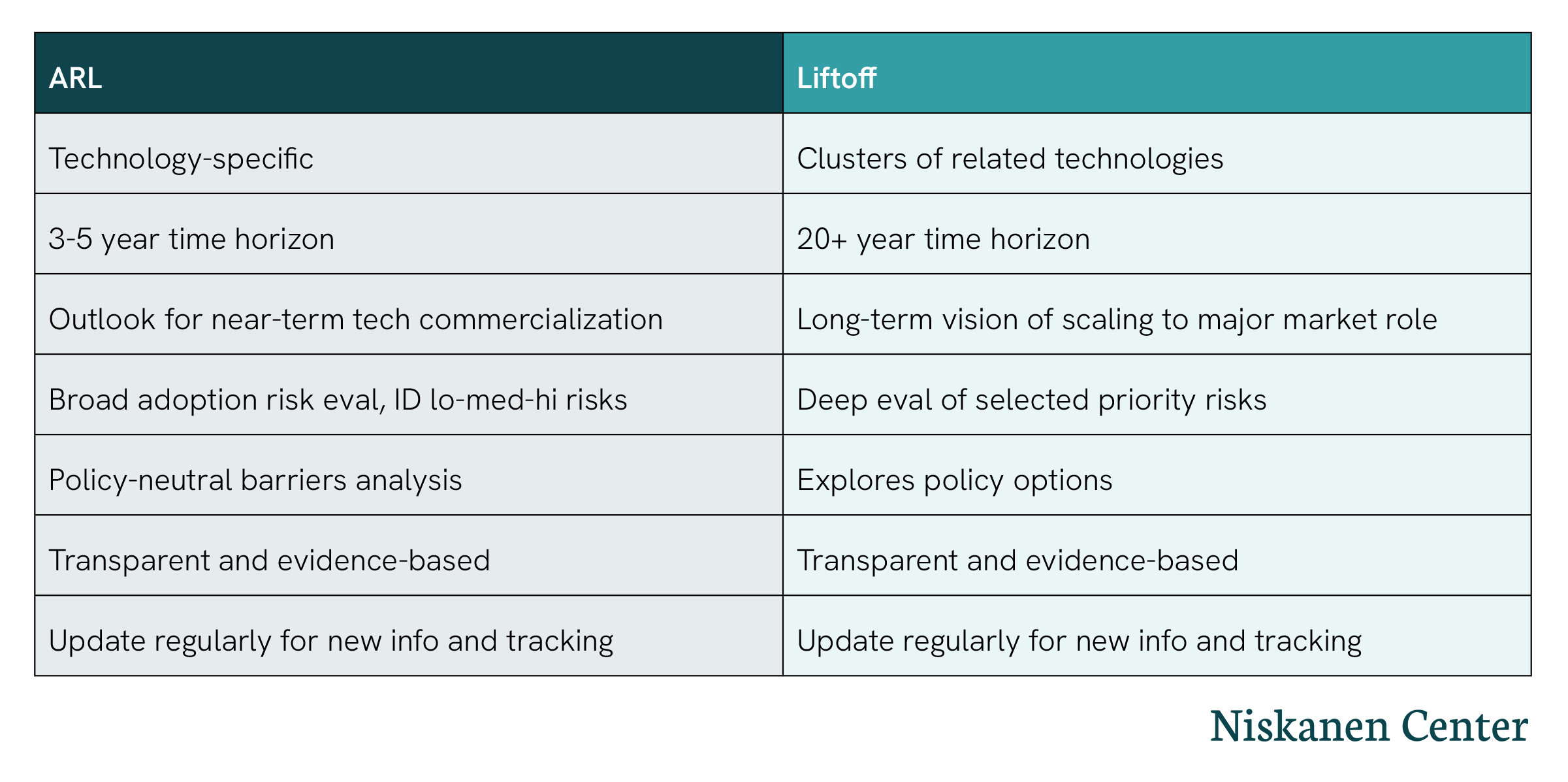
ARLs are not a panacea. To create commercialization policies that lead to energy abundance, we need several different tools and processes working together. For instance, PNNL described their redox flow battery ARL assessment as "a complement to the OTT-published, Pathways to Commercial Liftoff: Long Duration Energy Storage Report" that adds "in-depth analysis and increased granularity by selecting redox flow batteries, as a specific LDES technology class." Indeed, DOE's Liftoff report series is a good example of high-value analysis that can help guide innovation policy—but ARLs offer a unique analytical angle:
← Scroll to see full diagram
Full circle: spinning the learning-deployment wheel
Here's why ARLs are an irreplaceable tool for crafting innovation policy.
- They comprehensively map a technology's particular risks, and assign weights of high, medium, and low for each. This helps pinpoint where targeted government interventions are needed—for example, what permitting reform could entail for each tech. Pinpointing those needs also helps with effective policy development, avoiding the pitfall of giving a tax credit or a government loan to everything and expecting results.
- They leave policy responses open, focusing on granular barriers that need to be addressed. This fosters a non-partisan consensus approach to policy solutions.
- They provide transparent, collated results under a standardized methodology, which builds a common public-domain information set and language. This aids coordination across public and private sector stakeholders.
- They are useful individually or in a portfolio. Developing many ARL assessments allows comparison across technologies to help energy sector-wide commercialization policy, and program design decisions at agencies.
The ultimate goal? Spinning the learning-deployment wheel:
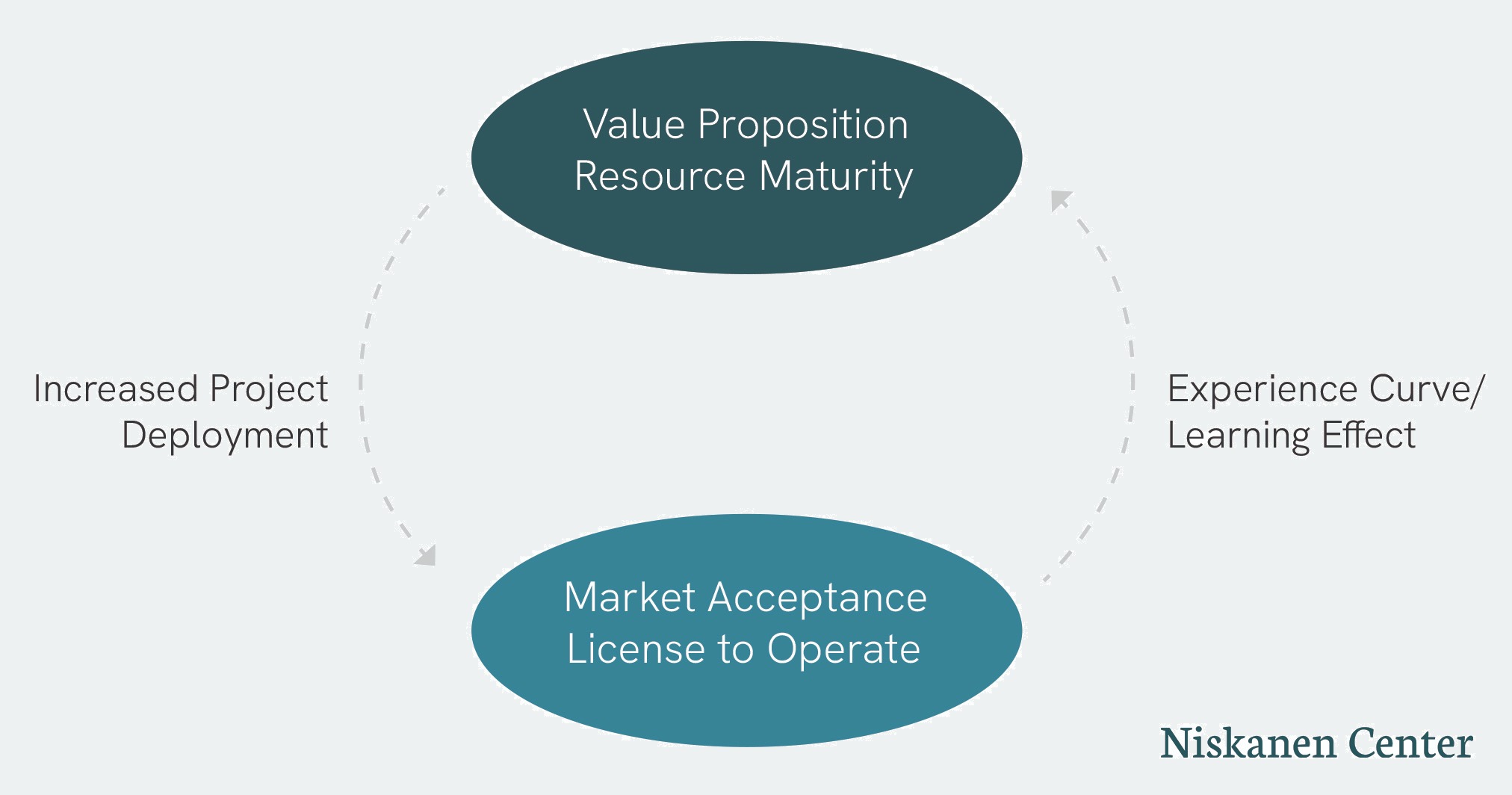
As we saw with fracking and solar power, early deployment can set off a virtuous cycle. Putting a technology into use helps companies learn how to improve it. Those improvements make the technology more valuable, which increases demand and leads to even more deployment, competition, and learning.
We can trigger this cycle with targeted, technology-specific interventions informed by ARL assessments. These interventions help move technologies closer to commercial readiness by reducing risk across one or more of the 17 ARL dimensions. Fixing a single bottleneck—like slow permitting or limited access to capital—can be enough to get projects built and start that learning-and-deployment cycle.
By tracking ARLs over time, we can also tell when a technology no longer needs public support. The goal is to spin technologies up just long enough for the private sector to take over so that commercialization can continue on its own, without ongoing government intervention.
Download our ARL assessments here
Niskanen ARL Research
Assessment forthcoming
Assessment forthcoming
What Should We Assess Next?
Our pipeline is shaped in part by demand from the policy community. Vote for the technology group you'd most like to see receive ARL assessments.
Research Team
The People Behind the Work
Kenneth Sercy
Energy Abundance Policy Manager, Climate & Energy Policy
Jia-Shen Tsai
Policy Analyst, Climate & Energy Policy
Questions about the project or interest in collaboration?
Get in touch