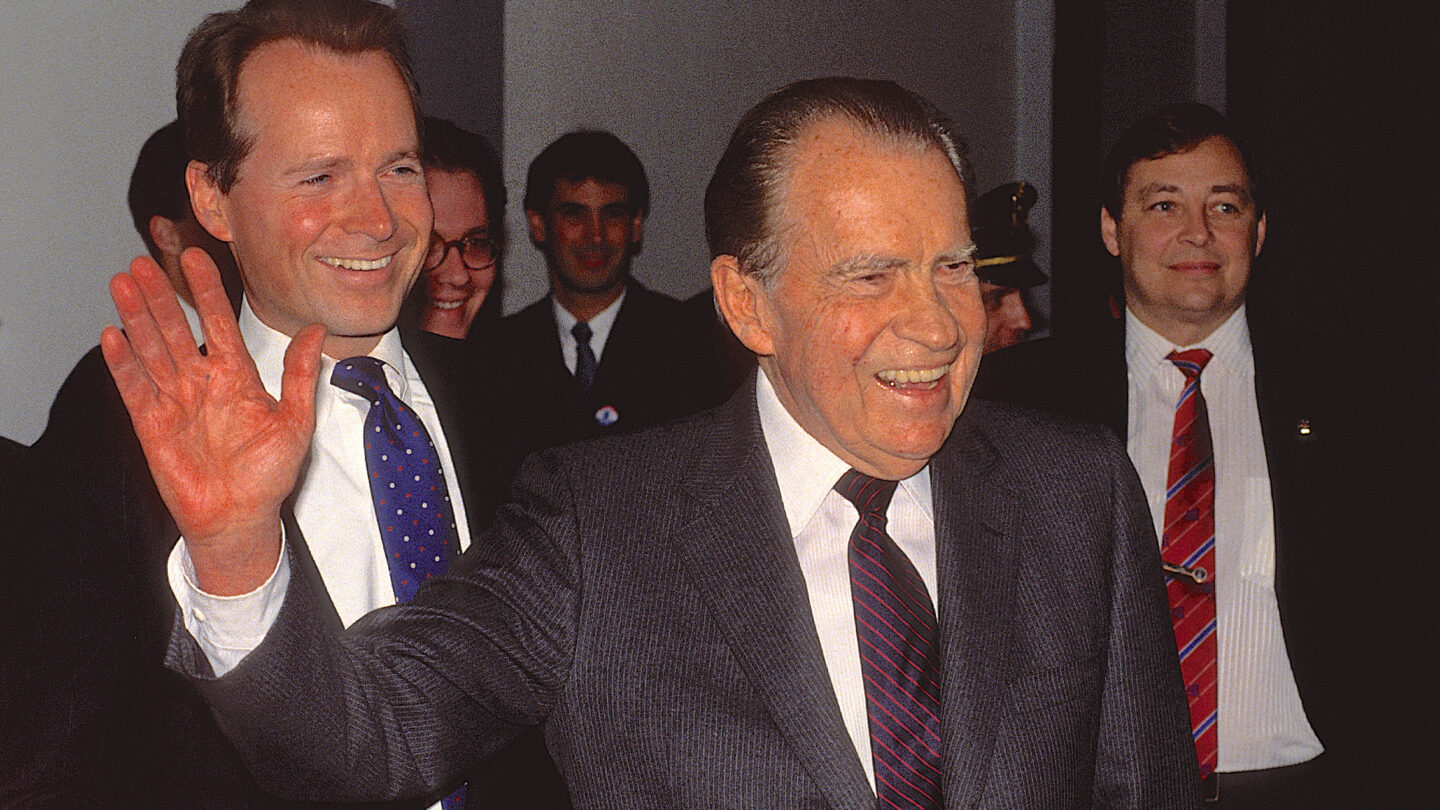
In February 1963, Lee Huebner, a first-year graduate student at Harvard University, attended a meeting of a new moderate Republican group called the Ripon Society. Six years later, after having served as the Ripon Society’s national president, he was in the White House as a speechwriter for newly elected President Richard Nixon. Huebner – who was still in his twenties when he joined the new administration – was part of a speechwriting team that included conservatives like Pat Buchanan and William Safire as well as moderates like David Gergen and Ray Price. He stayed in the White House until February 1974, just a few months before Nixon resigned over the Watergate scandal.
During his time in the administration, Huebner saw Nixon up close and came to think of him as having almost a split personality, which White House aides referred to as “the good Nixon” and “the bad Nixon”: “There were two sides to him, two very different sides. And I’m sure he was always puzzled himself by how he would reconcile his more mean-spirited, resentful, defensive personality against his gracious and open and thoughtful and brilliant, far-seeing personality.”
Huebner’s new book, Nixon’s Elusive Totality: It Depends on Who Writes the History, describes Nixon’s conflicting impulses and how they manifested in his speeches and actions. The book also reproduces some of Nixon’s most famous speeches, from his 1952 “Checkers” speech to his final speech to the White House staff as he left the presidency on August 8, 1974.
In this podcast interview, Huebner remembers episodes from his time in the White House, describes the conflicts between the moderate and conservative impulses of the administration, and assesses Nixon’s key strengths as a speechmaker. He shares his insights into what it takes to be a successful presidential speechwriter, and reflects on how history will remember Nixon, for good and ill.
Transcript
Lee Huebner: Nixon’s totality is very hard for people to grasp. It is elusive. He was almost, I want to say, a split personality. I’m sure he was always sort of puzzled himself by how he would reconcile his more mean-spirited, resentful personality against his gracious and open and thoughtful personality.
Geoff Kabaservice: Hello! I’m Geoff Kabaservice from the Niskanen Center. Welcome to The Vital Center Podcast, where we try to sort through the problems of the muddled, moderate majority of Americans, drawing upon history, biography, and current events. And I’m delighted to be joined today by Lee Huebner. He is the Airlie Professor of Media and Public Affairs at George Washington University, and previously taught journalism and communication at Northwestern University. He was for fourteen years the publisher and CEO of the Paris-based International Herald Tribune newspaper, and he has been president of the American University in Paris and the American Chamber of Commerce in France. He served as a Special Assistant to the President of the United States and Deputy Director of the White House Writing and Research Staff during the Nixon administration. And he is the author of numerous books including, most recently, Nixon’s Elusive Totality: It Depends on Who Writes the History, which was just published by the Miniver Press. Welcome, Lee!
Lee Huebner: Thank you so much. I appreciate the chance to talk with you, and thank you for your invitation.
Geoff Kabaservice: Absolutely, and congratulations on the new book. I’m really happy that this long-anticipated work has finally appeared. And it’s the product not only of your long association with Richard Nixon but also having taught a college course focused on Nixon for a quarter of a century, first at Northwestern and then at GW. So let me ask you the question that you ask your students in that class: Why study Richard Nixon?
Lee Huebner: I always ask that question. I’m curious why students should, in this later era, be interested in going back more than fifty years to study a president who left office back in 1974…
Geoff Kabaservice: Under a cloud, to put it mildly.
Lee Huebner: To put it mildly, yeah. And then what I always say is: What if I had chosen a late nineteenth-century figure to study when I was in college, like William Howard Taft, or someone in the early twentieth century? And the answer is they’re curious because Nixon is the only president to have been forced out of office, and because he was so complicated. And they hear various things about him from relatives and friends and teachers and they’re curious as to how it should settle out, what they should think. And so it’s fun to ask that question of them to start my classes.
Geoff Kabaservice: And you point out in your book that Nixon’s political career spanned almost half a century. And prior to the 2016 election, I used to ask some of my students a political trivia question, which was: When was the last time that the Republicans won the White House without a Nixon or a Bush on the presidential ticket?
Lee Huebner: Oh my goodness. Good question.
Geoff Kabaservice: And the answer to that question is 1928 — that’s how long it had been. So clearly Richard Nixon was a very important, consequential figure over a very long span of time.
Lee Huebner: Yes, a long span of time. One journalist said she felt she was part of the Nixon generation, who couldn’t remember a time when Nixon was not a national figure and couldn’t hope to live to a time when he would not be.
Geoff Kabaservice: So tell me about the quotations that provide both halves of your book title — both “Nixon’s elusive totality” and “It depends on who writes the history.”
Lee Huebner: Yes, and they sort of fit together. I guess I hope people think that Nixon’s elusive totality would be something that this book would be pursuing and discussing. And of course, that depends on who writes the history as to what parts of that totality might be emphasized.
The first part, regarding Nixon’s totality, stemmed from Bill Clinton — he was president at that point — being at Nixon’s funeral, in which he said, “Let the nation remember Nixon in his totality.” And my conclusion, as I explained in the book, is that Nixon’s totality is very hard for people to grasp. It is elusive, and I think it eluded Nixon himself. He was, I almost want to say, a split personality. There were two sides to him, very different sides. And I’m sure he was always puzzled himself by how he would reconcile his more mean-spirited, resentful, defensive personality against his gracious and open and thoughtful and brilliant, far-seeing personality. And then his strengths elude his critics and his supporters are still confused about what the criticisms are. That’s where the “elusive totality” title comes in from.
And the night Nixon resigned, he was walked back from the Oval Office to his residence in the White House by Henry Kissinger, who said, “History, Mr. President, will remember you much more kindly than your contemporaries.” And Nixon said — rather shrewdly, I think — “Henry, it depends on who writes the history.” And that’s the subtitle that seemed appropriate for the book. It’s also its closing line, so if people read the book long enough, they’ll find out how that fits in.
Geoff Kabaservice: I’m glad that you are weighing in on this history, because after all, various of Richard Nixon’s friends and associates have done their best to try to spin Nixon as a politician and to claim his legacy for their preferred stance. So Pat Buchanan, famously, has written quite a lot trying to portray Nixon as a populist conservative, maybe even as a forerunner of Donald Trump. You of course come from a much different political orientation than Pat Buchanan.
Lee Huebner: Right.
Geoff Kabaservice: Although you both, you and Buchanan, are members of the Judson Welliver Society. What is that?
Lee Huebner: Oh, it’s an association of former White House speechwriters. “Association” would be too strong a word; it’s just the label for a group that, provided somebody calls it into action, meets every year and a half or so, just to talk about anything — including the presidents for whom they worked. It’s all White House speechwriters. They have a table for each administration, and there’s almost always a representative of every president going back, oh, certainly to Eisenhower and maybe even, in the earlier years, to Truman and Franklin Roosevelt. And it’s about five people from each administration, or potentially that. Then for a while it didn’t meet, especially in the early Trump years, and then a couple of people called it back into action. And it’s fun to chat with people who are also helping presidents write speeches.
Geoff Kabaservice: There are so few gathering places that bring together people from different parties, different political orientations, that it’s nice that there is this organization.
Lee Huebner: Judson Welliver himself was said to be the first White House speechwriter; he was a press person for President Harding. So that’s why that name was attached to this informal gathering. But please, go ahead.
Geoff Kabaservice: So your book consists in large part of your reflections upon not only your time as a speechwriter in the Nixon administration, but Nixon as a speechmaker. And the book contains a lengthy appendix that contains some of what are Nixon’s most significant speeches. Why did you choose them?
Lee Huebner: Those speeches… I think because they’re the ones that were discussed at some length in the book, and it seemed useful to have the full text there since it was being discussed in the first part of the book.
Geoff Kabaservice: So when you and your fellow presidential speechwriters in the Judson Welliver Society get together, how would you all evaluate Nixon as a speechmaker?
Lee Huebner: Oh my goodness. I don’t know if that question’s ever been raised directly. I would imagine other speechwriters would respect, as I do, the quality of his speeches, which were often his own writing. The speechwriters would present suggestions and information, but depending on the importance of the speech, Nixon would write a lot of it himself. And the speeches have held up. I mean, various critics claim that that was one of Nixon’s strengths. He had learned as a student, really, to be a good debater, a good speaker. He loved to speak extemporaneously, although his mind would sort out and put into order — in a very almost lawyer-like way — the sets of points he wanted to cover.
And the speechwriters would not just write formal texts; a lot of the writing was for informal remarks. And we would list anecdotes — like a banquet of items he could choose from. And he would then choose the items and use them as ornaments, almost, to illustrate points and to decorate the speech and to tell jokes if we could come up with any — that was one of the hardest parts of the job — and to support his argument with statistics or historical references or quotations. That was fun, because you’d present him with this long list of possible anecdotes. For a while, I was called “the Anecdote Man,” partly because I had studied history and had a lot of resources at hand where I could look things up and put them down. And then you’d kind of keep score: How many of my anecdotes did he use today? It would depend on what else he had in mind to say. Sometimes he wouldn’t use anything and sometimes he’d use virtually everything.
But he cared a lot about communicating effectively and carefully, because his political mentality was to try to span the gaps in public opinion to build as broad a coalition as he could, which sometimes required pretty careful language that would appeal more to one side than the other but would not turn the other side off. And that got him a reputation of being a little bit too tricky now and then, and thus the phrase “Tricky Dick,” which was appended to his name by a lot of people, mostly beginning with his Senate campaign in 1950.
Geoff Kabaservice: So the speeches that you list in the appendix that you reproduce go all the way from his famous Checkers speech (which he of course called “the Fund Speech”) in September of 1952, which was a response to a political controversy that threatened to have him removed from Dwight Eisenhower’s presidential ticket in that 1952 election. And you go through some of the Cold War addresses he gave such as his address to the English Speaking Union at the London Guild Hall in November of 1958; the statement he made to the joint session of Congress in which he presided over his own defeat in the 1960 presidential election; his acceptance speech at the Republican National Convention 1968; and his first inaugural address. His famous and infamous speeches, such as the “silent majority” speech in the famous category and the “pitiful, helpless giant” speech, which was the address he gave to the nation after the Cambodia invasion. And then finally, both his resignation speech and his final speech to his staff, which fortunately for history was recorded — both of those on August 8th, 1974.
It’s an interesting selection, and I think it does actually capture the span of Nixon’s political career in many ways. But it’s interesting how he actually seems to sound the same from the Checkers/Fund speech all the way through his final farewell speech to his staff.
Lee Huebner: It was his own voice. And the Checkers speech, of course, in ’52… Television was new to the nation, fairly new, and it was the first big speech to use television as a medium for political discourse. At the time it was said to be the largest audience ever gathered because television was there. And then that of course became true of the Kennedy-Nixon debates eight years later, where everybody expected Nixon to do well because his Checkers speech had turned public opinion around. He had turned public opinion around in 1952 because there was so little validity to the charges that were being made about his accepting money for his own personal use. And he could pretty well establish in the speech (and in other documents that were released) that the account that was said to have been used questionably had actually been very carefully managed by some thoughtful executives in California, who limited the money they could be given and kept very careful track of how it was used. And Nixon was really replying. Some people even thought that the Nixon people had created the “fake” charges, as they called them, so that Nixon could look so good in clearing them up.
But Nixon used the speech in a psychologically useful way, to try to paint his own economic situation as one that people would identify with. And that meant he would suddenly become a symbol of the little man. Republicans had a reputation at that time, in ’52, of being the party of the more established classes, and the Democrats were the party of the working man. And in that speech, Nixon turned upside down that assumption. And one of the ways he did it was with that offhand reference to the little dog, Checkers, who they were not going to return to the people who gave it because the girls that were going to keep it. He argued, “No matter what they say” — and the word “they” is just loaded with his lifelong resentment of “they,” “them,” the people who think they’re in control — “No matter what they say,” he’s going to let the girls keep their little dog, Checkers.
Geoff Kabaservice: And it’s interesting… You drew a parallel with FDR’s Fala speech, speaking of another dog involved in political controversy. FDR knew who was in charge — it was him and his people — and he had what you called “a supremely confident and bemused” style versus Nixon’s lower-middle-class and resentful style.
Lee Huebner: Yeah, it was fascinating.
Geoff Kabaservice: Lee, let’s just for the moment detour a bit into your own personal biography. You were born in Sheboygan, Wisconsin, which is a small city on the western shore of Lake Michigan — the “Bratwurst Capital of America,” by some accounts. You attended Northwestern University as an undergraduate and then Harvard as a graduate student. What did you study at Harvard and who did you study with?
Lee Huebner: It was history. My major in college and my graduate degree were in history. And there were a number of great historians — Ernest May, Donald Fleming, Bernard Bailyn, Oscar Handlin — who I was fortunate enough to take courses with and sit in on their lectures. And it was a good time. But it was during that time that I also got diverted into political life with a group that was formed there, which we called the Ripon Society, which was moderate- (by today’s standards) to-liberal Republicanism. It was founded really in an effort to return the party to the Party of Lincoln. This was during the civil rights era and the Democrats had stolen the initiative on civil-rights-related issues, both Kennedy and Johnson. And it was also also to return the Republican Party to a status where it was honoring intellectual life, as it had forgotten to do in the Joe McCarthy period.
And that led to me being at the second or third meeting. My friend and colleague who I’d met in high school years, Tim Petri — who represented Wisconsin in Congress for thirty-some years — suggested that we call the society the Ripon Society — because Ripon, Wisconsin, where we had actually met, was the place where the Republican Party was first formulated in the anti-slave impulses of the 1850s. So that name stuck. And through the group I met future employers, I met Richard Nixon, and I met my wife — I’ll say in ascending order of importance.
Geoff Kabaservice: It was through Ripon and Tim Petri actually that you first met Richard Nixon. Tell me about that first meeting.
Lee Huebner: Well, I first met Nixon in New York. I think it was ’63, just after the Kennedy assassination. Nixon had tried to resume his career by running for governor of California in ’62 after losing to Kennedy, and he lost badly. And, embarrassingly, he decided to say he was holding his “last press conference” in a very resentful speech the day after the election.
He invited us to gather with him near his new office in New York, or at his new office, and then we walked over to the Recess Club — I remember that well — asking questions all the way and noticing his awkwardness and small talk; I talked about that during the book. He just was uncomfortable in “the world of drinks and jokes,” as he said.
But when we got to sit down at lunch, he did what he did with a lot of people at that point, and that was take us on a tour d’horizon, his trip around the world. And as he got from one region or country to the next, he would start by talking about the play of politics in that country — who was up and who was down, and who was likely to rise, and who represented who, and what the future was likely to be like — and it was just masterful. We were just astounded at how much he knew about so many places. And I think he did that with a lot of people and helped to rebuild his career after the California loss.
Geoff Kabaservice: Richard Nixon, as I read the history, was one of our most intelligent presidents in terms of his strategic and analytic capabilities, certainly, and also a great political intelligence. It used to be said of Franklin Roosevelt that he could take a map of the United States, draw a line across it, and he’d be able to tell you who every district-level leader from the Democratic Party was at every point that that line crossed. And I feel like Nixon had that capability in his own way, but even on a global scale as well.
Lee Huebner: Well, I think that’s true. And I saw some of that in 1964, when Goldwater had been nominated. The Ripon Society… We were not supporting Goldwater; we were breaking with the party on that. And Nixon was traveling the country, presumably in support of Goldwater, although what he was really doing was supporting the local people in every one of the places we stopped over a couple months. And he knew the politics at that local level in a hundred different places. So it’s similar to what you’ve just described: he knew the local leaders. And I think that’s how he was positioning himself well, even in ’64. Nixon knew that I did not support Goldwater, and it didn’t bother him. He was widening his coalition by including me, I guess.
He explained to Pat Buchanan that I was brought on… This was later, of course; Buchanan wasn’t around in ’64. But Nixon in fact offered me a job after the ’64 tour, a job which Buchanan finally got. When I was finally hired on the White House or in the campaign staff in ’68, he explained to Buchanan that I was being brought on to balance the staff. So that was one of my assignments, given Buchanan’s conservatism. But his knowledge of the local scene, I think was one of the great assets he brought into the campaign for the Republican nomination, which in the end he wasn’t really challenged about. I think the party decided that was the way they wanted to go in ’68.
Geoff Kabaservice: I had the foresight to interview you in 2007, and again in 2009, as I was writing my book on moderate Republicans, so I know that you and Tim Petri somehow managed to get into Nixon’s hotel suite in New York the morning that he was declared the victor of the presidential election in November 1968. How did that happen?
Lee Huebner: Well, Tim Petri was clever enough to say “yes” when… We were wearing Nixon staff badges in the big ballroom, and then he retreated to his suite of rooms upstairs. And a man came up to us and said he had a telegram — I think he said from the Japanese prime minister — and how could he get it to Nixon? And Tim Petri said, “We’re on the staff, we’ll take it to him.” Then we went over to the elevator and persuaded the security people that we were on the staff and we had a very important international document. And so we went up and got off the elevator and walked in.
Nixon was at the door greeting people. And what I remember so clearly about it is that, as happened later in his life, he was not in a rejoicing mood. We said, “Congratulations, Mr. President!” Well, we didn’t use that title yet because he hadn’t been sworn in, but we said, “Congratulations!” And Nixon said, “Yes, but we lost the House. We lost the Senate. The polls are not triumphant votes of approval. The Congress was against us. The press is against us.” He went into all the negatives. And they were legitimate negatives. But he had just won the presidency, and you would’ve expected… But he never… Bill Safire said he was a good loser but a poor winner; Bill Safire was one of his chief speechwriting and general aides. And I think that was true, and it reflects the psychology of the person. We were able to be at that victory reception after the declaration of victory.
Geoff Kabaservice: I mean, it is true that Nixon was the first president to enter the White House without having his party control at least one house of Congress since, I think, Zachary Taylor in 1848. So he wasn’t wrong about that. But I think Safire was very correct about Nixon’s psychology.
Lee Huebner: And when four years later he won with 61% of the vote — I checked this out just the other day — it was in absolute numbers the largest victory margin in history. Percentage-wise, it was a little lower than Roosevelt or Johnson, but in absolute numbers, it was the largest victory margin ever. And Nixon in his own memoir writes, “A strange sense of mourning came over me, a deep sadness.” And problem was I think for him that he had finally reached the top — and not just narrowly winning the presidency, but winning by a huge margin — and he didn’t know quite what to do with that. He was so accustomed to fighting against everything, and now suddenly he really was on top and there was nowhere to go, nowhere up to go.
Geoff Kabaservice: Perhaps he could understand the melancholy of Alexander the Great, who wept when he had no more worlds to conquer.
Lee Huebner: Exactly, that’s exactly the right phrase.
Geoff Kabaservice: So you were hired as a speechwriter. And out of curiosity, what makes a good speechwriter? When I think about the presidential speechwriters I’ve known, they go back as far as Sam Beer, who was a speechwriter for FDR; Stephen Hess, who wrote for Eisenhower; David Gergen, who wrote for a number of presidents but certainly for Nixon; and David Frum, with George W. Bush. All able writers, absolutely, but what is it that particularly makes for a good speechwriter for a president?
Lee Huebner: Oh, my goodness… I teach a course called “Speechwriting,” in which I take 10-12 weeks to wrestle with that question. I’m not sure of the right answer. I think part of it is a recognition that writing for the ear, as a speechwriter does, is quite different than writing for the eye, as many journalists do. Any number of journalists who were thought to be great supporters of Nixon, or great analysts of the challenges Nixon faced, were interviewed at the White House and asked to write some sample speeches. And they rarely excelled — because they were not speechwriters, they were writers for the eye, for people to read. And it’s a big difference.
We had nine points why the eye and the ear are different: The ear doesn’t remember things the way the eye does. And the ear… Oh, I’ve even forgotten what all the arguments were. Speechwriting for the ear requires you to paint verbal pictures, so that the memory will stick in a way that it doesn’t with writing. Things go “in one ear and out the other,” but we don’t say they go “in one eye and out the other.” So if one can use words to paint pictures, then that’s more likely to stick. It’ll go in one ear through sound waves, but it’ll turn into a picture in the brain that will be more likely to be remembered.
Geoff Kabaservice: I think it was Stephen Hess who mentioned that he wrote a speech draft for Nixon, and Nixon handed it back to him and said: “There are no cheer lines here.”
Lee Huebner: Well, that might be true too.
Geoff Kabaservice: How had your experience as president of the Ripon Society prepared you for your role as Nixon’s speechwriter?
Lee Huebner: I’m not sure that it did, except that I met a lot of people because of that. And I don’t think there were any speechwriting challenges in being part of the Ripon leadership, but a lot of people opportunities, people-meeting opportunities.
Geoff Kabaservice: It is true though, that the principal speechwriters around Nixon came from somewhat different political positions. Is that correct? How would you characterize the speechwriters around Nixon?
Lee Huebner: Well, Pat Buchanan of course had come from not just the conservative part of the party, but from the angry conservative part of the party. He wrote vividly about the failures of the left in terms that are almost reminiscent of our current president — very conflictual language. And then there was Bill Safire, who was a very clever, able, balanced writer who would write some of Nixon’s general speeches. He would also write in a Buchanan-like way; he could do that with phraseology to capture the tensions and conflicts in the country.
Geoff Kabaservice: Safire famously wrote for Spiro Agnew, Nixon’s vice president, and coined phrases like “the nattering nabobs of negativism.”
Lee Huebner: And Nixon knew enough not to make those his words, unlike the current president. He thought the president should be the president of all the people, to the extent he could. So he would then say, “Send this on to Agnew,” who would enjoy making a name with such language and attracting support, until he was forced to resign. And my theory about that is that had Agnew not resigned, he had become so controversial because of such language with the left and the center, that had he still been in office, people would have asked Nixon not to resign because they didn’t want Agnew to become president. But he was forced to resign because of personal misdeeds and financial ones. He accepted boxes of money, or so it was later reported. When he was vice president at the White House, people would carry the bag in with whatever the payoff was.
And so he had been forced to resign. Nixon appointed Gerald Ford, who was everybody’s friend, and that made it much easier for Nixon to resign, knowing who the next president would be.
Geoff Kabaservice: David Gergen was another White House speechwriter during your time. How would you characterize him politically?
Lee Huebner: Pretty centrist and able to adapt, I think, as shown by his later career in which he served as a speechwriter for presidents of different parties.
Geoff Kabaservice: And how about Ray Price?
Lee Huebner: A very good writer of speeches for really important occasions, like inaugural addresses and resignation speeches. A thoughtful and caring writer. He was the head of the writing staff for a while. Gergen and I were both his deputies at one point along the way.
Geoff Kabaservice: Ray Price had been the chief editorial writer for the New York Herald Tribune before that folded in the spring of ’66. How would you characterize the New York Herald Tribune for people who don’t know what that was?
Lee Huebner: It was thought of as the Republican newspaper in terms of its editorial page. It was a high-quality journalistic venture. A lot of great journalists were part of the Herald Tribune staff. And of course its offshoot in Europe, the International Herald Tribune, was a place I later spent fifteen years. By that time party affiliation didn’t mean very much, and besides, the Herald Tribune in Paris, where I was publisher, reported only to the Whitney Company; John Hay Whitney was a leading New York establishment figure of moderate-to-liberal views. So the newspaper was a moderate Republican voice, contrasted with the New York Times, which had become much more of the liberal point of view.
Geoff Kabaservice: I remember interviewing Ray Price at his apartment in New York and noticing that there was a portrait of Horace Greeley, the founder of The New York Tribune. And he said, “Yeah, that was in the boardroom, and I just took it with the newspaper folded.” He also had a comment about the Herald Trib… The film À Bout de Souffle, the Jean-Luc Godard film from 1960, begins with Jean Seberg’s character hawking the Herald Tribune on the streets of Paris. And Ray Price said, “We were the parent organization of the International Herald Tribune in Paris. So at the time that I was writing editorials for the Trib, I was writing for the paper in Paris as well. When you wrote editorials, you had both audiences in mind. That helped make us internationalists and that was part of the DNA of the paper.”
Lee Huebner: That’s great to remember. I remember Jean Seberg walking the streets in the film — Jean-Paul Belmondo was her co-star — crying out, as the people selling newspapers on the streets did at that time in Paris, “Le New York, le New York!” It was the phrase used to describe the paper.
Geoff Kabaservice: In my book, I was actually rather hard on John Hay Whitney, the owner of the Tribune. Because ultimately, I wrote, he made a dollars-and-cents decision to fold up the paper because it was losing money. But there were plenty of conservative people, who were nowhere near as rich as Whitney, who went through a lot more sacrifices and losses to support conservative papers and magazines. And it did seem to be that the moderates were not perhaps fighting to the extent that they could have in this battle.
Lee Huebner: Maybe they were too moderate.
Geoff Kabaservice: It’s possible. Walter Thayer was also an important person in your life; he was the publisher of the New York Herald Tribune. What was he like?
Lee Huebner: He was Jock Whitney’s close business associate and lawyer, and he was the one who really took an active political interest in the party and in what direction it was going to go. He was pretty much on the moderate liberal side of the party, and he was the one who really discovered the Ripon Society. He then later hired me to work with him and Jock Whitney, and finally sent me to Paris and the Paris Herald Tribune, as we called it. By that time, though, when I was in Paris, I was reporting to three owners: the Whitney Company, the New York Times, and the Washington Post. That was a wonderful position in which to be. Our journalists had pretty much the freedom to go whatever directions they wanted, including good down-the-line, straight reporting and news. And I think the paper became a trusted global source of information.
Geoff Kabaservice: I have to ask you about your experience as a young Ripon Society person getting invited to dinner at John Hay Whitney’s house.
Lee Huebner: Oh, it was kind of neat. I think we thought it was neat. I remember going there and I remember noting how nice it was — his house in the city and then his estate in Long Island. And I was supposed to go out to Long Island on one important occasion to meet with him about some big question, and that turned out to be the morning our son was born — so I stayed, I did not go out to Long Island. But they worried about me. Where was I? And I wasn’t at home, I wasn’t at the office, I wasn’t in Long Island. And they finally sent somebody to search our apartment to see if I had fallen over in the closet or was under the bed or something. And it was only when the baby was born and I called in to say, “Sorry I missed the meeting” that they knew why I had missed the meeting.
Geoff Kabaservice: Tell me about the experience of seeing a Picasso on the walls of Whitney’s house. You almost said to him, “Oh yeah, I have a print of that too.”
Lee Huebner: Yep, I remember that.
Geoff Kabaservice:There’s a comment you made to me when we talked in 2007 about your role as a moderate on the staff. You said, “I think Nixon was two different people. One of those Nixons regarded the moderate Republicans with disdain and a little contempt. It was the hard, practical politician putting down the softness of the moderates. But I think he had enormous respect for intellect and ability, and had real admiration for some moderate Republicans almost independent of their politics. But that was the good Nixon, and the two Nixons were always in tension.”
Lee Huebner: Yes, exactly. Well, thus the “elusive totality” title of the book, to look at the different Nixons. The staff at the White House of the five years I was with him… I left eight months before he did, actually, as Watergate gathered in the dark clouds. But the staff… You’d go in to see Nixon in a meeting, and you had people ask you coming out: “Was it the good Nixon or the bad Nixon?” And those terms were used to describe the two different sides of his personality — there were probably more than two sides — but to generalize about what mood he was in. It was a widely shared question as to which Nixon would dominate in a given situation. And that’s part of his totality and part of his mystery still.
Geoff Kabaservice: Of course, it’s probably no accident that the side of Nixon that liked dirty tricks and undercutting people in unfair ways, and maybe even his corrupt side, gravitated toward the more conservative part of his staff. Tom Huston, for example, who had been a leader in the Young Americans for Freedom, was somebody who was in charge of dirty tricks, even if most of them didn’t necessarily come off.
Lee Huebner: I guess that’s right, yes.
Geoff Kabaservice: I can’t help but think that when you were in the White House, you would have been, at least at the time you joined, maybe in your late twenties?
Lee Huebner: Yes.
Geoff Kabaservice: That to me is extraordinary. I sometimes tell this to students: It is not impossible that you could be in some significant positions if the dice turn out that way, even at your young age. Because I know people who went from being grad students, looking for jobs in teaching, to being in the White House. That’s an extraordinary transition to have gone through at such a young age.
Lee Huebner: There were a number of young people on the White House staff at that time. And Tom Houston…
Geoff Kabaservice: Tom Houston, that’s right.
Lee Huebner: He was about the same age. A lot of young people had gotten involved in campaigns and were there hoping to get appointed to staff positions, but that was true of people of all ages. But it included the young people who probably, as I did, had the time to take off. As I said, I traveled with Nixon in the ’64 campaign and was able to just pick up and go. And I didn’t get to work on my dissertation, but I picked up and finished that later. There’s a flexibility among some young people, I think, that maybe appeals to people appointing their staffs.
Geoff Kabaservice: When I talk to people like you and John Price and Emil Frankel, who were part of the Ripon Society and some of whom went on to the Nixon Administration, it feels like we’re not talking about “The Sixties” in capital letters. There’s very little in the experiences that you all convey to me about protests or political radicalism or the counterculture. Did you see it around you? Did you take part in it to any extent?
Lee Huebner:No. I think you noted what was happening. I mean, the Ripon people were not likely to join the marchers and protestors, who tended to come from further on the left, I would think. And I think we were proud of being moderates. In fact, the first big Ripon paper that I helped write ended with something like this: “What the country needs in fact are fiery moderates. If we cannot find them, let us become them.”
Geoff Kabaservice: It’s a great line. But how did you feel about the Vietnam War, for example?
Lee Huebner: Oh, it was hard. We wound up talking to knowledgeable military people — General Gavin, I think, was the person who we went to meet with — about ways to share our views that the war was not winnable, but it could be stalemated to the point where you could negotiate your way out of it without collapsing and, on the one hand, letting the communist movement take over the whole region — I think we were afraid of that — or on the other hand, winning the war and driving the communists out of Vietnam entirely. But I don’t remember the detail. It was a military doctrine of a way to not get bogged down in the jungles and tunnels of the Vietnam countryside, but to establish a firm presence that would lead to a successful negotiation. I shouldn’t be commenting because I don’t remember that well just exactly what we said about Vietnam. But it was sort of centrist, that’s what I remember.
Geoff Kabaservice: You shared the distinction of going from Harvard to the Nixon White House with Henry Kissinger, who became Nixon’s national security advisor after having been a Harvard professor and, of course, foreign policy advisor to Nixon’s political rival, Nelson Rockefeller. When Kissinger was, I think, ninety-nine years old, he wrote his 2022 book Leadership, and Richard Nixon was one of the six world leaders that he profiled.
There was an interesting passage in that book… Kissinger wrote: “American history is replete with raucous domestic controversies, but the situation confronting Nixon” when he first became president “was unprecedented in that, for the first time, an emerging national elite had convinced itself that defeat in war was at once strategically inevitable and ethically desirable. Such a conviction implied the breakdown of the centuries-long consensus that the national interest represented a legitimate, even moral, end.” And in some respects, Kissinger thought this was a return to America’s long-held isolationist impulses, but this time holding that America had become “too corrupted to serve as a moral guidepost overseas. Proponents of this position, having secured a foothold — and eventually a near-dominant influence — in institutions of higher learning, viewed the Vietnam tragedy neither within a framework of geopolitics nor as an ideological struggle, but as the herald of a national catharsis that would spur a long overdue turn inward.”
And clearly Harvard was the enemy for Richard Nixon in some sense. And of course, JD Vance later recycled his comment that “The professors are the enemy.” What was that like for you, having come from Harvard, to a situation where Harvard was seen as the problem?
Lee Huebner: Well, it made it more fun in a way, I would say. I wasn’t embarrassed by that fact. Nixon in a receiving line — for example, with a foreign leader… He’d go through the greeting line and he would then introduce you to whoever he was standing in line with. And he would say, “And this is one of my Harvard men, Lee.” That phrase, “one of my Harvard men,” made me wonder just where he thought I fit in. But then I remembered that his first two appointments actually were Harvard professors — not only Kissinger but Pat Moynihan — and it didn’t bother me.
Nixon had been accepted by Harvard when he was in high school and even given a tuition scholarship, but he didn’t have the money to travel from California to go back and forth to the Harvard campus. And that may have complicated his view of Harvard. Harvard symbolized for him (and for many) a place on the political spectrum: It was the Kennedy place. And our Ripon people had fought that a little, and I think Nixon was sort of proud that he identified people who would fight some of the old stereotypes. I think I decided he was saying proudly that I was one of his Harvard men; in other words, he too could benefit from whatever benefits Harvard brought to a discussion.
Geoff Kabaservice: Richard Nixon was unlike presidents after Ronald Reagan, or maybe after George H. W. Bush, in that he was very aware that the Republican Party was a factional party; that there were real differences of opinion among the conservatives, the moderates, and even to some extent the progressives who were still an important part of the Republican Party. And Nixon also — he’s not often thought of this way — but he was actually a product of the meritocracy. He graduated third in his class at Duke Law School, largely by virtue of his hard work. And although I think Rick Perlstein made too much of the difference between his college club of the Orthogonians — the squares — against the Franklins, who were the establishment, there is no doubt that he saw himself as someone who succeeded on the virtue of his own merits as against the aristocrats who had advantages handed to them by virtue of their birth or position.
Lee Huebner: Very true.
Geoff Kabaservice: Pat Buchanan partly draws upon this side of Nixon to make his case that Nixon, in his heart, was really a populist conservative. And he also points, of course, to Nixon’s famous work on the House Un-American Activities with the Alger Hiss case, and Nixon’s role in crafting the Southern strategy of appealing to conservative whites and barely reformed segregationists. I suppose some support for the idea of Nixon as a populist conservative also comes from the tapes and the recordings where he professes his hatred for intellectuals, cosmopolitans, media elites, business leaders…
Lee Huebner: Oh, the voice on the tape…
Geoff Kabaservice: I remember coming across a passage that actually struck me as almost poetic. He said that in his second term, he was going to build a new Republican majority with the support of the people “that the elitists look down their nose at: these Southerners that they despise, these ethnics, the ‘dese’ and ‘dose’ guys, the labor guys, those farmers, those cattlemen, those people down around San Diego and Orange County.” But that, again, was only one side of Nixon. There was the populist side, but then there’s the other side that you write about.
Lee Huebner: Yes, that’s true. Although you remember well some of that language that he was a populist — and it’s evident on the tapes — I don’t think he was entirely governed by that. And that’s where his totality is pretty elusive. But I think he knew that to some extent that was very true, and it was animating part of his response to political opportunities. But he knew that it wasn’t the whole of him, and part of his responsibility was to avoid such angry, resentful attitudes toward the country. So he would have been one of the first to say, “Well, the president should be president of the whole country, and not polarize and isolate.” And he made that almost into an art form when he wanted to employ those sensibilities.
Geoff Kabaservice: John Price has made an excellent case in his book, The Last Liberal Republican, that Nixon was in some ways that, as evidenced by his support for a national health insurance program decades before Obamacare; the Family Assistance Plan, which was a comprehensive system of social welfare with income supports…
Lee Huebner: A guaranteed annual income…
Geoff Kabaservice: Right. His support for the EPA (the Environmental Protection Agency), OSHA for workers’ safety… You can go down the list of Nixon’s liberal accomplishments.
Lee Huebner: I think I listed some twelve surprises in the book that showed the liberal side of Nixon, in support of John Price’s book. And in important ways, everything from the 18-year-old vote to his first day in office, when he walked around Washington, which was still burning after the Martin Luther King Jr. assassination and the aftermath. And he declared his support on the first day for home rule for the District of Columbia, which had been considered a very liberal position to take — but that was his first big action after the inauguration. I think the next day he took this tour of the burned-out area that resulted from the riots and declared his support for home rule, which was a symbol of that potential impulse.
Geoff Kabaservice: And I remember hearing from Bobbie Greene Kilberg, among others, that Nixon was actually very supportive of measures to assist Native American communities.
Lee Huebner: And she was a key to that too. I worked on that. I did all the public writing on that issue. And that was partly his simply for… I think there were two motivating factors. One was his college football coach, Chief Newman, who was of Native American descent and was the new father figure that he needed. His own father was rather erratic in his behavior and part of Nixon’s growing-up problem. But the football coach, Chief Newman, was one motivating factor.
And the other was that he was being charged with being anti-black — the Southern strategy and all of that, although I go on at some length in the book to say that Nixon was not the Southern strategy president. That that came from other parts of the party, from Kevin Phillips’ writing. Phillips says, “No, it was not Nixon who implemented that,” and Nixon says he had not read Phillips’ book about the Southern strategy. Nixon was prouder of what he thought of as his “Suburban strategy.” He was open to the fact that maybe he could pick up some Southern votes, but George Wallace was getting most of the Southern conservative vote.
And I almost forgot the argument, but I argue that Nixon spent more time trying to persuade people he was not the implementer of a Southern strategy but was rather an alternative to it. And then his record as president was pretty moderate on civil rights and minority rights. The school desegregation across the country, and especially in the South, proceeded much faster under Nixon than it had before or since. So there again you get the complications of his totality — we’re back to that word.
Geoff Kabaservice: One of the speeches that you reproduce in the appendix to your book is Nixon’s April 30, 1970 speech after the Cambodian incursion. And this does seem to be a speech where Nixon’s populist-conservative (or even dark) side comes to the fore. And it has the famous quote: “My fellow Americans, we live in an age of anarchy, both abroad and at home. We see mindless attacks on all the great institutions which have been created by free civilizations in the last 500 years. Even here in the United States, great universities are being systematically destroyed. … If, when the chips are down, the world’s most powerful nation, the United States of America, acts like a pitiful, helpless giant, the forces of totalitarianism and anarchy will threaten free nations and free institutions throughout the world.” Now, you say that was actually one of the few speeches that Nixon worked on exclusively with Pat Buchanan.
Lee Huebner: Yes. And he told Buchanan not to show it to Kissinger. Kissinger then said rather quickly… Well, maybe not in next the few days, but sometime before the presidency ended, he pointed out to somebody that it was the only foreign policy speech Buchanan had ever had a hand in. And it just created such a mess for Nixon. The country, as a result of the speech, became polarized. The Kent State shootings came a couple of days later, and it just divided the country down the middle. And it really cost Nixon a lot of support. He had been at 70% approval after his “silent majority speech” six months earlier, and that disappeared with the “pitiful, helpless giant speech” – just an entirely different mood.
Geoff Kabaservice: I think H. R. Haldeman said that it was really that speech, in a way, that sent Nixon on the path that eventually led to Watergate.
Lee Huebner: I remember that.
Geoff Kabaservice: I remember you telling me what Pat Buchanan had told you, which is that he, as you say, was forbidden by Nixon from showing the speech draft to Henry Kissinger. But he would get a call from Kissinger saying: “Und vhere is the speech?”
Lee Huebner: Yes, that’s true.
Geoff Kabaservice: Tell me about the visits that you and some of the other younger White House staff members made to college campuses in the aftermath of the Cambodian invasion and that speech.
Lee Huebner: After that speech, we were at a point where buses were surrounding the White House bumper-to-bumper – a visible sign of the isolation of the White House, but also the almost excessive effort to protect it against what some people thought of as wild, violent risks resulting from the demonstrations.
And in that spirit of communication, I think what was felt on the campuses — some of which, in all the demonstrations of that spring, never had graduation; the year just ended. And I know at George Washington University, there was some special grade if you were taking a course that spring. You wouldn’t get an A, B, C grade, you’d get some special grade that meant you had enrolled when the classes were suspended.
So there was that sense of division. And with the help of a communication staff person named Hugh Sloan, some of us who were then maybe in our late twenties, early thirties, got together and said, “Well, maybe there’s some way we can at least symbolize an effort to reach out and listen to the campuses, and not just write them off as anarchical madhouses.” So we did. I went to a couple of schools, including my own Northwestern University. We just chatted with students and we said, “We’re here to listen.” That was the big message.
And that worked. We all came back feeling very good about having done it. And the fact was that the people who were upset on the campuses were not just wild, emotional radicals. They were, as we phrased it in our report, “the sons and daughters of the Silent Majority.” The silent majority was always Nixon’s base, he thought, and these were the sons and daughters of those people. And that line caught on. I put it into our report to the president, and then it was in the paper that we had been out and the New York Times carried a little story about it. I learned only a couple years later that Pat Moynihan had leaked it, but inside the White House I got blamed for having leaked it — in part because of my own Ripon Society background, partly because I had written the report that was presented by the staff after we all went out to the campuses and came back. And Moynihan came to apologize to me for letting me take the blame, rather than messing up his own relationship with the president.
I didn’t feel I was being really disadvantaged by that. It was Haldeman himself, I think, who reassured me that I wasn’t being blamed. But it was easy for other people to assume that I was the one who had been leaking to the New York Times.
Geoff Kabaservice: You left the White House before the very end — I want to say in February of 1974?
Lee Huebner: Right at the beginning of February. I stayed long enough to work on the State of the Union message and then left.
Geoff Kabaservice: What was it like to be working in the White House while Watergate was unfolding as a scandal?
Lee Huebner:Really strange. Watergate wasn’t happening at the White House, it was happening more at the Washington Post and other journalistic places. Nobody at the White House seemed to know much. I don’t think Nixon knew all that much about what all… It wasn’t a well-organized White House plot. I think what did Nixon in, as he himself said… He said, “I did myself in, I handled it so badly.” But I think that was mostly covering up, not manipulating the events themselves.
I left in the beginning of February, and Nixon left in August. I think many of us felt great relief when Nixon finally resigned, because it was so hard on him. I always tell about leaving the White House that last morning and how I said, “It’s been great fun,” saying goodbye to Nixon. And he said, “Fun?” It was at the worst moment of Watergate. And then he went into this very nice talk about, “Oh, it’s not fun because I feel so badly for all the young people who came on the staff and who believed in me and now they’re being so let down.” And I think he wasn’t quite sure of how to handle it at that point. And of course, it played into all the negative stereotypes about Nixon. But I think the stereotype that was justified was that if he had actively tried to solve it — if he’d gone after the wild people who planned the break-in, for example — he would’ve emerged from it just fine. And I think he concluded, too, that he should have played it that way.
Geoff Kabaservice I’m glad you reproduced Nixon’s speech to the staff as he was leaving the White House, because I had been used to thinking of that as sort of a self-pitying speech: “My mother was a saint, my father was a little guy…” But Nixon there almost rises to the level of a character in literature — I mean, maybe Willie Loman in Arthur Miller’s Death of a Salesman.
Lee Huebner: Yes, I saw that play last week.
Geoff Kabaservice:And there is some sense by Nixon that we all contain within us the seeds of our own destruction. There’s that line that you cited: “Others may hate you, but those who hate you don’t win unless you hate them, and then you destroy yourself.”
Lee Huebner: That was pretty telling, I thought.
Geoff Kabaservice: Everyone who is a biographer is accused of using their subjects after their death and trying to hold seances with them: “Here we are on the Ouija Board. What would Richard Nixon think about politics now?” But of course, everyone wants to know that. I’m sure all of your students ask you, “What would Nixon think of Trump?” Just strictly as an evaluator of political rhetoric and political talent, what do you think Nixon would think about Trump and what has become of the Republican Party?
Lee Huebner: Well, I don’t think he would… I don’t know what he would’ve said publicly — that is a different question — but his personal view would be non-approval. Of course, a lot of my students say Nixon led the way to Trump — some say that. But more of them are likely to say Trump makes Nixon look better and better every day. I emphasize in the book that Nixon established his own seriousness about behaving properly when he refused to challenge the Kennedy election. Even though he had lots of reasons to, he just said, “We can’t challenge. It’s a presidential election. We can’t destroy faith in the electoral process. We have to accept the results.” And he did very quickly, within a couple of days — no mention of a fake election. And the same thing when the Supreme Court told him to turn over the tapes that did him in. He turned them over, acknowledging later that he had done himself in. So it’s a very different attitude from the current president. He shared some of the resentments that Trump must feel toward elements in the establishment, but he certainly handled them differently.
Geoff Kabaservice: I would say that Nixon certainly showed his fidelity to the basic American principles as he saw them — above all, perhaps, the rule of law, which he made manifest by resigning. And that, again, makes him a tragic figure because he knew better.
Lee Huebner: Yes, and he said himself he should have known better. I think, tracing some of his later comments about it all: “People ask, who did me in? I did myself in, I handled it so badly.” I could almost quote those long passages in his interviews with people like David Frost and Frank Gannon.
Geoff Kabaservice: Well, this is further proof that Nixon is a figure worth studying: a person of continuing interest and absorption, not just to students of American history but maybe to students of human psychology as well as leadership.
Lee Huebner: Oh, that’s true.
Geoff Kabaservice: So thank you again, Lee, for joining me, and congratulations again on your recent book, Nixon’s Elusive Totality: It Depends on Who Writes the History.
Lee Huebner: Thanks, my pleasure being here.
Geoff Kabaservice: And thank you all for listening to the Vital Center Podcast. Please subscribe and rate us on your preferred podcasting platform. And if you have any questions, comments, or other responses, please include them along with your rating, or send us an email at contact@niskanencenter.org. Thanks as always to our Technical Director, Kristie Eshelman, our Sound Engineer, Ray Ingegneri, and the Niskanen Center in Washington DC.
