
The nomination of Zohran Mamdani for mayor of New York suddenly has people talking about “Left Abundance.” Where earlier this year it looked as though the movement to create a more effective, problem-solving state and unlock the supply of crucial goods might end up fitting best with political moderation, it suddenly seems to have an avatar cut from a different cloth, arguing that we need to clear away roadblocks obstructing housing and…publicly owned supermarkets. Mamdani’s election raises the question of whether abundance will actually become a project of “Red Plenty,” one in which we deregulate the public sector in the name of more effective central planning and state provision.
Not so fast. Supporters of “Dark Abundance” are arguing that an abundant future can only come from the right, because progress will require, as Manhattan Institute President Reihan Salam argues, “stand(ing) behind profit-seeking real-estate developers” and others driving progress by making a buck, while the left and its institutions are the main obstacle to progress. Meanwhile, centrists are advancing a synthesis of abundance and cultural moderation within the Democratic Party, arguing that both the left and right are too committed to populist, zero-sum politics to drive the housing expansion, energy overhaul, and other changes the country needs.
It would not be hard to conclude that the emergence of these various flavors of abundance betrays the inherent squishiness and incoherence of the concept. And it is true that abundance is not a systematic ideology attached to a specific political coalition, as are conservatism or democratic socialism. But that doesn’t mean that it is ideological vaporware. As someone who has been working on many of these ideas for a decade or more, I think it is time to nail down just what sort of idea abundance is.
Abundance stirs confusion in part because, unlike contemporary conservatism and progressivism, it is not an idea that emerged to justify a specific party-political, coalitional, material, or cultural project. Given that abundance has been embraced by post-colonial socialists, techno-futurist capitalists, and Democratic centrists, it is best conceptualized as an alternative dimension that cuts across existing ideologies without entirely superseding them, defined by a new set of problems and tools for addressing them.
Abundance is fundamentally “syncretic,” spreading by attaching itself to a variety of different cultural practices and political projects, rather than by preserving its doctrinal purity. It will not wipe out everything in its path, but insinuate its way into a variety of seemingly incompatible projects and values. The Catholic church, for example, has been impressively syncretic over time, incorporating various languages and cultural practices, and remaining “Catholic” even as it spans the range from liberation theology to Opus Dei. We will know that abundance has succeeded when there is a proliferation of “abundances,” different governing projects attached to previously existing ideologies, interests, and parties.
We can already see inklings of Abundance Syncretism, as the idea merges with a variety of other ideological currents. Some have already formed as well-organized projects, while in other cases, this is a preview of coming attractions. Some are movements that combine political action with ideology, like democratic socialism, while others are more specifically ideological and philosophical. But each of the varieties of abundance that I sketch out below will, I predict, become more defined as abundance becomes a larger part of our political discourse in the next few years. In the process, they will increasingly structure political identities that cut across our inherited ideological lines.
What Abundance(s) have in common
How can Abundance be one thing, but also many? At its base, Abundance is best understood as having one central aspiration that requires tackling two interlocking challenges. The aspiration is to escape from a political economy defined by artificial scarcity, to create a world in which we solve problems primarily by unlocking supply. This vision is not inherently hostile to redistribution—my version certainly is not, and in fact, I think a strong system of social insurance is essential to an abundant future. But what makes it Abundance is an obsession with reducing zero-sum conflicts by creating more—more energy, more housing, more high-quality schools, more scientific discovery, more world-leading firms, and more, cheaper healthcare. Abundance seeks to create a surplus rather than divvy up a shrinking pie.
How do you get that bigger pie? All varieties of Abundance believe the path goes through two chief obstacles. The first is the problem of asymmetric power between concentrated incumbent interests and diffuse challengers. Yesterday’s winners, whether they are homeowners seeking to block new housing or doctors using licensing to prevent competition, have a strong incentive to organize to obstruct new entrants by gaming the rules to their advantage. When enough of these interests have captured the laws that govern the economy, the consequence is the seeming paradox of slowing growth and increasing inequality.
Abundance advocates seek to intervene in this toxic cycle of economic decline by changing the rules to favor market entrants over incumbents, to empower builders, whether public or private, over blockers. They also try to create new forms of participation that mobilize those who would benefit from a societal surplus. In doing so, they take inspiration from the YIMBY movement, which cracked what seemed like an impossible collective action problem by organizing those in favor of new housing over the NIMBY interests that social scientists were certain would always dominate politics.
The second challenge Abundance advocates agree on is helping the government regain its ability to manage complex tasks competently and decisively. This problem of diminished “state capacity” is both a cause and an effect of the power asymmetries identified above. Government tends to be captured by concentrated interests that weaken its ability to act in the public interest, and a feckless government encourages the accumulation of such interests. Critically, capture can occur from the outside as well as the inside: Bureaucrats can act as a concentrated interest obstructing the common weal. Abundance thus views government from the point of view of the consumers of its services, rather than through the interests of its producers. It is not anti-statist, but it draws its emotional energy from the various ways government fails to deliver for precisely those citizens who most need high-quality public services, and who most benefit from an economy that is constantly delivering more innovation and opportunity.
State capacity may mean more civil servants with higher status and pay. It might mean fewer, complemented more effectively by technology and increased authority. But it always means a state that has developed the routines, reputations, and organizational culture that allow it to do complex things, to coordinate challenging tasks quickly and effectively. All versions of abundance recognize the need to “deregulate government,” by giving agencies the discretion to use expert judgment rather than trying to control them through procedural constraints.
The counterintuitive insight that unites Abundants is that to achieve big goals, bureaucracy requires fewer procedural constraints. An effective state requires a certain level of bureaucratic autonomy, which is the space that state actors have to create capacities and organizational culture, and perpetuate them over time to generate performance-based authority. Rather than constraining states through a morass of procedure, abundance advocates typically seek to authorize it through the regular, predictable achievement of results. Rather than being captured by government’s own labor force, state capacity requires an ability to create a high level of esprit de corps and a ruthless focus on effectiveness. This model still leaves bureaucracy vulnerable to capture by internal or external forces—but a needlessly procedural approach virtually guarantees it.
To a greater or lesser degree, all forms of abundance aspire to attenuating zero-sum conflict by fighting rent-seeking and building state capacity, creating a state that responds creatively and effectively to broad public goals rather than concentrated interests. But that leaves an enormous scope for conflict, as the idea becomes syncretic with other pre-existing ideologies and conceptions of what society hopes to get more of.
The categories below do not always track specific individuals or organizations, especially some whose ideas substantially predated the rise of contemporary Abundance. For example, there is no question that a thinker like Michael Lind belongs in the abundance conversation. But his influence appears in very disparate parts of the spectrum—both in Red Plenty (through his advocacy for public enterprise and emphasis on the role of labor) and in Dark Abundance (in his focus on the need to deconstruct the nonprofit sector and his skepticism of climate regulation). The Breakthrough Institute’s “Ecomodernism” is unquestionably part of Abundance, but it appears through its influence at almost every place along the Abundance spectrum, from Cascadian industrial policy advocates to Dark Abundance supporters of energy super-abundance.
These categories are ideal types, created mostly as an exercise in imagining what the varieties of abundance will be in the future, rather than as a faithful description of which ideologies have already emerged. While I have more sympathy with some of these categories than others, my aspiration here is to describe each in the most compelling and coherent way possible, letting the reader decide for herself which is most attractive.
Red plenty

The Democrats’ nomination of Zohran Mamdani, and his centering of cost-of-living issues, has rapidly changed the conversation around Abundance. We should not be surprised, however, that Abundance has appeal on the Left. The DSA wing of the Democratic Party is certainly not motivated by unlocking dynamic capitalist markets. But they do want to accomplish a lot in and through the public sector, and when they try, they too find that the inherited structures of government stand in their way. Housing, which Mamdani made his signature issue, has always attracted a strong left contingent to the movement because of the regressive class and racial consequences of zoning. But the appeal to the far left of Abundance goes well beyond getting the rent down.
Consider, for example, the two signature issues for American democratic socialists: Medicare for All (single-payer health care) and tuition-free higher education. Both are effectively demand-side policies, designed to intervene in high-cost sectors by socializing payment. But unless the cost curve of both sectors is sharply bent downward, they will be too expensive to swallow into the public sector. Even worse, if we did try to socialize them, the sudden surge of demand would cause costs to rise sharply, putting government in a subsidy-inflation cycle. Socialism doesn’t eliminate the problems of rampant cost inflation in these areas. If anything, it makes them more pressing, because taxes alone will not rescue the state’s balance sheet.
A similar story could be told about public investment. Many on the Left are nostalgic for the New Deal’s grand projects of major public works that drove economic development. Saikat Chakrabati, who is running for Nancy Pelosi’s seat against YIMBY-hero State Senator Scott Weiner, has celebrated France’s postwar planning state, with its centrally directed building of nuclear power, high-speed rail, and housing. But Abundance advocates have demonstrated convincingly that this is precisely the kind of public enterprise that is nearly impossible to pull off, given the legal and regulatory constraints and the lack of sophisticated state capacity that characterizes the post-1970s governments. To put it bluntly, the Tennessee Valley Authority couldn’t have been built under NEPA requirements, and neither will those of latter-day New Dealers.
The distinctive feature of Red Plenty is its synthesis of ambitious public investment and strong support for organized labor. But rather than merely giving unions their favored topping on the everything bagel through project labor requirements, Red Plenty proposes to generate union jobs through aggressive support for public investment whose path is cleared by a strong, organized constituency to counter NIMBYism. Pushing for building scores of nuclear power plants with union labor, for instance, is a characteristic Red Plenty move. Another would be to provide guaranteed public demand for union-built modular housing, even if it replaces existing union jobs in construction trades.
Red Plenty may find a surprising role for AI as the solution for at least some of the coordination and information problems that market economists identified with earlier versions of Left economics. “Fully Automated Luxury Communism,” in one author’s phrase, requires replacing the coordinating role of prices with some other way to manage the huge informational challenges of a planned economy. AI holds out the hope that technology can substitute both for markets and “public input” as a way to discover what citizens want—and how to connect that to what the state can provide.
Red Plenty is Abundance for those who dream of state-led economic development aimed at publicly determined goals. Mamdani’s NYC mayorship, if it comes to pass, could be the tip of the spear of Left Abundance.
Cascadian Abundance

One step in from the far left in the Abundance spectrum is what I am calling “Cascadian Abundance,” after the region where it is likely to have the greatest appeal. This version of Abundance combines deep environmental commitments, especially around the need for rapid decarbonization, a commitment to urbanism, and a faith in technological solutions to environmental problems. The connection to Abundance is strongest in its critique of NIMBYism and the legacy procedural approaches to environmentalism. Cascadian Abundants reject these positions because they sense great urgency to build out all the things they associate with the energy transition—solar, wind, nuclear, electricity transmission, public transit, and dense urban housing.
Cascadian Abundants believe that large parts of the built environment need to be entirely reconstructed at a breakneck pace. They do not believe it is feasible or desirable to reverse human impacts on the climate by reducing energy use, as de-growthers do. They are not pastoralists or ruralists. Their philosophy is fundamentally urban and techno-futurist; they imagine the planet being healed by the expansion of urban living in highly dense, transit-rich, completely electrified neighborhoods connected to zero-carbon energy sources.
More than any of the abundance variations other than possibly Dark Abundance, Cascadian Abundance has an acute sense of urgency. While all forms of abundance share a scorn for NIMBYism, it is particularly acute for Cascadians who believe that the United States (and the world) has very little time left to make a radical energy transition. This leads them to be uncompromising YIMBYs on housing, and anti-procedural centralizers where building linear infrastructure is concerned. It also explains Cascadian Abundance’s focus on green industrial policy, both at the national and global levels. Unlike many abundance advocates further to their right, however, Cascadian Abundants want to keep carbon-based energy in the ground, less by pure obstructionism and more by making clean energy so cheap that it outcompetes the alternatives. Their techno-optimism also manifests in a distinctive focus on causes like artificial proteins or vertical farming. As with green energy, Cascadian Abundance proposes to use industrial policy to make such enterprises competitive with what it takes to be unsustainable forms of industrial activity.
Like Red Plenty and Liberal Abundance, Cascadian Abundance is optimized politically for places with little or no interparty competition and is grounded in the cultural instincts of deeply left and green cities like Seattle and Portland on issues it takes to be outside the core Abundance package. Unlike Red Plenty, however, it is not fundamentally socialist in its economics. In fact, it is enthusiastic about supporting the green entrepreneurial ecosystem of firms, envisioning a network of public-private partnerships rather than a fundamentally centralized bureaucracy driving the green transition.
Liberal Abundance
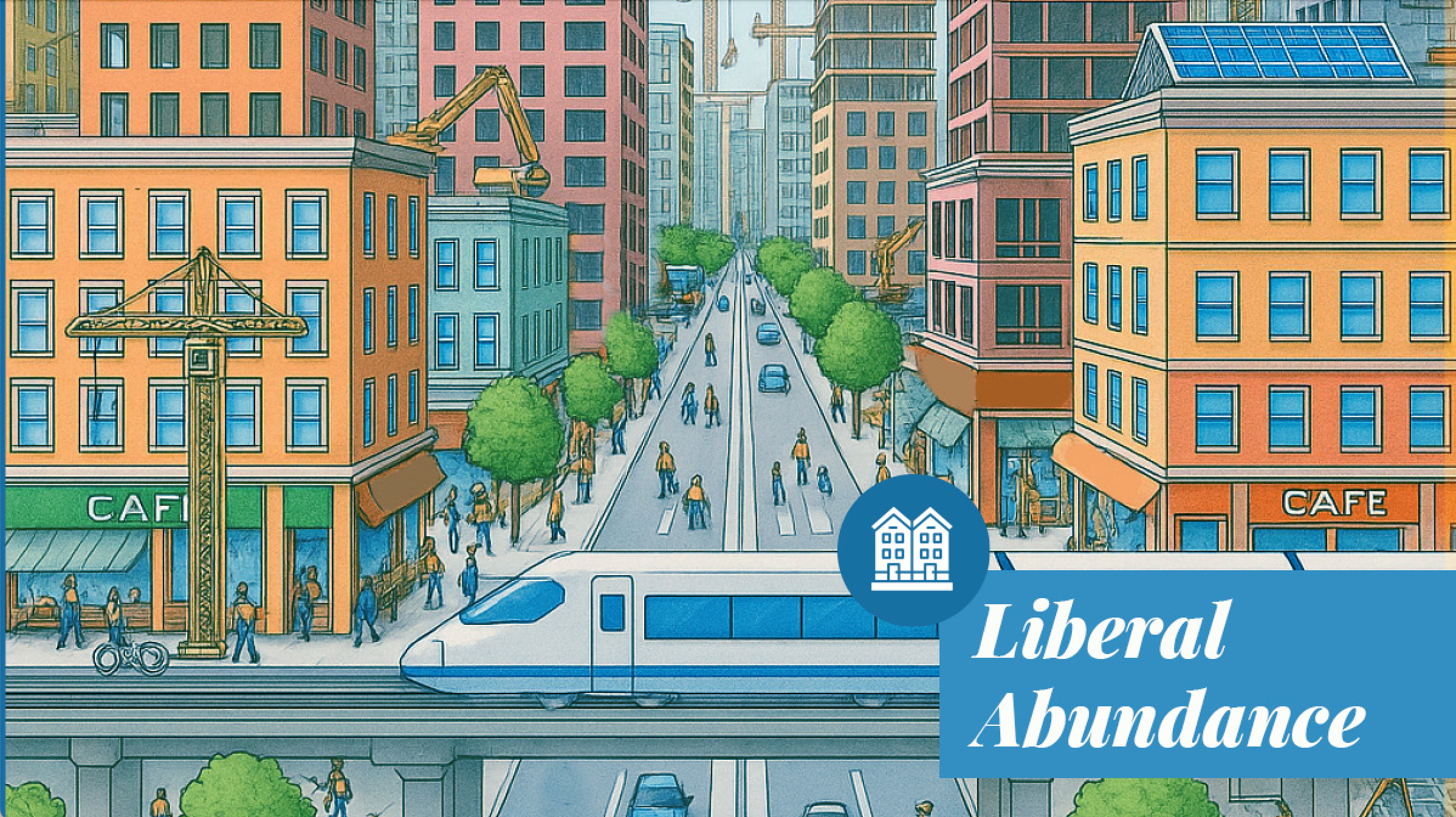
Klein and Thompson’s Abundance has been taken by some readers to be a statement of Abundance Orthodoxy, whereas I take it to reflect a very particular place on the Abundance spectrum. It is rooted in a response to the particular pathologies of contemporary California, but also the romance and aspiration of the state’s past. It is obsessed with the seeming paradox of one-party Democratic governance leading to comprehensive policy failure and the critique of government that comes out of it. It is center-left, but comfortable with a mixed economy that combines markets with an ambitious, problem-solving government.
Liberal Abundance is, as the name suggests, fundamentally liberal, rather than left. Because it is broadly liberal, it comfortably combines egalitarian ambitions with insights from liberal traditions further to its right, especially libertarianism. While it supports public goods and social insurance, it is much more influenced by mainstream market economics and public-choice critiques of government than Red Plenty and Cascadian Abundance. Liberal abundance is generally optimistic about the ability of well-governed markets to solve problems like housing scarcity. And while it accepts the power of libertarian analyses of government failure, it rejects their despair of a state that does better. It aspires to fundamentally reform government structures and create new forms of collective action to overcome NIMBYism.
While YIMBYism is a common denominator of all species of Abundance, the movement is the fundamental experience that grounds Liberal Abundance. The YIMBY movement was born in the Bay Area, and it continues to be the strongest organizational manifestation of Liberal Abundance. As UC-Davis law professor Chris Elmendorf has argued, the YIMBY movement began with a recognition of the collective action problem in urban housing. But while many of the libertarians who influenced Liberal Abundance gloomily argue that capture by concentrated interests is inevitable in democratic politics, YIMBYism shows that highly organized, public-spirited liberals in blue cities and states can defeat coalitions of NIMBYs, particularly if they can move decisions to more centralized venues.
Unlike versions of abundance to its right, Liberal Abundance is fairly relaxed about the role of culture in abundance and state capacity. It sees the toppings on everything bagelism as minoritarian, procedural, and bureaucratic extravagances to be disciplined rather than symptoms of an irredeemably corrupt cultural liberalism. Liberal Abundance thinks that liberal institutions of expertise, science, and professionalism are fundamental motors of progress, but are suffering diseases of old age (literally in the case of science) and need reformist energy. Released from regulatory and other shackles, these institutions could regain public trust and recapture their role as engines of economic and cultural growth.
Far from rejecting the left’s emphasis on social justice, Liberal Abundance frequently draws on such concepts to put constraints on building housing in the context of historical segregation and frame YIMBYism as a contribution to racial equity. Liberal abundance is also distinctively cosmopolitan in its vision of the link between abundance and the economy’s capacity to absorb higher immigration levels, which it understands as the ultimate non-zero-sum public policy.
Liberal Abundance sees the problems of California, and by extension the country, not as a function of liberalism, which it takes to be a perfectly fine moral foundation for policy, but of minoritarianism. It holds that the capture of the Democratic Party and the institutions of government by narrow interests is an abscess and not an appendage in the broader philosophy of liberalism. It is enamored with the idea of building state capacity—most vividly in the ideas of the Californian Jen Pahlka—because it is frustrated by how the state’s ambitious progressive goals are fumbled by its creaky government. It charges that a mulish state, accustomed to following the interests of its producers, negates liberalism’s higher ambitions. Liberal Abundance wants government to do big, ambitious things (just as the varieties to its left do) but thinks that this is a project of restoration through idealistic reform, rather than revolution.
Moderate-Abundance synthesis

At what I consider roughly the center-point of the Abundance spectrum, but generally within the Democratic Party umbrella, is the synthesis of Abundance with political moderation. More than most of the other Abundance ideologies here, the Moderate-Abundance Synthesis (MAS) is an attempt to graft Abundance thought onto an explicitly political, partisan project. The goal is to contribute a substantive, ambitious governing vision to a moderate Democratic persuasion that often tends toward incrementalism or electioneering through posturing rather than policy. On the other hand, MAS critiques the Abundances to its left by arguing that sustained victories for unlocking supply will only come by aligning with cultural moderation, especially around issues of social order. Only then, MAS contends, can a coalition be built broad enough to keep the right out of power nationally and the left out of power locally. It argues that while many Abundance victories may be gained by technocratic, “Secret Congress” style politics, larger victories require defeating “the groups” in the Democratic Party, both to deliver on Abundance policy goals and to avoid thermostatic electoral backlash.
MAS is primarily a political rather than a policy vision. It is aggressively YIMBY on housing policy, but because it is attuned to expanding the Democratic coalition, it is less hostile than some Abundants are to sprawl and more focused on homes for families. It is generally supportive of industrial policy to encourage energy super-abundance but skeptical about the politics (and feasibility) of crash efforts to transition to zero-carbon energy. It is very comfortable with the conceptual apparatus of contemporary “neoliberal” economics and less concerned than many on the left about corporate power. It is much more enthusiastic than the Abundances to its left about criticizing the power of government-producer groups and liberal NGOs, who it believes are the organizational foundations of proceduralism. It sees initiatives like environmental justice as driven by Democratic coalitional politics that prioritize extending the constituency of NIMBYism over meeting communities’ actual needs, as Abundance would.
The politics of MAS are much more explicitly partisan than single-issue. The most distinctive example of MAS at the urban level is GrowSF, which seeks to build political power through a fusion of traditional Abundance priorities like housing and transportation with “moderate” priorities like crime prevention, back-to-basics education and school choice, and a more assertive policy toward the homeless in public spaces. The failures of urban Democrats are becoming harder to deny, but the nationalization of politics means that Republicans can’t take advantage of them. Abundance, state capacity, and moderation provide a genuinely ambitious governing agenda for Democrats in blue places, and a coalition of wealthy donors and moderate voters makes them electorally potent. In the single-party Democratic politics of big cities, MAS has a fairly obvious lane to pitch itself as the alternative to the governance of the party’s left.
In national politics, MAS confronts a harder challenge: rallying the existing moderate Democrats around its banner. Those Democrats mostly hold or seek office in politically competitive places, or have ambitions to do so. They have typically been quite timid where policy is concerned, differentiating themselves from the rest of their party by having less policy ambition, supporting relatively incremental proposals, and opposing their party’s left more based on vibes than comprehensive governing strategies.. These moderates have traditionally been individualists, trying to win in hard places by standing out as geographically idiosyncratic and pragmatic. The problem with this strategy is that the nationalization of politics has made geographic idiosyncracy harder to pull off. But moderates find themselves ill-equipped to compete with the left for intellectual control of the party’s message, and unable to build the power to control the personnel of Democratic administrations.
MAS seeks to solve these problems by effectively nationalizing moderation to make it simultaneously more aggressive on cultural issues (like crime and border security) and more committed to the governing project of Abundance. It seeks to address the spoiled identity of the Democratic brand by creating an MAS “sub-brand” that those running in politically competitive places can proudly associate themselves with. And it tries to solve the problem of how the party governs by creating cadres of MAS affiliates to staff Democratic administrations. MAS supporters think that the path to Abundance is unavoidably through hard-edged battles for power, both at the urban and national levels. They hope to stiffen the spine of Democratic donors and office-seekers to realize that cultural moderation and Abundance are two great tastes that taste great together.
Abundance dynamism

Possibly the oldest variant of Abundance, Dynamism is fundamentally syncretic with libertarianism. Much of Abundance thought on the center-to-left end of the spectrum is motivated by the things it seeks to build—housing, public transit, clean energy—and is focused on removing obstacles to building them. Abundance dynamism, by contrast, is fundamentally Hayekian, and is interested in spurring mostly decentralized, privately managed, and financed innovation. Abundance Dynamists are distinguished from more traditional libertarians by their emphasis on learning and progress rather than individual rights, and their more pragmatic, politically opportunistic approach to what will unlock them.
Virginia Postrel could make a good case to be called the originator of the concept of Abundance, because her concept of “dynamism” suggested a dimension of political economy that cut across left and right with a focus on embracing technology as a force in enhancing human flourishing. While libertarian-oriented dynamists are much more enthusiastic than statist dynamists about relying on prices (including the information embedded in profits) as guides for investment, growth, and innovation, Postrel recognized the latter as somewhat mistaken friends of human progress, rather than enemies.
When Abundance Dynamism thinks about what has slowed the “natural progress of opulence,” it sees regulation as the primary cause. FDA caution slows down drug development. Rules on noise have killed transcontinental supersonic flight. The accumulation of regulation in the wake of Three Mile Island halted progress on nuclear power. Even where Abundance Dynamism grants that the state must be a key funder, it sees the growth of proceduralism as leading to the bureaucratization of science and the dominance of large, increasingly sluggish universities over new, creative places for science to flourish. As a result, Abundance Dynamists generally prefer creating as many spaces for “permissionless innovation” as possible, arguing that this mode would work for economic growth in the physical world just as it has for digital technology.
So far, so libertarian. What makes Abundance Dynamism syncretic with Abundance is its marriage of an emphasis on progress with an interest in state capacity—what Tyler Cowen has called “state capacity libertarianism.” Abundance Dynamism is more attentive than many versions of libertarianism to the affinity between strong, competent, effective, well-resourced state structures and dynamic markets. While, like other libertarians, it wants the scope of state action to be much more constricted than left Abundants do, it is strongly opposed to starving the state itself of resources and authority. It finds models in Singapore and Denmark, countries with high-status, autonomous, and low-corruption bureaucracies, rather than abstract minarchist utopias. Abundance Dynamists are also more ambitious than many to their left about AI’s potential to boost the productivity of public servants, and more willing to imagine a future with a much smaller civil service, albeit with higher salaries and status.
Abundance Dynamists also tend to be “market urbanists,” highly attentive to the importance of cities as drivers of agglomeration economies. Sam Bowman, for instance, has argued that the productivity of cities—especially mega-cities like London—is extremely high, and that high housing costs are a price signal of demand that policymakers should heed, rather than fight against. Abundance requires clearing space for the highest productivity cities to expand by making it easier and cheaper to build housing and accompanying infrastructure, leading new firms to form around that demand-driven density.
Abundance Dynamists recognize that government has an important role in establishing a legal context for innovation and supporting basic science, and even a role in creating public infrastructure that supports the extension of markets and the reduction of transaction costs. But they worry—as few to their left do—that redistribution is in tension with the investment functions of the state. They are therefore more open to constitutional constraints on state action to act as a shield against the capture of government by distributive coalitions. But Abundance Dynamists are so impressed by the long-term benefits of economic growth that they are more open to policies like Universal Basic Income that increase the political buy-in for pro-market reform, and serve as an alternative to growth-destroying distortions of markets.
While Abundance Dynamists appreciate decentralized innovation and public-choice critiques of government more than their left counterparts, they see them as partners in a project of progress, rather than enemies. They recognize the role that left-liberalism has played in breaking down identitarian constraints on free markets and see a free culture as a natural partner to an open economy. This allies them to Abundants who want to reform liberal institutions, and makes them somewhat more skeptical of those to their right who want to use the state to destroy their autonomy (even as they bemoan the capture of these institutions by the left).
Dark Abundance

Near the end of the abundance spectrum—but perhaps not all the way to its right—is “Dark Abundance.” Dark Abundance occupies a place on the Abundance spectrum that is syncretic with the more tech-adjacent parts of the Trump coalition. It is less libertarian, more culturally conservative and institutionally critical, and more security-minded—both foreign and domestic—than most of the rest of the abundance spectrum. Dark Abundance sees itself as the tip of the intellectual spear of the contemporary conservative project, weaving the National Conservative and National Libertarian projects into a new synthesis that combines a cultural-conservative-inspired assault on left institutions with a futuristic, Silicon Valley-inspired “Founder Mode.” More Milei than Orban, Dark Abundance seeks to wield national power to disrupt deep-seated institutions in American life to spur economic growth and revive American hegemony.
Central to the Dark Abundance project is its impatience (in which it resembles Cascadian Abundance) and its much greater taste for (creative) destruction. The first factor driving Dark Abundance’s impatience is its belief that the United States is at risk of falling far behind China both economically and militarily, and the time for it to make up that growing gap is very short. America’s industrial base, especially its ability to innovate in developing new weapons systems and energy, has declined precipitously. The imperative of recovering it makes Dark Abundance adherents much more open to industrial policy than Abundance Dynamists.
To rapidly rearm the country and rebuild civilian and military defense bases, the government needs to change root and branch. The spirit, if not the reality, of DOGE, and the practices of rising defense tech firms like Palantir, SpaceX, and Anduril, are the inspiration for what Dark Abundance thinks it can do with the state. Rather than the slow boring of hard boards, it envisions moving fast and breaking stuff —creative destruction in the public sector. That is not because Dark Abundance is fundamentally libertarian. Rather, it wants to use the state to perform critical, time-sensitive tasks, and it thinks there is no way to repurpose or retrain the our existing government to do them.
Unlike some of those even further to its right, Dark Abundance is democratic, but in a mode that might be called democratic centralism. Dark Abundance adherents contrast their patriotic, disruptive innovation with the decadence and regressive character of modern liberalism as it operates through government, nonprofits, and universities. Dark Abundance wants to use democratic majorities to deconstruct rather than reform the modern liberal state’s intermediary institutions, which it diagnoses as bloated, pathological and fundamentally broken. It sees those institutions not as embodiments of expertise and knowledge production, but as power centers for a liberalism that has become an instrument of woke groupthink. In its place, it hopes to create new institutions to create knowledge and develop practices entirely separate from existing institutions—think of the University of Austin rather than the more mainstream conservative-inspired UT School of Civic Leadership. In a world in which, in Alana Newhouse’s gripping formulation, “Everything is Broken,” it makes more sense to start over than reform from within.
Dark Abundance is also distinguished by what it wants an abundance of. While it shares the YIMBYness that all abundants have in common, it is less excited by urban, infill housing and much more excited by the prospect of large, family-size houses that could facilitate much higher rates of fertility. It is very relaxed about the prospect of climate change, and interested in alternatives to fossil fuels mainly for their contribution to the goal of energy super-abundance, which it sees as central to powering transformational AI and other economic breakthroughs. In fact, Dark Abundance puts much greater emphasis than other schools on the centrality of AI preeminence as a tool of foreign policy, which provides the security motivation for its focus on technological accelerationism achieved primarily by private capital. While it wants to improve the speed and lower the cost of building things through the public sector, the things it wants to build include much more effective prisons and systems for policing immigration policy.
Dark Abundance is not entirely comfortable with the overall drift of the American right, and in particular the Trump administration, which it views as somewhat clownish and lacking a coherent governing project. It shares with Abundance Dynamism a deep attachment to open trade, less because of a respect for the price system and more as a conscious element of industrial strategy. As Samuel Hammond has argued, protectionism will make American firms soft and uncompetitive by cutting them off from the discipline of foreign capital and the need to meet the standards of globally leading firms. The industrial policy Dark Abundance envisions aims to drive progress through new firm formation rather than (as Nationalist Conservatives aspire to) creating an entente cordiale between labor and capital.
Advocates of Dark Abundance believe deeply in technologically-driven progress, both as an engine for human flourishing and as the tip of the spear of American global supremacy. But Dark Abundance believes that getting to that future at the speed the United States and its allies need to, will require grappling fundamentally with the failure of liberal institutions. It is not hard to imagine that the degree of this belief in the need for wholesale institutional replacement could be what makes it hard for those in the Dark Abundance world to continue collaborating with others on the Abundance spectrum.
Frontiers of Abundance syncretism
As Rob Saldin and I have argued, the closest analogue to Abundance is the Progressive movement of the early 20th century. Like Abundance, Progressivism covered a very wide range of ideological terrain. Herbert Hoover was a Progressive, but so was Jane Addams. Some Progressives supported breaking up monopolies, while others advocated regulating them in the public interest. Progressives were organized into factions within the Democratic and Republican parties, but they also built institutions and professions that transcended the parties, helping them work together to transform American government.
Continued diversity rather than convergence, facilitated by a combination of shared and separate institutions, is the most likely future of Abundance. Where the purpose of institution-making is primarily intellectual, shared institutions make the most sense. For example, a number of student Abundance chapters are popping up in universities and professional schools across the country. It makes sense that these should be very broad-tent organizations, since they are designed to bring in young people whose political identities are still in flux, and for whom vigorous argument and discussion make more sense than being presented a party line. More broadly, Abundance benefits from being open-minded, problem-solving, and empirical in a time when many public-spirited people are looking for an alternative to rigid, narrowly partisan teams. Abundance should be a place where people like that can find a political home. It’s likely to flourish in places like professions, where the idea can provide an umbrella for institutional reform, and where differences between species of Abundance may be less important than what they have in common.
That said, these various forms of Abundance are likely to persist because there are deep philosophical, factional, and partisan differences between them. Abundance advocates disagree deeply on how much to prioritize decarbonization and whether existing governmental and civil society institutions can be reformed, versus needing to be replaced wholesale. They disagree about the role of markets and prices, and how much to emphasize building public infrastructure versus private enterprise. I suspect that we will see considerable conflict in the near future between those keen to encourage further technological innovation in the digital space (AI and crypto in particular) and those who think that the future is in hard tech (and that getting there will require actively repressing even existing digital technologies in areas like online gambling, social media, and pornography).
The varieties of Abundance described earlier may not exhaust those that we will see in future years. National Conservatism has some significant differences with those on the Abundance spectrum, especially around its tepid response to YIMBYism, and much greater enthusiasm for immigration restriction. But National Conservatism is also unquestionably productivist and excited to use an engaged state to open up new technological frontiers. It’s unromantic about protecting small business, and its pro-natalism opens it to the argument for liberalizing the housing market to create more living space for larger families. The line between Dark Abundance and National Conservatism, for example, is real—especially on trade and labor—but the overlaps on industrial policy to counter China and the desire to comprehensively replace liberal institutions are also quite large.
Something similar might be said about those in the “progressive antitrust” or “post-neoliberal” camp. There has been a lot of fire coming from these groups, leading to equally feisty counter-attacks. But there have also been many olive branches from the less online parts of liberal populism, and these have even included hiring key Abundance advocates. Messaging and coalitional politics aside, supporters of Abundance and critics of corporate power both agree that an absence of effective economic competition is at the root of constricted supply and increased inequality. Many parts of the Abundance spectrum could benefit from the less technocratic, more moralistic spirit of liberal populism, even as we disagree on how central traditional antitrust remedies are likely to be in the portfolio of pro-growth policies.
Political conflict is also on the horizon. 2026 will witness a straight-up fight between Liberal Abundance (Scott Weiner) and Red Plenty (Saikat Chakrabati) in the Democratic Party primary to replace Nancy Pelosi in Congress. Advocates of a Moderate-Abundance Synthesis are already actively organizing within the Democratic Party, preparing for races where they may face the heirs of Mamdani, as well as standard-issue interest-group Democrats. Dark and Dynamist Abundance will be part of the argument over the future of a post-Trump Republican party, but also a challenge to more liberal variants of Abundance in wooing the minds of Silicon Valley.
Balancing projects of cooperation and mutual learning, and those of competition and conflict, will require considerable arts of political and intellectual skill. But I am convinced that the basic ideas that all Abundance advocates share are powerful and will only be stronger for the scope of conflict and intellectual openness the movement continues to include.