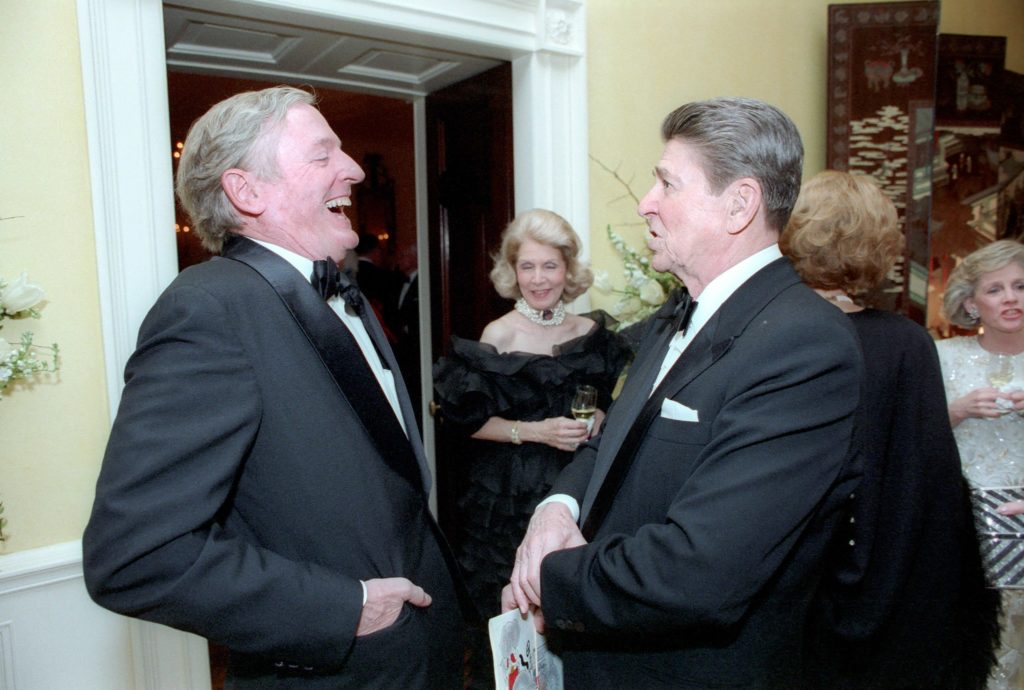
Sam Tanenhaus’ long-awaited authorized biography of conservative movement founder William F. Buckley Jr. — more than a quarter-century in the making – has finally been published. Tanenhaus’ magisterial work presents Buckley as one of the most consequential public intellectuals of the twentieth century, whose success in presenting conservatism as an attractive and even compelling creed did much to pave the way for the political realignment achieved by Ronald Reagan. The book also does justice to Buckley’s larger-than-life qualities as a debater, best-selling novelist, television star, political candidate, yachtsman, harpsichordist, celebrity, friend, wit and bon vivant.
But Tanenhaus’ biography also reveals a darker side of Buckley and the conservative movement, particularly in his younger years. Buckley was at times an ardent supporter of the America First Committee’s isolationism, Joseph McCarthy’s anti-communist excesses, and Jim Crow racial segregation in the South. (Indeed, Tanenhaus’ research revealed that the Buckley family secretly helped produce a newspaper that broadcast White Citizens’ Council propaganda during the 1950s.) The biography shows how Buckley eventually distanced himself from his early views, but also how a kind of anti-establishment radicalism remained a contradictory characteristic of both Buckley and conservative movement he led.
In this podcast discussion, Sam Tanenhaus talks about Buckley’s historical significance and the unknowable questions of what Buckley might have thought of Donald Trump as well as the degree to which Buckley’s conservatism paved the way for Trump’s takeover of the Republican Party. He also discusses why Buckley may have wanted him to write the biography, the influences he brought to the writing process, and what he tried to accomplish in the particular approach he took to his subject.
Transcript
Sam Tanenhaus: Because his real story was his own life. And here’s a man whose life was so full, he could write an entire book about one week in it, and ten years later write the same book about another week. Absolutely larger than life — but he gave us the politics we have today.
Geoff Kabaservice: Hello! I’m Geoff Kabaservice for the Niskanen Center. Welcome to the Vital Center Podcast, where we try to sort through the problems of the muddled, moderate majority of Americans, drawing upon history, biography, and current events. And I’m thrilled to have Sam Tanenhaus with me today. Sam, as dedicated listeners of this podcast may possibly remember, was the third guest on my podcast way back in the pandemic spring of 2021. And I’m delighted to have him back on, eighty-odd episodes later, especially since the magnum opus on which he has labored for a quarter-century has now been completed.
I refer, of course, to Buckley: The Life and the Revolution That Changed America, the magnificent and, in all honesty, enthralling biography of conservative movement leader William F. Buckley Jr., which was published on June 3 by Random House. Anyone who cares about Buckley, biography, American history and politics, or who simply wants to read a literary masterwork of the highest order, ought to run out and buy this book. Congratulations, Sam!
Sam Tanenhaus: Thank you, Geoff. You had more than a little to do with it, so we share some of the success.
Geoff Kabaservice: I mean, honestly, if it weren’t so early in the morning, I would be opening up a bottle of champagne, because it’s been a while for me too. I was your very first research assistant. I went back in my files recently and came up with a 7,000-word essay that I wrote on Buckley’s notorious first book, God and Man at Yale, which represented my first effort as your research assistant. And that essay is dated August 12th, 1998. So it’s been a while.
Sam Tanenhaus: It was a big book. It’s a big life, Geoff. I think we know that. So many facets… And he’s so complicated a figure, which I didn’t really expect, because he had this wonderful élan about him. You knew Buckley as well, and he was absolutely a captivating person, and seemed so light as he moved through his many experiences, all the things he did. And the surprise to discover, to uncover, the layers of complexity in him. I really wasn’t expecting that.
Geoff Kabaservice: Well, it was a great honor to be a hod carrier on the building site of this magnificent edifice, so to speak. And as I said at a party recently given here in DC in your honor by our friend Jacob Heilbrunn, I’m happy to soak up any reflected glory I can get from this book. But I also feel a sense of relief, since in my capacity as your research assistant, I sent you so many pages and sent you down so many rabbit holes that I wondered if I personally had added a decade to the time it would take you to complete this biography.
Sam Tanenhaus: Absolutely not. In fact, quite apart from some of the wonderful finds you made in the archive was the quite remarkable compendium you put together of Buckley’s correspondence highlights. That was a key roadmap for me. The archive is vast. We just spoke recently with the head archivist at Yale, where all of Buckley’s material is kept, as you know — you’re a Yale man yourself, with many degrees. And Buckley, of course, is tied to Yale historically and permanently, I think we can say. But the archive has a thousand boxes, which is about what you would find in a presidential archive. And when the archivist was asked about this, because I’ve made the comparison, he said, “Oh, yes, that’s valid.” Because he used to work at a presidential archive, I forget which, and he said, “Oh, this is the same size.” Bill Buckley got, at his peak, six hundred letters a week, and in some form or other answered every one of them — which is how you become a movement leader as opposed to just a celebrity.
Geoff Kabaservice: Yes, absolutely. There was a lot there. And you actually came upon some other sources, shall we say, that weren’t even in the Buckley archive at Yale. In order that the prospective reader not encounter folio shock, I should say upfront that this is a big book in all senses of the word. It’s one that weighs in at over 1,000 pages. But it reads so easily and pleasurably, Sam. It’s like slaloming down a mountain of butter, or whatever the appropriate metaphor might be. No one should be put off by its size.
But after all, Buckley was born — well, it’ll be 100 years ago on November 24th, 2025. And he died on February 27th, 2008, which was before some of the current class of graduating high school seniors were born. So I suppose then that the first set of questions I should ask you is: Who was Bill Buckley? What was the revolution he led that changed America? And why does he matter now?
Sam Tanenhaus: Bill Buckley was the sixth of ten children — actually eleven, but one did not survive infancy — who were raised mainly, but as we learned, not entirely, in what — I’m now living in Connecticut; my wife and I moved here ten years ago — in what’s called the Northwest Corner of Connecticut, which is Litchfield County. It’s near the Berkshires in Massachusetts, right across one border, and Dutchess County across the other.
And I mention Dutchess County because Bill Buckley was raised as a kind of patrician, reactionary Catholic in a very Yankee Anglophile culture. Dutchess County in particular is of interest because the distance from Buckley’s grand estate where he was raised in Sharon, Connecticut, to Hyde Park where Franklin Roosevelt lived, was really about half an hour. And the Buckleys looked at the Roosevelts, as they later looked at the Kennedys, as adversarial equals. They were all of the same class. That’s really difficult for people to understand now. Because Bill Buckley’s politics, and those of his father from whom he inherited them, were extremely reactionary and in many ways paved the way for the kind of counter-revolutionary conservatism we have today. It was born in opposition to the New Deal, which was anathema to Buckley’s father, who was a self-made oil man who was raised himself in southern Texas. The Buckleys were Southerners. His father was from Texas, his mother was from New Orleans. They had the Southern attitudes on all issues, including race, which I’m sure we’ll get to.
And the two great causes in young Bill Buckley’s life — he was William F. Buckley Jr., the third of four sons — were, first, opposition to the New Deal and “Bolshevism,” as it was commonly referred to by the upper classes then; and, so important, opposition to intervention in World War II. And that was the America First movement. Bill Buckley’s first idol was Charles Lindbergh. Bill Buckley, at age fifteen, was in the audience at Madison Square Garden when Lindbergh gave his last America First speech, right before Pearl Harbor. And after Pearl Harbor, Bill Buckley was still an isolationist and remained so through his time of military service.
And he went to Yale in 1946, as part of the — you’re the historian of this — the famous “new class” of newly democratized Yale. It was not democratized in the terms people think of today; there were quotas on Jews, there were quotas on Catholics, and the few Black people you could count probably on two hands, or maybe two hands and one foot. So it was very traditional in that way.
But culturally, Yale was changing. And the genius of Bill Buckley was to realize, as a very young man, as the chairman, as it was then called, or editor of the Yale Daily News, a brilliant campus newspaper… And here I’m going to say — and it’s open for discussion — I think the case can be plausibly made that William F. Buckley Jr. was the greatest campus journalist of the twentieth century. He was a transformative figure as a student journalist. It sounds absurd, but it’s true. And it’s because he declared war on his own professors.
His solution, that was hinted at in the Yale Daily News editorials — he wrote one a day — and in speeches he began to give while still an undergraduate, speeches in the Waldorf-Astoria banquet room — it’s a different culture, Geoff, but you know about it, so you get it, this patrician class… He was already saying, at the age of twenty-three, that alumni should try to get the professors they didn’t like fired. And donors should withhold money — an idea he got from his father and another publication that the family was involved with, an educational publication. All the things we’re hearing today about the culture wars, Bill Buckley saw, initiated, pioneered the means for doing them through media. And that’s the genius of him.
I remember when I talked to you years ago for a story I did in Esquire magazine on a great friend, David Frum, and the Never Trumpers as they still existed then, you said a really great thing which is in that story. You said what Bill Buckley wanted to do was to create his own media that was in every way as serious and sophisticated as the dominant mainstream media. You said he wanted his own New York Times.
Well, he didn’t get that far. But he started his magazine, National Review, arguably the most influential political magazine in American history because it supported the insurgent candidacies of figures like Barry Goldwater and Ronald Reagan very early on, when they were not well-known. He was a brilliant columnist, wrote three columns a week. His columns alone would fill twenty-five books. Instead, he published only a third; he got eight books out of them.
He was a TV personality. He was the star of Firing Line, still by far the greatest television debate show ever — the forerunner, yes, of the nastier ones that followed, but done on a level that’s almost comically abstruse and sophisticated today. I urge all listeners to go on YouTube and watch Bill Buckley debate Muhammad Ali. And you can’t believe what you’re hearing when they get into the fine points of the Nation of Islam, and Buckley is defending Malcolm X against Muhammad Ali — it’s really something — and with utmost, utmost respect and courtesy for this man. He respected Ali’s courage, his courage of his convictions.
So that was Buckley. We’ll add the spy novels and the memoirs. He was actually best, as a writer, as a memoirist, because his real story was his own life. And here’s a man whose life was so full he could write an entire book about one week in it, and ten years later write the same book about another week in his life. So he was absolutely larger than life, but he gave us the politics we have today, which is really about a kind of non-stop performance. So I call him — the phrase that’s being picked up — “a performing ideologue.” And he invented that role. No one had ever done that before that I’m aware of.
Geoff Kabaservice: He of course was instrumental as well in Ronald Reagan’s being elected to the White House in 1980 and re-elected in 1984. And I think some people think that when they hear “the revolution that changed America,” they think the Reagan Revolution. But it doesn’t seem that that’s the revolution that you really have in mind.
Sam Tanenhaus: No, I think it started earlier. Some of the discoveries for me had involved Bill Buckley’s very close involvement with Joseph McCarthy — the first of the, what should we say, great post-war demagogues. Buckley saw very early on, partly under the tutelage of his brilliant but kind of crazy mentor at Yale University, Wilmoore Kendall — a truly original thinker, a “primary thinker,” as they say on the American right — that McCarthy was the key to popular victories for the movement.
Lindbergh was a very admirable figure. And he was, in many respects — we know about the antisemitism, all that’s discussed in the book — but as a galvanizing force, as kind of an anti-politician, Lindbergh was an extraordinary figure. But he was not really an exciter of the mass. People were drawn to the movement. Lindbergh was an American hero. He was the greatest hero of his time after the famous flight he made in 1927. But McCarthy was something else. McCarthy stirred the passions of the people. And Buckley, who met him on the Yale campus in the late ‘40s, saw the effectiveness of McCarthy.
And that’s where the politics begins to look closer to what we have today. What I urge people to do is: Take your eyes off Donald Trump for a moment, hard though it is to do, and instead read the American Greatness website or Compact magazine. And then you begin to see the outer orbits of the intellectuals who were drawn to movement politics of this kind.
Buckley was a pioneer there: With brains and intellect, you can take up the iconoclast — that is what he would say; we would think of him as a destructive figure — and get the results you want. Because, Geoff, it was a politics of enmity — and I’ve written about this before, another book I did — where the right is not always able to tell you what they’re for, but they’re very good at identifying the enemy.
So Buckley’s second book, after his first, I think we can call it a classic, God and Man at Yale, published in 1951, with its endless spin-offs since, all the way up through Christopher Rufo’s books. They’re all telling the same story Buckley told, which by the way was two stories: not just that professors are bad guys, but that the universities themselves are hypocritical in pretending that there’s not an orthodoxy being promulgated. And there, there’s enough truth for the argument to stick. That’s why some of Buckley’s first admirers when that book came out were men of the left. The journalist I. F. Stone said, “Bill Buckley’s an able young fellow who exposes the liberalistic bunkum of American universities.” So there’s a horseshoe thing going on that Buckley got onto very early. And some of his early champions and admirers were leftist figures who also hated what Buckley and company called — they invented the term — “the liberal establishment,” which we now call elites.
Well, with McCarthy and His Enemies, the emphasis is not on McCarthy. There’s very little about him in the book. But there’s a lot about the enemies, who are the media, the professors… One of the great documents you found for me was the selling memo, the draft selling memo Bill Buckley wrote when he was looking for funders for National Review in 1954. And it identifies what he calls “the ruling class” in America, and he calls them — I love this phrase, he was so adept at language, not the best writer of his time but maybe the most articulate word person — he calls them “the liberal monopolists of public opinion.”
And I love that “monopolists,” right Geoff? Because that gets you away from the conspiracy argument. That’s what makes him more sophisticated than the mere demagogues on the right, as Bill Buckley would never say there’s a liberal “conspiracy.” The term I use is “coordinated duplicity.” People who know better are telling you things that you should not believe. If you look past them, there’s a “conspiracy of silence” — another of my phrases — that describes what liberals are really up to.
So if you read Breitbart today, or American Greatness, these various websites I’ve mentioned, that’s essentially the story. People who don’t pay attention to the conservative right-wing media think that it consists of counter-arguments to what the left makes. But it doesn’t. It consists of counter-narratives: “Here’s the story they’re not telling you about what’s really going on in Portland after the George Floyd murder. Here’s what’s going on in Los Angeles now. Here’s what was going on in Kenosha, Wisconsin. Here’s what the Times” — my former newspaper — “calls ‘mostly peaceful demonstrations.’” Say, oh really? “Mostly peaceful”? And what do we mean by that? We mean we’re not going to tell you about the violence, but Buckley’s side will. That’s the genius of the critique. It’s a kind of critique of liberal culture. That’s really what Buckley wrapped his mind around at a very early age. And it’s still with us.
Geoff Kabaservice: Sam, a lot of people will recognize you from having been a starring talking head in the 2015 documentary Best of Enemies, which was about Buckley’s notorious clash with Gore Vidal on television at the 1968 Democratic National Convention. And I do think it’s true that Buckley and Vidal together did pioneer this combative journalism that would be so attractive to later generations of TV people.
But I also think an important episode in Buckley’s life, which you do cover extensively, was his 1965 run for mayor of New York City, running on the Conservative line. And he didn’t come close to winning, but he actually inadvertently discovered the electoral attractions of conservatism to what would later be called the Reagan Democrats, the white ethnic working classes who previously had supported the New Deal. Am I correct in thinking that those two episodes are also kind of important ones in the Buckley story?
Sam Tanenhaus: Really important, yes. Let’s do them chronologically. The mayoral campaign was in 1965, so that meant it came right after Barry Goldwater’s calamitous defeat against Lyndon Johnson in the 1964 election. And Buckley and National Review had been the principal advocates for Goldwater. They’d discovered him years before. And Buckley, it’s interesting, always held a little back with Goldwater. There was a little bit of the blue blood in Buckley: “Well, this guy from Arizona, he didn’t complete his college education.” I remember he said, “This is not Robert Taft, first in his class at Harvard and Yale.” That’s who they wanted.
But other people around Buckley, including his brother-in-law and co-author of the McCarthy book, Brent Bozell — who was in some ways more of a strategist or tactician than Buckley was — saw that Goldwater was the way to go. And so they got him nominated, and then he lost so badly, as Goldwater knew he would do because President Kennedy had been assassinated, and with that there was no hope in ‘64 for the Republicans to win. But still they went forward with their nominee.
After he lost so devastatingly, the right wing of the Republican Party looked finished. And the moderates, your group — and you wrote the classic book about this, Rule and Ruin — thought they could get it back, that they would move the party back to the center. And so what were Buckley and company to do? Well, what Buckley did was to invent, in the words of very close and respected observers like James Reston, the great columnist in the New York Times, was to give an entirely different look and sound to the conservative movement. The arguments were the same. They grew out of the “white backlash.” That was the big term in that era when the civil rights movement, which had been in the South, moved to the North. Buckley and those around him were prepared for that, because Buckley had grown up in the North, but he had these Southern attitudes. And he used to say, “The racial beliefs are not really that different.” It was the sophisticated way of saying, “Wait until they move into your neighborhood.”
And that argument resonated so powerfully in outer-borough New York — including, for instance, the borough of Queens, where our current president is from. And Buckley was shocked by that in one sense and not in another. He was shocked because they were not really his people: Staten Island, where I grew up across the street from a Bircher, and in Brooklyn… Again, Geoff, you and I are familiar with these terms, but I’m always conscious when I speak to audiences of saying, “You have to understand the language people used back then.” They used terms like “white ethnic” and then German and Irish and Italian — often Catholics.
Well, Buckley knew them too. He knew them from the church he went to in Connecticut, and he knew them from the many speeches and lectures he gave. His most famous comment, most quoted comment that we’re seeing all the time now — “I should sooner be governed by the first 2,000 names in the Boston telephone directory than the 2,000 members of Harvard University” — actually originally was not Boston but Garden City, Long Island, because that’s where he gave the speech to a room full of what became the Reagan Democrats. 4,000 of them, in fact, heard that lecture.
So Buckley discovered that in himself, he could not just apply in a cynical way, but also extract in an almost heroic way, a kind of deeper civic value to the argument that was coming from the working classes, the white working class: “No, these are people who believe in their communities. They want their children to go to the best schools. They’re worried that the union won’t have a job for the son or daughter when they’re ready for it. They won’t be able to afford college.”
These arguments had been surfacing for a while. Buckley could present them in a way that was more persuasive. It made sense. It didn’t feel like resentment, especially when he went on television. There’s a newspaper strike right before the election in 1965, and Buckley is on with the two other candidates: mite-sized Abe Beame, the clubhouse politician and the Democrat, and the handsome, Kennedy-esque John Lindsay, who was the liberal Republican. A debate on television, these guys against Bill Buckley? Not a chance.
The great historian Robert Caro got in touch with me when I wrote the first version of that account in the book; it was for the New York Times Magazine. And through a mutual friend, he wanted to have dinner with me. He was writing his Lyndon Johnson, of course. And he said, “I don’t do this. I don’t get in touch with other writers. But there are two things in your story that made me want to meet you.” One was when I say through this campaign Buckley pushed politics away from consensus toward ideological and partisan polarization. He did it in a very direct way. He said that’s what he was doing: “John Lindsay is not a real Republican. We’re going to drive him out of the party.” He said that with no remorse and also said it with gentility.
The other thing Caro liked was an exchange in the first television debate, which you can get on audiotape. Abe Beame says to John Lindsay, “You keep on attacking me. But everybody knows you considered putting me on your ticket, and so you didn’t think so little of me then.” And Lindsay says, “That’s a falsehood. The party bosses would’ve had to clear you, and it was never going to happen. Don’t pretend we would ever have had anything to do with each other.”
Then the moderator turns to Buckley and expects him to move on to another topic. And instead, Buckley says — I wish I could do voices, I can’t, but I can do the words mainly — he says, “I feel a sort of historical obligation to the record to point out here that, Mr. Beame, I too decided not to include you on my ticket, great though my personal esteem for you is.” And it’s the “though” — very few people use “though,” which is the correct word. We normally say “as,” and Buckley says “though.” And Caro found that hilarious. And so did the columnists and reporters and the newspapers when they heard somebody speak like that. It almost didn’t matter what he said and stood for. He was so entertaining and such good company, he made conservatism good company.
And out of that campaign came his television program Firing Line, which started months later. And the idea was that Bill and some liberal are going to debate. The liberal will be in the firing line, and Bill Buckley will come after him. What that did was it made Buckley the moderator, the host, the combatant. He got the first word and the last word. So he controlled the debate.
That did not happen when he met Gore Vidal in 1968. And I love this story… Because ABC went to Buckley a year before the campaign election. They’re going to do a dozen debates. So we know about the one in Chicago, but it actually started in Miami, the Republican Convention of 1968. And you have told this history, you’ve written a classic account of what happened at those conventions, and we know there were riots in both cities. There were actually fatalities in Miami, as there were not during the Chicago demonstration. A lot of people got beaten up by the police, but nobody was killed. But it was violent. It was dangerous. There were assassinations that year.
But all this is in the offing in the fall of ‘67. ABC was the smallest of the three networks. And Best of Enemies, the documentary you mentioned — let me say here, I was not a producer of that. Several people have said, “Well, you produced that documentary…” I did not. I was just a talking head, as you say. So they said to Buckley — the ABC executives call him in, he’s already famous now, he’s run for mayor, he’s got his own television program — “We’re thinking, instead of doing gavel-to-gavel coverage all day long, we’re just going to do an hour and a half in the evening. We’ll distill some footage. We’ll have reporters explain what’s happened in the convention. Then we want you, Mr. Conservative, to debate someone else, Mr. Liberal. Who would you like it to be?”
Buckley expansively says, “Well, there’s so many smart liberals. Norman Mailer might be great, my friend Norman Mailer. My friend John Kenneth Galbraith” — Mailer the great novelist, Galbraith the economist and journalist. He said, “Or the great liberal Democrat Allard Lowenstein,” who’d helped unseat Lyndon Johnson. And I want to emphasize to listeners: these are Buckley’s friends. He socializes with them. It’s not our world. Norman Mailer gets on his motorcycle and drives out to Buckley’s house in Stamford, Connecticut. Buckley has Allard Lowenstein, who’s a left-wing Democrat — he’d be with Bernie and AOC on programs right now, I would suspect, domestic policy would be there — Buckley invites all his friends in Skull and Bones, “Oh, you’ve got to meet my friend Al Lowenstein.” Different world.
ABC says, “Well, is there anybody you don’t want to debate, Mr. Buckley?” And he says, “Well, I’ve had some bad experiences with Gore Vidal.” And so they look at the tapes from various programs. They had a real conflict once on The David Susskind Show/Open End, which was a precursor in some ways to Buckley’s Firing Line. And they watch these guys go at each other, and it’s great TV.
My friend the journalist David Remnick edits the New Yorker. After he saw Best of Enemies, he sent me an email and he said, “Best of Enemies — those voices, they sound alike. They look alike. They have those classic Alfred Lunt New York accents. And they’re calling each other vile names while they do it.” And Vidal won that debate because he goaded Buckley right from the start. He knew the buttons to push, and he worked harder. Buckley was so used to being the star of his show and having the opponent in the firing line, it didn’t occur to him he’s going to come up against somebody who’ll be just as aggressive and untruthful as Buckley himself sometimes would be, and who was uninhibited. Vidal was totally uninhibited on what he’d say.
Buckley’s advantage in debate was always that, if he debated a distinguished liberal — Arthur Schlesinger he had a major debate with, or Galbraith, once Norman Mailer in Chicago, a famous debate — they’re always going to present themselves as the reasonable person and try to make Buckley look like a lunatic. Vidal didn’t care about that. He knew it was all about the gamesmanship of television. He was on TV all the time just as Buckley was. And he knew it was sport — blood sport. And he was ready for Buckley. And he lured him in, and he taunted him and taunted him, and finally used the word “Nazi” — he called Buckley a Nazi in Chicago in that demonstration.
And it just set Buckley off, and he insulted him in this vile way — called him “a pink queer.” That had to be bleeped. Imagine you’re Bill Buckley, this master of language, with a full set of the Oxford English Dictionary — I do not mean the two volumes I have that you read with a magnifying glass, he had all twenty-two volumes or whatever it was. And I saw those books, and they’re well-thumbed; that’s where he got this absurdly sophisticated vocabulary. And here he is known to some 10 million Americans who hear him call another man “a pink queer.” And he says, “I’ll sock you in the goddamn face and you’ll stay plastered.”
And poor Buckley is haunted by this for the rest of his life. And I say “poor Buckley” because my good friend Andrew Sullivan, who identifies with Buckley in many ways: brilliant, gay, conservative, Catholic… Bill was not gay, but conservative, Catholic, and Bill was, we’ll say he’d be affected and effeminate, not gay. But Andrew Sullivan said to me, “I’m on Buckley’s side in that exchange.” Vidal is pushing his buttons for hours — night after night he’s doing it.
Because Buckley for the first time was the establishment guy. Because his man, Nixon… He decided to go with Nixon over Ronald Reagan in ‘68, which I think is also one of the big stories in the movement and his life and the book. The people around Buckley wanted him to go with Reagan as early as ‘68. He was a superstar, he’d gotten elected governor of California by a million votes, defeated the man who had beaten Richard Nixon pretty handily and before that William Knowland, who was a hero of the right — Pat Brown, Jerry Brown’s father. Reagan crushed him and instantly became the darling of the right. And Bill Buckley would not sign off on him. He went with Nixon instead.
And all those tensions are boiling below the surface. You know them very well; you did groundbreaking work on what really happened at the Republican Convention. It’s still a bit of a mystery, because there’s some possibility Reagan might’ve pulled it out. But at any rate, Buckley is now there to defend, as you called him in your book, the first professional Republican elected president since Hoover in 1928. They’ve got their guy Richard Nixon, and Buckley’s going to go down the line with him. And Vidal just goads him, and lures him, and embarrasses him on television — without diminishing, however, Buckley’s stature or standing. A lot of people kind of liked it, what Buckley said.
Geoff Kabaservice: Let me just parenthetically insert here that I had reviewed that documentary for The American Conservative, and I did note the strange sexual dynamics there. And a lot of conservatives, including those who review for The American Conservative, don’t like the fact that you’ve done your due diligence into Buckley’s sexuality and found no evidence that he was gay. But certainly a lot of people did think that. I always thought that the best comment on Buckley’s sexuality came in a review of one of his spy books, in the New York Times, somewhere around 2000. And the quote, if I remember correctly, said: “The sex scenes were like passion observed and described by an alien and exceptionally finicky life form.” It was just one of the peculiarities of Buckley.
But let me take the plane back up to 30,000 feet here for a second. When I was in grad school as your researcher, the tendency at that time was very much against what was disdainfully called “the great man theory of history,” the idea that significant individuals drive history as opposed to broad structural forces. I remember reading an essay by Clayborne Carson, who even though he directed the Martin Luther King Papers Project nonetheless concluded that the Black freedom struggle would have basically followed a course of development similar to the one it did if King had never lived. So there was a real diminishment of the role of significant individuals and “great men.” Was Buckley a great man in your estimation? Would the conservative movement have turned out more or less the same if Buckley had never lived?
Sam Tanenhaus: It’s so hard to answer. I think he was a great man in his dimension and size, and in his personal humanity. Almost all the people I talked to, including the group he famously called “the apostates” — Garry Wills was the most famous of them — all said he was the most charitable person they knew. But you raise it… I want to get to your earlier point, though, about the great man approach to history, because I think that’s so important. This is why you and I make good collaborators, because I’ve had the same thought.
I’m going to say something… I don’t want it to be misconstrued. There are other historians who’ve done really superlative work that has had an enormous influence on how we all look at this recent politics. And one of them is the writer Rick Perlstein, whose brilliant book on Goldwater, and then books on Nixon and Reagan, gave a kind of carnival atmosphere to how the politics worked. And part of the pleasure in those books is the panorama he shows.
And I am struck by how accepting younger readers, writers, journalists, historians are to my book, which does elevate this one figure — when it would seem to be, as you say, kind of an outmoded way of telling the story. Now, to be clear, there’s an orbit around Buckley. There are many figures in this book: the people around him, people he taught, the ones who learned from him, his friends. All that’s in there. It’s that kind of story. But I was wondering about this: Why this fascination with Buckley now? And it brings us back to the outsized figure we have in the White House. What we’re beginning to come to grips with now, I think — also an example is Max Boot’s biography of Ronald Reagan — is the outsized cultural personality who seizes hold of our politics in the age of entertainment and mass media.
The most admired political essay of the last half century, probably — the most closely read and quoted — is Richard Hofstadter’s famous “The Paranoid Style in American Politics.” The most prescient, and the one I urge listeners to read, is Norman Mailer’s remarkable “Superman Comes to the Supermarket,” about Jack Kennedy and the 1960 Democratic Convention. It’s right before the election, it was published in Esquire. Mailer has a pretty good sense Kennedy’s going to win. But he says, “If he wins, we become a different country.” Hofstadter was very good at dissecting a strain in American politics — although Hofstadter was a historian and journalist, I think of it as a political science approach — which many are pursuing now with Trump. Where does he fit in? Can we find parallels with Orbán in Hungary, or Putin in Russia, or even Erdoğan in Turkey? There are all these different names. We look for parallels, we look for models to follow.
What Mailer did was to write as a kind of impressionistic observer of American politics and culture. And he said, if Kennedy’s elected, politics becomes a kind of continual movie or television program. It’s like somebody who comes out of Hollywood who captures our attention in the same way. We’re fascinated by him as a personality. And I think what’s happened, Geoff, is you look at someone like Buckley, and you say, Well, greatness in the classic terms that you would have found in a nineteenth-century historian like a Macaulay or a Thomas Carlyle or even Henry Adams in his great books — in the classic sense, he’s not a great man. There’s not a great tragedy he’s dealing with, though there are many moral dilemmas he faces. And my biographies, this and of Whittaker Chambers, I think of more as almost kind of moral fables. They’re studies of the moral life, moral crisis, rather than conventional biographies.
Well, in that sense, in the classic sense, Buckley’s probably not a great man. But in the modern sense of someone who commands the public stage and shifts the culture around him… I think, oddly enough, the phenomenon of Donald Trump now makes us look back at the previous history. And then we see there was Trump, there was Barack Obama, there was Ronald Reagan, there was, in a lesser way, Bill Clinton… You go all the way back to Franklin Roosevelt, and the conservatives would say even Abraham Lincoln. And you see there are these large insurgent figures who take over our politics.
At this moment, I’m reading a very interesting commentary online by Bill Kristol, among others, who says we are living in a moment where the President says, “I haven’t decided yet whether I’m going to bomb Iran. Nobody knows, I don’t even know. In a week or two, we’ll figure it out.” And that was the stuff of Dr. Strangelove, black comedy satire, half a century ago. It’s now our politics, it’s our actual politics. It’s the absorption of the entire democratic republic into a single person, who may not even be that smart or interesting a person. So Buckley, I think, gave us that. Buckley saw politics could be carried out in that way. So that makes him great. It makes him great in the sense of that “how we got here” story. I think it’s enormous. It’s even bigger than I realized.
Geoff Kabaservice: Let me come at this question from a slightly different angle. When I started doing research on your behalf back in 1998, there had been relatively little academic scholarship on the conservative movement to that point. Subsequently, of course, there was a tsunami of it, really. I think most people identify it as starting with Lisa McGirr’s book Suburban Warriors in 2001. But since you’d mentioned Rick Perlstein, he had an article in the New York Times Magazine back in 2017 that I think is so relevant to this discussion that I’m going to quote from it somewhat extensively. He began:
Until November 8th, 2016, historians of American politics shared a rough consensus about the rise of modern American conservatism. It told a respectable tale. By the end of World War II, the story goes, conservatives had become a scattered and obscure remnant, vanquished by the New Deal and the apparent reality that, as the critic Lionel Trilling wrote in 1950, liberalism was “not only the dominant but even the sole intellectual tradition.”
Year Zero was 1955, when William F. Buckley Jr. started National Review, the small-circulation magazine whose aim, Buckley explained, was to “articulate a position on world affairs which a conservative candidate can adhere to without fear of intellectual embarrassment or political surrealism.” Buckley excommunicated the John Birch Society, anti-Semites and supporters of the hyper-individualist Ayn Rand, and his cohort fused diverse schools of conservative thinking — traditionalist philosophers, militant anti-communists, libertarian economists — into a coherent ideology, one that eventually came to dominate American politics. I was one of the historians who helped forge this narrative.
But he goes on to say that when Trump won in 2016, he concluded “The professional guardians of America’s past, in short, had made a mistake. We advanced a narrative of the American right that was far too constricted to anticipate the rise of a man like Trump.” But he did point to some historians like Leo Ribuffo at George Washington University, who avoided both what Perlstein called, “the bloodlessness of the new social historians and the psychologizing condescension of the old Hofstadter school.” Ribuffo wrote a response contesting the idea that “Trilling was right about American conservatism’s shallow roots. Ribuffo argued that America’s anti-liberal traditions were far more deeply rooted in the past, and far angrier, than most historians would acknowledge, citing a long list of examples from ‘regional suspicions of various metropolitan centers, and the snobs who lived there’ to ‘white racism institutionalized in slavery and segregation.’”
And it seems to me that what you have done in this biography is taken the old approach that did focus on Buckley and National Review and intellectual conservatism, and combined it with newer scholarship that examines the darker roots of American conservatism in Confederate loyalties, and Jim Crow, America First and American isolationism, xenophobia, violence… And you’ve combined them in a kind of synthesis where you describe Buckley as having been this somewhat great man who definitely did forge a revolution that did change America.
Sam Tanenhaus: That’s so interesting, Geoff, because you’re one of several historians who have told me that. And one of them — a superb historian, like you a student of John Gaddis at Yale — Beverly Gage, who wrote this important biography of J. Edgar Hoover, said to me that for a long time historians like herself have tried to understand how to reconcile the literary and intellectual sophistication of National Review with the ugly backlash politics that came out of the opposition to the Brown decision in 1954, first with the civil rights struggle in the South, and then as it moved North, the campaign that Buckley became the tribune of briefly when he ran for mayor. And she said, “You answered the question, because it turned out to be one guy combined it all.”
And so you’re right. And the news for me, for all the magnificent research you did at Yale, and I will tell the world, Geoff Kabaservice is the most accomplished researcher I have encountered in a long life of doing this kind of work. There’s nobody better, and no one more thorough, and no one more attuned to the nuances of what he’s reading. And I tell young people who are interested in this kind of work that my next researcher — a good friend of ours, also a remarkable historian, James Kirchick, who discovered the beauty of archives working on my book — I tell people all my researchers became much more accomplished and famous than I’ll ever be. But for all the great stuff in the Yale Archive, there’s a second Buckley archive and a story came out of that. So if you will indulge me, Geoff, I think it might be interesting to hear how that happened.
Geoff Kabaservice: Please.
Sam Tanenhaus: So, one of the things you do when you write about someone who founded and edited and published all this simultaneously — a weekly magazine that then became the elegant old term of a “fortnightly,” every two weeks — you have to read all the stuff in it. And much of it is unsigned. In those days, the editorials were at the “front of the book,” as they called it — the brief takes on news, which Buckley considered the most important thing in the magazine. He had that journalistic sense. He might publish a brilliant essay by Joan Didion on the novels of Evelyn Waugh or J. D. Salinger, which Didion pretended later never happened; she just erased it from history, but you can find them. But Buckley knew it was the news items in the front that mattered. And he often wrote them himself. He was a frighteningly, alarmingly facile writer. It was one of his problems, how quickly he worked.
Well, I began to notice… One of his great contemporaries — the columnist Buckley and almost all those of his generation most respected — was Murray Kempton, who was not syndicated nationally; he was a New York columnist, in various newspapers. And there’s a new anthology of his stuff that’s worth looking at, by a young historian I helped, Andrew Holter, a beautiful large compilation of Kempton’s writings. Kempton was assigned to read National Review. It’s a very smart idea. The Progressive, a publication in Wisconsin, asked him to do it: “Read six months of National Review and tell us what you find in it.” And Kempton has this very vivid… My friend Gary Wills says the best things in my book are my quotes from Murray Kempton. Kempton says, “You read six months of this magazine and you wonder: Does anybody go out in the street and talk to anybody? We have a lot of abstract theory, but where’s the journalism?” Where’s just what he called “going out in the street and looking at people?” Nobody’s doing this.
And I thought, well, that’s interesting, why is that? The New Republic and the Nation — those are the two liberal magazines that National Review measured itself against — they’re not any better financed, really, than National Review, but they’re getting people down to the South to report what’s going on. They have a famous report on the Emmett Till trial by a young writer, Dan Wakefield, who later wrote about Buckley. What’s going on here? It’s not that they can’t do it, it’s that they won’t do it. They don’t want to talk about it. So, I thought, why is that? Buckley’s a curious guy. He’s got family living in South Carolina. Why not do it?
And then, of course, this is what we do. People like me, we’re not that smart, we’re sort of diligent, and so we say, “Well, maybe it’s because they’re in South Carolina.” So what I find, Geoff, is one little editorial — unsigned — from 1956 that mentioned an attack, a physical attack, on a band leader in Camden, South Carolina. It’s the only time Camden, South Carolina is mentioned for many years in National Review.
So because I’m the biographer, I’m allowed to see the initial hand sign… They would, in the “master volumes,” as they were called in National Review, in red pencil initial in the author of all the anonymous editorials, unsigned editorials. And when it comes to race, and the Brown decision, and civil rights, Bill Buckley was writing three out of four. The other fourth, to my surprise, was by James Burnham, who came from suburban Chicago and was far more of a racist than Bill Buckley ever was — but that’s another story.
So I see this reference to Camden, South Carolina, and I think, okay, let’s find out what went on there. And my brilliant wife, Kathy Bonomi — whom you know, who was my co-partner in all of this — says, “You’ve been in the Buckley archive too long. You should never just stay in one archive.” And I tell other historians this too. I think your book has something like 160 archives; I couldn’t believe it when I wrote about it for the New York Review about how many archives you used. And in the Chambers book, I used many, many archives. Why am I just doing this one?
I had the idea to go to South Carolina and look around. So I talked to the sponsor of my book, Bill and Pat Buckley’s only child, the brilliant writer, the best political satirist of our time, Christopher Buckley. He said, “Well, if you go down South…” And I said, “I’m thinking of going to Camden.” He said, “Be sure to look at my Uncle Reid’s archive.” Reid was the fourth of the Buckley sons, the youngest, the only one younger than Bill, and the one Bill felt closest to. Reid was a literary man, as Bill Buckley was. Reid wasn’t as gifted as Bill, but nevertheless he was a writer.
And so I got in touch with the archive in Camden, South Carolina and said, “I’d like to come down and look at the Reid Buckley archive, because I’m told that after he died he gave it to your historical archive. And I’d also like to look at the local newspaper, the Camden Chronicle.” And the archivist said, “You mean the Camden News.” And I said, “No, no, the local…” — with this arrogance… You think you know. It’s a combination of stupidity and arrogance, and constantly having the scales drop from your eyes. That’s why it takes so long to write these books, and why they end up being kind of solid. A much smarter person is getting to all these places sooner; I’m the tortoise. And so she says, “Well, no, the Camden News, that’s the paper the Buckley family owned. And we have the microfilm for it.” They still use microfilm there; I don’t think it’s been digitized even now, and this was ten years ago. “We have the family papers describing their ownership of the newspaper, and we have the newspaper on microfilm.” I think, “This archivist actually sounds kind of like she knows what she’s talking about.” Archivists almost always do, right? You and I are the champions of archivists.
So we go down to South Carolina and go to the Historical Society, and there’s the Camden News. Now, the Camden Chronicle, the established paper, came out two days a week, Tuesday and Friday. The Camden News comes out one day a week on Thursday. And to look at the first page of the first issue, published on March 29th, 1956, is to think you are just reading one more edition of the Camden Chronicle: “The Carolina Cup, the famous horse race, is being held today.” And it’s stories of teas and garden parties, and the way of the rich white people in Camden; many of them are Northerners who go there for the winter, they’re called the winter colony.
And then you turn the page, you get to page three — and you can see an image of it in my book; it’s very grainy, but that seems all to the good — and it is an invitation to all the white citizens of Kershaw County, which is the county that contains Camden, which is kind of mid-state South Carolina; it’s not too far from the capitol, Columbia. And it says, “All white citizens are invited to join our council group, which believes in the following program….” And it is the “massive resistance” of Jim Crow: “We do not believe the NAACP has the best interests of colored people in mind, they’re only going to divide the races. We will oppose them by every legal means.” It’s all the stuff that was coming out of the Dixiecrats in the South. And this was the Buckley family newspaper, which they never, ever owned up to.
Geoff Kabaservice: Let me just back up here a second. The reason that the Buckley family is in a position to support this newspaper in Camden, South Carolina is that’s where they had their winter home.
Sam Tanenhaus: Yes, yes. I’m glad you brought that up. They had two homes. They had the beautiful estate in the Northwest Corner of Connecticut, and the winter home, an antebellum mansion which had originally been called Kamchatka; they called it Kamschatka, they added an “S.” And it was one of the mansions owned by the great Civil War diarist, Mary Boykin Chesnut. It had been built by her husband, a Confederate general who had been one of the U.S. senators who resigned their seats when Abraham Lincoln was elected, and he was standing next to Beauregard in Charleston when they made the attack on Fort Sumter. This is the Old, Old South.
And a great political scientist, who died a number of years ago but I was able to interview, was Harry Jaffa, the Straussian, who wrote a classic work on the Lincoln-Douglas debate; it’s really a brilliant, brilliant work. And that spawned a whole school of ideology that we now see in the Claremont Institute in California. All that stuff comes out of one man, Harry Jaffa. And Harry Jaffa said to me — he was ninety-two years old — he said, “The conservative movement came out of the Old South in 1860, and it never changed.” And this was the man who wrote those famous lines of Goldwater about extremism and moderation. Harry Jaffa was not a shrinking violet. But he was shocked by the pro-segregationism in the South, and by the hatred of Lincoln.
And then when I looked further into what the actual events in South Carolina had been, I saw that for a brief period Camden, South Carolina had become the citadel of white racial violence in the Deep South because of the attack on the bandleader which Buckley alluded to. It turned out to be Klansmen kidnapping a man, abducting a man, and flogging him with boards and thick ropes almost a hundred times, beating him within an inch of his life — a white man. This had followed the burning of three Black churches in Camden. All of it being either apologized for or ignored in the Camden News.
Geoff Kabaservice: And again, just to give a little bit of context here, the bandleader had been beaten because he had taught biracial classes at the Mather School in Camden, which actually happened to be the alma mater of James Clyburn.
Sam Tanenhaus: James Clyburn, yes. The Mather School was one the Buckleys supported. And this is where you get into the complications of race. Because somebody we talked to, my wife and I, in Camden, was a man named Edward Allen. I’m still in touch with him. I just got a note from him. He’s now ninety-one. I sent him my book. And his family were among the many — I’m just going to use the words of the era, Geoff, and I don’t want people to be offended by them — they were among the “help” in South Carolina, in the mansion, Kamschatka. And Edward Allen told us — he was then in his eighties, he’s now ninety, ninety-one — he said, “I walked by the Buckley house every day.” He’d gone off to New Jersey and had a fine career. He was a union organizer, all his kids went to college. And he gave me these great quotes in the book, where he’s making references to Erskine Caldwell’s Tobacco Road… This is a serious person to talk to. And he said, “I walk by the Buckley house and I look up at the heavens, I thank God for them.”
What? Well, because in their personal relations, they were… I can’t do air quotes in an audio. They were “progressive,” compassionate white folk. They gave a plot of land to one of the teachers at the Mather School because he wanted to be able to do some farming on it, to grow vegetables and fruits in addition to his small salary. They paid tuition for the Allen children to go to the Mather School, and then paid their college tuition. When there was no work in the South, they brought them up North. That’s why Tom Guinzberg, the publisher, said to me, “To see the Buckley house in Sharon, Connecticut — it would take Tom Wolfe to describe that scene.” He was seeing Black men in white tuxedos serving you in Connecticut — all this combination of North and South. And also incredibly humane, compassionate, face-to-face treatment of your Black fellow citizens, and also paying money to publish a newspaper that says, “If Black people get to vote, the nation will be destroyed” — the argument Buckley made all the way through National Review and beyond.
Geoff Kabaservice: And just to underscore this, what the Camden News was doing was acting as a mouthpiece for the White Citizens’ Councils. And these were known as “the uptown Klan.” They despised the violence and coarseness of the Klan. But ultimately it would be wrong to look at them as a moderate alternative to the Klan, because they were just as resolute in supporting the structure of Jim Crow segregation.
Sam Tanenhaus: They did it differently. They did it through economic boycott and sanction. If you’re in the wrong side, suddenly the bank’s not going to give you credit. An important man in Charleston in 1947 — this was the age still of the whites-only Democratic primary; Black people could not vote in the primary. And they tried to make the case — and got away with it for a long time — that primaries aren’t really elections, they’re kind of associational groups. And so you can say, “Well, you don’t belong to the group, so you can’t vote” — these absurd arguments that were not overturned until well into the 1940s. And when a businessman in Charleston challenged it, he won, and his family and career were destroyed by it. There were deaths in the family, there was mental illness, he was run out of business… He owned a couple of liquor stores, and suddenly they couldn’t get credit, distributors wouldn’t give them alcohol. They ruined him because he dared say he had the right guaranteed in the Fifteenth Amendment of the Constitution to vote.
And it’s just amazing to read how ardently National Review — and Buckley in his next book, his third book, Up From Liberalism — makes the case against letting Black people vote. If you let Black people vote in the South, they may “preponderate” — a very Buckley term — in some town, some district where they will tip the balance; one vote might be enough. “So logically” — Buckley prides himself on his mastery of logic — “So logically, in order to keep that one dangerous Black vote from happening, you have to stop all Black people from voting. This is a very reasonable consideration to uphold the Remnant and its hierarchical society.”
I’m seeing this stuff from all different sides, and I’m not a big promoter of my work; I think you have to decide whether you want to read a book, whether it works for you. The pages that mean the most to me are the chapters I wrote about the Buckleys in the South and this complicated set of racial relationships — because as you know, as a historian, the more you dig into the history of interracial life in the South, the more complicated it becomes. And the great historian Vann Woodward was one of the first to see this. You have mixed-race families all over the place. And so the sanction about Buckley… Yeah, go ahead Geoff.
Geoff Kabaservice: Just parenthetically, Vann Woodward actually won the Pulitzer Prize for History for his editorship of Mary Chesnut’s diaries, so there’s that connection to the Buckley family. But there have been various treatments of Buckley that have of course made reference to his infamous August 24th, 1957 editorial in National Review, “Why the South Must Prevail.” But it really wasn’t until I’d read your account of Camden that I understood that that was not an aberration by any means, that this was absolutely woven through the fabric of who Buckley was in that era.
Sam Tanenhaus: Yes, very much so. And there are two issues… You mentioned the question of sexual ambiguity, and we’ll leave that aside. That’s complicated. That just has to do with trying to give a rounded portrait of a man, what was he like, and we think people’s sexuality is important and it tells us something about them. But the big issues have to do with, first of all, the publication of his very first book, God and Man at Yale. He’s twenty-five years old. I find there is more discussion of that one book by Buckley than the other fifty-four books combined. That’s the one that seems most relevant because of what’s happening on campuses today and the strategies he came up with.
The second is this racial component. And this is what the Beverly Gage and yourself and others are talking about when they say this is where we get the story now. And it’s not to say it’s the only thing the conservative movement was about. Anti-communism was a very, very important part of it. And in my belief that was Buckley at his very best — not Buckley the McCarthyite. That’s what Dwight MacDonald, the great journalist, called the “low company” side of Buckley, where you align yourself with McCarthy and Roy Cohn. Donald Trump is mentioned once in this very long book, and that’s because he and Buckley both were character witnesses for the nefarious Roy Cohn when he was threatened with disbarment (and was disbarred) near the end of his life.
But it’s that the racial argument was brought in at a very crucial moment, Geoff. I’ve been thinking about this recently, that you could write a history of modern politics or the modern conservative movement that begins with the date May 18th, 1954, when the Brown decision came down — because it coincides with Joe McCarthy’s decline, his dissipation during the Joseph Welch Army-McCarthy hearings. At the same time Joe Welch is saying to McCarthy — in a totally staged confrontation, by the way… And I have a lot of McCarthy in the book, and Buckley’s relationship with him and told narratively as everything is. And I want to add, by the way, yes, it’s a thousand pages long, but that includes index and footnotes. The text itself is about 850, and people say it reads like a shorter book. You’ve said it, and others too. I tried to make it lively.
But anyway, as McCarthy’s sinking, a new cause emerges with the Brown decision and the “massive resistance,” where I think it’s 119 U.S. legislators, senators and congressmen. Only three Southern senators did not sign this manifesto — the “Southern Manifesto,” as we call it today — opposing the Supreme Court and the Brown decision and pretty much saying they will resist it any way they can. And that’s the forerunner in some ways of the legal/judicial issues we’re seeing now, where the legitimacy of the Court is being called into question. And Buckley’s colleague James Burnham was a leader in that. He questioned the legitimacy of the Supreme Court.
Geoff Kabaservice: You know, Sam, typically this is about as long as my podcasts run. But people on the left have been saying that they want their own Joe Rogan imitators, and although that’s not me, Andrew Sullivan set a very high bar with talking to you for three hours. So with your indulgence, I’d like to continue. I was still very new to the podcasting game when we talked back in 2021, and I hadn’t yet thought to ask my interviewees anything about themselves as opposed to their writings. But I’ve come to believe this is actually a useful public service. So let me ask you now: What can you tell me about where you grew up and went to school? What were your influences? How did you come to the interests that have shaped your career?
Sam Tanenhaus: I only recently realized, Geoff, that it goes back to I think about 1962 or ‘63. I was born in the end of 1955 — all this is interesting to me, by the way — I was born on Halloween 1955, which is three weeks before the first issue of National Review. So I feel that in my book, what I’m doing is explaining to myself the history I never understood that I grew up surrounded by. My father was a quite good political scientist and a professor at NYU at the time, and we lived in Staten Island, which is the outermost of the outer boroughs; it is almost an extension of New Jersey. I saw from my window, my sister and I — we were both young enough to share a bedroom; there were three of us then and a fourth brother born later — we could see the Verrazano Bridge being built from our window. It was completed in 1964.
And we had neighbors across the street whose name was Kappell with a K. And my father… We lived in a very conservative area. It must have been ’64, because my father would make an hour-and-a-half commute to NYU. First he took an overland train and then the Staten Island ferry, because the bridge goes to Brooklyn. So that’s irrelevant, but that’s how he got to Manhattan. And he would make these kind of sly observations about our neighbors. My father was a classic what used to be called anti-Communist liberal or Cold War liberal. That is to say, he was a Democrat, a believer in the New Deal, a supporter of liberal politics, but really strongly anti-communist, like an Arthur Schlesinger or Walter Lippmann. Lippmann was his hero.
And he said to me about the man across the street, Frank Kappell — and they had six or seven kids — he said, “Well, he thinks everybody’s a communist.” I didn’t even know what he meant, but there was something kind of mysterious and seductive about it: “What does he mean by that?” And I realized it stayed in my head for many, many years: “He thinks everybody’s a communist.” And we had a dentist down the street we would go to, and my father said, “Well, he’s a Goldwater guy. He thinks everybody’s a communist.” And somehow that stayed with me. And so that’s where the first seed was planted.
And then what happened was as I got older, I really wanted to be a writer, and I was kind of a mediocre student the way a lot of writers are. I didn’t work that hard and I just wasn’t that smart. But I read a lot. I liked to read. And my heroes were novelists, and I wanted to be like one of them. And I realized that when I was college-age. I went to Grinnell College in Iowa. My family lived briefly in Iowa, so we were there in the mid-1960s at the time of Vietnam protests. I have a brother who’s four years older than me, Michael Tanenhaus — quite a distinguished neuroscientist, who retired a few years ago. I interviewed Noam Chomsky once, and he said, “Well, your brother’s a very good psycholinguist.” And Steven Pinker told me that too. He’s quite accomplished. He was a little older, so he was actually going to anti-Vietnam War protests. The protests there were about things like Dow Chemical creating Napalm in the chemical laboratories — all the things that are surfacing now. At the University of Iowa, I heard Muhammad Ali speak there, got his autograph and promptly lost it. My brother and I both heard Muhammad Ali speak. We went together. It was in 1967, I was twelve.
And so I was aware of all this ferment. Big Ten universities were very exciting places. There were these university towns… Iowa City was not the most exciting — it wasn’t Ann Arbor and it wasn’t Madison, Wisconsin — but there was plenty going on and you felt it. So I got very interested in this idea of politics as a cultural phenomenon. I realized all this only in retrospect, of course. You don’t know this when you’re twelve or thirteen, you just know that you remember specific things.
And then as I got older and I went to college… My family had moved to Long Island. I was the son of an academic, and in those days it was like being an army brat because your father got the job — and he kept moving up the ladder to get better and better positions — and it meant moving across the country. So I went to something like seven different public schools as I was growing up. And one reason I’m seen as sort of genial and affable, as people will say when I do these things, is because I just had to get used to it being in these different environments. And there are four kids — the fourth one came later, my brother David, who’s quite a fine legal historian. My sister Beth Winsten is a filmmaker. We’re all interested in all these things. We’re interested in arguments and ideas and storytelling, in one way or another, and language very much for some of us. My very literary mother read Henry James cover-to-cover time after time, she’s still the best-read person I’ve ever known. She’s ninety-seven now. And when I sent her a copy of my book, she said, “Now where does this Keats epigraph come from? Are those the Letters we’re talking about, and what’s he referring to?” It’s actually a reference to Shakespeare.
And so this is what I grew up with, that kind of family — a kind of ambitious, striving, but slightly clueless family of Jewish intellectuals, I guess. But very assimilated, no religious observance. My family had on both sides been very observant. My parents were observant. My father was kosher until he went into the army. And he wrote a beautiful letter that was published in his hometown, Binghamton, New York — which I had not realized was a hotbed of right-wing activity — but he wrote a beautiful letter to his parents that was published in local paper about being in Germany with the Allies. My father was then twenty, twenty-one, and he wrote a beautiful letter about seeing the decline of this German Republic. And it’s so interesting because not all the facts of the Holocaust had come out. So my father, who’s this Jewish man, is saying, “Well, it’s such a tragedy to see this in the nation of Hegel, and so you begin to reconsider the great thinkers and maybe their absolutist ideology.” And this is running in the local newspaper, and there’s something wonderfully naive and open about it. My father was really good at looking at arguments from different points of view, and I think my siblings and I all take pride in that. It’s not, “I can take either side of the argument and win” — Richard Nixon was famous for that, right? It’s more that you examine everything in the most thorough way.
And so — I’m going to get to it, I’m going on too long — I wanted to be a novelist. I wrote the world’s worst fiction. I was terrible at it. But once I found real people to write about, then I could do it that way. And there’s one more piece that has to do with neoconservatives, but I will let you get a word in edgewise first.
Geoff Kabaservice: So what made you want to go to grad school in English literature?
Sam Tanenhaus: Well, when I dismally lost the short-story writing contest (I’ve never told anyone this) at Grinnell College, and my best friend won it — he’d hardly written any fiction, and he won the fiction prize and the poetry prize, and I dismally finished in both — it was a crushing moment for me. And I thought, “I’m never going to be a writer of any kind. I simply lack talent.” And that’s a hard thing to discover in yourself, to realize in yourself.
So I thought, well, one thing I can do is I’m pretty good at doing what was then called close reading, analyzing. And this was before the structuralism and all that. And at small colleges like Grinnell, which was very old-fashioned — I don’t want to get into the weeds of what very few people who will understand, but you did a kind of textual reading. It was called the New Criticism. Yale had the most famous professors in it, Cleanth Brooks and Robert Penn Warren, both of whom Buckley knew. And I was good at that. I wasn’t a terrible writer, I just didn’t know how to write fiction or poetry. My stuff was all gnarled and tangled. I was smart. I’ve had many students like this. I sit across the table from them and say, “You’re incredibly smart. Now look what I’ve done with my pencil. I’ve turned around every single one of these incoherent sentences of yours” — and they thank me for it. And I still do this with adults; I stopped because I just don’t have the time. I taught my last workshop at CUNY this past spring. I just don’t think I’ll have time for it next year.
But at any rate, I was a big reader. I always read voraciously. And when I was about nineteen, I discovered the fiction of Saul Bellow, and it was an absolute revelation to me. I read his novel Mr. Sammler’s Planet, which I recently reread. It’s a terrible novel, but it’s a magnificent essay on the disintegration of American civic life. And it’s also one of the themes of his probably greatest novel, Herzog, which had been published a few years before that one. I’m extremely excited by this. I thought, “Well, this is what I want to do. I’m going to go graduate school, I’m going to study English, and I’ll be a scholar of this stuff and forget all this other stuff I’m bad at.”
And so I did. I went up to graduate school — same school as you, although quite a bit earlier — Yale University. I lasted there about six weeks. I tell people, and I know it’s true, I’m the only member of my entering class of twenty-two students in 1977-78 who was very politely asked not to come back. That’s how bad I was. I never went to class, did all sorts of illicit things I’m not going to talk about here. But I was not doing the work because — and I’m ever grateful to Yale for this, it’s why I still have a bond with them — they made me realize I wasn’t going to be a scholar. So I’m not going to be a poet, I’m not going to be a novelist, I’m not going to be a literary scholar. What’s left? I had no idea.
I thought book publishing, and I was really bad at it because in those days you had to be able to touch-type. There were no computers. You had to be able to type like ninety words a minute and not make mistakes. Buckley could type a hundred words a minute. He was a great typist when he was young. You’ve seen: they are almost error-free, pages and pages at a time. So I’m not making it in book publishing, I’m failing at everything. Somebody I met later, the journalist Leon Wieseltier, told me this: “Good journalists are people who fail at everything else.”
And so I stumbled into this other thing of combining my interests, my love of language, and I thought, well, I can keep working at it and become a better prose writer. Yeah, talent is reserved for the very few. I have heard David Remnick — who is probably the premier journalist of my generation; Andrew Sullivan’s the most influential journalist, he’s the greatest journalist of our time — that’s another story — but David Remnick is the most gifted natural journalist of us. But he will tell you, “I’m not Philip Roth or John Updike. I don’t write the way they do. I can’t do what they do or what Don DeLillo does. No, but you can learn as much as you can from them and find your own thing to do.”
And what I found — someone who never did a lick of research in the three history courses I did in college, never went to the library at Yale to look anything up — I found that I was really good at going through archives and interpreting what I read. Because then the English major in me looks at the document, when I did the Whitaker Chambers book, and says, “He’s really saying this or he is not saying that.” And then all that stuff combined, and I found myself writing these long narratives about it. And so this is what I tell young people. You do not have any idea what you’re going to do, but when you get there, it will make sense if you stay true to yourself.
Back in the days of newsstands, when I taught writing, I’d say to young people — I’m sixty-nine, so I can refer to young people as young people — I’d say, “When you’re at the newsstand” — because now people don’t use them anymore, everything’s online — “what magazine do you pick up naturally? That’s the magazine you want to write about. Forget what your elders and professors tell you that you want to do. What is it that’s really interesting to you? What draws your attention?” And that’s what I found myself doing.
Geoff Kabaservice: One of the first discussions that we had when I started as your research assistant was about your interest in Lionel Trilling.
Sam Tanenhaus: Yes. My mother was a big reader of Lionel Trilling, the Columbia University critic and scholar who died in 1975 at the age of seventy. And he was a very elegant thinker and writer, maybe the greatest dialectician to come out of the American humanities, and a wonderful writer with a great feel for literature, with the moral dimension of literature. And in those days, he would use phrases like “moral imagination,” and I would use that in graduate school. Everybody in graduate school was into post-structuralism, all the theory — Jacques Derrida was there — and I didn’t understand a word of it. I tried to figure out, but I never knew what they were talking about, and I still don’t. And I would bring up Lionel Trilling, and one guy said, “Oh yeah, I knew Lionel Trilling. He was my professor at Columbia, and he spoke with a phony English accent.” One of my very first published essays was a little memoir — my imagined memoir — of Lionel Trilling. It was in the old American Scholar.
I want to add one more thing though, Geoff, about the reading. This is another one of those things you don’t know what you’re doing. When I was fifteen years old, we moved again; we moved back from Iowa City to Long Island. And I was starting what in those days was called junior high, and it was the ninth grade, which was the last grade of junior high/middle school, and we were getting a new house. What we would always do is rent a house for a year and then buy a house once my father figured out where we should live. So we’re moving constantly in a kind of controlled way; we’re not moving across the globe, we’re not going to Dubai, but we’re moving around.
And once in the new house we’re going to live in, there was a magazine. I picked it up and I started reading this fascinating narrative about the Joe Bonanno crime family. And I had no idea what I was reading. I didn’t know whether it was fiction or fact. I was mesmerized by it. And I set it aside; it was just for that hour or ninety minutes, I was enthralled. It never occurred to me to find out who the author was and read more of him. In my family, we didn’t get magazines like Esquire. We got the New York Review of Books.
I don’t know if any of your listeners or you are familiar with the film The Squid and the Whale. A very good friend of mine, a really excellent journalist, Jennifer Senior, said to me, “Nobody lives in a family like that where they talk about the major and minor Kafka.” I said, “I lived in a family like that.” I remember my mother looking up from the kitchen table and saying, “You know, I think Philip Roth may not be a major novelist.” So the Bonnano story turned out to be, of course. Honor Thy Father, Gay Talese’s great nonfiction narrative about really the end of the Mafia. It coincided with the publication of Mario Puzo’s book, The Godfather, a vastly better book than people know; I’ve re-read all of Puzo for the next things I’m doing.
Well, so that was in me to do this, because I was responding in this visceral way. And you’re a young person, there’s nobody there to tell you, “Well, that’s interesting. You read this story about the Mafia. Don’t you realize there’s probably an entire book you can read? Here’s a guy who wrote it, and here are the other things you might want to read by him.”
Even growing up in a very serious-minded family… My father had a Ph.D. My mother had an MA in classics at Cornell University; that’s where they met in 1949. They lived in Clinton Rossiter’s house one summer. I mean, they came out pure Cold War academia. They started off in Greenwich Village. That was the life. They didn’t think to tell me this basic thing: All lives are constricted. And it would never occur to them to say, well, maybe their son actually kind of likes this sort of journalism. Here’s some books he might read — although they gave me some things to read along those lines.
But at any rate, all those pieces came together. And I turned out to be, not to exaggerate or aggrandize, but I turned out to be a kind of a lineal follower of that kind of writing: Garry Wills and Talese and Bob Caro and David McCullough, and — I’m leaving some out — David Halberstam, whose great book is not The Best and the Brightest but The Powers That Be, one of the really great books on American media. These became the writers I learned from. Joan Didion… These are the writers I learned from and wanted to be like. And so I end up in this place I’m in now.
And here’s something I want to say that people don’t believe and I say it anyway. To me, all this stuff is material to write about. So when the intellectuals start debating it… It’s a very interesting, complex debate — you and I talked about this the other night — about what’s going on in the American right about my book. It’s much more interesting than what’s coming out of the left. The left is, “Oh, this is what it tells you about who Buckley is. You can put Buckley in a box, have fun reading the narrative, learn all the bad stuff they did, and life goes on.” No, the right is saying, “Is he a great man or not? Is he Trump’s progenitor or not? Do we want to get back to his way of doing things or not?” And they’re writing at great lengths, and some of them like the book, some of them hate it. But it’s not really about the book, it’s about themselves and the movement. And I actually think it’s a small contribution I’ve made, even though I myself am almost ignorant of it except to the extent I want to know about it to tell the stories about these people.
Geoff Kabaservice: Well, let me bring this back to Buckley then. Of course you wrote a very well-received book on Whittaker Chambers, who had been a central figure in the Pumpkin Papers controversy, had testified before HUAC in 1948, which led to Alger Hiss being exposed essentially as a communist agent. This resulted in Chambers’ 1952 book Witness. And your 1997 biography of him, which was the first ever undertaken, won the Los Angeles Times Book Prize and was the finalist for the Pulitzer Prize in biography.
But the key thing is that Chambers shows up again, of course, in the Buckley biography because he was both an important influence and important critic of the kind of conservative movement that Buckley was putting together. And in particular, Chambers wanted to move Buckley back toward a much more realistic conservatism, a more thoughtful and intellectual kind of conservatism. And he could see the anarchic and populist dimensions to it taking shape, particularly in the movement around Joe McCarthy.
So I guess my question is: Bill Buckley knew quite well who Whittaker Chambers had been and admired your portrayal of him. What did he exactly have in mind in asking you to be his designated biographer, knowing that you were going to come at his career from a basically Whittaker Chambers point of view?
Sam Tanenhaus: It’s a great question, Geoff. And Bill didn’t like to talk about these things. One of my discoveries was though he was so famously cerebral, he was really a man of feeling. And the cerebral aspect — the vocabulary, the ornate syntax, the constant use of these obscure terms from logic, these words you’ve never heard of and you only see in his writing, was really a way of masking what he felt. And what he felt was, I believe, that I would write about him as a person and not just a movement figure. We haven’t even talked about the Young Americans for Freedom and things that listeners know about, you’ve written about, I’ve written about. There’s a lot in the book on that: how the movement was put together, who the figures were.
He lived his life in a very grand way. And he liked how… Here’s what he said when I first approached him to write about Chambers, and he decided to help me — help me, a nobody, help me with this project. He said, “We have to get Whittaker off that damn pumpkin patch.” In other words, there was another side to Chambers: the literary man, the friend, the humanist. And I think that’s what Buckley wanted. He wanted me to get him away from the goddamn Sharon Statement. That comes from his… I’ve never thought of it that way, but that’s what it was. He wanted to be not the movement guy.
He was a figure in social Manhattan, and some of his friends wrote about this very vividly, and I wish I could have included more of it. His great friend, Wilfrid Sheed — Bill Sheed, as he always called him — the Anglo-Catholic intellectual and wonderful writer, would describe dinner at Chez Buckley. And you couldn’t believe it. So there you see Milton Friedman and John Kenneth Galbraith, and they’re not arguing about economics, they’re talking about which ski slopes they’re going to. Or Clare Boothe Luce is over to the right here, and Henry Kissinger is over there, and it’s almost comical. Buckley gave me his personal calendar from, I think it was 1968 to 2000. He had a weekly calendar, and I almost reproduced an entire page of it to show you how absurdly busy he was. And that’s the basis of the books he wrote — the books, the memoirs he wrote about his life.
Well, he wanted someone who would capture him in motion. And one of the things I try to do in the book is give it a kind of pace and speed. Kathy, my wife, who’s my alter ego in some of this, she said, “There’s got to be a lightness to this book because Bill was that way.” And we called him Bill — we knew him. They invited us to his house, Bill and Pat Buckley did. I mean, we were intimidated when we went there. Most people have no idea how famous the Buckleys were in the early 1990s when we got to know them and I was writing on Chambers. And there was this sense of wit and humor and play he had, and also that he’s constantly moving. And so that’s what I think he wanted a biography to capture.
In one of the interesting pieces written on the book by a great, great critic and journalist, James Wolcott, he says something like, “There were so many facets to Buckley that you can’t help being dazzled by him.” They’re all catching the light, he means. Jim’s great writer, so he uses his metaphors in a meaningful way. And Buckley was like that. He’s constantly moving. And I think he had the feeling, from the way I wrote about Chambers, that I’d capture the size of him.
And I’ll tell you an interesting thing… When Chambers’ hundredth anniversary, his centennial, came in 2001, right before 9/11, I was invited to make a presentation to the Bush White House. It was not in the White House, it was in the Executive Office Building. There were several speakers. I was one of them. And I read a text I had on Chambers. Bill Buckley spoke much more brilliantly. I remember my friend Jacob Heilbrunn said, “You never want to get on a stage with Bill Buckley. He’s half a foot taller than you are. He’s handsome. He’s got that voice. You don’t want to be doing this.” But I had no choice.
But when I get in the elevator, Robert Bork — Judge Bork everybody called him — is there, and he said, “I really liked your Chambers biography.” And he said, “What are you doing next?” I said, “I’m doing Bill Buckley.” And Robert Bork said, “Bill Buckley? How could you go from Whittaker Chambers to Bill Buckley?” And my wife and I talked about it later, and we said, “He doesn’t get it. Buckley’s much more important than Whittaker Chambers.” Chambers has that Dostoevskyan depth, so when you’re younger — and that book was written in my thirties — there’s a kind of weird glamour. And Trilling and other people, speaking of Lionel Trilling… He had known Chambers very well and wrote a famous essay about Chambers. And he got that there were these great fascinating depths and mysteries to Chambers. I actually found, in the end, the opposite was true, that Buckley was much more complicated than Chambers. Chambers was, in the formulation we know all too well, the hedgehog, and Buckley was the fox. And the hedgehog does one thing, and he burrows deeper and deeper, and the fox is all over the place. But foxes are very tricky and hard to keep up with.
But I think Bill Buckley had the sense, and especially his son, Christopher… Christopher, as Bill Buckley knew very well, was a far more disciplined, professional writer than Bill Buckley. Bill Buckley was a brilliant amateur at everything he did. He was an amateur sailor, an amateur musician, an amateur skier. You could even say he was an amateur movement-builder. The great professional writer in the Reagan era was George Will, who had been one of Buckley’s endless protégés. That’s one reason there’s less on that part of the career. Buckley’s place had receded by then. Reagan didn’t need him. Richard Nixon needed Buckley. Ronald Reagan didn’t, even though he’d been Buckley’s tutee.
Well, Christopher Buckley really liked the Chambers book. And he said, “Have you considered writing about my father?” And I said, “Yeah, I have.” And he said, “Well, let’s do it. I’ll talk to him.” There had already been one very good biography by a friend of mine, John Judis, a very good historian. He had written an excellent book, which came out in 1988. I’m starting ten years later in what seemed to be a changed world, with the fall of communism. That’s what I thought the book was going to be about: How Buckley was the prophet who really believed — along with a few others, like one of his heroes, Aleksandr Solzhenitsyn — that communism would actually be defeated. That’s what I thought the book was going to be about. And it turned out to be about that thing, but many other things too.
But I think he suspected, intuited, hoped that I would capture the life and its variety. He liked that I was a literary person and not a political one. I think that’s what he liked. He didn’t want, “So here’s what Frank said to Jim in the editorial meeting at National Review.” And some people have said, “Why isn’t there more on National Review?” Well, one reason is by the early ‘60s, Buckley was kind of out of there. He’s already a public presence, he’s writing his columns — the columns are much more important to him — and then he would reprint them in National Review. That was more interesting. That’s his public platform. The platforms are getting higher and higher, with greater and greater visibility. And that’s where Bill Buckley is. That’s what I tried to follow. I think he had the idea of that. Because when he and I got together, we talked about what was in the New Yorker magazine. He talked about Norman Mailer and Saul Bellow. He felt comfortable with that. And so he thought I would get that side of him more.
Geoff Kabaservice: Whittaker Chambers was thought to be the model for the central character in the only novel that Lionel Trilling ever wrote, The Middle of the Journey, which came out in 1947. Trilling had known Chambers when they were both students at Columbia University and followed him with great interest. But I always thought that Buckley was the proverbial truth that was stranger than fiction. You couldn’t really write him into a novel because no one would buy it. And there are a lot of reviewers of this book who have succumbed to what I think is the primal sin of reviewers, which is that they’re trying to say how they would’ve written your book rather than evaluating it in terms of what you actually sought to accomplish. And I think you actually kind of laid out your approach right at the very beginning in your epigraph, where you have John Keats’ observation that “A man’s life of any worth is a continual allegory,” which I think is part of what he’s writing about Shakespeare and his whole idea of negative capability. Am I exercising my own literary scholarship here?
Sam Tanenhaus: You got it right. Because when my 97-year-old mother asked me about that, she said, “What is that? Where is Keats saying that?” He was actually comparing Shakespeare to Byron: Byron was the great personality who imposed himself on the world in his poetry in “Don Juan” and the other great poems, but Shakespeare could become all the different people he wrote about. And there’s another epigraph, too, Geoff, from Marcel Proust, which comes from Swann’s Way. And those many brilliant insights… Proust is my favorite novelist. I think he was the greatest of all novelists; possibly his rival is Tolstoy. But I think Proust, with his mapping of the interior life, gets us into a different place. And that epigraph says that facts will not change what we believe, because facts isn’t what got us to believe them in the first place.
Geoff Kabaservice: If I may actually quote a little more in detail from that, it begins, “Facts do not penetrate the sphere in which our beliefs are cherished.” And Proust goes on to say, “An avalanche of miseries and maladies succeeding one another without interruption in the life of a family will not make it doubt either the benevolence of its God or the competence of its physician.” One cannot help but read the Buckley family into that quote.
Sam Tanenhaus: Yes. It’s interesting because Arthur Schlesinger used that quote too, I think, in A Thousand Days. I think it really applies to the Buckleys. And it’s very interesting to me because… And that is not said in disparagement by Proust. He’s just saying that’s how we all are. And people will say, “Well, that’s not true. When I get the facts…” The famous John Maynard Keynes quote: “When the facts prove me wrong, I change my mind. What do you do, sir?” But not in the way we really approach the world. We still approach it in the same way because it grows out of just our organic sense of who we are. And you’re right, it does relate to the Buckley family. And at the expense of sounding even more pretentious than I’ve sounded for close to two hours now, those of you who have the PDF or a Kindle, do a word search for the word “avalanche” — “avalanche of miseries” — and see how it recurs in the book.
That’s the way this book was written. And there are a few who see it. This is not a conventional biography, it’s a moral drama. And so the story rises and falls with the moral engagement of its hero. And I say “hero” in the old-fashioned sense. He’s the protagonist. And so the drama is lived out in that way. And so there are all these very important things that happen in Bill Buckley’s life that I guess some people find are not significant. For instance, his almost continual bankruptcies: his father’s bankruptcies and his own. I think those are important. And also this question of his “low company” friends. And close readers who knew the family well, Christopher Buckley preeminently — who, I’ll say again, knows more about his father, his life and works, than any living person, including the two of us. I mean, there are aspects of it we know that he doesn’t, but Christopher is immersed in it in a way you almost can’t believe. He can quote from the vast range of the writings. He said he’s going back and looking at some of those particular episodes to figure out what was going on there, who his father was.
And I feel with Bill Buckley that his largeness comes in that humanness he had. My wife always said that he was so human a person. And you meet a lot of great people in this line of work, in journalism — it’s just part of your job. It’s not a special entrée you have, it’s just what you do. They’re the people you cover, as journalists say. Buckley was the first one who ever said, “Now, now where are you from again? And why are you doing this?” And he would look at Kathy and say, “Oh, you play the piano really? Well, we have a couple of pianos in the house.” Or once, when there was a National Review party we were invited to, and Pat Buckley said, “Who is that singing?” And it was Kathy, she has a gorgeous voice. And Bill Buckley said to her, “We never knew. We never knew she does this.” That mattered to him, and this is personal stuff.
So I sense again with Buckley, he kind of felt that I would do that. And the book wants to be… And I don’t want to give names, but a really super, elegant, fine critic, a prominent American critic who doesn’t write about these things, sent me a note the other day. He may have sent it to you; I can’t remember if he did. He said, “This is a work of literature. There’s language done in a certain way, it’s planted a certain way. You’re trying to tell a life, you’re trying to hold it in balance.” And that’s how I feel. That’s what I wanted to do.
I think for some people, ideological critics who have a different stake in Buckley, that’s disconcerting because they want it to be either a defense or a celebration. And you don’t really do that as a storyteller. You really just want to make the life vivid, capture the vividness, the actual vividness of it, so a reader can experience it. That’s why people go through it so quickly. They’re surprised at how quickly they go through it. Because on the one hand, it’s very long and there’s a zillion notes and all the rest. But on the other, the story is kind of moving along. And that’s what took so long, by the way. It was not doing all the archival research. That took a long time, but it was telling the story and where does something go? Does this part belong in the beginning? When do you introduce race? How do you introduce race? When do you bring certain friendships in? How do you manage all of that? And that’s the art of it, the challenge of a symphony. And the reason you write these very big books is you reach a certain point near the end, where it’s all somewhere in your head. And with Word, with a computer, it’s so much easier, you can actually search for the thing. “I know I said this phrase somewhere, and do I want to bring that one back?”
And so my models and all that are the novelists. I saw John Updike’s papers at Harvard. I wrote a story about him for the Times, and I saw on his manuscripts how he would go over the manuscript and write notes to himself: “We have to add this, we have to add a layer here.” And then he would say, “Well, then you need the layer of imagery that goes over it.” It’s very much a modernist kind of writing. And that’s really what I come out of. It has much more to do with that than it has to do with the political debates. Yeah, I do a little bit — in the little book I wrote on conservatism, I get into that. But even that’s done narratively. It always comes down to the narrative for me.
Geoff Kabaservice: Well, you do both the narrative and the psychological portraiture wonderfully well. And I was very struck by a sentence from that email that you mentioned from the unnamed critic, which is that “You do things that very few biographers manage, beginning with filling your account of the early years with pre-figurements, finding the foundations for the later life in the family and the younger years.” And I suppose there’s a set of questions that I want to end this conversation with, which is that people are going to read this book wondering whether Bill Buckley is responsible for giving us the derangements of the Donald Trump era. They’ll wonder what Bill Buckley would make of Donald Trump. And I suppose there’s no way to definitively answer that. I think, to be honest, the reading I get from your book is that Bill contained so many contradictions that he both would have been an assiduous critic of Trump and an ardent supporter of him, maybe both at the same time, maybe even in the course of the same sentence.
Because there is a part of Buckley which is actually about a mature conservatism, even approaching something like moderation. You mentioned Christopher… I’ve actually committed to memory a line that Buckley wrote about having an argument with his son, where it’s something along the lines of, “I have recently had a dispute with my teenage son, regarding whom, I suppose, I possess weapons as definitive as any of those at the disposal of the nuclearists in the Pentagon. But I found myself — not temporizing, that’s the bad word. But calculating, figuring, reckoning. I do think it is part of the conservative function to do that. And I don’t think that to say so is to engage in betrayal.” And there was a kind of wisdom that emerged from Buckley’s battles especially with the right, much more so than the left.
But at the same time, if you go back in Buckley’s history, he will do all of these incredibly irresponsible things, which continued on into the mature Buckley years. The first time I interviewed him in 1991, he sort of gave a précis of our discussion in National Review and printed my address. Thank goodness, none of the kooks showed up. But there was a sort of carelessness and a recklessness to him that you get into as well alongside the measured conservatism.
And I’m going to just oppose two quotes here, which I think summarize the contradictions. When you were talking to Andrew Sullivan, at the 1-hour 55-minute mark — because I did make it that far — Andrew said, “The thing that Buckley had, I think, that always strikes me as odd: he liked destroying institutions, in a way. He liked being the renegade. And your average conservative wants to protect these institutions. There’s a recklessness in modern conservatism, an unconcern for consequences, and that was a side of Buckley.” But at the same time, you also wrote, “An America without Yale was one Bill Buckley could not imagine and did not want.” And there was both a sort of willingness to destroy and a deep belief in the need to conserve, which rest uneasily in this one very complicated and contradictory man.
Sam Tanenhaus: Wow, that is so well put. It’s so true. I gave a talk in Chicago the other day at the University Club, and a very bright young man came over and introduced himself. He’s a graduate of Grinnell College, I was pleased to learn. I graduated in 1977, I think he said he graduated in 2019. But he said, “I’ve read most of your book. I’m enjoying it. But you have these two Bill Buckleys. One is this humane, wonderful, generous person, and the other is mixed up with all these crazies and lunatics. And how do you reconcile them?” And the answer is you don’t. And that’s negative capability — that takes us back to Keats. Because what Keats is saying is that Shakespeare doesn’t have to answer all the questions. That’s what he says. That’s what he means by negative capability. He had that famous line about “searching after answers.” You don’t need to do that. You want to invest yourself in your character. And there is no way to reconcile it.
And that’s why the story to my mind was best told narratively. Let’s just see Buckley doing these different things with these different people at different moments. Let’s hear who he’s listening to and whom he’s tuning out. Whittaker Chambers eventually leaves — he can’t do it anymore — but he and Buckley remain the best of friends, and they talk on the phone all the time. But Chambers wants nothing to do with what these people are. He thinks they’re extremists. He thinks they want to create World War III. And then Buckley would talk about, he would say, “So what if 100 million people get killed?” This kind of crazy posturing, really a battle being fought against liberals all the time. He doesn’t really espouse nuclear Armageddon, but he’s going to say he does if it pushes the right buttons. And you do wonder about these things. That’s, Geoff, where the performative aspect comes in, and that’s where we see ourselves looking at the politics now.
Now, Buckley did once write about Donald Trump. We know this. In the 1999-2000 campaign for the Reform Party nomination, Trump lost to Pat Buchanan. And while that was happening — this is classic Buckley — Cigar Aficionado, which paid $5 a word I believe, commissioned an essay for him to write about some of the odd fringe figures entering politics. So the first one he wrote about was the most important, it seemed at the moment, by far: Jesse Ventura, the former professional wrestler who was elected governor of Minnesota. And Arnold Schwarzenegger hadn’t quite come on the scene yet, I think, or maybe he was lurking there in the penumbra, as Bill would say.
And the second was Donald Trump. He said, “What do we know about Trump? He’s a businessman who is in love with himself. If there were a Miss America contest that men could enter, he would enter it. He’s a narcissist.” And you think, well, gee, why not put that in the book? Well, no. I don’t put it in the book because he said it in 1999 or 2000, when a lot of people were saying things like that about Donald Trump that they were not saying later on. So it seemed to me that felt like a cheap point to make, and I couldn’t bring myself to do it.
Now, should I have had a note about it? Maybe. That would be a question. But it didn’t belong in the story because I don’t know what Buckley would have made of Donald Trump and nobody else does either. You can’t know. And as we know, the bane of historians — professional and credentialed on the one hand, and made-up ones like me on the other — is backward-looking prophecies. Or you have the presidential historians — kind of a hilarious term — go on television and say, “Well, here’s what Franklin Roosevelt would have done.” And nobody knows. Nobody knows what they would do. They’re these very engaging and opportunistic and calculating figures.
You mentioned calculating with Bill — Bill himself saying, “You want to calculate.” One of the most important documents I found was not at Yale but at Millbrook, the prep school he went to. And this book went on for so long, and it goes back so far, that I interviewed many of his classmates. I interviewed his childhood piano teacher before she died. And the headmaster, Edward Pulling — who was actually quite a great educator for that period, a protégé of Endicott Peabody, the famous rector of Groton — he wrote a quite remarkable, you wouldn’t even call it a recommendation, it’s an assessment of Bill Buckley to be sent off with his college applications.
Bill Buckley was a brilliant student in prep school, and at Yale if he’d wanted to be. He had a first-rate mind. Everybody knew this. But he was too hasty and distracted to do that kind of scholarly work other people wanted him to do, or even to finish a serious book on conservatism. He just couldn’t do it. But the headmaster says, “He has a calculating side to him.” And he said, “I don’t mean to say that in a disparaging way. He’s a lovely person. He’s becoming a wonderful young man. But there is a calculating side to him.” And I saw that in the political decisions he reached: “We’re for McCarthy until McCarthy is a problem, and then we’ll be defenders of McCarthyism” — which is essentially what one will see said about Trump by the intellectual right. “Well, look, he’s not our favorite guy. We wish he spoke a little differently, but the thing he’s doing, we’re going to get behind.”
So by the way, Geoff, this will interest you… I think an early diagnostician of all this in America, who’s absolutely worth rereading, is our first genius man of literature, Nathaniel Hawthorne, who was descended from witch-hunters and lived with that all his life and tried to analyze in his novels what that mentality was. And he realized… He has a wonderful phrase that I used in a new Vanity Fair piece on Trump; it’s coming out in a few weeks. He says, “When the witch hunts happen, you see the magistrates, you see the best people in the society there. They’re not better than the mob, they’re part of it.” And so Buckley had that in him too, where he sees where the sources of power and change happen. And that’s going to lead to some very strange bedfellows.
And as you say, loyalty came first. To my mind, Bill Buckley kind of ruined himself as a journalist during Watergate. There’s a lot on that in the book, and I think it’s a gripping story — I mean the actual story; make your own judgment about how I narrate it. But it was not loyalty to Nixon, it was loyalty to his great friend (and CIA boss briefly), E. Howard Hunt. And Buckley wanted protect him. He and Pat were godparents to three of Hunt’s four children. He wanted to protect him. He didn’t want him to go to jail. He tried to raise money to support him. Even when he knew what Hunt had been up to, he’s still doing this. And that is a kind of a club man loyalty: CIA, in some ways the Catholic Church, but there’s the Bohemian Grove… All these things he did, there’s something of the inside club man about it.
And it’s interesting to see how younger readers react to that because it’s very old-fashioned. And I think some wonder if I was seduced by that. Whereas I think instead, “I’m doing my job as the (one likes think) negative capability writer, and I just inhabit every world that Buckley moved through.”
Geoff Kabaservice: You have given critics on the left who don’t like Buckley a lot of ammunition with which to write their reviews, certainly. On the other hand, I do find myself — as somebody who knew Buckley, liked him, went down to visit him on some occasions at his home in Stamford — a little bit hesitant about your description of him as a “performing ideologue.” Because “ideologue,” again, seems not really to me who he was.
Since you mentioned Hawthorne, there’s a quote from The Blithedale Romance where he describes someone who does strike me as an ideologue. And he calls them “men who have surrendered themselves to an overruling purpose,” which eventually “grows incorporate with all that they think and feel, and finally converts them into little else save that one principle.” And Hawthorne goes on to say that such people “have no heart, no sympathy, no reason, no conscience. They will keep no friend, unless he make himself the mirror of their purpose; they will smite and slay you, and trample your dead corpse under foot, all the more readily, if you take the first step with them and cannot take the second, and the third, and every other step of their terribly strait path.” One encounters such characters a lot in the history of modern American conservatism. Bill Buckley does not strike me as that kind of person.
Sam Tanenhaus: Well, that’s very interesting. And of course, Hawthorne’s writing about Brook Farm and many people he really admired. Yes, that’s a great quotation, and it’s a great observation. What I would say, Geoff, is maybe in the phrase “performing ideologue” — which I know is being picked up, because it’s just circulating — the emphasis is on the performing. I mean, you could say — and I think I said this to Andrew, and some people were affronted by it because they thought I was being disparaging — Bill Buckley wasn’t an intellectual, but he played one on TV. And I don’t mean that as disparagement, because he understood that part of the intellectual’s role is to perform as one if you are going to intersect with the larger history.
Look at my figures, Chambers and Buckley. What’s interesting about them is that they’re literary men of ideas and words who actually interact with history in a profound way. That’s what Trilling said about Chambers, that he became this historic figure. When he knew him as a young man at Columbia, it seemed like a kind of delusion, that he would be the Bolshevik. And then he ends up playing this huge historical role, and his generation could never accept that. How did dumpy Whittaker Chambers, how did that guy become so hugely significant? With Bill, no one ever questioned it.
Some have wondered, “Well, why didn’t you put an introduction?” And well, of course, I had six or eight different introductions. I decided, forget them. Readers should read the book. And our friend David Frum said a great thing to me when we were together the other night, all of us. He said, “I’ll tell you why you don’t write an introduction. People think they don’t have to read the book.” And that triggered a memory for me of a quite good journalist who years ago wanted to do something on the Hiss case. And he said, “Well, I haven’t read your book, but I read the appendix you wrote summarizing the evidence.” I thought, No more of that for me! You want to find out, you’re going to have to read it.
But here’s the thing… What I would say with Buckley was he is playing the ideologue in that sense, that as a person and as a thinker, as a movement organizer, excluding when he needs to, a “gatekeeper” (a word that’s out there now), welcoming allies when he can find them… Remember, his colleague, Bill Rusher, whom you’ve written about, And parenthetically, one could make the case that both William Rusher (the publisher of National Review for a long time) and Brent Bozell were more involved in actually building the conservative movement as we know it than Bill Buckley was. Bill Buckley was more the impresario and master of ceremonies, the ringmaster of all this. Well, they took their ideology more seriously than Buckley did, and Buckley knew when to pull back. That’s the calculating side. But I never doubted he was absolutely committed to these beliefs.
There’s a very interesting exchange he had with one of the either three or four geniuses I have known, Michael Lind, who was the last of the great protégé apostates. And anyone who doubts the brilliance of Michael Lind should see his correspondence with Buckley, written when he was in his twenties. You’ve seen some, and you almost can’t believe what you’re reading. And he loved Buckley and Buckley loved him. And Mike says to him, at one point during the 1992 convention, some of which I saw on TV at Buckley’s house when I was working on Chambers — he invited Kathy and me over… Mike said, “Bill, Pat Buchanan and Rush Limbaugh,” whom Buckley sponsored, and Pat Robertson were attacking gay people… I think Mike has a phrase, he called the Republican Convention in Houston “an Orwellian Hate Week.” He said, “Bill, how can you go along with this? I remember seeing a video with you that showed Rush Limbaugh, it was on your boat, and we all laughed at him. Why are you doing this?”
And it all went back to something Dwight McDonald had observed in Buckley in 1950, when Buckley went on television — there were a few television book programs — and defended this trashy book, what’s it called? Washington Confidential, the series by the Hearst writers — really lurid stuff. Doing things like you mentioned, giving out the addresses of people. By the way, Geoff, you say, “Well, Bill Buckley did that then.” If that were done today, you would be doxxed, my friend, and it would be done on social media. And don’t think Bill Buckley would not have been on social media. He would’ve made Elon Musk look like a piker. Buckley with that quick mind of his, as long as he had his fingers positioned right on the keyboard — because at the end, they shifted over a couple spaces. Christopher and I have these funny exchanges where we pretend to imitate his father and all the letters are off. Well, he was not above doing that. And because of his sense of self and the warm friendships he had and the genuinely warm feeling he had, he thought it was okay to do that.
One of his early tutors, in another crucial document, says about the young Bill Buckley… He’s fifteen or sixteen or seventeen maybe, and he’s maturing in prep school, in a small prep school, Millbrook Academy, where tutors would write a little note. One of them says, “He needs to be made to understand that the rules were not made only to be invoked in his favor.” And it just never ended. And that’s why I think some people say, “This is a totally privileged, elite guy who gets away with things other people wouldn’t.” Gets away not with murder, but with sponsoring a murderer. He thinks he can do these things. And that, I think is where we find ourselves getting in closer and closer to Trump territory.
Listen, Geoff, you know far more about political theory than I do. You know very well some of the things Bill Buckley’s mentor, Willmoore Kendall, said about what democracy is really about. He has that famous, notorious line: It’s about riding somebody out on a rail. That is a subject of one of Hawthorne’s first great short stories, “My Kinsman, Major Molineux” — which Lionel Trilling, by the way, totally misinterpreted. He saw it as a Freudian story. It’s not a Freudian story, it’s a story about democracy. It’s about how democracy very easily degenerates into mob rule. And Buckley, he was flirting with that. And when you start to flirt with something like that, let it go pretty far, at some point that does feel like an ideological commitment. You’re willing to accept that.
Watergate went too far for him, but only because the polls had turned against Nixon. And he has that line at the end in Overdrive where he says, “Well, if the Scotch tape had held better at the Watergate Hotel, maybe we wouldn’t have had the boat people in Vietnam.” That’s a kind of fantasy. He had a brilliant imagination, and he’s almost too imaginative, almost too much temperament for the world he was in. And I think that was part of the tension. You get it wonderfully because you read him really closely and you knew him. And anybody who knew him — and it sounds so insiderly and snobbish to say; it’s not meant to be that way, because he would welcome almost anyone into his home — but once you knew him, you came away with a very different idea of the kind of person you were dealing with. His largeness and capaciousness were really quite marvelous to see.
Geoff Kabaservice: Well, I did know Bill Buckley, and I think the highest compliment I can give to your book, Sam, is that you capture him in all of his dimensions, and with all of the elements of bright and dark that flow through not just Bill Buckley but American history as well. So thanks so much for joining me today, and congratulations again on the new publication, long awaited, of Buckley: The Life and the Revolution That Changed America.
Sam Tanenhaus: So great talking to you, Geoff, as always.
Geoff Kabaservice: And thank you all for listening to The Vital Center Podcast. Please subscribe and rate us on your preferred podcasting platform. And if you have any questions, comments, or other responses, please include them along with your rating, or send us an email at contact@niskanencenter.org. Thanks as always to our technical director, Kristie Eshelman, our sound engineer, Ray Ingenieri, and the Niskanen Center in Washington, D.C.
