On July 25, 2025, the Department of State (DOS) announced the latest update to its interview waiver guidelines, drastically expanding requirements for temporary visa applicants to attend in-person interviews at U.S. consulates worldwide. The change restricts waiver eligibility by visa type and eliminates age-based waivers. These changes threaten to undermine long-standing strategic risk management practices and disrupt the flow of regular international travel, with potentially serious repercussions on U.S. national security and the American economy.
Age-based waivers have been a long-standing practice of DOS, allowing most child beneficiaries of immigration petitions and applications to forgo in-person interviews since the 1980s. Categorical interview waivers, based on visa type, have also been an essential tool of DOS workload management for years. First initiated by the Obama administration, both the first Trump and Biden administrations leveraged categorical waivers to maximize consular efficiency.
In February 2025, the second Trump administration made its first changes to waiver eligibility, reducing the qualifying window for those seeking a new visa in the same classification held previously from 48 months to 12 months post-expiration. While this reduction had notable impacts on the eligible pool of applicants, the most recent changes are more substantial.
The latest changes eliminate the categorical waiver for anyone applying to reissue a recently-expired visa, except tourists. Beginning September 2, 2025, workers, students, and others who need to renew their visa will have to schedule and attend an in-person interview, even though they have already provided fingerprints and were questioned by a consular officer in the past. Tourists whose visa expired within the past 12 months will still be able to bypass the in-person interview in most cases.
The latest update also eliminates the interview waiver for all non-immigrant visa applicants under the age of 14 and over the age of 79. If applicants in these age ranges do not qualify for a waiver on other grounds, they will be required to attend an in-person interview at a U.S. consulate. The implications: Consular officers across the world will have to interview babies and young children in person before granting them visas (U.S. consulates began interviewing children in China in June before the policy was announced for worldwide application.)
It’s difficult to overstate the absurdity of this policy. Take, for example, an adult woman who holds a valid tourist visa and plans to travel to the United States. She has recently given birth and wishes to bring her newborn along. While she would not be required to attend an interview before traveling, her infant — only weeks or months old — would be.
Furthermore, while many tourists will still be able to forgo the in-person interview if they recently held a valid visa, the rules specifically exclude anyone whose prior visa was issued before their 18th birthday. While this may sound like a common-sense safety guard, in practice, it creates similarly questionable requirements. If two adult parents took their 3-year-old to Disney World ten years ago (the typical validity of a tourist visa), and now want to take their 13-year-old to see a show on Broadway, the parents would likely renew their visas without an interview, but the child would be required to attend one.
It may be tempting to defend these rollbacks on categorical and age-based waivers as reflecting an “abundance of caution.” In reality, they stand in direct conflict with the administration’s stated objectives of improving efficiency. More critically, they undermine sound principles of risk management. Consular officers will need to devote time to interviewing toddlers, diverting them from identifying genuine security threats. If the policy were truly grounded in security concerns, visitor visas would not be exempt, given that overstays on visitor visas outnumber those on student and other visa categories by far. Thus, instead of meaningfully advancing U.S. immigration security, this change threatens to slow the system down. Between the forthcoming policy changes and existing resource constraints at U.S. consulates, appointment wait times are likely to balloon out of control rapidly.
DOS has already lost over 1,000 staff, including over 200 foreign service officers, due to cuts made by the Department of Government Efficiency (DOGE). The Trump administration has also given consular officers new vetting responsibilities, like reviewing all incoming students’ social media accounts. This review process triggered the cancellation of all student visa interviews for nearly a month during a period of peak demand ahead of fall enrollment. Although interviews have since resumed, DOS leadership has directed consulates to consider the increased burden of these social media reviews and to offer fewer appointments if necessary.
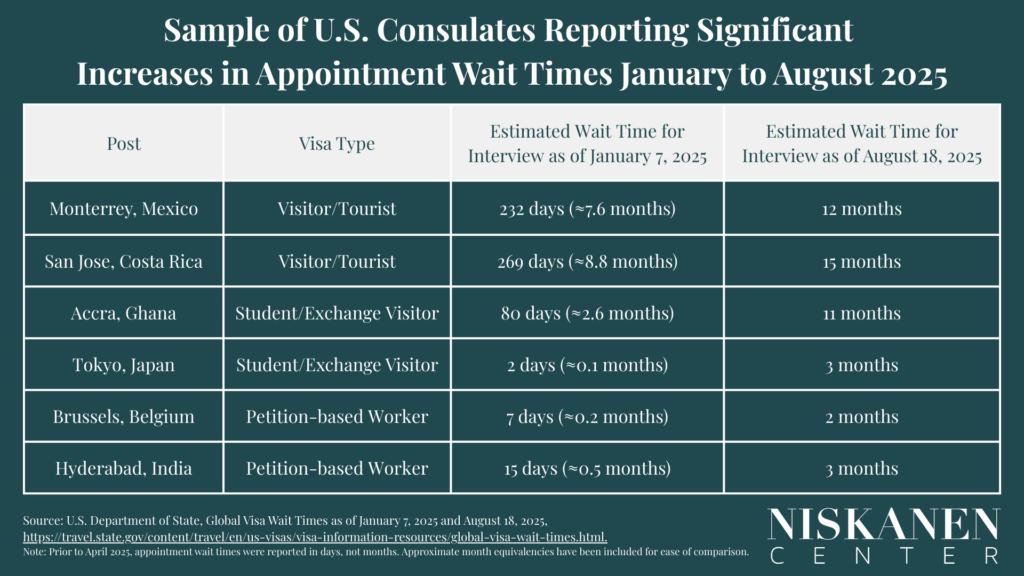
Earlier constraints imposed by the Administration have already had notable impacts on appointment wait times around the world.
- On average, among reported posts, the estimated wait time for a visitor, or tourist visa appointments increased by 69 percent between January 7, 2025 and August 18, 2025.
- For student visa appointments, the estimated wait increased by an average of 259 percent.
- For petition-based appointments, like farmworkers or specialized employees, the increase was 187 percent.
Not every consulate has experienced such significant increases, but all could face increased pressure as the forthcoming restrictions stimulate additional appointment demand.
Forty percent of travelers obtaining nonimmigrant visas in 2023 utilized an interview waiver. The swell in consular demand, therefore, will probably be significant when the pool of applicants requiring an interview rapidly expands. The waivers allowed consulates to prioritize review of first-time applicants and those who warranted additional scrutiny. The new rules require staff to divide their time among children, the elderly, first-time applicants, and routine renewals, regardless of risk level.
Rising demand will likely leave consulates with two options: shorten interviews to increase capacity, or maintain current interview lengths and watch wait times balloon. Shortening interviews across the board carries the risk that something or someone may slip through the cracks. On the other hand, excessive wait times carry costly implications for the U.S. economy. The last time wait times spiraled out of control, the U.S. Travel Association estimated that in a single calendar year, the U.S. would miss out on 2.6 million potential visitors and $7 billion in lost visitor spending due to visa delays. That does not even account for the economic losses the U.S. may face if students pursue their studies elsewhere or businesses move employees to another country with more reliable immigration options.
President Trump will have the unique opportunity to oversee several major international events this term, including the 2026 FIFA World Cup and the 2028 Olympic Games, both of which have the potential to bring substantial foreign expenditure to the United States. These events may attract many first-time visitors to the U.S., provided they can secure a visa in time to attend.
Securing our immigration system is essential, but inefficient policy choices that duplicate work and exhaust valuable staff time on baby interviews have real costs for the U.S. economy. More importantly, those choices can hurt the Americans who hold steady jobs as a result of the expenditure and contributions of foreign visitors, international students, and immigrant workers. Rather than using waiver changes to undermine the legal and orderly immigration system that most Americans want, the Trump administration should prioritize efficient, informed, and strategic policy changes that can make our country safer and our economy stronger.