Musa al-Gharbi is a Niskanen Center senior fellow. This article originally appeared on his Substack, “Symbolic Capital(ism).”
Throughout the late 90s and early 2000s, there was a growing bipartisan consensus that major reforms were needed to the American policing and incarceration systems. “Artists of the possible” worked across administrations to hammer out the contours of a formal agreement. These efforts culminated in the First Step Act, signed into law under president Trump in 2018.
The First Step Act was one of the most significant pieces of criminal justice reform in decades. It was an achievement of a broad array of stakeholders working together and building agreement over many years. It was intended to be a cornerstone upon which further reforms would be built. Instead, due to growing polarization and conflict over moral and cultural issues after 2011, the legislation barely managed to limp across the finish line.
Efforts by Republicans and Democrats to continue forward progress went nowhere. Messaging by folks aligned with the left (advocating for looting, abolishing the police, closing all prisons, and denouncing people as “racists” if they disagreed) — paired with financial scandals and mission drift within Black Lives Matter, COVID-related surges in crime, and “fiery but mostly peaceful protests” breaking out in many American cities — led many conservatives, moderates and even normie liberals to pull back from the cause. Going into the 2024 election, bipartisan reform efforts weren’t completely dead, but their prospects seemed bleak due to growing dysfunction in Washington and wariness among voters.
Sensing that the political winds had shifted1,Donald Trump was able to win reelection in part by capitalizing on growing concerns about crime and social disorder (including and especially among non white voters). Although Trump showed receptivity to the cause of criminal justice reform during his first term, this time around he’s rolling back much of the progress that had been made under his previous tenure.
The movement to reform police and the criminal justice system is dead, and we have killed it. The consequences of this collapse can be measured in “black lives.”
The number of Americans killed by police rose every year during the Biden Administration even as overall homicides fell sharply (during the first year of the Trump Administration, killings declined slightly but remained higher than in any year on record prior to 2023). Racial disparities in these killings remain high.
However, black folks aren’t just dying at the hands of law enforcement. The number of black lives lost to violent crime is down from 2021 peaks but remains elevated compared to pre-2020 levels. Nonlethal violent victimization continues to rise uniquely for black people despite declining for everyone else.
With respect to mass incarceration, after a decade of annual declines in the U.S. prison population, there have been increases to America’s prison population every year since 2021.
The timing here is critical to note. It can be easy to slide into partisan narratives about how and why things got here, but the Orange Man is clearly not to blame for the trends described above. Again, police killings were flat for most of Trump’s initial tenure but rose every year under Biden. The reversal of incarceration trends occurred under Biden. Black victimization from crime was higher every year of Joe Biden’s tenure than in any year of Trump’s first term. Trump’s (re)election was not the cause of these adverse trends. His return to the White House was instead another consequence of the reform movement’s self-immolation.
My efforts to reckon with how and why we got here over the last few years led to a significant evolution of my thinking on both the police and criminal justice reform movements and the broader issues at stake.
Crime and the movement for Black Lives
In the early part of my scholarly and journalistic career, I was focused near-exclusively on national security and foreign policy issues, with a specific focus on the Middle East. As the protests against mass incarceration and police violence gained traction in the U.S., I grew increasingly curious about whether, how, and to what extent the work I was doing on sectarian tensions, social movements and state repression in the Middle East might translate to the U.S. context.
Witnessing the “Arab Uprisings” give way to civil wars and oppressive regimes, my interest in domestic struggles over race, policing and inequality was always governed by pragmatism and practicality. But I skewed towards abolitionism and was broadly aligned with the movement for black lives.
As I’ll talk about more in my next book, I grew up in an area with one of the highest levels of cops and corrections workers per capita in the country. Throughout my formative years, I saw many lives wrecked by encounters with the criminal justice system – not just through the immediate consequences of police encounters and imprisonment, but also the enduring stigma, opportunity foreclosure, relationship strains and administrative burdens associated with probation, parole and a criminal record. In practice, “serving one’s time” was only the beginning of the punishment, and the end of the punishment seemed to never arrive. And the ends of all this punishment were also unclear: the town I grew up in was quite safe. There didn’t seem to be a severe problem that these draconian measures were a plausible solution for.
Because my life circumstances and experiences left me with little fear of crime but a lot of apprehension over how the system seemed to be swallowing up young men in my community and social networks, my attention was focused primarily on the problems tied to incarceration and law enforcement rather than the social disorders these institutions are supposed to be mitigating. Yet, from my current vantage point I can recognize that, although crime victimization was never a major threat in my own life, it is nonetheless an immense problem… including and especially for society’s most vulnerable.
For instance, although black people are far more likely than others to suffer the excesses of the criminal justice system, they are also disproportionately victims of crime. Roughly half of all homicide victims in the U.S. are black.
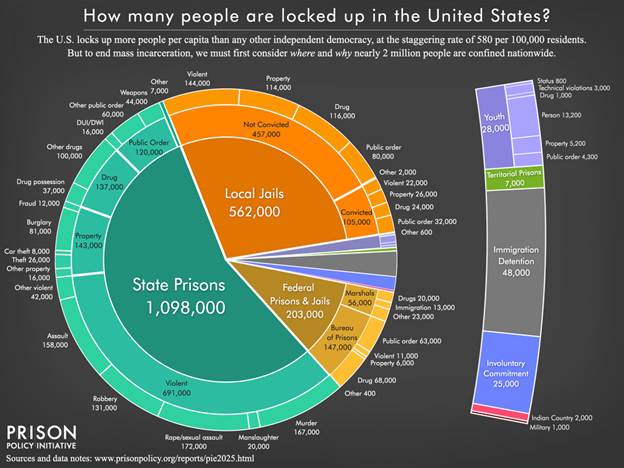
At the time, however, violent crime was not front of mind. Writing in the shadow of Michelle Alexander’s landmark The New Jim Crow (published in 2010), I was under the impression, still held by many of my peers, that America’s prisons are overflowing with nonviolent drug offenders. To this day, the conversation around decarceration tends to be centered around people who got snatched up with small amounts of illegal substances intended for their own recreational use. However, these folks amount to a miniscule (and shrinking) share of America’s actual prison population.
Every year, the Prison Policy Initiative releases a chart called “The Whole Pie,” visualizing everyone incarcerated in the U.S. at the federal, state and local level alongside the crimes that landed them there. One thing that becomes immediately clear when you look at that chart is that, in fact, 60 percent of those in state prison systems, and a significant share of folks in other systems, are locked up for violent crimes: rapes, murders, assaults and robberies.
Even when we look at non-violent drug offenders, most are not serving time for merely using drugs or possessing illicit substances for their own consumption. They are locked up for trafficking large volumes of drugs that hollow out communities, or for dealing (i.e. preying upon others’ addiction for their own enrichment), or for endangering the lives of others by driving under the influence of drugs or alcohol (reckless actions responsible for the deaths of more than 10k Americans each year). These offenses may not be violent, but they are far from harmless2.
Many of those currently imprisoned would certainly go on to cause more social damage if they were released.
For instance, it is a relatively small share of the population who engage in violent victimization, and those folks tend to be serial offenders. According to estimates by social scientists, roughly 1% of the U.S. population is responsible for nearly two-thirds of all violent crime convictions.
Non-violent criminals are often repeat offenders too. A majority of current U.S. prisoners have at least two previous incarcerations. Roughly a third of current prisoners have been incarcerated more than five other times.
Folks who’ve already racked up huge rap sheets often persist in criminal activities across the life course, even when most others in their cohort have “aged out” of crime or otherwise turned their lives around. Simply putting these dangerous individuals back on the street would be devastating for the communities they’d end up in. And it is not ambiguous where they’d end up.
If the prisons were to close, and the rapists, murders, and drug dealers were set free, they wouldn’t be going to live in the Hamptons, on the Upper West Side of Manhattan, or anywhere else that symbolic capitalists tend to concentrate. Instead, just like with homeless people, refugees and immigrants, any newly-released criminals would be pushed to poorer and darker communities. For communities already struggling with public safety and public order, this understandably not an attractive proposition.
The costs of crime are immense and long-lasting for victims and their families. One of the most pernicious effects of being preyed upon by criminals is that it often leads others towards criminal activity as well. Whether to even the score, or as a result of losing faith in the social order, crime victimization and perpetration are intimately linked. Violence begets more violence. Tolerance of social disorder leads to more social disorder. This is something less-advantaged people intuitively understand, and it informs their deep skepticism towards abolitionist policies and rhetoric3.
A compelling case could certainly be made for releasing prisoners who have already served significant time and are unlikely to harm others. But even by more generous estimates of how many could be released in this way, it’s still the case that most people who are behind bars in the U.S. today should probably remain separated from the public until they are less of a threat (or until there are actual institutions, systems and processes in place to better manage the risks they pose to others).
Of course, prisons need not, and likely should not, retain the form they have. And there is much to be said about mitigating the “collateral consequences” of a criminal record, probation and parole that often make it difficult for folks to reintegrate into society or flourish after they’ve served their time (contributing to recidivism). There are likely ways to empower citizens and communities to prevent or defuse violence before state intervention is required. Many communities are also piloting non-police emergency response interventions to address conflicts or crises that may not require law enforcement officers and the criminal justice system. But this is all orthogonal to the reality that, for now and for the foreseeable future, it likely is necessary to keep most of America’s current prison population separated from the communities and individuals they would otherwise victimize.
If we care about black lives and black communities, or poor and working class people and communities, we should work to protect these constituents from crime more effectively while we also push for reforms to law enforcement and the criminal justice system. After all, criminals kill far more black people every year than cops do. And they are responsible for lots of other devastation as well.
Life, Liberty, Property
Perhaps owing to my theological background, when I first began focusing on crime and criminal justice reform, I didn’t take property crime particularly seriously. After all, “stuff” can be replaced, I thought. Human lives cannot. It therefore seemed immoral to ruin or endanger someone’s life over “stuff” by siccing the cops on perpetrators of property crimes — especially petty crimes.
I can now recognize many things wrong with this picture of the world, not the least my easy assumption that “stuff can be replaced.” For the genuinely vulnerable and disadvantaged in society – for the people and communities most likely to experience crime – reality is not so simple.
For instance, I have a nice bike. I like it a lot. When circumstances permit, I use it to get to work. I enjoy rides with my family. If someone stole my bike, that would suck. But because I am a tenure-line professor at an R1 research university, I can ultimately afford to buy a new bike. And in the meantime, I could get where I need to go with my car. And if my own car was out of commission, my wife could drive me around in her car. For me, my bike really is just “stuff” that I could readily replace or do without (even if I’d rather not).
However, for those without easy access to cars or generous discretionary income, if someone steals the bike they use to get around, this is often a major problem. They may not have the money on hand to just buy a replacement. They may need a bike in order to earn the money that could help them achieve that goal (in many suburban areas where poverty is increasingly concentrated, public transportation is not a particularly viable option). If they do somehow manage to scrape together cash for a replacement, that’s money they are no longer able to spend on their bills, their children, their partner, and so on. And if they can’t come up with the money for a new bike of their own, they may ultimately resort to stealing someone else’s ride to get around. If they get caught, they risk physical harm and/or imprisonment. If they succeed in the theft, their own problem is solved… albeit by putting someone else in the same desperate situation they faced.
In short, for folks who are less fortunate, losing one’s bike can be a major disruption. It can be a huge practical problem that interferes with someone’s work, social life and finances for days or weeks on end. And that’s “just” a bike! When we’re talking about someone’s wallet, phone, car, computer, or other significant investments, the consequences can be far more destabilizing and enduring. And those effects are rarely confined solely to the affected individuals.
When communities experience lots of property crime (robberies, shoplifting, vandalism, arson) businesses tend to pull out or avoid investing to begin with. This reduces the jobs available to people who live in the area. It forces people to commute further to work, shop, or address other wants and needs — diminishing their quality of life.
Crime also leads property values to plummet. As crime goes up and property values go down, those who can move do move (leading to further concentrations of poverty among those who remain). Government responsiveness to the communities tends to decline alongside the falling tax revenues (caused by closed businesses, fewer residents and the lowered value of real estate).
In turn, urban blight, closed storefronts, disinvestment, litter and graffiti tend to be associated with still higher levels of crime. It can become a doom loop: crime leads to closures and disinvestment, which increases crime, which exacerbates flight and neglect, which leads to more crime, and so on.
More distressingly, as I’ll discuss at length in my forthcoming book, instability, scarcity, precarity and community decline can lead people who live in those conditions to disinvest in their own lives and futures.
It becomes difficult to imagine discipline, sacrifice or efforts paying off in a meaningful or durable way when anything you have can be easily and arbitrarily lost or destroyed, and when everyone around you seems to be spinning their wheels (with any progress they make reliably erased by one catastrophe or another). It can feel futile to build when the rug can be pulled out from you at any time and hard-fought gains seem unlikely to stick around. It seems more rational to instead focus on the short term, the here and now, and instant gratification.
But, of course, these tendencies towards myopia and reduced impulse control ultimately lead to even less opportunity or mobility, to even more conflict, crime and instability, and to further disinvestment and neglect at the hands of individuals and institutions. The doom loop that plays out across several levels.
Put simply, protecting the built environment and the integrity of people’s possessions is super important to improving people’s quality of life and their life chances. It’s not just “stuff” at stake when property crime goes unchecked. Even cash isn’t “just” cash — it’s typically freighted with social and personal meaning – including and especially for those who have less of it.
Culture war unrealities
I have always believed that violent crime and police killings in small towns and rural America are underdiscussed. Unfortunately, the main way these issues come up is in the context of misleading culture war narratives.
Trump supporters, focusing on high total incidents of rapes, murders, and assaults, try to define “blue cities” as violent hellscapes. Liberal pundits will reliably retort, “well actually, if you look at incidents per capita, New York City is safer than many other places — including much of Trump country.” This latter claim is true, but it misses a lot.
For one thing, focusing on citywide rates of crime obscures how the distribution of crime is wildly uneven in places like New York City (these metropoles have much higher levels of inequality across all dimensions). Many areas of New York City are, indeed, quite safe. Others are dangerous — far more dangerous than the city-level data suggest. Denizens of these areas within ostensibly “safe” cities would, in fact, be far less likely to experience violence if they moved to smaller communities that have higher per capita rates, regardless of where in those towns they ended up residing.
In any event, the sheer number of incidents that take place in a city like Manhattan (obscured by the per capita rate, which is kept low because there just tons and tons of people) means that most denizens are confronted with violence in their proximity on a daily basis. Even the types of folks who write “well, actually” columns are not immune.
For example, when I attended Columbia University, my family and I lived in a CU-owned apartment on 113th and Amsterdam, three blocks from the university (right next to a fire station and across the street from both a hospital and a church — a good neighborhood!).

Whether you look at crime per capita or compared to other parts of the city, it was a very safe area. Nonetheless, Columbia Public Safety had to send out alerts that someone in the area had been mugged, sexually assaulted, or otherwise victimized almost every day4. Sometimes, people were even killed.
During my time in Morningside Heights, a sniper shot off rounds from the church directly across the street in a successful bid to commit suicide by cop. In Morningside Park, where I regularly took my kids, a visiting scholar was stabbed to death in a random knife attack and Barnard student Tessa Majors was murdered by a group of teenagers in a robbery gone wrong — both tragedies occurring a block away from where my family and I were currently living.
A little ways down the street, there was a shootout in broad daylight in a place I regularly walk (the combatants, strikingly, escaped by riding away on scooters). While I lived on the Upper West Side, several people of all ages were hit by, or narrowly escaped, stray bullets while going about their lives (e.g. here, here, here, here, here, here). Once, a woman even tried to mug my wife – unsuccessfully (she bit off more than she could chew by trying to intimidate a Lebanese Shia woman who’d been exposed to war).
These are just the incidents that spring immediately to mind that occurred over the span of a few years in the especially “safe” area of the “safe” city I lived in.
And beyond my own neighborhood, when I watched or read local news that alerted me to incidents throughout the city, I could see that the events described above were mild compared to what others were going through. In modern history, the longest the city has ever gone without a murder is 12 days. Rapes, assaults, robberies and other violent crimes occur multiple times daily, without fail.
On top of the regular violence that actually transpires, many feel deep unease navigating past unstable and desperate people behaving in erratic and menacing ways and hitting passersby up for money. Most denizens have to navigate this gauntlet repeatedly in the course of their daily routine (on the street, in public transportation, and beyond), living with a constant and acute awareness that things could go awry at any moment in ways that are beyond one’s ability to predict or control. The potential for violence seems to hang in the air virtually everywhere you go5. This is not what life tends to be like in small towns and rural America.
In many other communities, per capita rates of violence may be higher (owing to low total populations that lead every incident that does occur to radically juice the stats), but you don’t see violence in your proximity and hear stories about violence that happened elsewhere in your community every single day. Your risk of getting randomly accosted or menaced by a mentally deranged person or criminal on your way to work, or school, or shopping is near zero. Differences in per capita rates of violence may indicate that cities like New York City are safer than most other places, but the lived reality of these different contexts may be very different from what statistics suggest.
The regularity with which people in “blue cities” feel unsafe in their own communities is a regular talking point for the political right. Unfortunately, their primary “solution” to this problem is to give law enforcement agencies even more resources, less oversight and fewer constraints. Yet, the empirical evidence is clear that this is unlikely to improve anything.
To illustrate this reality, consider: Since 1993, crime has declined significantly across the U.S. while staffing levels have remained essentially flat (rising through the early 2000s before returning to antecedent baselines).

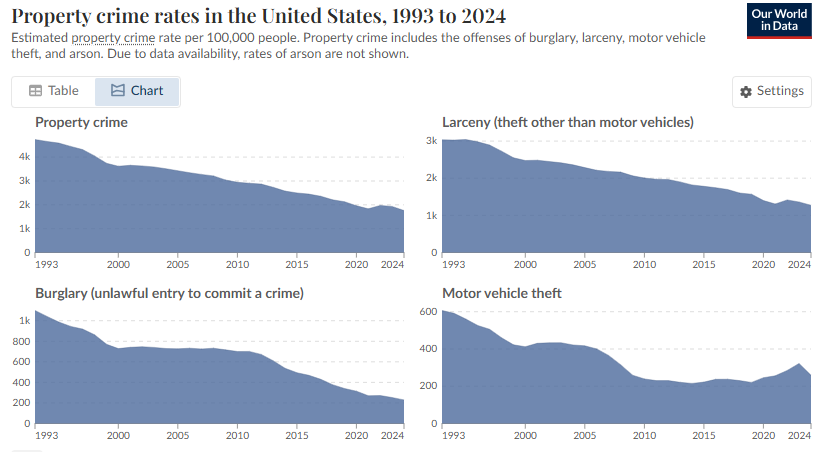
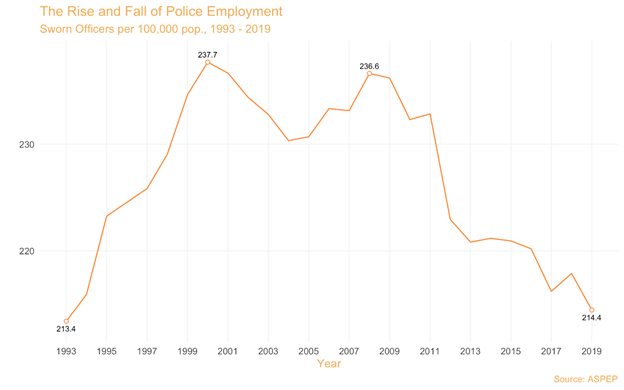
With the same levels of staffing per capita and significantly less crime per capita, departments have more bandwidth than in the past to address incidents that do occur.
Meanwhile, police budgets have increased significantly: cops don’t just have more manpower (relative to the total number of crimes), they have far more resources to dedicate to each incident than they’ve had in the past.

If the “writing legal and financial blank checks for cops” was a sound approach to addressing crime then we’d expect that, as a result of having significantly more bandwidth and resources over the last 20 years (relative to falling crime levels), crime clearance rates should improve a lot. But in fact, the share of reported crimes solved by law enforcement remained largely flat, even in the years of peak police presence from 1999-20096. In more recent years, the clearance rates have declined across the board relative to 1993 levels, even though officers per capita is the same as it was three decades ago (while crime is lower and budgets are fuller).
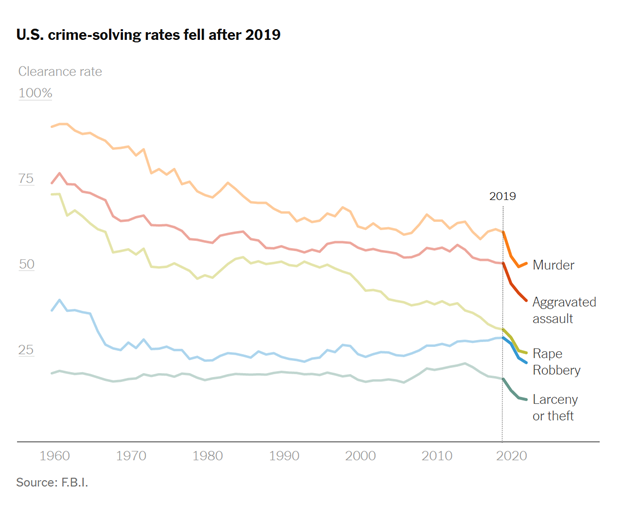
Today, more than 40 percent of murders go unsolved in the U.S. A majority of reported assaults and the overwhelming majority of robberies, rapes and theft are likewise never cleared.
What we see when we compare these numbers to the baseline frequency of different crimes in the U.S. is that police are actually the worst at solving the crimes people experience most regularly (although they aren’t great at clearing cases in any category).
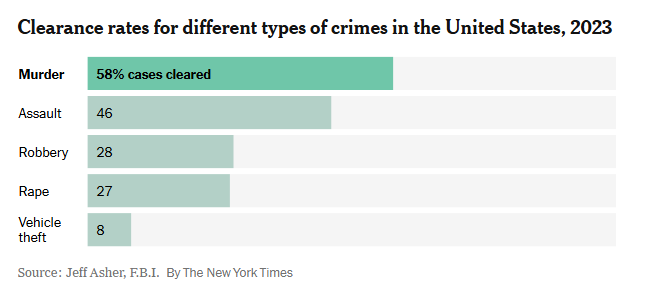
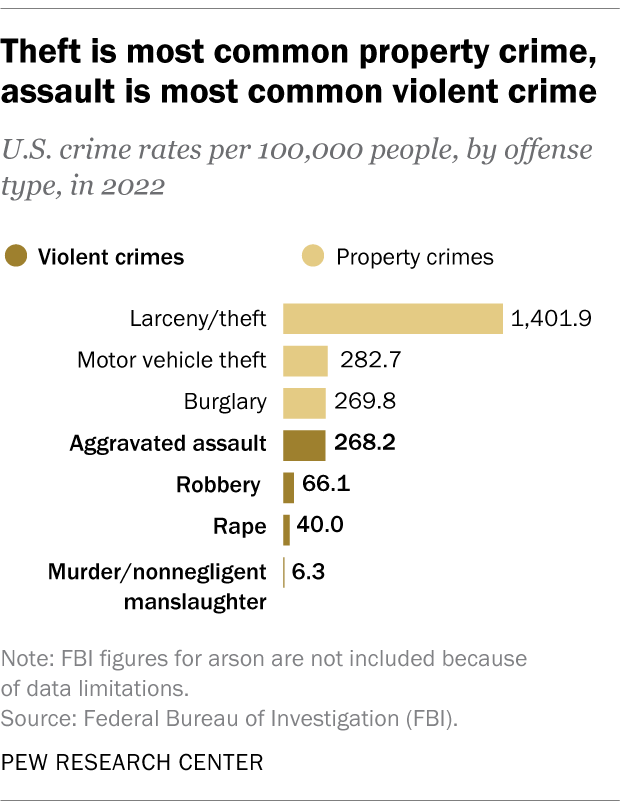
This means the clearance rate for reported crimes overall skews much closer to the rates for vehicle theft than murder — i.e. the overwhelming majority of criminals in the U.S. get away with their crimes.
In fact, the total rate of crimes that get solved is even lower than these bleak data suggest because the clearance rate only measures the gap between reported crimes and the arrest of perpetrators. Often, people who are victimized never bother to get the police involved because they understand that their case is unlikely to be solved or, if anything, folding cops into the picture may make things worse. According to BJS estimates, nearly half of violent crimes go unreported.

For most property crimes, the reporting rates are lower still.
Looking at estimates of total incidents rather than just reported cases, it seems that roughly 7 out of every 8 rapes and three out of every four assaults may go unreported or unsolved each year, alongside a much higher share of property crimes.
And even this doesn’t fully capture how poorly-served many communities are because when law enforcement officials face pressure over how few crimes they’re solving, they often respond by cooking the books — reclassifying more severe crimes as petty incidents, not logging incidents at all, or pinning additional crimes on someone already behind bars without good evidence in order to close the file (“administrative clearance”) – in order to make it seem like there were improvements to public safety when, in fact, nothing has changed. That is, the clearance rates, abysmal as they are, likely exaggerate police effectiveness nonetheless.
Instead of solving crimes or protecting people, cops spend inordinate amounts of effort shaking down, harassing and abusing the public they’re supposed to serve. Americans regularly find themselves facing verbal insults, physical violence, property confiscation, sexual exploitation or unjust detention at the hands of law enforcement agents — even when they have committed no crime (the prevalence of these other issues has been largely obscured by the intense and narrow focus on police shootings of unarmed African Americans). Law enforcement agents are rarely held to account for abuses of their authority and the public’s trust. They are even worse at addressing crimes committed by their own than they are at clearing victimization carried out at the hands of others.
All said, despite growing resources and bandwidth per incident, crime in America is rarely solved by police. Criminals victimize others with broad impunity, leaving citizens who live in crime-ridden areas with few legal recourses for meeting their needs for safety and order. As a result of the culture wars, voters are regularly forced to choose between
- One faction that ostensibly takes public safety and public order seriously but whose “solution” to crime is to grant still more unconditional resources and impunity to agencies that are already rife with failure, waste and abuse, OR
- Another faction that is willing to acknowledge problems in law enforcement and the criminal justice system, but who tend to simultaneously deprioritize acknowledging or confronting crime and public disorder — and who often embrace policies that seem likely to make these problems worse.
No matter which side of this struggle wins at any given moment, the genuinely vulnerable, marginalized and disadvantaged in society are sure to lose.
The Signal and the Noise
In his landmark paper, “Up and Down With Ecology,” economist Anthony Downs described the issue-attention cycle as follows:
- For historically contingent reasons, an issue breaks into the public consciousness. At the time of discovery, the issue is framed as a crisis – an issue about which dramatic action needs to be taken – and now. The solutions to the problem are held to be straightforward – often captured with pithy slogans. The issue is strongly moralized: progress is held to be constrained only by cowardice among insufficiently committed allies and malevolence of opponents (there is no good reason to be opposed and no good reason the problem hasn’t been solved yet).
- Gradually supporters come to recognize that the reason many longstanding problems are longstanding is because, in fact, solving them is hard: they have complicated causes that don’t map clearly onto the predominant cultural, economic and political fault lines; most plausible solutions involve gnarly tradeoffs. It becomes increasingly obvious that making meaningful progress will require sustained focus, discipline, effort, consensus-building and compromise over a long period of time — there is no quick fix.
- As these inconvenient realities become increasingly obvious to everyone, more and more people and institutions disengage. An issue that once dominated the agenda drops out of sight entirely or, in the extreme case, the narrative gets inverted as opponents rally while former supporters attempt to distance themselves from their previous positions. In any event, the intense focus on the issue in the early stages typically amounts to naught by the latter stage. There is generally little-to-nothing to show for all the intense discussion, activism, fundraising and contestation – at least not for the stakeholders the campaign was supposed to be “about.”
The criminal justice and police reform movements of the 2010s seem to have followed this pattern to the letter. Public attention has largely evaporated even though nothing at all has changed about the actual urgency of promoting public safety and reforming the institutions and processes that are supposed to mitigate crime. If the last year has taught us anything it should be that, practically speaking, reforming the police and the criminal justice system is more important than ever.
I, for one, remain engaged. However, my interests have expanded beyond the problems with law enforcement and the criminal justice system to include the harms of criminal victimization. It is now clear to me that crime, policing and the criminal justice system are a bundle of issues that are best handled together.
Additionally, my work is now more tightly focused on questions of strategy: is a given message or tactic likely to achieve its expressed goal or not? And if not, how might those objectives be better promoted?
Finally, as a result of researching and writing We Have Never Been Woke, I’m now much more sensitive to whether or not, to what extent, and in which respects the goals of activists are aligned with the expressed interests, values, priorities and preferences of the stakeholders they’re supposed to be helping.
What comes through crystal clear in research on the views of those who suffer both the excesses of the criminal justice system and from crime itself (e.g. working class and poor people, non-white people) is that they definitely want better policing, but they don’t want less policing. If anything, they want more.
Mutatis mutandis, the same holds true for the criminal justice system more broadly: communities already struggling with public safety and public order want those with a high propensity towards victimizing others to be removed from their midst. They want people who commit crimes to be consistently held to account. However, there is also strong appetite for helping people turn their lives around and make things right should offenders be genuinely committed to those goals.
There is deep wisdom these preferences.
One way America is an outlier is that we have far fewer cops relative to incidents of violent crime than most other wealthy industrialized nations. Scaling up law enforcement to approximate peer countries’ ratios of officers-to-crimes would likely lead to a more representative police force that has richer connections with the publics they serve (instead of the current status quo, where cops are often very socially distant from the communities they police and approach them as an occupying force).
More police could also help improve America’s clearance rates, which are exceptionally low relative to peer countries. This can create a virtuous cycle that leads to lowered crime overall. Research consistently finds that the certainty or frequency with which crimes are noticed and criminals are caught and sanctioned is much more important for curbing crime than ramping up punishments (here, here, here, here). Focusing more on clearing cases in a consistent way — and being present and integrated into the community to deter crime — this would not just accord better with the preferences of folks most adversely affected by crime and policing, it would also be more effective at reducing crime itself than the current strategy of responding to calls with extreme levels of force and coercion and then meting out draconian punishments for the few criminals are actually caught.
A focus on detection and clearance would also help shift resources to more directly on support the places and stakeholders that struggle most with crime (rather than the current norm of prioritizing those constituents who are most likely to vote and who contribute the most taxes – even though these folks already tend to be safer than most).
In a larger and more heterogenous police force, it would also be harder to maintain a culture of impunity. At present, one of the biggest challenges to holding police accountable for failures and abuses is the “blue wall”: cops corroborate (or fail to challenge) misleading accounts of events in order to protect one-another in the face of misconduct. They professionally and socially punish those who expose or refuse to go along with immoral actions, rather than celebrating or rewarding them for doing the right thing. The solidarity and homophily required to preserve these norms would likely be severely undermined as police forces grew larger and more diverse and held deeper allegiances to the communities they police (that supersede or supervene on their ties to one-another).
Put simply: law enforcement agencies absolutely do not need more impunity or blank checks. But they could use higher levels of staffing drawing from a wider range of stakeholders alongside better professionalization (as civil servants rather than warriors), different incentives (geared more tightly to preventing and solving crimes rather than generating revenues or meting out punishment), and more oversight and accountability. Reforms like these would help address both crime and the excesses of crime mitigation (to the benefit of the least advantaged in society) while bringing the United States into closer alignment with other wealthy democracies.
As I’ve argued elsewhere, Trump may have lost in 2020 because he ran an aggressive “law and order” campaign that seemed to resonate with non-whites but alienated a broad spectrum of white voters — including and especially moderates and independents. By 2024, many of these folks had come around to believing social trends were moving in the wrong direction under Biden. This rendered them more receptive to the message that Trump was selling as compared to the previous cycle.
↩︎- Drug decriminalization has generally yielded far fewer benefits than predicted. With respect to enhancing tax revenues, providing opportunities to individuals and communities adversely affected by the war on drugs, eliminating black markets, reducing mass incarceration, curbing racial disparities, or encouraging the use of safer substances — the gains have been much smaller and less consistent than advocates promised.
Meanwhile, legalization has coincided with growing potency of drugs, higher levels of use and addiction and, in some cases, higher levels of overdose deaths and social dysfunction.
For these reasons, many states and communities are revisiting their approach to legalization – in some cases, recriminalizing possession or sale of certain drugs, in other cases stepping up regulations and the enforcement of drug laws that remain on the books. Referendums to legalize drugs where they are not yet licit are increasingly failing at the ballot box.
The “War on Drugs” has been an unambiguous failure in most respects. However, legalization and destigmatization is not working out as intended either. Americans will probably end up settling on an equilibrium point that lies somewhere between these two extremes.
↩︎ - Although many radical criminal justice policies are advanced in the name of the marginalized and disadvantaged, as a matter of fact, ideas like defund and decarceration are most popular among highly-educated, relatively affluent, urban and suburban white liberals.
↩︎
During the height of the 2020 racial reckoning, Columbia University Public Safety removed images of perpetrators from security alerts because the racial composition of perpetrators was unsettling to progressive sensibilities. The lack of images in the alerts rendered them less useful for helping identify, avoid or catch criminals in a timely fashion. But on the bright side, these maneuvers did allow CU stakeholders feel better about avoiding the reinforcement of stereotypes. It also helped them avoid reckoning with the awkward racial dynamics of how Columbia University relates to the community it’s embedded in. It was a striking case of prioritizing the symbolic over the material… among stakeholders who have the luxury to do so (living, as they did, in apartments with doormen, neighborhoods with gates and private security, and working in buildings that often require keycards to access).
↩︎- In the interest of candor, I should admit that I virtually always felt safe while walking around in Manhattan — in public transportation, at night, in any neighborhood I happened to traverse, wherever. But I’m a 6 foot 3 black dude with a scary beard who typically wore non-expensive urban wear (hoody, jeans, baseball cap and sneakers) and carried myself in a way that didn’t invite others to interact with me. I didn’t look like a particularly valuable target. I certainly didn’t look like an easy mark.
I strongly suspect that if I had different demographic characteristics my experience of the city would have been much different.
↩︎ - Note: the period of peak police-per-capita visualized above occurred before the rise of BLM or the Great Awokening writ large. It therefore precedes any law enforcement pullbacks in response those social justice movements. This period also precedes the election of Barack Obama and the ensuing “national conversation” about race.
It is therefore implausible to blame “woke” activists and legislators for the fact that rapidly growing police budgets and force numbers from 1999-2009 did little to budge the clearance rates despite falling crime over that decade. Even without “woke” obstructionism, and with falling victimizations, higher staffing, and more money, cops still couldn’t manage to solve a higher share of crimes.
This should complicate people’s assumptions that giving cops more money and less restraints would mechanically improve public safety or police performance. Instead, it seems like additional staffing or resources would need to be accompanied with changes to incentives and accountability structures for any major investments to have their intended effects.
↩︎