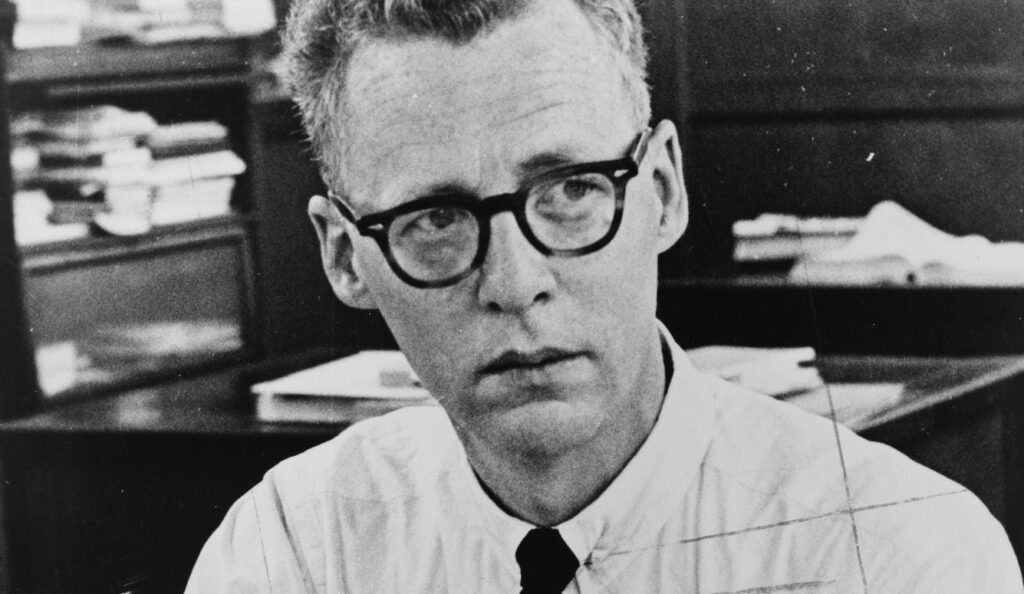
Murray Kempton (1917-97) was one of the greatest American journalists of the twentieth century. His career extended across seven decades, during which he produced somewhere around 11,000 columns, essays, and pamphlets, nearly all of them marked by his distinctive dry wit, insight, and stylistic elegance. He wrote about government and politics but also the civil rights movement (of which he was one of the earliest and most incisive white chroniclers) and a range of subjects that included jazz, sports, the arts, religion, history, and philosophy. He won the Pulitzer Prize for Distinguished Commentary in 1985 but was not widely known to readers outside of New York, where he wrote for newspapers including the New York Post, the World Telegram and Sun, and New York Newsday. But he was a hero and role model for many of the leading journalists of his era including Garry Wills, Joan Didion, David Remnick, Molly Ivins, Darryl Pinckney, and David Halberstam. And although he always identified with the political left, some of his greatest admirers included conservative journalists like William F. Buckley Jr. and George F. Will.
Andrew Holter recently has brought to publication the first collection of Kempton’s writings to appear since the 1990s. The anthology, entitled Going Around, offers a selection of Kempton that extends from his student journalism during the New Deal to his criticisms during the ‘80s and ‘90s of figures like Bill Clinton and Donald Trump (of whom he wrote that “Trump dresses his hatred up as though it were a peacock’s feathers”). In this podcast discussion, Holter talks about how he became interested in Kempton’s work, how Kempton’s writings provide an overview of and window into American life in the twentieth century, and why he wanted to make Kempton’s work available to a new generation of readers. He explains how his research led him to rediscover long out-of-print writings along with previously unpublished work (including Kempton’s uncompleted memoirs). He also describes why Kempton’s model of “going around” – beat reporting and direct interactions with people in the streets and in the community – is a necessary corrective to much received opinion and analysis today.
Transcript
Andrew Holter: Kempton’s ethic of “going around,” the title of the book — his belief in leaving the house and talking to people and understanding the world through interacting with other people directly out on the street — I think that there’s something in that for everyone.
Geoff Kabaservice: Hello! I’m Geoff Kabaservice for the Niskanen Center. Welcome to the Vital Center Podcast, where we try to sort through the problems of the muddled, moderate majority of Americans, drawing upon history, biography, and current events. And I’m very pleased to be joined today by Andrew Holter. He is an historian and writer whose work has appeared in a wide range of publications, and he is the editor of an anthology of writings by the legendary reporter and columnist, Murray Kempton, entitled Going Around: Selected Journalism, which was recently published by Seven Stories Press. Welcome, Andrew!
Andrew Holter: Thank you, Geoff.
Geoff Kabaservice: Andrew, candor compels the admission that at this point a certain fraction of my listeners are thinking about switching off the podcast as the realization sinks in that this discussion will be about a book by a writer most of them haven’t heard of, which has been brought into being by an editor and publisher that most of them haven’t heard of. But I personally want to say that I’m thrilled that this anthology exists. I want to congratulate you on what clearly was a labor of love, and I thank you for taking time to talk with me about it today.
Andrew Holter: Well, thank you, Geoff. I’m thrilled for the chance to talk about it. And I have a feeling that many of your listeners will be interested in this book and know many of the points of reference, and there are many kinds of guideposts that I think will be familiar to them.
Geoff Kabaservice: Well, fingers crossed. So speaking of guideposts, there are some subcultures of American intellectual and political life that are sort of like speakeasies, where in order to get in you have to say the password. And the password for entry is familiarity with certain individuals who are revered within those subcultures but are generally unknown to the greater public. So for example, the password to the American intelligentsia for many years used to be knowing who Robert Silvers and Barbara Epstein were, the co-founders of the New York Review of Books — which depending on your viewpoint is the premier English-language literary-intellectual journal or maybe what Tom Wolfe called “the chief theoretical organ of Radical Chic.”
Murray Kempton’s name is another kind of password. He was, and in some circles still is, revered as one of the greatest American journalists and columnists we have yet produced. He was a writer’s writer, someone whose works spanned and helped define the twentieth century.
His journalistic career extended from the 1930s, when he was an editor-in-chief of the Johns Hopkins University student newspaper, through his death in 1997, when I think he submitted his last column just weeks or even days before his death. He produced somewhere around 11,000 columns, essays, and pamphlets across that time, along with several books. He wrote for a number of publications but principally New York newspapers including the New York Post, the World Telegram and Sun, and Newsday, along with magazines and reviews like The New Republic and the New York Review of Books. He won the Pulitzer Prize for Distinguished Commentary in 1985.
More than that, he was a hero and inspiration to a legion of writers and columnists, many of them far better known than himself. These writers included Garry Wills, Joan Didion, David Remnick, Darryl Pinckney (who wrote the forward to your anthology), and David Halberstam. But his admirers also included — somewhat surprisingly, since he was always a man of the left — many conservative writers including William F. Buckley Jr. and George F. Will. Well, Andrew, let me pause there and ask you how else you would situate Kempton in the big picture of American journalism and twentieth-century politics.
Andrew Holter: That was all very well said, Geoff. You’re exactly right: He was this legendary figure, particularly among New York journalists and in the political press corps too. He went to almost every presidential convention from the mid-‘30s to 1996. He covered Bob Dole at the Republican National Convention — Bob Dole, whom he preferred to Bill Clinton, by the way. But yes, you’re exactly right: He was a legendary figure. But he is a historical figure now, of course, in a way that he wasn’t in the 1990s, when people like David Remnick were writing about him and when the last collection of Murray Kempton’s work was published, which was in 1994, thirty years ago. And so part of my interest in doing the book was to understand the quality of his appeal that you’ve just described, the range of his appeal. Where does that come from?
It is hard to find critical remarks or critical writing about Murray Kempton, really. There’s not that much of it. So my interest was in understanding that quality, but it was also in recovering Kempton as a figure of the twentieth century: as a witness, as an observer, but to an extent as a participant in political debates, conversations — a political participant, certainly. So that was my interest too. I felt that he didn’t really have all that much interest in his own life the way that many of his contemporaries did. He wrote very little autobiographical writing. And there also hadn’t been too much deep archival digging in his career and in his clips, which as you said are numerous. So I felt like there was some historical work and some contextualization there that ought to be done to show him as this figure of his times.
Geoff Kabaservice: David Halberstam thought that Murray Kempton in some ways was the creator of the New Journalism. And I think there’s a sense in which that’s true, in that he wrote so much, almost every day, and also just drew on such a wide range of his own interests. He wrote about politics, he wrote about contemporary events, particularly the civil rights movement and the various political activisms of the era. But he also wrote about his interest in jazz. He could write about high art. He wrote a very incisive critique of Karl Marx as a journalist, which you included in this anthology. And he leavened all of these writings with an incredible array of quotations and insights from classical literature and from his seemingly measureless depth of knowledge of British history in particular.
So in that sense, he was kind of a New Journalist before the letter. But he was not somebody who was always making you conscious of his own presence as an observer of the scene in the way that later New Journalists like Hunter S. Thompson or Tom Wolfe would do.
Andrew Holter: Absolutely. That’s very well said. He was a writer of enormous style. I think the term “stylist” shouldn’t be an epithet. Kempton was an incredible stylist. An editorial in Harper’s magazine in the mid-‘50s, long before New Journalism was a term, observed that Kempton wrote as “the central character in a drama of his own contrivance” — which is kind of a nice definition of what the New Journalism was really about, and that was before that. But that Harper’s editorial also noted that that was part of Kempton’s inheritance from H. L. Mencken, who was extremely important to him. And so I think that for the listeners who are interested in the history of American journalism, who love to read this kind of writing as I do and as I know you do, I think it’s useful to think about Kempton as a kind of transitional figure in that sense from someone like H. L. Mencken to the New Journalists of the ‘60s.
Kempton was a little bit older than Didion, Hunter S. Thompson, Garry Wills. He was really somebody who influenced those people. But it is conspicuous that he is not in that famous collection edited by Tom Wolfe called The New Journalism. And I think some of that has to do with a bit of — “animus” might be a little bit too strong of a word, but… I said earlier that it’s hard to find criticisms of Kempton, but Tom Wolfe is one of the writers who would be quite critical of Kempton. Maybe that is some of the kind of “familiarity breeds contempt” to an extent, or perhaps I mean to say “the narcissism of small differences” because there are similarities between Tom Wolfe and Murray Kempton. But no, Kempton was not really included in that crowd, and I think ultimately felt a little bit outside of it too.
He really liked to think of himself as an old-school shoe-leather reporter. The story is not about him, it’s really about “going around” — the title of the book — about making sure he goes around the city talking to people, just beat reporting. He loved that kind of thing. But of course, there’s something a little bit disingenuous about that, his identification with just being a reporter — because, as you say, he was so much more than that. He was writing these literary essays and long, very thoughtful pieces for the New York Review of Books. But he had this kind of… I think he really liked to think of himself as a reporter, as the reporter that he was, but he was humble in that respect. He didn’t like the label of an intellectual or an essayist. He really preferred to be thought of as a reporter.
Geoff Kabaservice: There’s a famous saying that journalism is the first rough draft of history, but its — what would I call it? — contemporaneity is also what makes it perishable. From the perspective of a historian, journalism obviously can be incredibly valuable as a guide to how the past appeared to scribblers at the time, but most journalism isn’t really worth rereading for the same reason that most rough drafts usually aren’t worth rereading.
There are a lot of journalists who I do think are worth reading their anthologies, but it’s usually essayists. If I were to think of who are the journalists whom I have reread most often, there are people like Joseph Mitchell, obviously, who in many ways was kind of a forerunner of Kempton, writing for the New Yorker… Garry Wills, who I mentioned before… Bill Buckley, Didion, Jimmy Breslin, Norman Mailer, Mike Royko, George Will… But some of them are essayists, in terms of what we’re actually reading in their anthologies, rather than daily journalism. And in any case, these are the exceptions. So what makes Kempton, in your view, one of those exceptions? Why is it worth reading not just his longer and more considered essays, but his 700-word pieces that he was writing for the New York Post, which was used to wrap fish later that day?
Andrew Holter: Most of the writing that Kempton did in his career, by far, were 800-word, thousand-word pieces. He wrote multiple columns a week for years and years and years. I think about that myself and think just how incredibly intimidated I would be by the prospect of having to fill those pages every week, not to mention being physically exhausted — because remember, he took the form of the newspaper column really seriously as a piece of reported writing. He really believed in reporting.
Not every single Kempton column is a reported story; sometimes, of course, he’s using secondary sources, just like Karl Marx used secondary sources in his journalism in the nineteenth century. There is some of that, of course. But many, many of Kempton’s columns are based in direct testimony and in interviewing and him having physically gone to some Bronx courthouse or talking to people on the street. That was just the way that he loved to work.
I think you can really see him at his finest in the column form. He brought a lot of energy and concentration into those pieces. But I will say I think that one reason to read the columns and to read the contemporary journalism is that there are so many subjects that Kempton wrote about. He wrote so much. There are so many subjects that it’s like on any given day you can find something — hopefully in this book, but certainly in Kempton’s broader body of work — that relates to some event happening in our own time.
Christopher Hitchens said once, “A good way of saying that we’ve been here before is to say that Murray Kempton was there before us.” Kempton kind of saw it all. So many topics! As I was putting this book together, it would seem like every week there was a new Kempton column that spoke to whatever that issue was: executive power, or the mayoral race in New York City, or a piece in this book about the National Guard being used to police a civil matter. You just have to give it time and there will be a piece in this book that will really resonate with the present.
So I think that in that sense there is something really fresh about Kempton. And I think that he must have known that. He wrote long enough that he had an understanding of history. He had a sense of dialectical materialism that he never shed, even though he stopped being a formal member of the Communist Party in the ‘40s. He wrote with a really keen sense of history and of continuity and recurrence.
And that’s part of the reason why the book is called Going Around. It’s not just that that was Kempton’s term for moving around the city to find his next story, but there’s also the sense in Kempton’s work that these subjects come back around, the same people come back around. Sometimes he would write about the same people decades and decades apart. It’s pretty incredible. It’s a really fascinating chronicle of the twentieth century — in some cases day-by-day, which is pretty amazing. And I think this is just a sample of it. But I really hope that it is entertaining and that readers find something in it to enjoy.
Geoff Kabaservice: It is certainly entertaining. And just in terms of the recurrence, I found it fascinating that Kempton wrote a book published in 1973 on the trial of a number of Black Panthers, one of whom was Afeni Shakur. And then he wrote about her son, Tupac Shakur, when he was both on trial and then after he was killed. And he had that kind of continuity that gave him greater understanding than almost all of the other commentators on pop culture and subjects like Tupac Shakur.
Andrew Holter:
Absolutely. It was the sense of history that really derived from firsthand experience, among other things. He was certainly a great student of history and of literature and of philosophy and art, but a lot of it was just Kempton had seen everything and gone everywhere and knew everybody. And so he brought all of that experience to even really quotidian events. And I think that had the effect of elevating the news a little bit, which is debatable whether that’s something you always want to do; I think that some people can find Kempton a little tiresome because his style sometimes probably felt like he was elevating things a little bit too much. But no, I think it is fascinating.
And the example you mentioned about Afeni and Tupac Shakur is perfect, because I don’t know who else in American writing could have written about Tupac Shakur and also H. L. Mencken, and to write about both of those people from firsthand experience and have both complimentary and shrewdly critical things to say about both of them from firsthand experience. That is pretty amazing.
Geoff Kabaservice: That’s a pretty wide span, both chronologically and in terms of subject and outlook, shall we say. There’s actually an essay by George Will that I think is worth quoting at length because it gives some insight into Kempton’s writing and his influence on other writers.
In 1958, when George Will had just turned seventeen years old and was newly enrolled at Trinity College in Hartford, he took a train to Grand Central and, as he put it, “I plunked down a nickel for a New York tabloid in order to see what was going on in Gotham. This purchase of a New York Post was a life-changing event because in it I found a column by Murray Kempton. I do not remember what his subject was that day, but his subjects generally were of secondary importance to his style, which reflected his refined mind and his penchant for understated passion, mordantly expressed. Here, for example, is a sentence from his October 1956 report on President Dwight David Eisenhower campaigning for reelection:
In Miami he had walked carefully by the harsher realities, speaking some 20 feet from an airport drinking fountain labeled ‘Colored,’ and saying that the condition it represented was more amenable to solution by the hearts of men than by laws, and complimenting Florida as ‘typical today of what is best in America,’ a verdict which might seem to some contingent on finding out what happened to the Negro snatched from the Wildwood jail Sunday.
And Will observed that “This 75-word sentence — sinewy, ironic, and somewhat demanding — paid a compliment to his readers: He knew that they could and would follow a winding, syntactical path through a thought so obliquely expressed as to be almost merely intimated.” Your thoughts?
Andrew Holter: That’s very well said. I think George Will captured it exactly. There is something demanding about some of Kempton’s sentences. I don’t think that should be overstated; Kempton was also quite compelling as a writer of short, simple, declarative sentences. Some of those really hit you like a gut punch. But it is true that Kempton was really — the word that is often used is “baroque” or “ornate” or something like that. He was certainly capable of that, and that gives some of his work a demanding quality. But I will say that I think that there is something really exciting about that, and I think that there is something refreshing about that kind of literary tone of voice that he uses.
I think one of the admirable things about him is that he didn’t really modulate himself, whether he was writing in the New York Post or the New York Review of Books. George Will is so right to say that that way of writing was a compliment to his readers, because I really think he didn’t talk down to his readers. He took for granted his readers’ intelligence but also their curiosity. There are things in this book that Kempton mentions — and of course I’m aware of this because I do it myself — there are things in this book that you will have look up. There are references that people reading at the time would have had to look up, not to mention certain aspects of the subject matter of a given column — just references to historical or literary figures or something like that. But I find that really pleasurable, and I think it’s something that is missing from a lot of writing today.
So many young people and newspaper writers are instructed to have a very un-showy prose style; the word is always “flowery,” “Make the language less flowery.” Well, Murray Kempton is a little flowery, and I think that’s okay. Especially it’s okay, I think, in a thousand-word piece. And there’s a whole other question about Kempton’s ability to write a full book, but certainly in a thousand words I think that kind of writing is really enjoyable.
Geoff Kabaservice: I’ll add something to what you just said, which is that Kempton for much of his career was writing for the New York Post. And yes, when it was under publisher Dorothy Schiff, it was more of a left-leaning publication as opposed to what it has become under Rupert Murdoch. But then as now much of the readership of that tabloid was the working class. And I think Kempton, by refusing to adopt a less elaborate syntax, was actually, as you say, paying a compliment to those working-class readers and saying that “You can understand this and you should.” And it’s just such a radical difference from today, when a working-class audience is addressed as though they were bloodthirsty simpletons.
Andrew Holter: Yes, that is exactly right. And his readers appreciated that. Murray Kempton is still fondly remembered in New York City by readers of a certain age, particularly in the outer boroughs, who remember him in the New York Post and in the newspaper he wrote for later on in his career in the ‘80s and ‘90s, New York Newsday, which is of course still around. But that is absolutely right, Geoff.
Geoff Kabaservice: Andrew, how did you come to the idea of preparing this anthology and how did you go about it?
Andrew Holter: I thought it was a shame that the last collection of Kempton’s work, as I mentioned, was published in 1994. I have to say I was four years old when that happened and I never had the chance to read Murray Kempton when he was actually writing. And I became interested in his work in college and then discovered not long after that — I was living in Baltimore — that Kempton’s childhood home was basically on the same block where I lived in Baltimore. The Mount Vernon neighborhood — if some of your readers have been through Amtrak in Baltimore, that’s where you are in the train station — he lived very close to there. And so I became interested in the bigger story of his upbringing, his time at Johns Hopkins University, his career, the middle of the century.
And I started digging around and finding more and more of his work that hadn’t been included in that 1994 collection, and I thought, “Wow, there’s really a huge amount here.” Especially a lot of work from early on in his career that I think he left out of the 1994 collection in part because there had been an earlier collection thirty years before that, and I think he must have felt kind of self-conscious about including a lot of that work from the ‘50s in the later book. But the point here is just that I felt that there was no comprehensive collection of his writings and that there ought to be one.
I thought it might be a good idea at first to do a biography. I think Kempton is worthy of a biography. But you have a chicken-and-egg problem with someone like Kempton because you can write a biography, but if the writer’s writing is not available for anyone to read, that seems to me like a kind of disservice. And you could do a collection of essays — what I wanted to do and what I ended up doing — but if there’s very little biographical information about that writer, then that’s also a kind of disservice.
So I tried to split the difference, and that involved doing a lot of archival work, especially in Kempton’s papers, which are at Columbia University. The thing that really shaped the book was when I met Helen Epstein, who is the daughter of Barbara Epstein, the late founder and editor with Robert Silvers of the New York Review of Books, a very important publication in Kempton’s career. And it was Barbara Epstein who had donated Kempton’s papers to Columbia University, deposited them there. But she had also been his girlfriend, I learned, for many years, which was a bit of an open secret in the New York literary world. And I learned from Barbara Epstein’s daughter that she had wanted to edit a collection of Kempton’s work herself that never came about before Kempton died. It’s a very poignant story, I think, and sadly this book never happened.
Helen very generously said that if I would like to see her mother’s files for that project that never happened, I was welcome to. And so I did. Barbara Epstein’s preliminary work on that book was very helpful to me in making some of the decisions here and in remembering the full picture of his life. It was this kind of connection to his personal life too — not just his writing, but it was a very personal project in that sense, certainly for her. And then it kind of became that way for me to an extent.
But in terms of finding the articles, it was a lot of rooting around in archives and in databases. I’m sure I didn’t find every single Murray Kempton column to consider carefully whether I should include it. Kempton’s friend William F. Buckley, who was involved in putting together the 1994 collection I had mentioned, believed very strongly at that time that there was plenty of material for a second book, the book that Barbara Epstein wanted to put together. So I had no doubt that there was going to be enough material. It was really just a matter of sorting through it all.
Geoff Kabaservice: There’s considerable irony in Kempton’s papers ending up at Columbia University, since you include an essay where he says of Columbia, “I have hated it as long as I can remember. I am a man whose dream for Columbia is that it fall into ruin, like the Roman Forum in the eighteenth century…”
Andrew Holter: Yes, it is funny. I have to say, though, the archivists at the Butler Library Rare Book & Manuscript division are really wonderful stewards of that collection and were extremely important to me. When you do a book like this, you really do rely an enormous amount on archivists and on library professionals, and so I’m very grateful to them. They were as important to the book coming together as the people I spoke to who remembered Kempton, his old friends and the writers who were inspired by him. But you’re absolutely right, Kempton was not a fan of Columbia University, or really most institutions, so he would appreciate the irony, I think.
Geoff Kabaservice: Of course those of us who do research owe a lot to the archivists in our world. You discovered, with the help of these archivists, not only that Barbara Epstein had planned for there to be an anthology that never came together, but also that Kempton had started a memoir that never was finished or published.
Andrew Holter: That’s right. I was really fascinated to find in those archives the draft chapter of a memoir that he had started to write too late. He started it when he was too old and never finished it. There was part of that memoir which was a reminiscence of his service during World War II in the Pacific. That piece was edited by Barbara Epstein and published in the New York Review after he died. But there was this other chapter too that I found really fascinating about Kempton’s early life in Baltimore in the ‘20s and ‘30s. Kempton was born in 1917. And I was really fascinated by this piece because, as I said, Kempton wrote so little about himself, really, and about the details of his own life. That chapter is such a funny little snapshot of the making of Murray Kempton, the thinker and the person, but also just an interesting snapshot of Baltimore at that time too, which was and is a kind of strange place. So I was excited to include it in this book.
Geoff Kabaservice: Let’s talk about Kempton’s basic biography. As you say, he was born in 1917. He lived briefly in Philadelphia during his youngest years, but he moved back to Baltimore at age three after his father died in the pandemic of a century ago. Some interesting facts of his upbringing include that he grew up in what he called “the shabby-genteel” setting of Baltimore’s Mount Vernon Square amidst its fading aristocracy. And he was named for a great-grandfather, I think — maybe a great-great-grandfather — who as a U.S. senator had been author of the Fugitive Slave Law and then Confederate Ambassador to Great Britain.
Andrew Holter: That’s right, which brought him a great deal of embarrassment throughout his life. Kempton came from the stock of people who were supposed to have led the Confederate States of America. They were the Mason family of George Mason, the Randolph family as well. His grandfather had been a judge in Baltimore. I believe there was a great-great-grandfather who had been an Episcopal bishop, in the Army of Northern Virginia, to Robert E Lee. And so he was really from ex-Confederate royalty there in Baltimore.
Geoff Kabaservice: It’s important to point out that although he did think this Southern heritage had something to do with his sympathy for underdogs and lost causes, that emphatically did not include the capital-L, capital-C Lost Cause of the Confederacy.
Andrew Holter: No, certainly not. It’s one of the ironies, of course, that Kempton became a great chronicler of the civil rights movement and a great, very perceptive observer of the Black freedom struggle at large; he recognized it ahead of other people. I don’t mean to skip ahead in the biography, but he recognized the civil rights movement as really the great event of the middle of the twentieth century — the great domestic event certainly. And yes, all of that from someone who had come from this line of Southerners.
Geoff Kabaservice: You’ll occasionally read online that Kempton at a young age worked as a copy boy for H. L. Mencken, whom you’d mentioned earlier, the famous journalist, humorist, and cultural critic at the Baltimore Sun. Was that true?
Andrew Holter: Well, not exactly. Kempton never worked directly for H. L. Mencken, never worked for the Baltimore Sun. But he did work for Western Union running telegraph copy at the Democratic National Convention in ‘36. You or your readers smarter than I am will remember which convention that was for FDR, what number. And in the course of working at that convention, which was in Philadelphia, Mencken was there covering the convention. Back then the reporters would be typing on their typewriters, and then they would rip the page off and have a boy — in this case, eighteen-year-old Murray Kempton — run over and grab that copy to transfer over the telegraph wire.
And that was the job that Kempton did. But it did give him a chance to observe Mencken in action, which was pretty special. And Mencken — it won’t be surprising; they were both from Baltimore — it won’t surprise your listeners that Mencken has an outsize place in Kempton’s work, and the kind of influence that Mencken had on him, and the kinds of lessons good and bad that Kempton drew from Mencken’s career.
Geoff Kabaservice: Mencken has basically been disowned by the academic and literary establishment for what undoubtedly was his racism and anti-Semitism. In fact, speaking of current events, the far right has laid claim to Mencken’s legacy. You might remember that Darren Beattie, who’s one of the farthest-right members of the second Trump administration, was actually kicked out of the first Trump administration when news got out that he had addressed a conference of the H. L. Mencken Club, which was a gathering of white nationalists. So here’s a complicated question: What do you think would explain Kempton’s affection, maybe even excuse his affection, for someone with such deep flaws?
Andrew Holter: In the first place, Geoff, I’m glad you mentioned that the H. L. Mencken Club, I think it is, is a really odious and not very literary-minded organization. And some of Mencken’s admirers drew a lot of the wrong… They looked to what Kempton called “the frozen model of his manner” rather than “the warm example of his intelligence.” That was Kempton’s line about Mencken. And I think that’s it. Kempton was drawn to the warm example of his intelligence, the Mencken who was a kind of archetype of the reporter/critic.
Mencken never went to college. If you read his memoirs — really fascinating memoirs — Mencken began as a reporter from a very young age and really worked his way up to the status that he ended up enjoying as probably the most… Well, I don’t know if he was the widest-read columnist in the country in the ‘20s, but he was certainly the most controversial, certainly the most interesting newspaper reporter in the ‘20s.
But Mencken was a great cultural critic as well. As editor of the American Mercury, he had published Zora Neale Hurston and Theodore Dreiser, and he had this rich intellectual interest as well. And I think that that model appealed to Kempton quite a bit: that you could be a shoe-leather reporter who was also interested in big ideas and in literature and in intellectual subjects. And that’s not that common. There weren’t that many people who would write weekly columns for the New York Post and then review some political or historical book for the New York Review of Books. Kempton did that.
So some of it was that. Mencken was a critic, more than he is sometimes remembered to be. Mencken was certainly, in places, a critic of white supremacy. He was a great opponent of lynching. He was, in a way that was really of course quite snobbish, a real critic of the Southern white working class, memorably in his writing about the Scopes trial and about “The Sahara of the Bozart” and all of that.
Kempton was also somebody from Baltimore who went to the South and was a kind of interpreter of the South for the North. And the difference with Kempton is that you don’t see the kind of rancor in Kempton that Mencken had. Kempton usually is not mean. He doesn’t really punch down the way that Mencken would sometimes. But Mencken’s eye was, and I think remains, really compelling. That reporting on the Scopes trial — you see the influence of that on Kempton’s reporting on Emmett Till’s murder, on the many, many trials that he did. And of course, it’s that sense of humor too. So I think it has to do with all of that.
Geoff Kabaservice: You’ve included in this anthology Kempton’s marvelous 1981 essay, “Saving a Whale,” on Mencken. And among the other observations that he made there is that “Even in the thirties, when [Mencken] was bleakly and even grouchily conservative, [he] never forgot that society is divided between those who own property and those who work for a living.” Kempton also referred to the experiences that Mencken had had in the late nineteenth century and early twentieth century as a very young reporter and the terrible things he saw, which he said were “a permanent coarsening; but they also bred a lasting tenderness toward the victims of life.” And he also said that while “Mencken never presented himself as other than a Tory, contemptuous of democracy and scornful of the masses,” nonetheless “faithful as he tried to be that vision of himself in the abstract, he was almost invariably false to it in confrontations with the here and now. … some fugitive feeling constantly drew him into places where the complacent do not choose to travel.”
Andrew Holter: Yes, that piece is incredible. That is certainly on a short list of Kempton’s best work, I think. It’s just the perfect combination of subject and writer. There was nobody who was better positioned to write something probing and critical and thoughtful about Mencken as Kempton was at that time. It is really fascinating. And that essay that you mentioned, “Saving a Whale,” is also quite revealing about Kempton himself and about the work of being a columnist, which is really fascinating. Because what he says in that piece, and he says things to this effect elsewhere, is that Mencken for him was also a kind of cautionary tale, Mencken’s life. Because Mencken became more brittle, I think, as time went on. And by the late ‘30s, he’s writing that “FDR is a way bigger problem for the United States than Hitler,” and this kind of thing.
And the other issue with Mencken is that Mencken didn’t really get out enough. He never left Baltimore, famously. He was very proud of being from Baltimore. Mencken never traveled. There was a kind of limit to his curiosity. And I think that Kempton, it mattered enormously to him to maintain that curiosity in his old age and to continue to go around and to challenge his own assumptions. And I think he looked at Mencken and thought, “Well, I might end up like this if I get a little too lazy.”
Geoff Kabaservice: Yes, that’s a good point. Even though Kempton, as a mature journalist, kind of regarded New York City as his backyard, the fact is that he did continue to travel and had traveled widely. You’ve included in this analogy the pamphlet he published in 1941 with Pauli Murray, who was then an activist with the early civil rights movement, entitled “All for Mr. Davis.” It’s the story of the sharecropper Odell Waller, who had killed his landlord in self-defense and was later executed by the state of Virginia.
And Kempton was very much on site for a lot of the critical developments of the early civil rights movement, including the killing of Emmett Till and the trial of his killers, as you said; the Montgomery bus boycott; the refusal of the University of Alabama to allow Autherine Lucy to enroll; some of Martin Luther King’s earliest appearances as a public figure in Birmingham; the March on Washington… You can kind of go down the list. And then of course he also served in World War II with the U.S. Army Air Forces taking part in combat in New Guinea and the Philippines. And that was all before he joined the New York Post in 1949.
Andrew Holter: That’s right. Yes, he had a pretty rich reservoir of experience as an activist, in a way. He probably would not have liked that term, but he certainly had a political life and a kind of engaged life in the ‘30s and ‘40s before he joined the Post to become a regular columnist, which was really in the late ‘40s. And those experiences in the world of the labor movement, in the world of the Communist Party, in socialist politics — all of that served him very well when he covered the McCarthy period, when he covered the civil rights movement. He knew people, he knew what to look for, he knew what these ideas were. He understood something about the threshold between activist politics and electoral politics. I think he apprehended that very well. So yes, all of that was relevant.
Geoff Kabaservice: Again, something quite interesting about Kempton just as a person as well as a reporter… He became known with the Post as a white reporter who would intensively cover the civil rights movement and also as an opponent of Joe McCarthy and his anti-communist crusade. And yet he became very close friends with William F. Buckley Jr., who loved McCarthy, as Kempton put it. And he could be quite critical of Buckley — but not, I guess, for the usual political partisan reasons that we think of now.
You have a piece in this anthology where Kempton reviewed the first half a year’s worth of issues of National Review, starting in 1955 and continuing on to ‘56. And his critique was not just that Buckley was conservative, it was that National Review “had the view that so little had happened with any juice and blood in it,” as Kempton put it. National Review was not sending people out to go around, to cover things on the ground. And he has this quote, which I still think of, which is that “Persons possessed by ideology are simply uninterested in that sort of thing. To them there are only ideas and no conflicts of the heart.” And this is still a problem with the conservative movement.
Andrew Holter: Yes. That piece is so funny. I think you put your finger on it that he was really doing Buckley a favor with that piece, because he was trying to show Buckley: “You could actually have a pretty viable magazine here, but you need to think a little bit more, to send these people out and have them talk to people.” Absolutely. And Buckley took his advice.
I have to recommend one of your previous guests, Sam Tanenhaus, who in his new biography of William F. Buckley writes about this. Buckley listened to Kempton — listened to him then in those early days of National Review and actually continued to listen to him. Garry Wills said that he thinks Kempton was the one writer on the left that Buckley really listened to, that he considered, and their friendship is pretty fascinating. And Buckley is also very important to the story of when the last book of Kempton’s work was published in 1994. So really I feel a certain debt to Buckley, because without him, Kempton’s work might have remained much more obscure.
Geoff Kabaservice: Yes. That’s why Kempton dedicated the book to Buckley with a dedication that reads something like, “To William F. Buckley, whose genius for friendship passeth all understanding.”
Andrew Holter: Yes, absolutely. At one level it might seem a little odd, but if you look a little closer, it’s actually not that odd at all. They wrote similarly, to an extent. Everybody knows Buckley was accused constantly of flowery, baroque language — that’s Kempton. There was certainly an affinity at the level of prose style. But I think Buckley also really appreciated that Kempton was not a partisan; he was certainly not a liberal partisan, I don’t think. I think it’s fair to say that Kempton was always very willing to criticize liberals — frankly, including himself. And I think Buckley really enjoyed that.
There’s a wonderful clip from Firing Line of Kempton’s appearance in 1967, and they’re talking about Robert F Kennedy’s prospects as a presidential candidate. When Kempton is criticizing Lyndon Johnson at one point, early on in the interview, you can see Buckley is just delighting in this. He loves that somebody is coming at Johnson from the left, basically. So it’s not that strange that they became so close.
Geoff Kabaservice: Buckley himself could take flak from some of his conservative supporters for being friends with Kempton. And there’s an excerpt I found from a letter where Buckley writes to one of his supporters, “It is sickening to think that you are in the mood for categorical proscriptions directed at someone who has such galvanizing spasms of honesty as Kempton sometimes has.”
But this question of civility is an interesting one because Buckley and Kempton in 1963 held a dinner for Westbrook Pegler. Now, Pegler is kind of a forgotten figure as well, but Garry Wills at some point said that the only three columnists who ever have deserved to have their works collected in hardcover were Mencken, Kempton, and the early Westbrook Pegler, particularly his sports writing, which still does rank with the greats of the century. But of course Pegler was even more notorious than Mencken for his anti-Semitism, his racism, his opposition to the civil rights movement. I think the question would certainly be asked now and probably should have been asked then: Is it okay to have a dinner for such a figure as this in the name of civility?
Andrew Holter: That’s an interesting question. Yes, Kempton’s affection for Pegler is fascinating. I didn’t include in this book, and perhaps should have, Kempton’s essay about Pegler. It’s not really fair to Pegler, because Pegler really is a kind of forgotten figure. But he was enormously influential in the ‘30s particularly, ‘30s and ‘40s and ‘50s. In fact, I read somewhere that it may have been Pegler who coined the word “racketeering” to describe labor racketeering.
But that collaboration that Kempton and Buckley did to honor Pegler… I think that Kempton had this kind of devilish streak, in a way, where he enjoyed sometimes allying himself with people he knew at some level were odious. This happened with Richard Nixon too. Kempton was not naive about Richard Nixon’s crimes. But he found Nixon charming and kind of pathetic, in a way that elicited his sympathy. And I think in a way he felt that about Pegler. He felt much as Buckley felt about Kempton. I think Kempton felt that Pegler was this sort of exiled figure to an extent. Kempton was really fascinated by these kind of fringe, exiled characters. And I think he must have gotten a rise out of that, hosting Pegler in that way.
Geoff Kabaservice: In thinking about this, I remember an episode from my earlier years when I was part of a writers’ lunch group, and we met at the Women’s National Democratic Club. And I got into it one day with Betty Friedan, of all people, because she was saying that the people who joined the Communist Party in the 1930s were the most idealistic, warm-hearted, and intelligent members of their generation. And I came back at her saying, “They were joining the Communist Party of Joseph Stalin.” It didn’t really take that much moral insight to realize that, while it did look like capitalism was failing at that moment, Stalin was evil. The system he represented was genocidal and you shouldn’t actually have been doing that. And we went at it.
And I actually had cause to regret my position when I read Kempton’s 1955 memoir of sorts called Part of Our Time, which was him looking back on the 1930s and particularly the leftist enthusiasms of those times. David Remnick wrote an introduction to a later edition of that book which has really stayed with me, because he said that as he reread Kempton’s book, “I find in it a maturity, a sympathy and patience with the gods and the fools of his time that is beyond me or any of my similarly coddled peers. It seemed that Kempton had lived so much by the time he began writing that he was beyond the cynicism and the unforgiving impulses of the young. Writing on a subject that is almost always given to accusation or defense, Kempton adopts both a prose and a moral stance that speaks less of his understanding of Lenin and Marx than of Matthew and Mark.” And I’ve thought about that, and I have actually modulated a lot of my own behavior as a result of thinking about that.
Andrew Holter: That essay by David Remnick is very elegant. Yes, Kempton’s own past with the Communist Party, which he writes about in Part of Our Time, is interesting. And also the place that communism has in the big picture of Kempton’s life and career and in his political identity is curious. Because unlike some of his contemporaries — particularly the writers who are now associated with the neoconservative movement — the story with Kempton isn’t quite so simple as that he was a radical in the ‘30s, a member of the Communist Party in the ‘30s and early ‘40s, and then he saw the light and became a conservative. That’s not really what happened — in part for a reason, Geoff, that your young self recognized.
Kempton was not really an idealist himself, at least with regard to the Communist Party. And the circumstances under which he joined the Communist Party in the ‘30s were really very practical: He joined the party because he had an opportunity to take a job at the Port of Baltimore, a summer job. And so he joined out of no especially great sense of conviction or ideological passion. He was pretty much, as far as I can tell, from his youth to basically to the day he died, essentially a Norman Thomas socialist. He had at points kind of formal association with the Socialist Party of Norman Thomas, but he had never been a dyed-in-the-wool Communist.
But as you say, he could talk about that subject and those people with nuance and with complexity and with sympathy. And in a way that kind of made his own life harder because it was a little less legible than it might have been if he had been just the out-and-out critic and condemner of American Communists that he might have been, that he was certainly qualified to be. But he wasn’t that.
Geoff Kabaservice: True. But as you said on I guess it was the New Books Network podcast, Kempton knew the critical people at the center of one of the major anti-communist scandals of the 1950s: Alger Hiss and Whittaker Chambers. And he knew about them because he had grown up in similar circumstances in Baltimore as they had. And there’s a quote from his great chapter on those two men where he writes, “A man’s childhood can condition him more than a law of history or what he conceives as the logic of his time. Alger Hiss and Whittaker Chambers both grew up in shabby-genteel families, and each was framed inside the code of shabby gentility.” And both that code and the resentments that it produced explained in large part how those men acted as they did.
Andrew Holter: Yes, that is wonderful. You’re referring to the chapter in Kempton’s book Part of Our Time, which I should say is the only other Murray Kempton book that is in print, and I really encourage your readers to find that book. Of course there was no need for me to republish parts of that book here, but that chapter about Whittaker Chambers and Alger Hiss in Part of Our Time is I think maybe the best thing he ever wrote. It’s certainly incredibly insightful. It was an important piece in Hiss-Chambers studies; your former guest, Sam Tanenhaus, is the dean of those studies. But that piece is just crucial.
And you’re right, there was just a sort of depth to his apprehension of all of that material that is really stunning. He did not write about that subject as an ideologue one way or the other. He really brought a lot of experience and speculation and psychology to bear, among other things certainly.
Geoff Kabaservice: Andrew, you and I first crossed paths virtually six or seven years ago when Sam Tanenhaus sent out an email to you and me and Matt Sitman and a few other people trying to get somebody to be a research assistant to Garry Wills. But I think you also crossed my radar at that time because you wrote a piece for Lapham’s Quarterly which was not just on Kempton but more specifically on the five dwellings or addresses in Baltimore that pertained to Kempton and Mencken and Pauli Murray and other figures of that time. Did you yourself grow up in Baltimore?
Andrew Holter: I’m not from Baltimore. I’m actually from Frederick, Maryland. But I lived in Baltimore when I was in my mid-twenties. And that piece that you mentioned, about the homes of all of these people who were connected to Kempton’s life in some way… It was sort of an eccentric idea, but those buildings were all around and I was fascinated by all of these people from these different parts of Kempton’s life: Pauli Murray, Mencken, Alger Hiss, Afeni Shakur the Black Panther — she had lived in Baltimore briefly. And so I thought I would use that as a starting point to talk about Kempton from an odd angle.
Geoff Kabaservice: Baltimore is a place that I think inspires a lot of historians because, in some ways, progress didn’t really happen there. Baltimore was declining even at the time that Alger Hiss was growing up on Lanvale Street and Kempton was living at East Preston Street. It’s a city that actually has ruins: for example, the Howard Theater where Kempton used to go to hear Black blues and jazz. And you can still find, in some of the streets, arabbers: essentially nineteenth-century merchants with donkey-drawn carts, calling out to would-be customers. It’s incredible how the past survives there in a way that it doesn’t anywhere else, much as the skyline still in many parts is a kind of nineteenth-century skyline. But it’s also a story of decline, and I wonder how you relate to that.
Andrew Holter: How I relate to it myself?
Geoff Kabaservice: Yes.
Andrew Holter: That’s interesting. For me, I will say, the formative event, the really central event of the years that I lived there was the killing of Freddie Gray by the Baltimore Police Department and the events that followed from that. And what that meant to me as a young historian, a young researcher and writer — I was doing a bit of journalism at that time for the now-gone Baltimore City Paper, our free weekly — what that meant to me was that there was just an enormous appetite in the city for historical excavation: How did we get here? And what does this archeology that you’re discussing, what does that have to do with Baltimore’s Southern legacy as a Southern city, north of Washington D.C.?
And of course at that time — this is not the case anymore — there were many Confederate monuments in Baltimore, monuments to Lee and Jackson and Roger Brooke Taney. And really it was Kempton’s family, that family of people who left Virginia after the Civil War and resettled in Baltimore — there was a whole wave of people like them who came to Baltimore. There was plenty of Confederate sentiment in Baltimore before the Civil War, as you well know and your listeners know. But these people who came after the Civil War, it was those people who put those statues up. And so some of my interest in Kempton really came out of that moment and how Kempton’s story, how Kempton’s life has to do with the story of race in Baltimore. And of course, as we said earlier, the irony of his reputation as a civil rights movement reporter coming out of that world.
Geoff Kabaservice: Yes. I also should add that I’ve been going to Baltimore since the 1980s, and it used to be very difficult to find any reference to Frederick Douglass, who also came out of Baltimore. But now, thankfully, that legacy has been recovered and reclaimed.
Andrew Holter: Definitely. And it’s a shame, I think… One of the reasons why I was so interested in that bit of Kempton’s unpublished memoir, that has been published in this book for the first time, about his very early life in Baltimore, is that Kempton basically never went back after he left. His mother, who was a widow — as you mentioned, his father died when Kempton was very small… He would go back to visit his mother, who never remarried. But he never really wrote directly about Baltimore as a subject except in that bit of the memoir that was never published.
But I wish that he had said more, actually. Because I think that there’s no question that between Mencken, between the peculiar kind of Southern/Northern quality of Baltimore, between his time at Johns Hopkins University in the ‘30s and his involvement in radical student politics — all of that was really important for him and the writer that he became. So frankly, I wish that he had written much more about Baltimore. There’s every reason to think he would have said really perceptive things about it.
Geoff Kabaservice: How did you come to your path as a historian?
Andrew Holter: Well, talking about Baltimore, I went to the University of Maryland, Baltimore County. I was very fortunate to go there. I went there on a scholarship. I had great, fantastic mentorship there from the History Department faculty, from the English Department faculty; I was double major in History and English. And it was a great place for me, I found, to really explore some of my interests and deepen my curiosity. We still have a fantastic library at UMBC, and it was really when I was there that I fell in love with old periodicals, the bound periodicals in the section of the library nobody goes to.
The bound periodicals I really loved, and just getting a sense of the world of magazine journalism — which of course there was much more of then (we’re talking fifteen years ago), sadly, than there is now. But the world of print journalism really fascinated me and it was just always an interest of mine. I do other historical research as well that really doesn’t have to do with print journalism. But that is I think where my interest in Kempton and people like Kempton came from: the chance to explore some of those things at my university library.
Geoff Kabaservice: And am I correct in thinking that you recently received your Ph.D. in history?
Andrew Holter: That’s right. Yes, I just finished my Ph.D. at Northwestern University.
Geoff Kabaservice: Congratulations. What was the subject of your dissertation?
Andrew Holter: Thank you very much. The subject of my dissertation is police surveillance, a subject that Kempton wrote about a bit. But a subject that I have been curious about for a long time, from back in the period when I lived in Baltimore, is municipal police surveillance, and particularly the divisions of municipal police departments that were known colloquially as the Red Squads. My friend the historian Joshua Clark Davis, who teaches at University of Baltimore, has a new book coming out this fall called Police Against the Movement that is about some of this material. But that has been an interest of mine for a while, and especially photography. Photography is also one of my interests and has always been important to me. So my dissertation is really about policing and photography.
Geoff Kabaservice: When I think of one of the great photographer-journalists of New York, I think of Weegee, who I think was born in Ukraine — Ascher Fellig might have been his actual name. He just would listen to police radio broadcasts, and that allowed him this almost preternatural ability to get on the scene and be the first to take these photographs of crimes in progress, tragedies, what have you, the kind of things that would involve the police. I wonder if you’ve thought about Weegee at all in the course of your research?
Andrew Holter: Oh, absolutely. I love Weegee. And Weegee is just a fascinating character. The way he worked, as you were saying, is really interesting. Talk about somebody who knew about going around… Weegee was always out on the street. You kind of imagine he had a fireman’s pole in his apartment to out of the house. But also, of course, the Weegee aesthetic is so interesting too, and has interested historians and critics of photography because there is something that is a little bit maybe lurid about Weegee, or a little shocking certainly. But he also had, as you say, this pretty close relationship with the New York City Police Department.
So all of that, yes, all of that is fascinating to me. Although much of the work that I look at really has to do with basically amateur photographers, either police officers who were taking pictures themselves who were trained as amateurs, or people taking pictures of the police who were amateurs too. Before the era of cell phone cameras, the whole business of documenting the actions of police officers or the presence of police officers — I was curious about the history of that as well. And so that’s some of what I write about. And that goes back to the ‘70s, to the ‘60s as well.
Geoff Kabaservice: Murray Kempton, as you say, wrote a fair amount about the police. He was notorious for not driving — I don’t know if he ever learned to drive — and he would bicycle around New York City on a three-speed bike in his three-piece suit. And his bike frequently would be stolen, which was a kind of at least triennial event that he reacted to with mostly good humor. But he said at the end that he didn’t want to report these thefts to the police because they were really on the side of the thieves, since they wanted bikes out of Manhattan’s downtown. But it’s interesting to me that Kempton’s star falls a bit among the general public — I would date it to starting around 1968 and the Ocean Hill-Brownsville School integration crisis. Because then there really seems to be a divorce between Kempton and a lot of his working-class readers that wasn’t really there in the earlier phases of the civil rights movement.
Andrew Holter: That’s true, and I think the readers interested in American political history and the history of New York City will take a special interest in that part of his biography and in those pieces. Something very odd happens with Kempton at the end of the ‘60s where he becomes disillusioned with newspapers, with daily newspapers for one thing. There’s a bit of what feels like a midlife crisis going on here a little bit. He’s starting to speak out more against the Vietnam war. He’s starting to become much more receptive to young radicals than he had been, I think, for a few decades before that. And he actually left daily newspapers. He felt like he was just constrained. He felt kind of politically askew from the New York Post. And he set out to write books and felt much more comfortable in those years at the New York Review of Books.
Geoff Kabaservice: Although he also in the mid-‘60s was in Washington, not New York, writing and as an editor for The New Republic.
Andrew Holter: Oh yes, in the mid-‘60s, certainly. I want to say ‘62 to maybe early ‘64, he was in D.C. at The New Republic to kind of try out that sort of magazine writing. And then he came back briefly to New York, to New York newspapers, and then left again. So actually, even though he wrote constantly for his entire career, he did go in and out of the New York Post in particular because of some feud or other at various points. But in his work from the end of the ‘60s through much of the ‘70s, he’s really trying to find his footing. And he gets arrested at the Democratic National Convention in Chicago; he says he didn’t mean to, but he did. Later on, he gets arrested at a draft board office in New York City. That time was definitely on purpose.
So he becomes this kind of… I think it would be wrong to say that he became a counter-cultural figure, but he got much cozier with the New Left. We mentioned the Black Panthers earlier. This is in the time where he’s covering the Panther 21 case. He had this kind of funny middle period. I say “funny” — I don’t mean to diminish it; he wrote a lot of great pieces then. But it’s this sort of curious bit of his career there at the end of the ‘60s.
Geoff Kabaservice: I actually found myself disagreeing with Kempton more in the pieces that you’ve excerpted when it comes to the ‘70s. Because he seems, on the one hand, a bit credulous, frankly, about the Black Panthers and what they were up to. And then also, in sort of typical liberal fashion, minimizing the problems of crime in New York City. He wrote a piece for Playboy where he’s kind of, in jocular fashion, writing about getting mugged. But this was not a jocular thing to the residents of New York.
Andrew Holter: No, not at all. You’re right. I think that that’s accurate. That piece that you mentioned called “My Last Mugging,” which originally appeared in Playboy — it’s one of Kempton’s better-known pieces, I think. It was certainly one of the ones that was written for a national publication and it got him some attention. It’s also a very rare example of a personal essay. He doesn’t do too many of those; he’s not E. B. White. But “My Last Mugging” is one of those pieces that is personal. I think it is resonant of Edgar Allan Poe, a little bit. There’s a kind of Gothic quality to it.
But you’re right, the main quality of it is that it is being light, in a way, about this serious issue, one that could have been fatal. He describes an incident of being mugged, and of course it is very serious. And it also maybe throws into relief a little bit what you just mentioned about this distance that Kempton developed in those years between the kind of readership of the New York Post of the ‘50s and ‘60s — that working-class, outer-borough readership — and the audience that he was developing more in the ‘70s, which would be the New York Review of Books crowd, which would be the crowd that would get a rise out of “My Last Mugging” and that story.
Geoff Kabaservice: It’s also notable that in his later years, Kempton really doesn’t seem to actually respect most politicians out there. He didn’t like Bill Clinton. He has a great quote about Ed Koch, the New York Mayor: “New York is a city of beggars separated into the two classes of those who are capable of shame and those who aren’t. The Koch who scorns abject beggars smears his mouth with shoe polish in his dealings with arrogant ones.” Which is kind of funny, and it’s very tempting to know what would Murray Kempton make of the present-day scene and Donald Trump’s administration.
Well, we certainly do know what he thought about Donald Trump in 1989, because he wrote a piece there where he said not only that “The man demeans anything he touches” — sort of anticipating Rick Wilson’s comment that “Everything Trump Touches Dies” — but he also added, “We are assured that God does not make trash, which thought disposes of the impression that Donald Trump is not altogether a self-made man.” Sigh.
Andrew Holter: Yes, you’re right. Trump was really… As you say, Kempton was not a booster of politicians. He said once, which I think is a good ethic, that it’s impossible to judge any politician with the proper distance once you, as a journalist, begin calling them by their first name. I think that’s something that a lot of the press corps could probably do well to remember. But he also just had a certain… He could find something nice to say about anybody. I mentioned Richard Nixon earlier. He writes something nice about Richard Nixon, even the politicians that he basically disagreed with.
But I will say that, as you point out, Donald Trump was one of a very few figures that he really had nothing nice to say about. He really sensed in Trump that there was deep rot going on, a deep sort of moral rot going on in Donald Trump. And one of the reasons why it’s fascinating, again, to read this contemporary journalism is that you see what Kempton was detecting in him and in other people too, back at the time when not everyone was thinking of him in those terms.
Geoff Kabaservice: So as a final question, Andrew, what lessons do you think Kempton has for us in the present day? Granted, he hasn’t been with us for a quarter-century, but what do you think we ought to take from his writings as we think about the current political situation?
Andrew Holter: Well, I don’t want this to sound trite, but I really do think Kempton’s ethic of “going around,” the title of the book — his belief in leaving the house, in talking to people, in understanding the world through interacting with other people directly out on the street, of being willing to have his own assumptions and beliefs tested and challenged — I think that there’s something in that for everyone, actually.
I think that there are certain lessons in Kempton’s life and work for journalists, for reporters, for people who write prose for a living. I think there’s kind of a set of lessons and insights there. But I think for everyone, there’s something to remember about how to find the truth, about how to really connect with your community. I know that sounds a little silly, but I think Kempton is a really good example of the writer as somebody who belonged to their community and felt a sense of accountability and responsibility to the community of readers that he wrote for.
And I think, in small ways, there are versions of that that all of us could probably remember, even if we are not ourselves reporters. I think the idea that “Don’t just sit in social media for your view of the world and receive opinion and analysis at this distance of the computer screen” — I think that Kempton’s work is in part a good lesson that it’s certainly much more interesting and will leave you morally, I think, in a much safer place if you get out, if you go around, get out of the house and talk to people. That’s what I’d like to think is the general reminder of Kempton’s work.
Geoff Kabaservice: That’s a good answer. Well, thank you again, Andrew Holter, for speaking with me today, and congratulations on the publication of Going Around, the selected journalism of Murray Kempton.
Andrew Holter: Thank you, Geoff.
Geoff Kabaservice: And thank you all for listening to the Vital Center Podcast. Please subscribe and rate us on your preferred podcasting platform. And if you have any questions, comments, or other responses, please include them along with your rating or send us an email at contact@niskanencenter.org. Thanks as always to our technical director, Kristie Eshelman, our sound engineer, Ray Ingegneri, and the Niskanen Center in Washington, D.C.
