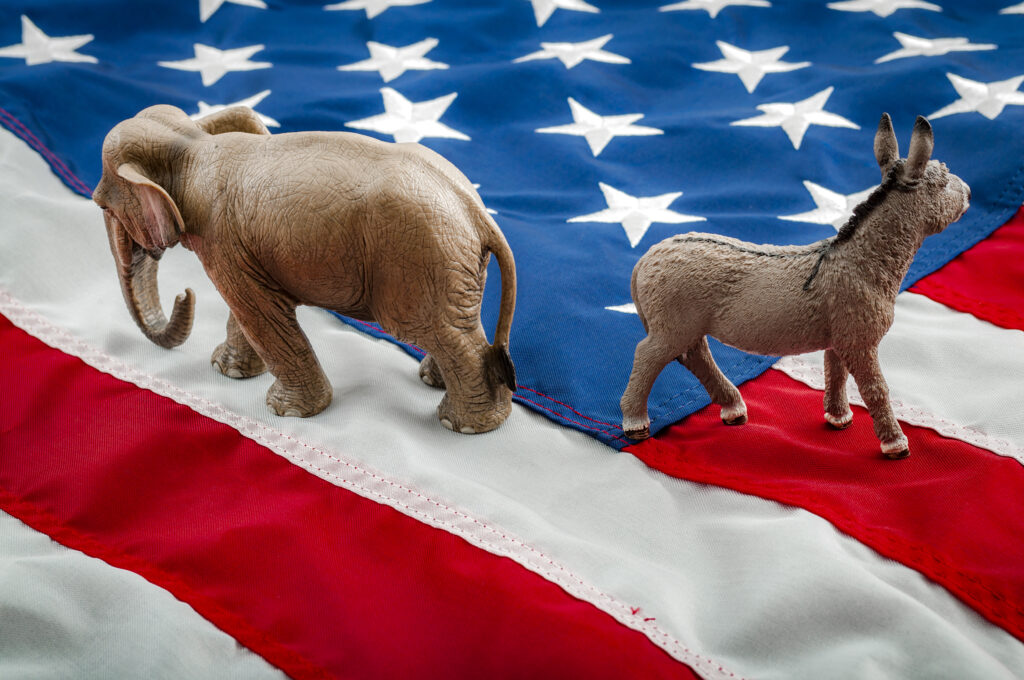
From the 1930s through the early 1960s, roughly half of Americans described themselves as liberals. But in the decades that followed, liberalism has suffered near-continuous reputational decline. The critics, rivals, and enemies of liberalism sought to redefine its public image downward, and nearly all succeeded.
Among these opponents were the conservatives around William F. Buckley Jr., who attempted to portray liberalism as a combination of militant secularism and socialism or even communism; while a majority of Americans didn’t buy this definition, Buckley and his confreres succeeded in equating liberalism with leftism, to the point that more than half of Americans tell pollsters that the Democratic Party has become “too liberal.” But actual left-wing critics felt that, on the contrary, postwar liberals had betrayed the radical potential of the New Deal and smothered American society in corporate capitalism and conformist consensus. Black civil rights activists, for their part, came to feel that white liberals were treacherous allies, unwilling to push for true equality if it would threaten their own power and position.
Kevin G. Schultz, a professor of History, Catholic Studies, and Religious Studies at the University of Illinois at Chicago, has researched the descent of liberalism’s reputation across the latter half of the twentieth century and up to the present. Why, he wonders, “have so many people come to hate white liberals, including, perhaps, even white liberals themselves?” He describes this history in his new book, Why Everyone Hates White Liberals (Including White Liberals). In this podcast discussion, he concedes that liberalism set itself up for criticism in many ways, but nonetheless concludes that liberalism did not fall of its own weight – it was “assassinated,” as he put it, by its political opponents, who “recognized they could defeat liberalism in America… not by attacking its politics or policies, which generally remained popular,” but instead by “giving it meanings no self-respecting liberal would accept but from which they couldn’t successfully escape.” And by mocking the people who upheld that philosophy, the white liberals, the critics gave the word “liberal” so much baggage that the concept of liberalism could no longer be defended — to the point that Schultz now feels the very term should be abandoned.
We welcome your thoughts on this episode and the podcast as a whole. Please send feedback or suggestions to vitalcenter@niskanencenter.org
Transcript
Kevin Schultz: So I do think there is this sense that there was a version of liberalism that could still be a rallying cry. But it’s attained so much baggage that there’s sort of this conundrum that we find ourselves in, where people want to reclaim this sensibility but they don’t have the words by which they can do it.
Geoffrey Kabaservice: Hello! I’m Geoffrey Kabaservice for the Niskanen Center. Welcome to the Vital Center Podcast, where we try to sort through the problems of the muddled, moderate majority of Americans, drawing upon history, biography, and current events. And I’m delighted to be joined today by Kevin G. Schultz. He is a professor of History, Catholic Studies, and Religious Studies at the University of Illinois at Chicago, where he has also served as chair of the Department of History. He teaches twentieth- and twenty-first-century American history with a focus on religion as well as American intellectual and cultural life. He is a past president of the Society for US Intellectual History, and is the author of several books including Buckley and Mailer: The Difficult Friendship that Shaped the 1960s and, more recently, Why Everyone Hates White Liberals (Including White Liberals):A History, which was published in May 2025 by the University of Chicago Press. Welcome, Kevin!
Kevin Schultz: Thanks for having me, Geoff. I’m glad to be here.
Geoffrey Kabaservice: I appreciate your coming on. And congratulations on having written a wide-ranging and thoroughly enjoyable history of liberalism as a category and concept in American politics.
Kevin Schultz: Hey, coming from you, that’s high praise. I’ll take it. Thank you for saying those nice words.
Geoffrey Kabaservice: I mean it! And it’s also a hugely entertaining discussion of the way that white liberals in particular have come in for praise (for a while) and abuse (mostly) over the decades.
Kevin Schultz: I know the abuse part is definitely more fun, even if it’s hugely problematic at tampering with the Vital Center — as you call it on this podcast — of American political life.
Geoffrey Kabaservice: I’m one of what I’m sure are a lot of people who laughed aloud when I read your title. And listeners won’t be able to see this but, amusingly, the cover of your book is reflective, like a mirror, so that your presumably white liberal readers will be able to see their reflections in the cover and wallow all the more in self-loathing.
Kevin Schultz: I thought it was brilliant. I love the cover. I approved it, but I didn’t come up with it. I’ll give all credit to the University of Chicago press design team. But that it’s reflective… I’ve seen people look at the cover of the book in bookstores when I’m giving talks, and I can watch it dawn on them what the cover is trying to say, and then they start laughing. So it’s working. It’s working.
Geoffrey Kabaservice: It’s a real innovation. So let me start by asking then: Why the title? And given that it’s in the present tense, what was the historical contribution you were seeking to make to this dialogue around liberalism and its reception?
Kevin Schultz: Well, the title — Why Everyone Hates White Liberals — is obviously a little bit snarky. As an academic, we’re supposed to be a little bit more careful in the words that we use. And I get that, but I also was struck — and I stand by this title in a lot of ways — that even when people come up to me and say, “But I don’t hate white liberals,” I guess they have a point: not everyone hates white liberals. But I was struck — like probably many listeners to this podcast and certainly many Americans — by the extreme polarization that we have in our life that certainly affects and infects our political ability to get things done. But it also has trickled into realms of our life well beyond the political. They’re in our social. They determine what neighborhoods we choose to live in. They determine sometimes what jobs we choose to accept and certainly the companies we want to work for. I read a story a couple of years ago about how dating apps have included your political preferences, and so some people won’t date across the partisan line. And while that might make sense, I was just struck by the way that this polarization in American life has trickled down to extend well beyond policy into everyday lives of Americans, making those fabled Thanksgiving dinner talks so much more difficult for so many more Americans.
So this was my current-day obsession, concern, interest. The fate of democracy is important to me. And as a historian, I had written several other books on earlier parts of the twentieth century: the early parts of the twentieth century, the middle decades of the twentieth century into the 1960s and ’70s. And part of one of the themes of the book was moments of creating a narrative of what it meant to be an American, of what the United States stood for and what definitions fit under that meaning.
And so — to use just an example to put some meat on the bone here — the first book that I wrote was called Tri-Faith America — so of the three faiths. The three faiths in my title were Protestants, Catholics, and Jews. And that book told the story of a bunch of rabbis and ministers and some Catholic priests who came together in the late 1920s and 1930s, and they looked out at the American society at the time and they saw an increasing conservatism and a strong notion of a narrowing of what it meant to be an American. Of course, the biggest social movement of the 1920s was the Ku Klux Klan — still one of the largest social movements in American history, this 1920s version of the Ku Klux Klan. And I should say that that version of the Klan certainly hated Black people, but they also hated Catholics and hated Jews and hated foreigners and hated immigrants. They were equal-opportunity haters. But what they were doing was putting forward a narrative and a definition of the United States as a white, Protestant, predominantly Western European nation.
And so my Catholics, Protestants, and Jews, in the story that I told, were trying to put forward a different vision of what America was: one that was religiously tolerant, one that was inclusive of differences. Because they were writing in the ’20s and ’30s, they were conscientious of the stark color line that existed in American life. And so they thought a more efficient (and for them frankly more personal) way to imagine what was American diversity was to put it in religious terms and so see that it could be between Protestants, Catholics, and Jews. And this more pluralistic vision of the United States won out in the 1930s and of course in the 1940s, when we were defining ourselves in opposition to Hitler and Hirohito. And it became “the American Way of Life” in the 1950s and ’60s.
And I was struck by the fact that a lot of this was done under the rubric of the word “liberalism.” And it was the liberal way of life, the liberal form of government that really came to power in the 1930s, ’40s, and ’50s. It was much more capacious than religious inclusivity. But nonetheless, it was this moment, my books had taught me, where Americans had been less polarized. Sure, there were political differences. Sure, there were disagreements in the 1930s, ’40s, and ’50s. But there was a sense of an order which Americans (both Republicans and Democrats) lived under, and they labeled that liberalism.
My next books were about the ’60s and ’70s, which was the breaking apart of this moment. If you fast-forward that to today, we see a complete breaking apart of any centrist notion and a rise in especially the amplified volume coming from the extreme right and the extreme left. And one thing that they all can agree on, it seems to me, is that they all hate liberals: the white liberal is a horrible person for reasons X, Y, and Z, which I get into detail in the book.
So my title, to get back to your question, is certainly snarky, and it’s meant to be provocative. And as you said, you laughed out loud, which makes me happy to hear that. But I also did want to get at this very real problem that once upon a time, in the not too distant past, there was this strong centrist tradition in the United States. Of course, one of the adherents of this and one of the describers of this tradition was Arthur Schlesinger, Jr., whose famous book on this was, as you well know, The Vital Center. So I wanted to talk about that tradition and see how it came apart, to the point where we are today where there is no way to defend a centrist tradition in American life. And all we hear (or what we mostly hear) are the amplified visions of the polar extremes on the left and the right.
Geoffrey Kabaservice: Certainly your mention of the centrist tradition appeals to the theme of this show. And I do think it’s really a key insight of your book that how one defines a white liberal is really a kind of Rorschach blot test of one’s own political allegiances. And indeed, you trace the history, over the course of your book, of how white liberals come in for contumely from Buckleyite conservatives, 1960s left-wing radicals and protesters, Black civil rights activists and militants, satirists like Tom Wolfe, populists like Spiro Agnew, artists like Jean-Michel Basquiat, intellectuals like Michel Foucault, conservative Republicans like Ronald Reagan, relatively moderate Republicans like George H. W. Bush, Rush Limbaugh and the Fox crew, and even to some extent New Democrats like Bill Clinton. It’s a long list.
Kevin Schultz: You took us through the greatest hits of the book right there. And that’s one of the things that really struck me was watching this expand beyond just a political definition into someone like Jean-Michel Basquiat, who’s painting, of course, in the 1980s. He’s the radical Black hip street artist that everybody wants a piece of. He’s twenty-one years old and he’s world-famous, dating Madonna at the time. It was a very fast rise for him. And one of the things that he felt uncomfortable with was that now he was a commodity. And who did he see profiting off of him? Well, it was the liberals. And he began several paintings, but one in particular that I describe in some detail in the book, about the capricious halfway friendship of liberals. Those are not really those wealthy conservatives who are trying to buy the Black street artists and put their pictures on the wall and have them paint what they want to paint. But they’re someone who’s in-between: who’s pretending to be understanding of what’s going on, but not really putting up a strong defense, in Basquiat’s vision, of Black radical freedom.
So this extended well beyond Ronald Reagan harping on the dreaded “L word,” which George Herbert Walker Bush picks up on. It extended into realms that I was frankly surprised by. I think it gets at why there is this generalized hatred and even anger towards liberals today. And it’s not just because they’re politically weak, but because they’ve taken on all of this baggage of an image of everything that might be wrong with modern society. So in the hands of their enemies, the definition of what a white liberal is has grown and grown and grown and grown to be elite snobs, to be woke snowflakes, to be people who are just the beards of capitalists, they’re not really putting forward any policy. They’re under attack for who they are as much as what they believe.
Geoffrey Kabaservice: Part of the reason that talking about your subject is confusing is that there are different concepts sloshing around inside the same words, liberal and liberalism. You begin your book with an inspired bit of etymology. Can you tell me about the historical meanings that liberalism had accrued in the years leading up to Franklin Roosevelt, who in your telling really redefines the word?
Kevin Schultz: In the American sense, he does redefine the word, yes. And I say “American” for good historical reasons, just to make sure that’s on the record. But yes, the word “liberalism,” like all really difficult and important words, goes through several iterations in its long several-hundred-year history. It derives from the Latin liber, which means freedom (or free, actually). And it becomes a catchphrase in a lot of ways for how individuals can enhance or grow their individual freedoms in the face of oppression.
During Shakespeare’s time — 500, 600 years ago at this point — the word didn’t have that meaning completely. It meant a generosity of spirit or even a financial generosity. One illustrative example of this is that this the birth of what many of us who might be listening to this podcast called and got when we got our “liberal arts” education. That was in opposition to a “vocational” education. Vocational education is where you get your training to be an electrician or a plumber or whatever specific profession you are going into. And in opposition to this, you have a liberal arts education (or a liberal education), which suggests that there is value in a broad depth of understanding in things that might be far afield from your profession, including literature or political science or philosophy or the arts or economics, whatever it is. So it does mean this broadening and this generosity and this expansion of humanity in a lot of ways.
It takes on this more foundational “free” definition, though, in the centuries that follow. And in the seventeenth and early eighteenth century, the word “liberal” gets affixed to… It’s about enhancing individual freedom against what is perceived to be the power-holders in society. And in Western Europe at the time, the power-holders were deemed to be the church, and especially the Catholic Church. And so to be liberal meant to be embracing religious freedoms, religious tolerance. So a liberal in the seventeenth century was mostly one who was eager to encourage individual freedom in the face of the religious oppressors. It was about religious tolerance.
In the eighteenth and nineteenth centuries, the oppressors are no longer so much the Church but what has taken over the place of power of the Church, which is the monarchs and the nation states. And so for liberals, in this new concept in the eighteenth and nineteenth centuries — the time, I want to add, of the American Revolution and the French Revolution — to advocate individual freedom is to oppose monarchy. So this is where you get liberals demanding a system of rights, a system in saying who it is that we are governed by, a system that gives individuals an opportunity to change the leaders without having to resort to war or anything like that. So liberals become more politically inclined.
Importantly, in this moment when there’s an opposition to monarchy, liberalism also embeds itself with mainly small-market capitalism, because the small-market capitalists can oppose the monopolies of the kings and queens, and this becomes an avenue for individual freedom. So liberals in the late eighteenth and nineteenth century are primarily about advocating individual freedom — that root word of liberalism. They’re advocating individual freedom over the political monarchists — the “kings and queens and guillotines,” for any Aerosmith fans who might be listening — and they do so through a demand for political rights, but also a demand for economic freedom, small-market capitalism, to push back against monarchical monopolies.
Eventually, by the late nineteenth century, we have this thing called the Industrial Revolution. We get the rise of big business, we get the rise of the oligarchs, the famed Rockefellers and Mellons of the late nineteenth century, and liberalism then once again shifts definition. Now, of course it keeps that bedrock foundation, as liberals are advocates of individual freedom against whatever it is that is trying to hold power against them. But the power has now changed hands once again: from religious in the seventeenth century, to monarchies in the eighteenth and nineteenth centuries, to oligarchs in the late nineteenth and twentieth centuries.
So that’s when liberalism gets redefined in the way that we see it in some of the early parties in Europe, especially; this is when the British Liberal Party gets formed. And the liberals are advocating a pushback against the power of the oligarchs. This is when the liberals start demanding the use of the national state or the local states to ensure individual powers and individual rights against the power of big business. So you get to see some mandates for public education, so that education becomes a resource for all and not just the wealthy. You begin to see things like workers’ insurance and injury insurance and child labor laws. You get to see early healthcare systems, although they take a couple of decades to come into place in the way that we might understand them today. You get to see pensions for veterans and things like this. It starts in Europe more quickly, and under the banner of the word “liberal.” The first liberal parties are started in 1809 in Sweden and in Spain. And, of course, the British Liberal Party starts in the middle decades of the nineteenth century, and it embodies this vision, this new version of what a liberal is.
This doesn’t happen in the United States, as far as the word does not get picked up in the nineteenth century in the United States. There are several reasons for this. One, we have what’s coming to be called the Progressive movement, so the Progressives take on the mantle of this movement, this ethos. And also, because the various popping-ups of liberalism in the United States under that language have a lot to do with anti-Catholicism and pushing back against the power of the Catholic Church in the United States, a lot of American politicians are a little bit nervous about grabbing onto the language of liberalism like they had done in Europe — because they didn’t want to be associated with the radical secularists or atheists that were most ardently pushing back against the power of the Catholic Church in the United States.
So there is no real liberal party in the political life in the United States until — to get to your question again — 1932, when Franklin Delano Roosevelt is running for president in the depths of the Great Depression, when we have 25 percent unemployment — 50 percent in cities like mine in Chicago and a lot of the manufacturing cities up in what is now the Rust Belt but was the manufacturing belt of that era. And he wants to propose this vision of a government-sponsored curtailment of the power of big business, a sense that the government has a responsibility to help people go back to work, to provide jobs in some capacity for American citizens (especially the unemployed), to basically create a floor by which most Americans would then be freed from the power of the big businesses, which have in a sense caused chaos through the mechanisms of the Great Depression. He’s weary of being labeled as a socialist or a communist — which of course he is [labeled] — and so he’s fishing around for a word to use to describe this political philosophy. And in the summer of 1932, giving a speech while running for the Democratic nomination for president, he falls on this language that “We must be the protectors of liberalism.” And that language strikes a chord with his audience. And from this moment on, he starts grabbing the word “liberalism” as the way to define his political philosophy that he is putting into place in the United States for really the first time.
So it has this whole tradition that goes back to Shakespeare’s time that I get to tell in my book. I probably spent more words talking about it right now than it appears in the book. But it keeps that core notion that what a liberal is really is the preservation of individual freedom over the power-holders in society, and whoever those power-holders are deemed to be is what liberalism is going to fight. And that means that liberalism has gone through several iterations of where its force has been placed. So it’s not a single policy, but it is a spirit, an idea that will change policies and change political objectives depending on who it is that is holding power in the country.
Geoffrey Kabaservice: That’s extremely useful historical-political detective work, Kevin. But there are pluses and minuses to defining liberalism as something that changes with the political context versus something that has a relatively fixed philosophical identity. Liberalism, as you just described it, does have its origins mainly in Europe, starting in the eighteenth century if not earlier, but it does reduce to somewhat core principles of individual freedom, political pluralism, and the rule of law. And these are principles that have been held by people on both the political left and the right at various times in various places. Cass Sunstein, for example, in his recent book on liberalism, defines a liberal broadly as someone who believes in the philosophical liberalism of a kind that would be comprehensible to English philosophers like John Locke or John Stuart Mill or the authors of The Federalist Papers. And there’s a certain economy to that. But your book isn’t defining liberals or liberalism that way, which is presumably why you don’t really engage with critics of philosophical liberalism like postliberal philosophers including Patrick Deneen, or Catholic integralists like Adrian Vermeule, or proponents of illiberal democracy like Hungary’s Viktor Orbán.
Kevin Schultz: Well, this is true, partly because my book is about the changing iterations, especially in the American political and political philosophy context, and how it has been put into practice as opposed to the philosophical core of what you’re referring to, which is this political notion that is grounded in Western Europe beginning in the eighteenth and nineteenth centuries. Of course, many people in the eighteenth and nineteenth centuries whom we now describe as the founding fathers of liberalism never used that word “liberalism.” They didn’t call themselves liberals. So we are ourselves imposing a linguistic framework onto them that we are seeing more today. And the critics like Patrick Deneen that you’re referring to now are responding to that one fixed moment of when liberalism came to mean what it meant, at least in the context of a certain philosophy.
My book is more about the changing definitions that have happened since then, not just in a philosophical foundational principle but in the way that it’s been used and abused in American political and even political-philosophical life. So I cede you… You are correct in your criticism there. But I think there were really interesting and good reasons for me doing that. One last thing that I’ll add is that in the last seventy-five years where it’s been mostly but not entirely people just piling on — “dunking on,” as the kids say — dunking on liberals, owning the libs, this has been the large push that we’ve seen in American political life for the last seventy-five years.
And I do think that that has hampered the ability of the philosophical liberals to make a solid case for liberalism. Of course, Rawls himself put forward maybe one of the most compelling and important — whether you believe it or not is an open question — but important cases that people have to grapple with. I think Cass Sunstein is, in his most recent book that’s now only a couple of weeks old, trying to carry that forward, but he comes up with 85 separate principles of what liberalism is. And so he’s embracing this broad, capacious definition in a lot of ways, and what he’s doing by doing that is accepting a lot of the baggage of what other people have piled onto what liberalism is.
So while I cede your point that yes, there is this philosophical liberalism that has those principles that you defined, I think because of the word’s history that I describe in my book, the past hundred years of piling on the libs has made it much more difficult for the philosophers to actually identify a singular liberal philosophy.
Geoffrey Kabaservice: That’s plausible. Nonetheless, the fact remains that Franklin Roosevelt, as an extremely talented politician, was able to sell his definition of liberalism over contending or even philosophical interpretations of that term. So the conservative diehards want to say that the New Deal is this revolutionary departure from American political practice, which comes very close to (or even goes over into) alien doctrines like socialism or communism. Whereas Roosevelt, it seems to me, is both saying on the one hand, yes, this is radicalism, but it’s also a kind of centrism, as you were saying earlier. How do you think he succeeds in squaring that circle?
Kevin Schultz: I think he does it because, like you said, for several reasons… He’s a masterful politician in a lot of ways. And the country was really looking — in 1932, in the depths of the Great Depression — was looking for a political philosophy of action that was going to at least put into play a new philosophy, a new kind of governing that was going to respond to the needs of the citizens and the needs of the time. I also think he was helped by the geopolitical unfoldings that were going on in Europe. 1932 was only fifteen years after the Russian Revolution and the seeming march of communism, which was occupying a lot of the imagination of the United States’ political class and prompting a lot of fears after the Red Scare of the 1920s. So you see this fearmongering (with some justifiable reason) on the left. And on the right, you’re also watching the authoritarian governments start to generate a lot of momentum throughout Europe — of course, most famously in the rise of the Nazi Party in Germany, and we know how that story goes. But these are the rumblings that people are seeing at this time in the United States.
And so they are looking for a centrist philosophy that is not going to lead them all the way to the Russian Revolution, but also not going to mandate a rise of authoritarianism that’s going to force them to give up the political rights that they seemingly, in the narrative of the American past, have fought for ever since the revolution of 1776. So he is able to use the language of liberalism to find this “Vital Center,” as Arthur Schlesinger calls it a couple of years later. He uses this language to describe this position, and because he successfully positions it between the extreme left and the extreme right, he’s given large leeway in pushing forward programs that might be well beyond the historical norms (or are well beyond the historical norms) in the American past. But the American population supports him for it, partly because of the reasons that I’ve explained: the depths of the Great Depression, the demands for an activist president, and the fears of both the extreme left and the extreme right.
Geoffrey Kabaservice: Yes. I was reminded, in reading your definition of New Deal liberalism as a kind of philosophy of balance, I was reminded of FDR’s own address to the New York Democratic Party in Syracuse in I think 1936, where he on the one hand said, “This administration is not contaminated by any foreign isms. It’s rooted in the letter and spirit of the American form of governance.” But he also quoted the British politician and writer Thomas Babington Macaulay, who had said, “Reform if you would preserve.” And I remember the phrase where FDR refers to the saying: that “wise and prudent men, intelligent conservatives, have long known that “in a changing world, worthy institutions can be conserved only by adjusting them to the changing time.” And, he concluded, “I am that kind of conservative because I am that kind of liberal.”
Kevin Schultz: Yes. Every historian from the very first historian of the New Deal (or one of the first historians), William Leuchtenberg, all the way to Jason Scott Smith’s recent book on the New Deal — they all describe this as reforming capitalism. He’s not trying to bring about a new system of economic relations. He’s not trying to push capitalism out of the way. But what he’s trying to do is regulate and reform capitalism in order to preserve and save it. I honestly think — and he said so, not quite in these words — that capitalism was the least worst way to set up your economic life. And having a regulated capitalism was the way to prevent the oligarchs from obtaining too much power and weighing their hand on the scale of history too strongly at the basic cost of the workers and the general middle class of the American polity.
This is exactly right, what you’re saying. He is mostly a very dramatic and creative reformer trying to a buttress a system that he thinks needs correcting, and not throw it out completely. I think there are a lot of claims that Roosevelt is this incredibly radical figure — and in some ways he is. But that is because he’s radical in the ways that he reforms capitalism, not in the ways that he really wants to overturn it or remove it completely from the system.
Geoffrey Kabaservice: It’s worth underscoring here, as you well know, that Roosevelt’s Democratic Party dominated American politics but also its social and cultural life for decades. The Republican Party in Congress was really reduced to a rump. But even within that rump, quite a number of Republicans supported major pieces of New Deal legislation. George W. Norris, who was a Republican senator from Nebraska, supported the New Deal because he saw it as being very consonant with the progressivism of Theodore Roosevelt’s era. And his name attaches to some of the major legislation that deals with the creation of the Tennessee Valley Authority, for example, rural electrification, unions and so forth.
But the dominance of liberalism as a political philosophy I think can be compared to the dominance of the United States as this colossus that emerges from World War II with all of its potential competitors left prostrate. And eventually they recover, and eventually alternatives to New Deal liberalism recover, and New Deal liberalism is left as the establishment. And if you’re against the establishment, then you’re kind of in the situation of Marlon Brando in the early ’50s film The Wild One: “What are you rebelling against, Johnny?” “Whaddaya got?” And what you’ve got, in this case, is New Deal liberalism.
Kevin Schultz: Yes, that’s true. And that is the seed of all the attacks that I get into from Chapter Two onward in my book. Everybody’s attacking New Deal liberalism as a way to create and broaden the pathway for their own movements, whether it’s a conservative movement or a more radical leftist, democratic-socialist movement, or greater egalitarian movements for equality coming from civil rights advocates, women… It continues and continues. And you’re exactly right.
And I would add to your point something else that’s really interesting… We’ve talked a lot about the amoebic definition of liberalism and how it changes with the times. And liberalism does what liberalism does. When New Deal liberalism had basically succeeded… When FDR was creating New Deal liberalism, he was trying to rebuild the middle class and buttress capitalism and create opportunities for Americans to perceive that there is this economic floor below which they cannot fall, and from which they are able to (if they want to) jump up and succeed and develop and grow and prosper as they wish.
But for a variety of reasons … You mentioned the foreign reasons, of course: the aftermath of World War II, the incredible spike in manufacturing that happens during and after World War II… You talked about how New Deal liberalism became the way, and Republicans embraced it too. I read Rule and Ruin, so I know how that story goes. But of course, Eisenhower, when there’s a blip in the economy in 1956, he increases the money to the military so that they can invest in McDonnell Douglas and the aerospace industry, and that money will then bleed out into… So there’s the government once again giving contracts to private business so that they can grow their businesses. But my point is that what happens in the 1950s is that those “common men” who were falling below in the depths of the Great Depression, some of those 25 percent of Americans who were unemployed — by the 1950s those very people who had needed New Deal liberalism had taken advantage of New Deal liberalism and things like the G.I Bill that came out of it and came out of the aftermath of World War II. They were now solidly middle-class citizens. And now New Deal liberalism is through the G.I. Bill, for instance, building the suburbs. This is not mandating a Moscow apartment, this is building suburbs with white picket fences and a culture of conformity.
So liberalism once again has to shift in the 1950s and ’60s. Of course, we can keep the idea that it’s going to have this floor; Arthur Schlesinger called this “quantitative liberalism.” But by the late 1950s and 1960s, there was less need for quantitative liberalism, especially for white people — we can get into later why other populations are left out and how they respond to this. And they shift their version of liberalism to being not just providing this economic floor, but going for something that Arthur Schlesinger calls “qualitative liberalism,” whereby the idea is not just to provide a certain quantity, a certain economic bare minimum, but now let’s enhance the quality of life. And of course, the definition of quality of life is different for every single American, but the definition that gets endorsed by the liberals of the 1950s and ’60s is one that is really premised on this white middle-class expectation of having a college education, of having highway beautification, having housing for all.
And so in the midst of these emerging critiques that we were talking about of liberalism — if you’re not for us, what are you against? Or if you’re not against us, what are you for? — In addition to that, they don’t do themselves a lot of favors by jumping from quantitative liberalism to qualitative liberalism, where they’re using government money to try and push everybody into living a certain quality of life. And that opens up the floodgates for critique even wider.
Geoffrey Kabaservice: Yes, I think that’s an astute explanation. A broader explanation, as you write in your book, is that the reason there is this eclectic and catholic hatred of white liberals “is that it was an assassination,” you write. “It was cold-hearted, deliberate, and designed to transfer power in America. … And the way many people recognized they could defeat liberalism in America was not by attacking its politics or policies, which generally remained popular, but instead to affix idiosyncratic definitions to the term, giving it meanings no self-respecting liberal would accept but from which they couldn’t successfully escape.” And by mocking the people who upheld that philosophy, the white liberals, the critics gave the word “liberal” so much baggage that the concept of liberalism could no longer be defended.
Kevin Schultz: Yes. That was a fun phrase to write, right there. And I think it’s very true. I think it’s interesting that using that language of assassination works rhetorically. But seeing the rise of political violence in the United States in the second half of 2025 is startling, to be associated with that kind of language. But I do think that this sense of quantitative and qualitative liberalism, which I just spent some time describing there, it did open itself up to critiques. And those critiques came from all aspects. They came from the right, they came from the left, they came from civil rights advocates. And they were pushing liberalism for its weaknesses and for its inability to live up to what it promised. And more than that, pushing beyond that, it then, as I said in that sentence that you read, it then shaped its own definition of what liberalism was.
So to give an example, so that we’re putting some more meat on the bones, to use that phrase again… People like William F. Buckley Jr. on the right, as he’s trying to bring together, to fuse together the various factions of the conservative movement, which had been very splintered in the 1930s and 1940s and 1950s, he was looking for a common enemy that would help bring these groups together. Of course, he famously did that by looking for an external enemy, which was the Soviet Union and communism more broadly speaking. But at home, he found that he got a lot more traction and got a lot more people interested if he could slay the centrist party that was in power in the United States, and these were the self-described liberals.
And how he criticized the liberals in the 1950s and 1960s, all the way onward in the ’70s and ’80s, was by saying that they were belittling the two C’s, Christianity and capitalism. And in his rendering, they were opening the door for moral disorder by eroding Christianity’s prowess in the United States specifically and in the Western world more generally. And also they were just closet socialists who were trying to bring about the communist revolution in the United States. This is how he interpreted liberals.
And in 1959… I know you had Sam Tanenhaus recently on your podcast, the great biographer of William F. Buckley Jr. But Sam and other biographers of William F. Buckley Jr. are startled by the fact that Buckley’s most impassioned definition of what this conservative movement is going to be comes in this 1959 book, which is called Up From Liberalism, which is a direct parallel to Booker T. Washington’s Up From Slavery, although William F. Buckley Jr. doesn’t say that. But what he’s doing quietly is paralleling nineteenth-century chattel slavery with mid-twentieth century American liberalism. That’s the parallel that Buckley is trying to create.
And in that book of 229 pages, 217 of them are spent excoriating liberals by name and by policy. And the thesis is not that there’s going to be some conservative revolution and here are the principles, but instead: We need to stop the march of liberalism because liberalism will destroy Christianity in the United States, but more damningly it will erode the capitalist order and bring about a communist revolution. So people on the right start affixing liberals as quasi-communists; they’re socialists who are just going by different names. Now, no good liberal would own up to that definition. They would say, “That is not at all what we’re trying to do.” But nonetheless, that is the argument on the right.
On the left, at the exact same time, you have guys like Irving Howe or Norman Mailer or Saul Alinsky, and they see the centrist liberalism not necessarily as bringing about communism — in fact, anything but that. They see liberals as the beards of capitalists; they’re trying to protect capitalism and the foundations of capitalism, and they are foreclosing radical possibilities. When the American Communist Party gets outlawed in the 1950s, Dissent magazine, which is edited by Irving Howe, says, “There’s a fatal blow to American democracy — and it was struck by the liberals.” They had foreclosed the possibilities of the left. They’re defining liberals as somebody who is completely different than William F. Buckley is. They’re actually completely opposite definitions of one another.
And then by the time the 1960s come around and the civil rights movement comes, there comes a Black critique against liberals as people who are basically just bureaucratic fixers. They only are interested in political fixing so that they can garner more votes. They’re not morally embedded in any foundational principles — which is a longstanding critique of liberalism — and so they will only be halfway friends to the civil rights movement, which is demanding a more egalitarian society for Americans white and Black. Liberals, in their telling, get in the way.
Now, self-respecting liberals say, “Hey, we helped pass the 1964 Civil Rights Act. We helped pass the 1965 Voting Rights Act. We helped pass the 1968 Housing Rights Act, the various amendments that come about in the 1960s. What are you talking about that we are not being good enough friends to the civil rights movement?” But what they’re saying, Martin Luther King and James Baldwin and Lorraine Hansberry and Gwendolyn Brooks, they’re critiquing American liberals for not necessarily pushing far enough in bringing about true economic egalitarianism and only doing things that will end legal segregation. So this becomes a critique against white liberals for being halfway friends to the cause.
Geoffrey Kabaservice: Let’s back up a little bit. It’s a slight quibble, but I think you said that Buckley was criticizing the Democratic Party, which he was. But the conservative movement gets started actually as a critique of the Eisenhower administration in the mid-1950s, because Eisenhower in many ways has made his peace with the New Deal arrangements. And actually Ike says that at this point it would be a radical, not a conservative move to take away some of the securities on which the American public has come to depend.
And I think there’s a question about: To what extent does that accusation get traction? So Buckley goes after Yale, his alma mater, for its allegedly insufficient dedication to Christianity and capitalism, but the reality is that Yale in the 1950s is one of the most conservative universities in America, and Buckley’s accusation really doesn’t stick. Nor does his accusation stick to Eisenhower. And both the left- and right-wing dissenters against the liberal order are really relatively insignificant up until the mid-1960s. So what do you suppose allows them to get traction at that point, which is also the point at which more than half of Americans stopped defining themselves as liberals?
Kevin Schultz: Well, several things happen in that moment, one of which I just mentioned: the civil rights movement. And it does seem like there is some resistance from the Democratic Party, which is the harbinger of the liberal movement, even if it is not exclusive to the Democratic Party; the “liberal order,” as we are calling it, continues well beyond the scope of the Democrats. The other one that I’ve already mentioned, that enables this critique to gain traction, is this overly bureaucratic notion of what liberalism is. I described this transition from a quantitative liberalism to a qualitative liberalism. And this qualitative liberalism becomes this gigantic bureaucracy that is seeking to proceed (or at least seemingly proceed) without any narrow mission, but seeming to try and squash all problems and all inequalities. And all of these problems become, in the liberal imagination, the solutions that should be solved by the federal government.
Now, a lot of people in the American tradition, they have no problem with the federal government to an extent. But there is this sense that things that could be solved at the local or state level should be solved at the local and state level. This argument only gains more traction when you add to the equation race, because there’s been a longstanding notion that racial matters should be better left to the states. And this was an argument that of course came out of the South trying to preserve its segregationist status.
I would also say, in addition to this, that you have increasingly unpopular protests against the Vietnam War as it expands, really starting in 1964 and especially in 1965, and then of course growing into ’66, ’67, and ’68. This is when the left and the student protest against the Vietnam War sees liberalism as having this national security edge, which is going to help the colonial adventures abroad and spend American lives for the expansion and growth of American corporate life. So there’s a lot of traction that gets gained by these social movements that emerge in the middle decades of the 1960s, and they open up these critiques against liberalism as having this spent power that is now spiraling out of control and pushing us into so many different directions. So because of this, you get a lot of traction against the liberal order.
Now, the only thing that is more unpopular than the Vietnam War in the second half of the 1960s is the protest against the Vietnam War; people absolutely hate that. This is something that Nixon keenly picks up on, that the only thing more unpopular than the Vietnam War are those protesters who are protesting the Vietnam War. And so both sides can attack liberalism as upholding this war, even as Nixon sees it as embracing and entertaining these protesters. As liberalism grew beyond its foundational definition from quantitative to qualitative, and then as these social movements perked up in the mid-1960s, all of a sudden liberalism got pulled by its enemies in so many different directions, part of which it invited onto itself; I want that to be clear. But nonetheless, it lost all sorts of power.
One of my favorite finds when I was writing this book was in 1968, when you have four different Democrats running to be the candidate for the presidential campaign of 1968, all of them had good liberal credentials. Many of them, as late as 1965, had written entire books called “A Liberal Response to Barry Goldwater’s Conservative Order,” or something along those lines. And by 1968, not a single one of them was calling themselves a liberal. I looked, I read all the speeches. It could be there somewhere; we’re always worried that we missed something as historians. But I could not find a single instance where any of the four Democratic party candidates called themselves a liberal in 1968. They knew that that word had been attacked and assassinated, and it was no longer a politically viable phrase that people would rally behind.
Geoffrey Kabaservice: Actually, I think Bill Buckley succeeded — in a way that would be interesting to see if you could actually get polls to confirm this — but Buckley made liberalism into a synonym for leftism. Contemporary polls will even say: “Do you think the Democratic Party is too liberal?” — that is to say, too far to the left. And yet at the same time, people on the left are attacking liberalism as not being leftism. So there is a sense that the liberals are left in this thankless and hard-to-defend position.
Kevin Schultz: I actually tracked this because Gallup, one of the great polling companies, they would ask Americans: “Are you conservative? Are you liberal? Are you radical?” And because of the success of Buckley and others on the right, by about the 1980s… I can’t remember the exact year, so I’m not going to say it on a podcast where we’re recorded in perpetuity. But about the 1980s, they begin saying, “Are you a conservative?,” and then they introduced this new word: “Are you a moderate” — “or are you a liberal?” And so liberal has now taken on this leftist definition. So Buckley is incredibly successful in pushing liberalism and equating it with the far left. He’s very effective.
What’s interesting in the 1950s is that he was actually fishing for a word that would describe these people. He called them “collectivists” for a while. Some of the fundraising letters that I saw when he was trying to raise money for what became National Review in 1955, some of the letters in ’54 and ’55, he was talking about “This collectivist movement that is taking over and ushering in socialism.” He didn’t care for that, probably because it was too associated with Ayn Rand, who he of course has historic differences with, mostly about her atheism. So he leaves behind “collectivism” and eventually, only in the mid-1950s but especially the second half of the 1950s, “liberalism.” And then he coins this phrase, “the Liberal Establishment,” which we still use to this day. He coins that phrase with a capital-L and a capital-E, referring to the power-holders in America. And he does this really magical thing, exactly what you say, where he equates this centrist philosophy with the left, and it succeeds.
Geoffrey Kabaservice: Let me take a step back here, Kevin, because I always ask people who come on this podcast to tell me something about themselves. So can you tell me something about where you grew up, your interests, your education, how you came to follow the path you have pursued?
Kevin Schultz: Sure, a great question. I grew up outside of Los Angeles. I still love it there, and I still root for the Dodgers — and as we speak, the Dodgers are in the World Series. So I’m staying up late with my children, rooting on my Los Angeles Dodgers and texting my parents back at home. I am a sports fan in a lot of ways, mostly for emotional and physical release as I need to touch grass for my own wellbeing.
I think one thing that people don’t know is a lot of the books that we write, and the things that we’re interested in, come to us because of our own biographies. So at the beginning of our discussion, I talked about my first book about Protestants, Catholics, and Jews finding a way to create a tradition which they called “the Judeo-Christian tradition,” by which we could all have certain principles to oppose a more monistical culture, a monoculture of a Protestant white vision of what the United States was. Well, sure enough, my dad is a mostly secular Jew, my mom is a semi-lapsed Catholic, and I was foundationally interested in how they met and how they could find commonality with one another — and of course that embeds them into history. And so those questions led me into the direction that I started my scholarly work with. I don’t want to say all scholarship is biography, but some of the questions that we ask in our scholarly work do derive from questions that we had to grow up with and that we live with to this very day.
Geoffrey Kabaservice: That’s interesting. Where did you go to undergraduate and graduate school?
Kevin Schultz: I grew up in LA, as I mentioned, going to public schools. I wanted to try something completely different for college, so I got into Vanderbilt University in Nashville, Tennessee. I went to Vanderbilt and experienced the South for the first time in my life, and had a culture shock for sure. I won’t say I fell in love with the South, but there are certain aspects of the South that I found quite charming, of course. And maybe because of some of the friction that I had with the general culture of the South, I grew more and more fascinated and embedded in the History Department at Vanderbilt; they have this amazing history department there. And I got involved in the thesis-writing seminars that they were doing — which is now the Honors Seminar, but it sounds snooty if I say it myself. And that’s when I really fell in love with the archival work of doing history, of touching the signature of people like W.E.B Du Bois and Langston Hughes. This was a project I did — I worked in archives at Fisk University, which is also in Nashville. And just feeling that electric moment when you’re actually engaged with these great minds of the past and you can see how they put forward a future that we’re living with today. And so I fell in love with history there.
Everybody told me that becoming a history professor is an impossible thing, so you should try to do anything else before you try and commit yourself to the academy. So after college, I moved to the mountains of Utah and I got a job making $9 an hour as a ski patroller. So I ski-patrolled for a couple of years in the Wasatch Front mountains of Park City, Utah, and met great friends there that I still have to this day. I wrote for a newspaper and I worked as a mountain guide and sawyer in the summers. I still had this nagging need that I wanted to pursue the past, and I wanted to become a professional historian. So I applied to graduate school and I got into Berkeley, and I ended up getting my Ph.D. from Berkeley.
Geoffrey Kabaservice: I think most grad students would be happier if they’d had some time between undergraduate and grad school to go skiing as an instructor.
Kevin Schultz: No, not an instructor, a ski patroller.
Geoffrey Kabaservice: Patroller.
Kevin Schultz: We had this great rivalry between the instructors who get tips and us who just go and save the people that they didn’t train properly.
Geoffrey Kabaservice: Okay, well done. I actually remember reading your first book on Tri-Faith America. It came to me recently because I was in Philadelphia and I went to what I believe is called the Chapel of the Four Chaplains, referring to the four chaplains aboard the USS Dorchester who were killed in 1943, during World War Two. Am I remembering that they do feature in your book?
Kevin Schultz: This is the opening vignette of my book, yes. They were on a U.S. troop transport ship crossing the Atlantic, and the ship gets torpedoed and is going down. And the chaplain’s job — there are four chaplains on board, two Protestants, one Catholic, and one Jew — their job is to distribute life vests to the soldiers, which they do admirably. And then when they realize that there are no more life vests to hand out, they all look at each other and knowingly recognize what they have to do. They take off their own life jackets and give them to the young soldiers. And then they are seen as some of the last images on the ship as it goes down, huddled arm-in-arm reciting the Shema, the great Jewish prayer about the unity of God. And so this is the image that kicks off my book.
And then the fundraising goes on to create the chapel that you went to, about the celebration of how these three great faiths, Protestantism, Catholicism, and Judaism can come together and idealize the Great American project, and how it was celebrated during the Eisenhower years and during the Kennedy years. And this chapel is a marvelous specimen to this moment of what it means to be an American as this interfaith project. So I’m glad you went there. I’m glad you got to see it.
Geoffrey Kabaservice: Yes, it’s terrific. I think our paths crossed semi-directly about a decade ago when I reviewed your book on Buckley and Mailer for the Los Angeles Times. How did you have the idea of writing that book?
Kevin Schultz: Well, first I want to thank you, because you said it was in the Los Angeles Times, which is something I found out when my mother called me up and said, “Kevin, here’s your book!” And I think it was a two-page spread with images of them, and there you were reviewing the book. So thank you very much for making me look good in my mother’s eyes. You have a special place in my heart for that.
Geoffrey Kabaservice: My pleasure.
Kevin Schultz: That book came about because right after Norman Mailer died… Well, right before he died, he sold his papers to the Ransom Library at the University of Texas in Austin, Texas. And then the papers completely opened up after his death. And the New Yorker actually got a collection of his letters, and they published a couple letters in… I’m guessing that it would’ve been about 2011. That sounds right to me, 2011. And so I was up late and I was reading the New Yorker, and sure enough, I found these letters from the Mailer archive. And one letter between Norman Mailer and William F. Buckley, they went back and forth, and they put this in the New Yorker. And I was struck by this letter where they were not even debating politics, but they were debating whether or not they could get together for a cocktail party, or if they were going to be able to go to the Black and White Ball that Truman Capote was throwing, or something like this. But there was such a spark in the letters, and there was such a familiarity and obvious friendship and respect.
And I was struck by the fact that someone who was “The Patron Saint of the Right,” as John Judis called William F. Buckley — this was before Sam Tanenhaus’ biography came out, of course — someone who was the patron saint of the right, and then Norman Mailer, who was this pugilistic presence on the left, who was famous for drunkenly stabbing his second wife, almost killing her; he was this radical on the left. How could they have this intimate friendship, and what were the bonds that united them? So I thought, “This is a really interesting story to tell. How could we get at the real fissures of the 1960s that happened through a friendship of people who were on opposite sides of the partisan line?”
Geoffrey Kabaservice: It was a fantastic book, and it certainly underlined a theme that comes up in your current book, which is that there is a tacit alliance between the far left and the far right, given that they both hate the political center.
Kevin Schultz: And that’s exactly what came out of the thesis of that book: They both hated the liberal order as they understood it to be. And it’s not too hard to see the threads of this current book, Why Everyone Hates White Liberals, in the outcroppings of that book, where you see the left of Norman Mailer and the right of William F. Buckley finding common ground in opposing the liberal order.
Geoffrey Kabaservice: So let me go back to this question about why liberalism lost its popularity, why the attacks that were made on it from all the different quarters finally succeeded in getting traction. I went back to see my edition of The Vital Center by Arthur Schlesinger Jr. It was originally published in 1949, but this edition came out in 1988, I want to say. And Schlesinger wrote an introduction to this new edition where he basically said, “Maybe it would be more interesting for me to say that I’ve repented of something, but I haven’t. I am still a New Deal liberal.” And he made it clear that he had no patience for the younger generation of historians who even at that point were basically starting to say that the American liberals of the 1940s, by opposing Stalin, had in some way legitimized McCarthyism. Schlesinger insisted that liberalism and communism have nothing in common — not in terms of ends, not in terms of means — and this was furthermore the only principled position a liberal could take. So in Schlesinger’s view, essentially he hadn’t changed, but the people who were nominally on his side had moved away from liberalism as he understood it. What do you think of that viewpoint? How realistic do you think that is?
Kevin Schultz: Well, two things really pop in my head. I don’t think I’ve read this introduction, but the timing is right before he wrote The Disuniting of America, which is a leftist or center-leftist or New Deal liberal criticism of what today we would call “identity politics” and the notion that the left had become too embedded in racial equality and too factionalized in who it was that it was supporting; it had lost great amounts of support from the general population and it was going to lead to a breaking apart of the American project — thus the title of “The Disuniting of America.” And his call, if I remember correctly, in that book was for the Democratic Party specifically and liberals more generally to go back to a New Deal liberalism that was not necessarily singularly tied to racial egalitarianism, but instead was more broadly embraced or encompassing of a broader American population. Now, this is Mark Lilla’s critique that we’ve seen in the last ten years, or I guess maybe even more recently than that. And there are several critiques of this.
So I think Schlesinger… It makes sense what he’s saying, and this critique is not his alone. It is interesting that he makes it as early as the late 1980s. One other really interesting thing is that not only is he not alone in that, but I do think there is a sense, at least in the historical imagination of the United States, that if we go back to this mid-century liberalism — not just New Deal liberalism but also World War II liberalism, in other words before 1960s qualitative liberalism — there is a there there, that Americans rallied behind that. I think a lot of Americans associate the 1960s with Lyndon Johnson, with the crumbling of the American Dream, with a lot of radicalisms on the left in particular, especially when it comes to Vietnam and the more violent demands of the civil rights movement. And so I think especially Democratic politicians, they’re leery to go back to a blanket liberalism. But now they need the qualifier that “I want to go back to liberalism when it was a fighting faith during World War Two, or New Deal liberalism.”
So even someone like Hillary Clinton, who was asked several times when she was running for president if she was a liberal… She said, “Well, liberalism used to mean something that I believed in. It used to mean an economic floor for all Americans. But since then, the term has taken on a baggage that I no longer want to own up to. So I consider myself a good old-fashioned American progressive.” She didn’t say what that was, but that was the label she wanted to fix to her. And of course she didn’t win at any time. She said that in 2007 when she was running for the Democratic nomination, which was actually won by another guy named Barack Hussein Obama, who of course didn’t call himself a liberal either, by any stretch of the imagination. He was the candidate of “Hope and Change,” but not of liberalism.
I do think there is this sense that there was a version of liberalism that could still be a rallying cry for especially the left and particularly the center-left. But it’s attained so much baggage that there’s this conundrum that we find ourselves in — an “impoverishment of language,” I think is the phrase I used towards the end of the book, where people want to reclaim this sensibility but they don’t have the words by which they can do it. So I start off the book… The Introduction is called “It’s Just a Word” — liberalism. And so I end the book by saying it’s time to replace it with something new. I don’t know what it is. I go through a catalog of possibilities, but I’m not in love with any of those possibilities, for a variety of reasons. But I do think it is time for something new, because the baggage is just too heavily placed on the back of liberalism right now.
Geoffrey Kabaservice: Let me return to that point in a second. But it seems to me that you do present liberals in your book as more sinned against than sinning. They are the victims of sliming by their enemies and opponents who try to pin this ridiculous cartoon version of their beliefs on them that bear no relation to reality. But I wonder if that doesn’t let the liberals off the hook a bit too easily.
One of the quotes by Bill Buckley that I don’t think was in the book was his well-known quote that “Liberals claim to want to give a hearing to other views, but then they are shocked and offended to discover that there are other views.” And there certainly were, I think, some justifiable grounds on which to say that liberals do often tend to have this sense that their views are the only valid views, that ideas from the right do not even qualify as ideas; they’re just “irritable mental gestures.” Or they’re so obviously wrong that charges of viewpoint discrimination have to be dismissed out of hand because “We, the liberals, possess the truth and conservatives possess only error.” So there is, I think, a sense that the liberals were led into disarray by some of their own arrogance.
Kevin Schultz: Absolutely. Guilty as charged. I take the criticism of my book that they are more sinned against than sinning themselves, because that is the thrust of the book that I was trying to write. But I do try with various levels of success — I’ll own up to that — to point out not only the philosophical problems within liberalism, of which the primary one is that it doesn’t have a deep foundational belief in the way that a religious person or somebody with a deep-seated religious belief or a deep-founded nationalism, “My country right or wrong,” might have. Liberalism by definition is amorphic, and it’s designed to change, and it’s designed to fluctuate meanings. And so I think that that has hampered liberals from defending a philosophical position that they might otherwise have been more successful at doing.
But to your point, there are plenty of moments when liberals, like you said, took on a notion of what would be easily called elitism, thinking that they were the only ones who had the right answers, and they were subsequently excoriated for that. This led them to take on or support many errant programs; I think most readily of some of the urban housing programs that they embraced that were not successful. But nonetheless, they were not willing to hear critiques of those when they were moving forward and pushing billions of dollars into these projects. So I do think there were moments, and I try and describe a handful of them in the book.
But what comes out more in the book — I think or at least I hope it does, or at least I tried for it — is when in the 1970s and ’80s in particular, a group of one-time liberals and especially people who would call themselves New Deal liberals, tried to reclaim the liberal mantle by owning up to many of the errors of the past. I’m thinking specifically of a character like Daniel Patrick Moynihan, the senator from New York, who of course worked in both Democratic and Republican administrations. He was trying to be a centrist politician, but he also gave speech after speech after speech saying that liberalism, whatever it is, can’t provide the answer to all social problems.
People have to take on a lot more responsibility themselves in order for a government to work. So liberals, by trying to solve all the problems that are in the modern world, have overextended themselves and have pushed themselves into regions where they have no area of expertise, and they’ve created a system by which there are huge amounts of federal dollars going to programs where there is no expertise in the federal government. So then the federal government has to create oversight committees by experts, and those experts are vested interests. Corporations, for instance, are going to oversee agricultural production, and so who are they going to benefit? They’re going to benefit giant agribusinesses. So federal dollars are going to be regulated by agribusinesses. Of course this is going to be hugely problematic where small-time farmers are going to get hosed by the system, and this is going to generate great resentment. So this was an actual example that Moynihan gave to some of the problems of an overachieving and overextending liberalism, where they’re trying to own some of the flaws of the qualitative version of 1960s liberalism.
Geoffrey Kabaservice: I’m sorry that we don’t have time to get more into Moynihan, because he is a fascinating character in many ways, and I agree that he’s trying to rehabilitate liberalism during this time. I remember coming across his 1967 Phi Beta Kappa address, which is interesting to me in that where most of his peers were criticizing the student protest movement as just spoiled rich kids or spoiled brats, he actually was taking it seriously. He actually, I think, called it one of the first movements of heresy of liberalism — because he did believe that liberalism had come to resemble an established church. But in addition to critiquing its overextension both at home and abroad, he also alluded to a problem, which was that New Deal liberalism had been rooted for better or worse in the fortunes of the working class. And increasingly, liberalism became the province of an educated group, and increasingly an educated elite. And one of Moynihan’s criticisms of this new liberalism was that it was becoming elite, rational, academic — and that meant that it actually was seeing older attachments of nationalism and patriotism as unseemly and primitive. And that too distanced it from the working class.
Kevin Schultz: Yes, that’s a fair critique. And that was why he won by almost a million votes when he was running for Senate, because he was able to say exactly what you said and shore up some sense that the working class wasn’t being left behind. One of the interesting finds, when I was writing this book, was that in 1968 all the journalists were covering the election, which of course saw a Richard Nixon victory. And one of the things that these journalists detected was the rise of what they called “the angry white working class.” That’s what they generally called them. But every major periodical in the United States — Time magazine, Life magazine, the Saturday Evening Review — they all wrote articles on the angry white working class, this force to be reckoned with. And they had been embedded within the Democratic Party ever since FDR in 1932 brought them into the fold, if not earlier, and that was more geographically based in the 1920s before Roosevelt helpfully or successfully brought them under the mantle of the Democratic Party.
And by 1968, like you were saying and like Moynihan recognized, they were beginning to feel increasingly alienated. Because the Democratic Party was now a party of the more educated elite — not elitists and snobs, although there was some of that, but definitely the economic and educated elite for sure. One interesting thing that I saw when I was reading all of these articles from 1968 and on into 1969 about the angry white working classes, as they were called, was that they were really up for grabs. It was unclear which party they were going to support, who they were going to vote for. And mostly the thesis that I got out of reading all of these articles was that they really wanted to feel heard, and they really wanted people to push for the kinds of changes that they wanted to push for. And this was the fascinating thing… They were all overwhelmingly — well, not overwhelmingly, but generally supportive of Robert Kennedy’s run for president in 1968. Robert Kennedy had this magical way in which he was going to bring about the civil rights activists of the 1960s and the white working class of the 1960s into a Democratic big-tent party.
When Kennedy was assassinated in Los Angeles by Sirhan Sirhan after giving a speech, that angry white working class, those voters all shifted. But they didn’t shift to anybody that was a Democrat, nor did they shift to a centrist Republican. Instead, they all went to George Wallace. And so the journalists were struck by: “How could somebody go from supporting Robert Kennedy to supporting George Wallace?” And it was the sense that George Wallace was the one who was now speaking on their behalf, who was speaking about their interests.
I was struck by this because as I was doing this research, I was thinking about our old other podcaster, a guy named Joe Rogan, who today is of course the most popular podcaster in America. And during the election of 2020, Joe Rogan supported a guy named Bernie Sanders for president. And in 2024, he of course famously supported Donald Trump. And so how could somebody shift? And I said, “Oh, there’s a historical precedent for this kind of shift.” And it’s because there is this sense that the white working class — or whomever it is, however we want to describe Joe Rogan himself and Joe Rogan’s listeners — wants to feel heard and wants to be recognized, such that they are.
So I think you’re hitting at a very, very, very important point, one that I think started in the late 1960s and carries all the way to today. And this is a reason that liberals — and liberalism less so, but certainly liberals — are having a hard time gaining any traction for themselves, especially under the label of liberalism.
Geoffrey Kabaservice: So just to return to that point, and this will be my final point here… I think for about the past twenty years, a lot of people on the liberal side have been thinking along the lines of the book by George Lakoff, Don’t Think of an Elephant. It’s this idea that “Basically the Democratic Party has a message that the vast majority of the public would believe if only we presented it to them more effectively, if only we framed the idea differently. If only we could defeat the Republicans in the messaging wars!” And there is something to that. But I think the reality is that… Part of the reason that I like your book cover is that I actually do want liberalism to hold up a mirror to itself and take an honest accounting of the way that it has lost popularity, precisely with the working-class listeners to the Joe Rogan podcast.
I know Kamala Harris didn’t go on that podcast for a number of reasons, but one of them is that her handlers were convinced that Joe Rogan had views that were beyond the pale, and therefore you cannot “platform” him by going on his show. But also she couldn’t handle being on a show for three hours without notes, without pollsters, and just say authentically what she honestly believed.
And I think liberalism needs to learn how to recover its old language — well, here I am on language — it needs to recover how it feels honestly about the issues of the whole country, including the working class. My criticism of the liberals is not a tu quoque, it’s not a both-sides-ism to say that Donald Trump, because he comes across as more authentic, is better. He’s not. He’s deeply frightening. But this means that the opposition to him has to be more effective than it has been to this point. And I hope that’s a message that liberals will take from your survey of the ways that their image has become tarnished over the years.
Kevin Schultz: Well, we’ll see. I actually think it’s a really interesting moment right now in October of 2025. I think the Democratic Party itself is at civil war with itself; that’s what a civil war is, of course. I think the centrist Democrats who inherited this liberal tradition, especially as the liberal tradition reconstituted itself in the 1980s and 1990s as a more business-friendly, tech-centered kind of economic arrangement, leaving behind the working class and favoring technology as the economic engine, and that’s where the Democratic Party placed its bets… I think that was a hugely flawed move in a lot of ways because it left behind a lot of the working class. And I think for that reason, it failed. The Democratic Party really failed to answer the financial crisis of 2008, where Barack Obama famously bailed out all those banks without worrying too much about all the homeowners who lost their homes and helping those people out. Well, into this frustration steps a charismatic guy like Donald Trump to speak on those people’s behalf. So what we’re seeing right now is the voice of those frustrated people. The most popular politician in America, if you look at the polls, is Bernie Sanders right now.
Geoffrey Kabaservice: Depends on the viewing, but yes.
Kevin Schultz: Depends on the viewing, fair enough. But I think that if you look at the social democratic tradition on the left, they’re voicing a lot of this anger and a lot of frustration. And we’re seeing it in live time right now with the New York mayoral candidacy of Zohran Mamdani, where he is trying to find the socialist, social-democratic tradition and the liberal tradition. Now there’s this Venn diagram where those areas overlap, and I think he’s trying to articulate that position.
I think the New York Times is pushing hard against him. There was this terrible, horrible op-ed piece in the Sunday New York Times not too long ago, where they declared that moderation is the way to go: “We don’t want any extreme parties.” How they defined moderation was absolutely ridiculous, but this was the centerpiece of their Sunday editorial section. And I thought, well, what does moderation mean? And it was just a plea not to have the radicals take over or whatnot, but I think it was this limp attempt to try and buttress people to support what was this liberalism. But this liberalism has already come into its own criticism and lost its ability to speak on behalf of the American population — something that I try and detail in the last sections of my book.
Geoffrey Kabaservice: I was a big fan of that New York Times editorial, but this is something that we can discuss when we meet up in Detroit for an upcoming conference. Kevin Schultz, thank you again for being with me today, and congratulations again on the publication of your book Why Everyone Hates White Liberals (Including White Liberals).
Kevin Schultz: Thanks, Geoff. It’s always great to chat.
Geoffrey Kabaservice: And thank you all for listening to the Vital Center Podcast. Please subscribe and rate us on your preferred podcasting platform. And if you have any questions, comments, or other responses, please include them along with your rating, or send us an email at contact@niskanencenter.org. Thanks as always to our technical director, Kristie Eshelman, our sound engineer, Ray Ingegneri, and the Niskanen Center in Washington, D.C.
