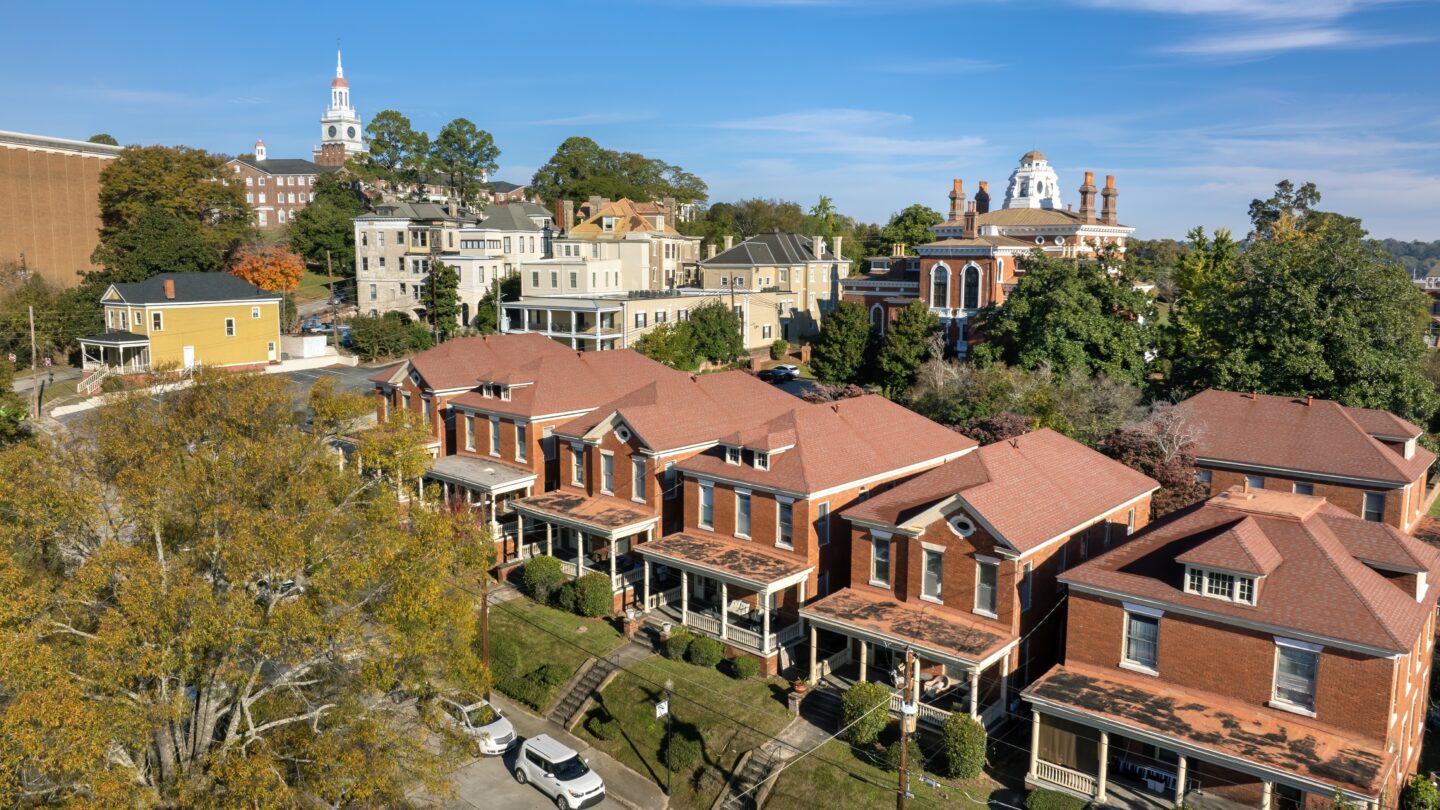
Seth Kaplan had built a career as an expert on “fragile states,” countries plagued by dysfunction and institutional disrepair. But as politics here in the United States plunged into its current time of troubles, Kaplan began to see surprising parallels between his home country and those struggling faraway places he studied. There, countries were still wrestling with the age-old problem of material poverty; here, a deepening spiritual poverty was emerging in the midst of unprecedented material plenty. But here again, he traced problems back to an underlying social and institutional fragility, located this time at the local or neighborhood level. In this episode of The Permanent Problem podcast, host Brink Lindsey and Seth Kaplan discuss the problem of “fragile neighborhoods” — the importance of place, the perverse dynamics that have disconnected us from each other, how top-down bureaucratic and philanthropic solutions fall short by failing to focus on the vital relationships that make communities functional, and how investing in local capacities and encouraging local agency can turn things around.
Transcript
Brink Lindsey: Hello everybody, and welcome to a new episode of the Permanent Problem Podcast. I’ve been away for a few months, but happy to be back today with my guest, Seth Kaplan.
There are other elements in his bio that we’ll get to in just a bit, but the reason he’s on this show today is because he’s the author of the 2023 book, Fragile Neighborhoods: Repairing American Society, One Zip Code at a Time, and out of which has grown an ongoing project of his, the Substack Flourishing Neighborhoods, which he helps to run. So, Seth, welcome to The Permanent Problem.
Seth Kaplan: I’m very appreciative of you inviting me, and I do want to compliment you on the book. So, we’re here because I like your book and I guess you like my book, so I appreciate it very much.
Lindsey: So, we’re living in topsy-turvy times, lots of things that are anxiety provoking and confusing and unsettling. So, lots of downsides, but one of the delights of living amidst this tumult is finding convergence and overlap with people that I didn’t expect to, and who are coming from very different starting points, but who through the commotions of these times, we’ve all been shaken into the same space.
So, in your case, your career started out not looking at the problems of American neighborhoods, but looking at the problems of fragile and failing states overseas. And that’s something you continue to work on and has been a major element of your career. So, let’s start with that, how you got started in that, the places this work has taken you, the kinds of projects you’ve been involved in, and how much you’re still involved in that kind of thing.
Kaplan: So, again, I think my journey started as a wanderer. I had a wandering bug. I spent a summer as a student in Istanbul, Turkey, loved it. After college, I traveled a lot, ended up spending a period of time in West Africa. I got a little more practical and then I spent many years in Northeast Asia and I was even in business at some point, have an MBA.
But at some point, roughly around 30, I said that my real interest was because I had already been in dozens of countries and I had constantly been reading about countries and also, let’s say, political theory about different issues involving how countries work and not work. The topic that most fascinated me was why do some countries do far better than others. And I therefore thought that I wanted to take a plunge into a much more intellectual role or, let’s say, a practitioner-intellectual role because I’ve done both.
And I looked around and said, “Where do you apply knowledge when you’re curious about why some countries work better than other countries?” And this is some years after 9/11 and you see what’s happening with US policy. And so, at least to me at that point, the logical value-add that I could offer people was fragile states. And so, I literally wrote the first book ever published on fragile states, that’s 2008, then started publishing lots of pieces.
To be honest, nobody knew who I was, but I sent my book around. I would go to conferences and within five years of the book coming out, I was teaching at Johns Hopkins. I was doing work for various Washington institutions and then a nonprofit got started, which I continue to help manage all these years later that focuses on conflict prevention, political transitions, negotiations. And so, that started a pathway for which continues to this day for about half my time working on fragile and conflict affected states.
Lindsey: Can you give me a quick definition of a fragile state?
Kaplan: Well, I would say there’s two definitions. There’s the standard definition and then there’s my definition. The standard definition is people look for what’s wrong with the country and if a lot of things don’t work, oh, it must be fragile. My approach is we need to look at drivers. We don’t need to look at symptoms or things downstream. I would say the same approach if you’re trying to figure out what’s wrong with the United States. And so, for me, a fragile state lacks two things.
One, it lacks social cohesion and two, it lacks institutions at the national level robust enough to equitably manage disagreements between parts of society. So, if you don’t have the cohesion within society, you don’t have the institutions, it could be outside of society, but mostly it’s within government, you are going to be chronically unstable, conflict prone, and therefore fragile.
Lindsey: What’s the distinction between a fragile state and a failed state?
Kaplan: So, a failed state is a state in which basically Somalia would be the standard example. Last had a government in 1991. A government failed and there has never been, at least at the national level, at the local level, there are statelets, Puntland, Somaliland, which I spent some time in, and I’ve been to Puntland as well. So, a failed state is basically a place where things no longer work and there’s nothing functioning in a coherent fashion at the national level.
You have a lot of fragile states that never become completely failed. There are different forms of fragility, some on the way to failure, some that simply are just highly chronically prone. But I mean, today you could look at South Sudan, it doesn’t really work. It’s mostly failed, but it’s not like Somalia, which the government controls a piece of a city.
Lindsey: Okay. So, for a medical analogy, fragile states are states that are in the ICU and failed states have coded.
Kaplan: I would say failed states are states that are in the current situation, you couldn’t call them dead, but they’re equivalent of basically they’re not breathing on their own. And so, basically to whatever extent there’s a national government, it’s international aid and to some extent international security and the government exists within a very narrow geography. And a fragile state has lots of problems, can be out of the hospital, in the hospital, out of the hospital, in the hospital.
I think a good example would be Syria. I wrote a chapter on Syria in the 2008 book and Syria, I spent a month in Syria. Syria was the safest place to travel in the Middle East. It was extremely peaceful. You could go everywhere in the country. And yet I included in my book as a good example of a country that it is peaceful, it is quiet, it doesn’t meet your standard definition of fragile, but if anything happens in this country, it will be awful.
And so, sure enough, five years later, I wrote that in 2006-08 and it came out and by 2011-12, it was awful. And that is a good example of a country that it’s not the current situation, good or bad, it’s something more structural. And I’m a structuralist, always looking within society below the ice. And I teach this in my classes. You want to understand countries, you got to look at the 90 percent of the iceberg that is not visible and that will enable you to understand what is reality in a country.
So, Syria would be my example and we can find positive examples, countries that don’t look great on the surface, but are really strong underneath it.
Lindsey: So, like you, I’m what I call a xenophile. Something far away and exotic was always more interesting to me than things that were under my nose.
Kaplan: You’re living in Thailand, it’s proof. It’s total proof. I love Thailand. Great choice.
Lindsey: Yeah. So, the fact that I’m living on the other side of the planet from where I come from is evidence of that. But one thing that happens when you travel a bunch of places, and before this I satisfied my wanderlust by steering my legal career into international trade regulation. So, I spent seven or eight years hopping up and down the Pacific Rim for three or four months of the year. And that’s how I ultimately… that started the path that wound up with me here today.
But anyway, one of the things that happens when you go to a bunch of different places and get these impressions of how people do things very differently from how you do things at home is you start seeing life at home in a different light and you start applying insights from your little epiphanies you’ve had abroad to what’s going on under your nose.
So, tell me, what was the process whereby you went from this xenophilic expertise in fragile states and gallivanting around the world trying to solve faraway problems to thinking, first, that it was time to devote attention to problems closer to home and, second, that things you had learned abroad might be applicable to challenges in the United States?
Kaplan: Well, first as an American, I’m always curious about the United States and I’m always reading about it. However, I never thought it would be part of my career or my professional portfolio, as I like to think about it. Because I’m a believer that careers are good with portfolio approaches.
But around 10 years ago or so, I’m in Washington and I do the Washington thing, meeting people for coffee. It’s how I make connections, a lot of one-on-ones. And all of a sudden, 2015, ’16, and you have some idea what’s going on with American politics and people in Washington are somewhat in a bubble. They don’t quite fully understand or even partially understand what goes on in large parts of the country, but they’re sitting there, they’re watching the politics, they’re wondering what’s going on. And people started asking me, partly in jest, but I think a lot of anxiety there, is the US becoming fragile?
I’m thinking, this is 10 years ago, I’m coming back from Sri Lanka, Nigeria, horn of Africa, I’m like, this question doesn’t make sense. You’ve got these great national institutions, you’ve got great companies, you’ve got national nonprofits. The Constitution has been in force longer than any other similar document around the world. Really hard to assume the US is fragile.
But when the question gets asked, not a couple times, but six, seven, eight times, it makes you stand up and think and ask what does this mean. And so, I started within a year or so… Again, I always look at countries through the lens of relationships, social dynamics. Most people look at policy, politics, and I’m always telling people, you want to understand a country, start not reading the news. Start looking deeper into society for understanding.
Yes, the news might give you some indications or some places to look for, but be very wary of understanding the country through what makes the newspapers. I started, and again, I believe in social dynamics. I started a group in DC. Again, this is probably around 2017, 2018, sometime around then, partnered with someone named Anne Snyder. I had David Brooks involved, Yuval Levin would come, other people would come, and we would just meet every month or so for a social capital luncheon.
Did that for several years. When COVID started, we ended up doing this virtually, which allowed other people to join. And so, we were basically having different people come in and talk about their opinions about the social dynamics and what the problems were.
Somewhere along that journey, I began to understand that what really changed, because if you want to know… Let’s assume that we think something is wrong with the American dynamic, and there’s a lot of problems we have today that we did not have 15 or 20 years ago, and you believe that relationships or something about society is the driver of such problems, it leads you to the question of what has changed.
What was working 50, 60 years ago that’s not working now? If you take that as your lens and you look at society, what you see is at the national level, so many more institutions are there and are strong. The number of national nonprofits, national philanthropies and national companies and the strengths of the corporate sector and material wealth is so much better for so many people.
Of course, you always have areas that are not equally well, but you begin to think that the real problem is not the national, but what has really declined is the local, all the local institutions, the local communities, the smaller businesses, smaller charities, smaller nonprofits, all those things and there’s plenty of data. And it’s not novel that I will argue this.
What I think is novel about the work, as Robert Putnam and many others have commented on this, but what I’ve tried to do, is I’ve tried to take my practical lens, and of course I mostly get paid for my work in different countries, not for being theoretical. We do publish a lot and write things, but for being practical. So, for me, there were two things that were lacking in this conversation. One is a practical framework.
And for me, I bring in the idea that place matters and especially small places, neighborhoods matter, and it gives you a practical framework to see things, to think about things and to come up with solutions.
So, the second big difference is a strong focus on not what the problem is because we have great analysis and I do my analysis and I bring in the data and I show how neighborhoods matter so much and all of that I’ve done in my work, but what I’ve tried to do is focus on what are good solutions, what can governments do differently, what can nonprofits do differently, what can philanthropy do differently and so on and so forth.
And I believe the solutions are there, but we have to find them, identify them, promote them, and that’s really what I’ve committed my time towards.
Lindsey: Well, let me note here the overlap between what we’ve both been up to over the past decade or so. So, my intuition that it’s the tumultuous times that have led to our converging paths is spot on. It was the 2015-2016 earthquake that started my path towards writing The Permanent Problem and wrestling with the ideas that ultimately I put on those pages.
In my telling, we’re victims of our own success, that is we’ve achieved humanity’s oldest dream, which is to conquer or at least marginalize poverty, at least in the advanced countries and we’re making great progress almost everywhere on that front. But then once you do that, once you shove to the side what had been the pressing concern for humanity day in, day out for the overwhelming majority of people, people don’t stop worrying. They start worrying about new things, their expectations get raised, the goalposts get moved.
And so, instead of just wanting survival and they want quality of life, they want flourishing, they want fulfillment, they want meaning and purpose and belonging, not just stuff, not just a roof over their heads and a full tummy. And of course, people always want those things, but they become much more salient once the material needs have been more satisfactorily satisfied.
And so, the way I tell it, this malaise of the 21st century is we’re stuck in this no man’s land between mass prosperity in the advanced countries and mass flourishing, which we now feel we’re entitled to, but aren’t getting. And the central problem that I identify in what I call a crisis of capitalism, and I’m talking about capitalism in its broadest sense as the whole integrated social system, is a crisis of inclusion.
That is, the connections between us are unraveling, and that is harmful to our prospects for flourishing in many, many different ways. We’ve come apart at the macro level with a new class divide along educational lines that has led us to develop very different life courses, depending on whether you’ve got a college degree or not.
And then at the micro level, we’ve got just the unraveling of personal face-to-face connections in all manner of different ways, but the odds of getting married, the odds of having children, the average number of close friends, you have all these things going down. The percentage of people who think they don’t matter, their life has no meaning, they’re not useful to anybody, that’s going up.
I call this the crisis of inclusion. I think you have a much zingier term for it. It’s social poverty. So, when you’re dealing with fragile states abroad, you’re dealing with states that have not yet mastered humanity’s initial problem, that is keeping material scarcity at bay. So, they are struggling with and floundering with what we’ve already succeeded at, which is producing society that gets on top of material poverty.
We’ve done that, but now having done that, we find ourselves slipping into a kind of spiritual poverty, where according to the numbers, Americans should be just in a uniformly great mood, right? We’re the richest, healthiest, best educated human beings that have ever lived. And so, what is our problem? And yet the overwhelming majority of people think America’s on the wrong track and things are going the wrong way and there’s a whole bunch of social wellbeing indicators that are going the wrong way.
And I think that adds up to what you call social poverty. And in your description of it, you’ve upended the old proverb. In this case, the fish is rotting from the tail upwards, right? This is happening at the bottom, at the basic units of society, families and neighborhoods, that’s where you’re identifying problems and now looking for solutions. Let’s just describe the argument in the book.
Just give me a five-minute pitch on the argument of Fragile Neighborhoods, how you’ve set out the problem and then what you identify as what your diagnosis, the big contributors to this social poverty we’re dealing with, and then point in the direction of at least the broad principles that take us in a better direction.
Kaplan: Well, thank you. Yes, there is a lot of overlap in terms of what we’re discussing. Broadly speaking, I identify two problems that have a heavy overlap, but I would call them distinct.
One is basically our society has organized us to live physically in class-based neighborhoods, and those who live in concentrated poverty neighborhoods are extremely disadvantaged because all the overlap of problems accentuates the problems, multiplies the problems, and therefore you have a significant segment of the population that basically walk around every day with heavy weights on their shoulders and it’s much, much harder for them to access opportunity, to find the right institutions, to find stability on a daily basis.
And it’s not just that you and your family are struggling, but that your actual social economic context is highly debilitating. And so, that would be the first thing I would talk about. The second thing I would talk about is across most, not all, but I would say most neighborhoods and most of the population, you have this great disconnection of people, which many people have talked about, but I don’t think we fully understand how big a role the neighborhood plays in this.
When you live in a house and you have no relationships around you, yes, you can pick up the phone. Yes, you can use your wallet. Yes, you can use the app, but it basically increases your daily costs and risks and lowers your sense of security, lowers your sense of, I would say, confidence on some very foundational level, and creates a much more vulnerable and at-risk society because you are disconnected, the decline in belonging, the decline in support networks.
We have tried to think that public support can substitute for your daily needs on a certain material level. Yes, it can, but what we need is something much more broad and deep than that. And many materially well off people are simply much more at risk and much more psychologically, I would say, I don’t want to use the word not well, but not secure and not happy because of their isolation and vulnerability.
And so, both of these can be looked at as a problem of fragile neighborhoods in different forms. In some ways, they’re both forms of social disconnection, one just materially well off and among neighbors. The second one, the neighborhood itself is disconnected from everything else, as well as the problems of the neighborhood are much worse.
If I think of a solution, I’m always thinking, how do we ensure that every American or every person in the country, because given your location and mine, we’re talking to a much larger audience, how to ensure that every person lives in a flourishing neighborhood? Now, what is a flourishing neighborhood? A flourishing neighborhood is where people are well connected. There’s lots of local institutions, the local school, local church, local shops, local charities.
Yes, you have the larger systems, nonprofits, government around you that provide support, but they are the second tier, the supporting tier, and really what you need is this abundance of relationships and institutions. I often use my neighborhood as a model, not that my neighborhood is perfect or great, but it does have an abundance of relationships, a sense of community and loads of local institutions for various reasons, the physical, whatever location.
There’s a lot of religious people there and there’s other forms, a lot of local institutions. So, you can think of various reasons, but the point is when you live in such a neighborhood, you walk out the door and you feel a sense of hope and optimism and joy, and you know you can turn to people.
I could give dozens of examples, a time we ran down the street to find a medical professional, time that I needed carpool help, time I had a leak and whatever I knocked on the door across… In fact, I texted the person who lives across the street from me, and you could just go on and on. I have a hundred examples of just people showing up and just because I asked and then they asked me and it’s a completely different life experience. And I think this is what so many people are lacking today.
And so, my solution is not to go to the past, we’re not going backwards, but to go to the future and think about how many more people can live in these kinds of flourishing neighborhoods.
Lindsey: So, let me home in on the overlap between social poverty and class or socioeconomic status, because it seems to me that at least some aspects of social poverty are endemic across American society. They’re in the super zip codes as well as in the marginal neighborhoods.
And you see that I think most clearly in the case of kids, this social disconnection is especially pronounced with stats showing teenagers, they work less, they party less, they hang out with their friends less, and all of that has just been transferred to hanging out in their room by themselves on the phone. So, that’s an impoverished form of life.
They may be flush with human capital and go to the best schools and be lined up to join the meritocracy, but as humans that want to be happy and have a life filled with fulfillment and joy, they’re handicapping themselves, crippling themselves through their upbringing by not living life, interacting face-to-face with other people and learning how to deal with those frictions and learning how to develop those skills that are absolutely essential to a well-lived life. Yes there are different strokes for different folks, but the absolute core foundation for a flourishing life for most people is solid, sturdy, ongoing, close personal relationships.
So, this is a problem that affects everybody, but these problems of social disconnection are especially severe on the other side of the socioeconomic divide. Outside of the four-year college degree class, these problems are much more severe, and at least in part because the better off can buy substitutes for a lot of the benefits of living in a flourishing neighborhood. They can produce a commercial simulacrum of it through their wealth.
But if people who don’t have those resources, if they don’t have the public good of a flourishing neighborhood, they can’t provide the privatized equivalent and so they’re sunk. Does that sound right to you?
Kaplan: I mean, yes, it does. I mean, the key point is, again, our society to some extent is oriented towards isolating, disconnecting us. I mean, you talk about in your book as a product of capitalism, I do believe that we could have a different version of capitalism.
Lindsey: It’s a product of this, the particular version of capitalism we’ve got right now.
Kaplan: I mean, again, I would not frame it as capitalism. I would frame it as the way we’ve defined modernity on a more basic level. We’ve defined modernity as if we are all individual, economic, rational actors, and society should be designed to maximize the welfare of each of those autonomous units. And that pervades thinking. It pervades thinking in the nonprofit world as well. In the government, policies are designed to maximize utility of individuals. Same thing in the nonprofit philanthropic world.
So, I don’t believe it’s actually capitalism. It’s some underlying ideology. For some reason, again, these things are built by the West, and so the West has…
I mean, since you live in non-Western parts of the world, and this thinking now pervades almost the whole world actually, but because it has its roots in the Enlightenment West. And, let’s say, the economics profession has played a very role in shaping what it means practically for us for many, many decades, what ends up happening is that we have designed our society with that explicit goal, or at least it means that anything that doesn’t fit within that model either has low value or basically is undervalued, low value, ignored, not taken into account.
I don’t think you use the same language as me, or I don’t even use this language in my book, but when I think about these problems, I think this is the foundational issue, is that we could have a different way of thinking of progress and modernization or development, whatever you want to call it. Again, I’m coming from my developing country experience and I just think we today still develop our countries and make progress in our countries. I think progress is great. Technology, we’re not going backwards.
We need to embrace new kinds of technology. But having said that, there’s a different frame mean to what it means to flourish than what we currently have. And if we don’t frame it differently and we don’t think about the implications throughout our society, the end point is we have all the issues that you’ve raised. And I would raise the issue of fertility, which you haven’t mentioned.
Lindsey: Let’s get to that later because I do want to talk about that.
Kaplan: I think that’s the most stark example because if we’re all rational individuals and nothing else matters, having children doesn’t matter for a lot of people. And that’s the most stark, obvious example of this thinking carried to its extreme.
Lindsey: Yeah. We’ll get to that in a little bit. So, let me just clarify. I don’t think there’s anything intrinsic in a market economy, the basic institutions, the economic institutions of capitalism that lead us to the present pass. The way I frame the problem is these are problems of mass affluence. So, they’re good problems to have, but they’re still problems.
And so, in particular, the way I see it is that one important dynamic is that once upon a time when we were poor, our face-to-face personal relationships fulfilled vital practical tasks. So, our kids, first, they were act of God that we couldn’t really control, but second, they helped out on the farm and then they took care of us when we were older. Our spouse was our co-producer on the farm. Our neighbors were our insurance policy against bad times. They were our police force when bad guys were coming and they were the only alternative to listening to the crickets chirp at night in a world without commercialized entertainment. So, the people around you, it was obvious that you needed them and they needed you.
Kaplan: You didn’t even think about it. It was organic.
Lindsey: Right. Yeah. Absolutely.
Kaplan: And today, we need something more intentional in my humble opinion.
Lindsey: So, many of those functions that face-to-face relationships once played in our lives, we’ve outsourced either to the market or to welfare state. And so, as a result, our face-to-face relationships have become in our eyes just one other consumption option in a sea of expertly marketed alternatives, right? But it’s not true. They’re not just another consumption item. They’re not just another widget. They are an absolutely irreplaceable building block of a well-lived life.
And yet we have tricked ourselves into seeing them as just one option, kids have gone from an act of God and an absolute economic necessity and an asset, to being the costliest consumer splurge you can make. And in an environment now that increasingly sees children as just a purely individualistic decision. Okay, you decide to have kids, good for you, but keep them out of my restaurant, keep them off my airplane.
So, the attitudes that have been developed as a result of our blessings of material plenty have led us to undervalue things that we used to just value instinctively. So, that makes sense to you?
Kaplan: I mean, I agree with that. I might even go further than you, but I agree with everything that you said. I mean, I do believe it’s not only consumers. I would say you used the example of children as having the greatest cost. I would say even basic relationships, when you don’t know your neighbor, it’s not only more costly today in terms of your time to have a relationship. It’s harder to do in the nature of the society. So, even if your cost wasn’t higher, there’s two costs that have changed.
It’s a greater cost to you because your time now is how you value everything and you’re trading off work versus other things. But it’s also harder to do because we’ve designed a society where to reach people and enable relations with people takes greater effort. So, I think it goes both ways ends up being more, it’s more cost and harder to do in terms of all of these things.
Lindsey: Let’s dive a little bit more into the analysis in your book. You’ve got key variables that relate to fragility. So, you’ve got social cohesion, you’ve got local institutions, and then you’ve got the larger social structures. So, if the economy is bad, if affordable housing is unavailable, those are things that you can’t repair from the bottom up, right?
So, those are macro problems. But at the community level, you have just the issue of social density and social connection, cohesion…
Kaplan: There’s family structure. There’s disconnection to larger things within society. And I would just say housing is a more macro, but we’ve actually, it could be incrementally improved locally, but we’ve made it impossible for people to add cheap units in their neighborhood. So, we’ve actually made it harder for people to fix some of these problems as well.
Lindsey: Oh, that’s absolutely the case, right? So, much of the low hanging fruit for building neighborhoods that are more inclusive and more affordable is currently illegal under local zoning laws.
Kaplan: I mean, it’s illegal. The finance is harder. The building… I mean you can go to a lot of neighborhoods where there are vacant lots and things like that. And so, again, you could never get finance to build something there. And then the zoning would prevent you from building things that were very cheap, like a two room or three room, a really, really simple starter house. I mean, we’ve actually made it harder.
We have created the class differences and accentuated them partly through all the rules that we have created. And we’ve taken power from people, agency from people, which is again, another reason why we have weak social fabric because a lot of things we’ve done has made everything worse in my humble opinion.
Lindsey: Sure. So, at the local level, you’ve got this interrelationship between social cohesion and institutions. And this is the same for your fragile states, right?
Kaplan: Yes. I believe those are the two things that interact everywhere.
Lindsey: Right. And so, you see that these determine the capacity of a locality for agency and for improving its lot. So, if it doesn’t have the connections to begin with…
Kaplan: What you might call communal capacity or place-based capacities, you could think of it in any of those terms.
Lindsey: Then once it gets sufficient capacity, it can start building up better institutions. And then once the institutions are better…
Kaplan: I mean, even influence on government, you see great inequality in the ability of neighborhoods to influence government simply based upon their capacity and resources. So, I would say yes, the more connected and the stronger the institutions, the stronger, more flourishing a neighborhood is likely to be.
Lindsey: So, what are the failure modes of normal government assistance, social programs designed to help people with social deficits, help people to live better lives? Why have we had a half century of a big and increasingly generous welfare state and at the same time increasing disconnection and atomization? What’s going wrong? What is the top-down help failing to do or how is it misdesigned?
Kaplan: So, I’ll give you two examples and we could give more, but one is we measure success of the top down approach by units, people served, units built, and we don’t think at all about relationships in place and any of that. So, just an example would be that we build low-income housing in low income neighborhoods, which make them more low income as a neighborhood, which concentrates poverty, which makes it harder for anyone in there to thrive.
That would be one example of how we can claim success for a policy, but it makes the lives of people in a place worse. Another example would be that when we try to help people, and this is not only government, it’s everyone who tries to lift up the highest achievers. One way we approach poor places or places that are not doing well is that we try to identify the best achievers and help them get out.
So, for example, universities will take whatever, we’ll take the top 5 percent, 10 percent of your class and we’ll help them go to college. What does that mean is that the best people always leave and we basically create… It’s again making it so that if you’re not doing well, you’re stuck in this neighborhood. If you’re doing well, you’re going to go to that neighborhood over there.
And so, those would be two simple standard ways of working that basically condemn a significant percentage of the people who live in these places to have their lives get gradually worse. I mean, we could go on and on, but I would just say those are two examples. In general, if our social policy focused on uplifting neighborhoods or places, again, there’s always a role in a free market and free society for people to move and want to go to better places.
And you could argue that we have less mobility than in the past, which just has some negative consequences for our economy. And I understand all that, but in general, when you only focus on the individual and you do it top-down, I would say a third example would be is that these top-down policies weaken local institutions, therefore weaken local capacity, weaken the local collective capacity to make their neighborhoods better.
If we took a different approach and focused on making places better, of course, a priority would be boosting local institutions or local capacity, boosting local connections. And also, we would have the goal of mixed income rather than single class neighborhoods. And I would say one of the biggest problems in the United States that almost no one talks about it is the single class neighborhood. If our goal was a flourishing society, we should all be living in mixed income neighborhoods.
But tell me a policymaker, nothing against any think tank, but tell me that anyone elevates the issue of mixed income neighborhoods as that should be a pressing goal for policy. I would call it a pressing goal for policy for the reasons we’ve just described.
Lindsey: Another interesting point you make on how things go wrong is the government assistance is organized functionally around a problem.
Kaplan: It’s functional. Everything is siloed. We can do that really well.
Lindsey: Whereas the people live in places and if the place is afflicted and fragile, then the money’s going to go down the drain.
Kaplan: In general, if you just take a housing lens or again, education is a good example. You cannot make schools in the worst neighborhoods better if you don’t think of the neighborhoods. And a good example is that is LeBron James. So, LeBron James comes from Akron, Ohio. And one of the things he wanted to do when he made it big, he wanted to invest in schools. I don’t know how ambitious he was, how many schools, but he made an effort to improve schools where he was from.
And after a period of time, he realized he could not make the schools better if he did not make the neighborhoods better. And he took a neighborhood approach, not a school approach. And actually the best organizations, think of Harlem Children’s Zone. It is all about education, but it’s focused on the zone, the geography, Harlem. It is not focused on the school in isolation, but when you took a siloed approach, you only look at the silo, you only judge success by the silo.
And again, the silos can achieve success while the neighborhoods get worse. And in some cases like housing where it’s units for schools, it would be much harder, of course.
Lindsey: So, the book came out and it’s been, I guess, three years now. Where has it taken you? How has it been received? How has it changed your career path? And particularly tell me about your current Substack and the activity there.
Kaplan: Thank you. I wonder what would happen if I can ask you that question in three years, but we’ll save that for that time because it’s always a bit of an unknown.
Lindsey: Yes.
Kaplan: I would say, first of all, I can be grateful that the book did as well as it did. I mean, you as an author know this, how do you judge the success of a book? I don’t want to compare my book with Jonathan Haidt’s work because I know when I visited him last year, he was getting to two million copies of his last book. It’s really hard to compare success with that, but I was very grateful. We got a lot of traction.
And what I’ve been doing is, I’m a practical person and the only reason I write is to try to gain traction with ideas. So, I have actually run and will run this year my fifth annual conference on flourishing neighborhoods. The host is the Federal Reserve Bank of New York. I’m very grateful that it has-
Lindsey: Where does it occur?
Kaplan: It’s in New York City, the Federal Reserve Bank of New York. It’s right there off of Wall Street. And so, I’ve been doing that and we have about a hundred people come in every year. And I’ve basically been organizing people in neighborhoods. And then I have had a big campaign on different media around neighborhoods. And now I have a new platform, a Substack Flourishing Neighborhoods, which is going to be more than just me because we’re taking lots of guest authors.
Our goal is to eventually have our own website and to build this up as a larger movement of taking neighborhoods as basically the framework, or the larger goal to make our society flourish is to have flourishing neighborhoods, but to use it also as a lens to address many more of our challenges across the board. And of course, I also learned a lot from my travels and speaking to people.
And I’ve worked on another book, which is just now going to publishers. And I won’t talk too much about it, but I would just say the thing I learned the most from writing this book was that this book very much looked at what it took to make a neighborhood flourish. And so, the next book is taking a broader lens and looking at a lot of the policies and institutions in our society that make it hard for our neighborhoods and places to flourish.
Because I do believe we want tailwinds around flourishing neighborhoods. But right now we have lots and lots of headwinds. And so, the question is what needs to change to make places be better positioned to succeed?
Lindsey: So, the message of your book is that things have to work from the bottom up, you’ve got to focus on bolstering the agency and the capacity of people on the ground to make their own lives better and to build their own institutions. It’s not a welcome message for the earnest technocratic policy wonks that tends to populate DC think tanks because it leaves them scratching their heads on, well, what can government and what can philanthropy do, right?
If it’s ultimately the problem is at ground level and ground level change needs to happen, what does either government assistance or philanthropic assistance success look like? I’m sure you’ve been looking for success stories. You give some in the book. So, tell me what it looks like when either philanthropists or government do things right. Give me a specific example or two.
Kaplan: Yeah, I can give lots of examples. So, again, let me give the broad sweep and then let me give a couple of examples. So, the broad sweep is, of course, we can start by measuring success differently. Again, at the city or county level, because not everyone lives in a city, of course, at the county, rural, whatever, suburban level, you can certainly take a much more neighborhood-centered focus. But I would say we certainly can at all levels measure success.
An example of that is the city of Atlanta has developed… Because the current mayor of Atlanta is the most neighborhood-centered mayor of any major city in the country, they literally have a metric in which they’re creating an income statement for the city based upon the neighborhood level. So, if taxes go up, your income goes up. If the cost of keeping people safe goes up, you’re going to create a loss.
If you have code enforcement costs go up, you’re going to create a loss. So, they can literally create something like an income statement, a proxy of an income statement. But you can have lots of metrics. So, one thing I would say broadly speaking is we need to measure success differently from a policy lens. I would say another thing is we need to be much more focused, and I’m not the first person to say this, on enhancing local institutions.
And that means great differences in how we think about philanthropy and policy. We advantage the large, we advantage the things that scale up and away. We definitely do not advantage or reward organizations that are small and local. The rules disadvantage them. The way funding works disadvantages them. There are a lot of things that could be tweaked, the size of grants, the rules behind grants, just simply the rules on insurance, the rules on registration.
There are so many things. This is more obvious at the city level, but think about… But even think about how legislation, legislation is geared towards the silos. It’s not really geared around places. And so, you can think of a lot of things at the federal, at the state, at the local level. You can think of one example, healthcare. Healthcare, that sector is the sector with the most to gain from taking a neighborhood approach, yet there’s very little, little incentive.
Occasionally at the state level, you have incentives, for example, for a hospital to get paid per patient. And if it gets paid per patient in a geography, it immediately has an incentive to make neighborhoods better on different levels, rich or poor. But there are very little incentives and yet almost 20 percent of our economy is the healthcare. It’s a bit abstract, but there’ll be broader. In terms of practical things we can do, let’s give a couple of examples. So, I’ll give an example.
My favorite example for my book is an organization in Detroit that basically built a neighborhood hub, and I could go through the whole story, but the main thing is they went to a neighborhood that wasn’t doing well. They had to build the trust. The trust was a whole story in itself because it was a white guy going to a black neighborhood.
But once they enabled that, they built this hub in a former school that didn’t have enough students to support the school. The education bureau of the city could not afford the school, so they basically gave the building for a 50-year lease to this nonprofit. The nonprofit had to raise money to renovate it. Of course, that comes from philanthropy or companies.
And once they had this hub, a hub is a great approach that you don’t see it talked about in policy, but they brought in 39 organizations to a neighborhood that had none. Some of them were local businesses. A lot of them were nonprofits. Some of them were employment-oriented. A lot of them were youth-oriented because they were in this former school. Some of them were health-oriented. Again, they had the neighborhood decide what would be the priorities. They created two advisory committees.
So, it was very much neighborhood-led. And once they have this hub, a hub is a place where now people come, where people gather, where people connect, where institutions can know each other and work with each other. And by bringing institutions into a neighborhood, that changes the dynamic because they work differently in a neighborhood. Their relationships with people are different when they’re in the neighborhood.
And it’s a way of thinking that by bringing institutions together and into a place and by having the local residents define what their priorities are, all of that changes everything. And it’s not in my book, but after I wrote the book, the two statistics will just show you how impactful this approach is.
One is what was one of the most crime-ridden neighborhoods in Detroit now has one of the lowest crime rates in Detroit because what we call the collective efficacy, the collective capacity of the neighborhood went up a lot, eyes on the streets, people know each other, crime is way down. The second thing is that Detroit has somewhat uniquely has Gallup polls at the neighborhood level. I’m not quite sure the history of that.
And this neighborhood went from being relatively low on future expectations to ending up having, I believe it was the second highest or something like that, expectations of the future in the city, yet it was a relatively or still is a pretty poor neighborhood. But not only was the crime down, people were optimistic and felt positive about the future because again, the social and institutional dynamics had changed, which affected everything about what they thought about the future.
And so, that just gives you an example. I could give one more example from the book if you will let me.
Lindsey: Okay.
Kaplan: The organization that is largest in taking a neighborhood-based approach to change is not Harlem Children’s Zone. It’s a peer organization called Purpose Built Communities built out of an Atlanta real estate developer. And this organization, again, it creates a quarterback.
A quarterback is another one like a hub, a place-based institution whose goal is to steward a neighborhood forward, and they take a more holistic approach to neighborhood change and they partner with the silos, they partner with the nonprofits, they raise some money and their goal is to change the education, the housing, the physical landscape, like the commercial district, the amenities in the neighborhood, and to make sure that there’s economic opportunity and economic wealth created in a neighborhood.
And again, if you take a more comprehensive approach and you do it from within the neighborhood, again, with an institution, it’s there, again, a place-based institution. Again, you get very different. And yet policy very rarely thinks about the nature of institutions and the nature of relationship cohesion, yet those, in my opinion, are the two determinants of any place’s success, not the siloed services.
Lindsey: Okay. Let’s come back now at the end of the conversation to the point you were raising earlier about fertility and the rapid decline in the United States and all around the world. And this seems to me to be both an effect of and a cause of fragility and fragilization, if that’s a word. So, on the one hand, there’s this disconnection, this unraveling of what had been organic tight-knit face-to-face relationships, where we’re now all hived off in our rooms by ourselves looking at little screens.
In that world, a consequence of that is that people aren’t coupling up and having babies at the same rate that they used to and to the point now where in America, the fertility rate is 1.6, but the replacement rate is 2.1. So, that’s something that we could make up for, that America could make up for with robust immigration if we’re not getting off that trend as we have in recent years. So, other countries are facing sharper population effects than we are, because we’re a magnet.
But here in Thailand, the fertility rate is 1.0 or below. So, that means every generation’s half the one before it. So, that’s a recipe for just tumultuous wrenching change coming right around the bend. And then once that happens, once you start actually having depopulation, then the problems of fragile places start escalating all the more. Even when we’ve had national population growth in the United States, very steady throughout the 20th century, we also had urbanization going on at the same time, which meant a whole lot of towns were emptying out.
So, right now, I believe a healthy fraction of American counties are losing population, and it could be a majority of counties are losing working-age population right now.
Kaplan: It’s the majority right now.
Lindsey: And then once that starts happening, then the problems of maintaining flourishing communities just become insuperable, because you get the declining density of everything, the declining social density, just not as many people there so that they can’t support the institutions. The institutions unravel, the place therefore with bad institutions becomes less of a good place to live, so more people exit. So, you get a real downward spiral once a place has started shedding population.
And so, the whole planet is now facing the prospect of more and more emptying places, where the conditions for flourishing will be all the more challenging because of that. So, is it your idea that we can turn this whole thing around, that by creating good, healthy places we’ll create better relationships that produce more babies? Or how do we get out of this jam, and how does what you’re doing fit into the larger puzzle?
Kaplan: Well, I wrote a piece last year on how we… I mean, for me, there’s various things happening here. And I wrote a piece last year that we can start with the neighborhood. And I know people who are thinking about this at a city level, but I wrote about how you could create a high fertility neighborhood and then gradually grow the model and then you could reproduce the model and expand the model.
But I think the key point here is that for us to value fertility, two things have to change. One is, which I think many people have spoken about, is we have to think much more positively about our societies and the future of the world. When all we talk about are negative thoughts about climate change and we talk about negative parts of our history….
And I do think, yes, we want to take a critical eye and we want to worry about the climate, but when we generally create some sort of negative energy and feeling around us as a whole, this is part of the larger dynamic, which I don’t think many people talk about, going back to my point about modernity. Modernity as we’ve defined it is all about the economically rational autonomous unit individual.
And as we see, some people will still value children, some people will still value having larger families. But on the average, given the media, given the type of culture that we have developed, which is highly secular, even if you’re religious, you swim in a secular sea and you are picking up norms and values and aspirations and careerism, as we might call it, about how your career is so important and your personal interest and your entertainment. And as you said it very well before, and you say it in your book, this idea of consumption, being consumption, individual consumption, being the endpoint of everything, we will not value children enough in this context. So, for me, the single most important thing is we need to value the society, the nation, the community as much as we value the individual, and we need to place an equal emphasis, and some of this is…
Again, it’s not many generations ago we valued patriotism or what is nationalism, however you want to think about that. If we value the whole, the community, I’m very much a communitarian, and if we value the community, as much as we value ourselves, it’s one way you build flourishing neighborhoods, but it’s also a way that you think perpetuating and continuing the community, the society the whole needs to be seen as important as valuing the individual.
And if you live in that type of mindset, then it becomes a rational choice to have children because you’re contributing to something larger than yourself. If our only point in life is to contribute to ourselves, all these problems, as you call it the permanent problem, will only get worse and worse. So, how do we create a society in which we are belonging to something larger than ourselves and we contribute to something larger than ourselves?
For me, a flourishing neighborhood is a way to do that. Again, it’s the foundation of society, but of course, given where we are now, to solve the fertility problem, you’re going to have to start by intentionally creating places, neighborhoods, or larger units that are going to be designed for high fertility, which is going to affect the type of housing, the type of streets, the type of playgrounds, the type of work, family balance.
You’ve got to create this culture and then bring people there who have an interest in that, and then you’re going to grow the culture as a competing culture, and hopefully over time, that becomes the mainstream culture. That to me is the only way forward because it’s really hard to change 330 million Americans, but you surely could imagine changing tens of thousands of people if you concentrate and you make it intentional.
And then again, I’m a big believer in place, I’m a big believer in relationships. I’m also a big believer in norms and social networks and the osmosis of culture. And therefore, I believe the way to tackle this is to create high fertility flourishing places and grow them. And that is the way forward. It’s not through a policy we spend more money. Again, I’m not against all the debate about how do we create better policy on fertility, but I think it’s only going to be at the margins.
Another way to dramatically change this is you have to create a different cultural ecosystem and then grow the cultural ecosystem.
Lindsey: I like to end these shows on an upbeat note if I can. And I think you’ve put us in a position to do so. Even if it may frustrate the technocratic mind, the fact that the problems are on the ground and need to be dealt with by attention to local context from the bottom up, the inspiring takeaway from that is that if all our problems could only be handled by big top-down technocratic solutions, then there’s just a small governing elite and society’s in their hands. And if they do a good job, we’re saved and if they don’t, we’re doomed. But from your perspective, this is something that this is all of our jobs and all of us can make a difference, right?
Kaplan: Yes, yes, totally, totally.
Lindsey: And so, just one little anecdote along these lines, Derek Thompson, who co-wrote the book Abundance with Ezra Klein and runs a great Substack, he’s writing a new book following up on a series of essays he’s done on the “antisocial century,” this problem of social disconnection. And one of the most recent Substack essays he did was on the dramatic decline in home dinner parties. We’re spending more time at home than ever, but we’re spending it by ourselves. We’re not inviting people over.
And so, now there was on Substack today and on Twitter, people are sending him photos, “You’ve guilted me into doing a dinner party. So, here’s a picture of me and my 20 best friends. We just had a party thanks to you.” So, it’s as easy as that, isn’t it?
Kaplan: It’s as easy as that, actually.
Lindsey: To say what we need is more connection and so I can start where I am and build out from there. And that’s something we all can do. So, Seth, I appreciate your giving us this focus on the ground level realities and on the need and the importance of place and the need for effortful, agentic behavior of people to make their places good places to live. So, it was a delight talking to you and the best of success in your future endeavors.
Kaplan: Thank you so much.
