
Scott Kupor, Director
Office of Personnel Management
Re: RIN 3206-AO86 “Reduction in Force”
Dear Director Kupor,
On behalf of the Niskanen Center, I am pleased to share comments on the Office of Personnel Management’s (OPM) proposed rule regarding “Reduction in Force” published in the Federal Register on March 5, 2026.
Background
The Niskanen Center is a nonprofit public policy organization that advocates for a government that provides social insurance and essential public goods, fosters market competition and innovation, invests in state capacity, and does not impede productive enterprise. We are committed to the principles of liberal democracy and an open society that encourages engagement, cooperation, discussion, and learning
An agile, accountable, and high-performing public workforce is essential to our vision of a stronger government and better governing outcomes for all Americans. Our reform agenda for the federal workforce revolves around several core design principles:
- Fewer, Simpler Personnel Systems – Reduce the complexity of federal personnel systems to make them easier to understand, simpler to administer, and more flexible to accommodate changing conditions.
- Fast & Fair Accountability – Streamline and speed up the process for removing poor performers or those who engage in misconduct while maintaining constitutional guardrails against arbitrary partisan dismissals and unlawful discrimination.
- Market-Sensitivity – Prioritize the federal government’s ability to compete in the labor market in approaches to compensation, hiring, and benefits administration so that the federal government can attract and retain the best talent on offer.
- Minimized HR Touches, Maximized Manager Flexibility – Devolve as much authority to agencies and then to line managers as possible, recognizing that centralized HR functions have no accountability for mission outcomes and minimal ability to weigh tradeoffs in their pursuit.
- Internal Capacity First – Invest first in internal agency capacity before looking to augment agency workforces with vendors who may have misaligned incentives and are more difficult to manage in the long term, especially for core agency work not otherwise happening in the private sector.
Underpinning each of these principles is also a commitment to uphold nonpartisanship and observable merit as the foundation for all policy choices related to the federal workforce—without a bedrock commitment to a merit system free from partisan meddling, no meaningful reform will be able to address the root causes of state incapacity.
The government needs tools to rightsize its workforce to respond to labor market disruption and congressionally directed mission changes
These views are themselves downstream of a fundamental belief that the federal workforce (not contractors or nonprofits) must take the lead in carrying out the government’s work. This means that the federal workforce must be appropriately sized, resourced, and empowered to actually execute on the direction provided to them by Congress. Too often, over the last several decades, this has not been true. In particular, the size of the federal workforce has been a constant political punching bag for both parties in ways that result in consistent downward pressure on headcount relative to mission scope.1
While we hold the general view that the federal workforce is undersized and under-resourced relative to the work it is asked by Congress to perform, this does not mean that the current, incumbent workforce is well matched to the needs of any given moment. To the contrary: one theme of our work on skills-based hiring, merit systems, classification reform, and other topics is that the government should not presume that it has the right talent today for the missions of tomorrow and that its personnel systems need to be flexible to accommodate this reality. This extends not just to hiring, but also to workforce reshaping—if the goal of personnel policymaking is to ensure agencies are staffed with the right people, at the right time, for the missions they’re given, it is sometimes necessary to reduce headcount in some areas while bolstering it in others.
This will be particularly true in the coming years as the impact of artificial intelligence starts to ripple through the white-collar labor market with greater speed and consequence. One need not be an AI optimist to see that even in the most modest scenarios, contemporary white-collar work will change. Bundles of tasks that were stable throughout much of the 20th and 21st century may be significantly augmented or automated in a matter of months or years, leaving employers and employees scrambling to re-sort and redeploy talent to match new skill needs. The government has some peculiar features that may buy it some more time—like the current practice of outsourcing much of the junior and coding-related work to contractors such that there are fewer federal employees actually impacted by early automation waves—but general-use automation tools will likely change many parts of the government workforce in ways that are foreseeable but hard to specifically pinpoint in advance. For a government with an already-poor track record of strategic workforce planning, the pace of this disruption will pose new challenges to quickly reorienting its workforce around new skills, competencies, and topics.
The government’s current workforce reshaping tools are not up to the task ahead of them
Nearly all of the tools available (Reductions in Force (RIF), Voluntary Separation Incentive Payments (VSIP), Voluntary Early Retirement Authority (VERA), dismissal of probationary employees, hiring freezes) have some kind of adverse selection effect that means their deployment often ultimately weakens, rather than strengthens, state capacity. In fact, with RIFs being the oldest tool in the toolkit, many of these other mechanisms were created in a deliberate attempt to avoid having to use the RIF mechanism and experience the resulting disruptions.
The government’s uneven experience using RIF rules in the late 1940s—rules that are mostly unchanged today—to manage the drawdown from World War II resulted in a shrinkage of women in the federal workforce, the release of capable staff that agencies would have preferred to retain, and other disruption. Since then, agencies have routinely sought ways to reshape their workforce without triggering RIFs. OPM’s recent Deferred Resignation Program (DRP) is the most recent (and perhaps the most creative version of this strategy) but it is not alone. The government’s mixed experience reshaping the federal workforce in the 1990s following the end of the Cold War, for example, involved a set of mostly voluntary reductions that had slightly different but similarly adverse selection effects.
Examining the historical and contemporary deployment of the suite of tools available to the
government reveals significant defects in each:
- Early retirement offerings have the advantage of being voluntary and financially attractive to employees that qualify (i.e., those with 20-25+ years of service) by allowing them to draw their pension for additional years. However, it is poorly targeted in the sense that it is only available to those in a narrow eligibility group, disproportionately impacts the most experienced employees with the most institutional knowledge, and is a significant long-term fiscal burden on public pension funds, which must absorb greater numbers of annuitants earlier than expected. In a period with yawning federal deficits and increased fiscal pressure, this may not be sustainable for governments to continue to offer.
- Voluntary separation incentives share the advantage of being voluntary and can be made much more widely available to employees of all tenure levels. However, agencies typically receive fairly low uptake on offerings when they are forced to work under relatively low caps on payments. For example, Congress has limited payments to a maximum of $25k in the Federal government since the mid-1990s and its incentive power has been eaten by inflation in the intervening 30 years such that it has poor uptake today when offered by agencies.2
- Reductions in force have the advantage that they can be directed unilaterally by agency management but are often subject to a complex set of procedures that make them difficult to carry out and can lead to poorly targeted results. The rules governing RIFs in the federal government, for example, dictate that non-performance factors like tenure, length of service, and veterans’ preference dictate which staff are retained during a RIF—meaning that such layoffs are often disproportionately targeted at newer employees that have the most marketable skills. This may serve some political ends but it also creates an adverse selection mechanism when adaptability to new technology is the cause of the layoff action.
- Hiring freezes also have the advantage that they can be directed unilaterally and an added advantage of not requiring any action to be taken against current employees. However, like any blanket policy of declination, they are an inherently blunt instrument. The burden of frozen hiring falls disproportionately on naturally high-attriting occupations and programs (like nursing, for example, which has high attrition rates across all sectors and indeed globally)3 and on jobs that were vacated incidentally by retirement or a regular resignation. This can create holes in a government’s workforce that are not strategic or particularly intended—the mere fact that someone left a job is not a good indicator either way of whether that job ought to be refilled. Usually, there is some process for exception cases (as there was for the Federal government in 2025),4 but this involves adding significant administrative burden to agencies, managers, HR, and others who then have to navigate another new process in already too-long public sector hiring processes.
- Probationary separations (i.e., the mass dismissal of employees without tenure protection) have the advantage of being generally undertaken at the discretion of agency management and without significant rights of appeal to other third parties. They also enable agencies to avoid being saddled with poor-performing employees in the long-term when utilized properly. However, new employees are disproportionately hit by these actions, further weakening early career hiring pipelines. Additionally, because being promoted to management can also trigger probationary periods for high-performing existing employees, this strategy can make some of an agency’s best talent uniquely vulnerable to large-scale separations made under this authority. Under current rules, future workforce reshaping efforts at scale will result in a workforce that is less capable of managing the government through the 21st century and supporting the ambitious goals of any administration and any Congress.
OPM’s proposal both addresses some of these challenges and introduces new ones
Accordingly, we agree with OPM that the current rules are both in dire need of reform and that reform is needed now before an incoming wave of disruption overwhelms these systems and further damage is done to the federal workforce with their clumsy application. After careful consideration of OPM’s specific proposals in this rulemaking, we write to express our general support for this proposed rulemaking, contingent on adoption of two recommendations that we discuss below to prevent intentional manipulation of competitive areas. Additionally, we point out that OPM is currently also pursuing changes to the performance management system in parallel to this rulemaking that may negatively interact with the positive changes contemplated by this rule as well.
Specifically, we support OPM’s changes that address the adverse selection effects of the current rules and simplify administration where possible. These include:
- We applaud OPM for simplifying the composition of retention registers, particularly elevating performance above length of service, veterans’ preference, etc. such that retention standing is faster to compute, more transparent, and more equitably applied. This will help avoid some of the historical adverse selection effects (e.g., release of more junior but higher-performing staff as opposed to those with longer tenure but are less highly rated). This will address a set of long-standing issues with the current retention formula that are well-documented.5
- We appreciate OPM’s simplification of assignment rights in ways that will limit the disruption caused by today’s “bump and retreat” process, which has historically served to amplify the operational disruption of a RIF by cascading changes throughout a competitive area. We also appreciate that OPM has added a mechanism for agencies to utilize assessments to determine qualification for those assignments that is skills-based and consistent with merit principles in selection.
- We agree with OPM’s clarification about furloughs related to a lapse in funding, excluding those “shutdown” furloughs from applicability under the regulation consistent with long-standing OPM and OMB policy direction related to lapses in appropriations. Particularly given that Congress has subsequently guaranteed backpay to federal employees in a law signed by President Trump in 2019,6 we do not believe RIF or even short-term furlough procedures are required for such actions — because all employees are eventually compensated by law for time they would otherwise be at work, the process does not need to be adversarial or provide significant advance notice in the way other forms of furlough must be.
At the same time, we believe OPM has created new challenges that need to be addressed in its final rule for us to support the entire enterprise:
- OPM should discuss how it expects this rule to interact with its other recent proposals, especially regarding performance management, in its final rule. While we do support OPM’s move to give greater weight to performance ratings in the calculation of retention standing, we would be remiss if we did not point out some potential challenges posed by OPM’s other recent efforts to impose forced distributions of performance ratings to the efficacy of this change. Specifically, we have concerns that the mechanism OPM is contemplating in other rulemakings7 may inadvertently incentivize agencies to deflate performance ratings such that they cease to be a useful filter in the RIF process. If, for example, agencies respond to OPM’s direction by erecting extremely high barriers to issuing ratings of 4 or 5, we may still see grade compression — just centered around 3 instead of 5. In such a scenario, unfortunately, it would once again be impossible to differentiate between employees. While this may not be OPM’s intent, agencies frequently respond to centrally driven policy mandates with these types of clumsy implementations that flatten nuance.
We have good historical reason to be concerned about this possibility. In a 1952 report on Reductions in Force, the Senate Committee on Post Office and Civil Service found evidence of exactly this mechanism playing out in agencies, writing that:
Congress had set in the Performance Rating Act very high standards for the “Outstanding” rating and the Civil Service Commission has rigidly maintained the integrity of that rating, both in the letter and in the spirit. The result has been, though, that more than 99 percent of all employees in the Federal civil service are now rated “Satisfactory” … The result of the present system is that efficiency, as a factor in the layoff process, is of virtually no effect whatever … In practice, therefore, while “recognition” is given to more than 99 percent of Federal employees by means of a 1-point credit for “efficiency,” the actual efficiency of the individual employees in Government service — whether good or bad — is absolutely ignored.8
OPM should consider the real risk posed by the interaction of these two policy priorities and address this directly in its final rulemaking.
In our comment on OPM’s performance management rulemaking, we discussed what it would look like for OPM to pursue a more decentralized, evidence-based course for performance management reform9 and we continue to urge OPM to do so — both because it would improve the administration of performance management systems in their own right, but also because it would avoid potential unintended consequences that would weaken the good parts of this proposed rule on RIFs.
- OPM’s proposed loosening of furlough-related RIF procedures has no obvious use case and could create mechanisms for abuse; we recommend that OPM abandon this proposed change. OPM is correct that long (greater than 30 calendar days) furloughs are rare today. However, they also elide the fact that agencies have significantly more flexibility for short (less than 30 days) furloughs and rarely make use of that power either. Agencies, in general, do not use these long furloughs (or really any furlough) because they’ve long judged that the negative impact on workforce morale and retention can be significant in cases where employees are asked to go unpaid for extended periods. Agencies, as a result, typically view this tool as a last resort in cases where they cannot close fiscal gaps in any other possible way (e.g., in 2024, the EEOC made headlines by providing notice of a one-day furlough to close a budget gap10 but managed to generate enough savings through other mechanisms to avoid having to implement it).11
Though a traditional furlough will likely remain rare and disfavored by agencies for this reason, the possibility that agencies could set their own process for long furloughs under OPM’s proposed rule opens up a potential avenue whereby agencies could selectively furlough as a form of constructive dismissal without having to go through regular RIF procedures. For example: suppose an agency wanted to separate a specific group of employees but would not be able to reach them on a traditional retention register without separating others (whom it would prefer to retain) first. With flexibility to design their own criteria and selectively apply them, the agency could place these targeted employees on long-term furlough to coax them to resign, without having to also furlough all others with lower retention standing. Of course, employees would not have to resign, but even a month of lost wages is significant for many federal employees such that they may need to seek other employment (as evidenced by challenges with attendance at DHS during the recent extended furlough,12 despite even the guarantee that they will be paid eventually). In effect, this would be a form of constructive dismissal achieved by gerrymandering furlough guidance to accomplish an otherwise impermissible end. This does not appear to be OPM’s intent in issuing this rule, but rather an unintended consequence of additional flexibility.
Weighing the relative potential benefits and downsides of this change, we recommend that OPM strike this provision from the final rule: it does not solve a problem agencies are likely to have but it does open the door to abuse in ways we believe OPM does not intend. - OPM’s revised procedure for designating competitive areas still poses some challenges; we recommend that OPM pick a single, authoritative data source that agencies must use in defining “organizational unit.” OPM is correct that the current regulation is vague, but its new definition is not much of an improvement. We appreciate that OPM’s attempt to retain the basic values behind the current regulation (e.g., the organizational unit must be reasonably distinct from others), but this regulation introduces new challenges.
Chief among them: “organizational unit” still has a definition that can be manipulated to gerrymander RIFs around certain organizational subsets. OPM’s proposal to replace “under separate administration” with “must be clearly distinguished from other organizational units with regard to its operation, work function, staff, and supervisory oversight” involves plainer language but is no easier to apply in practice. OPM itself acknowledges that the intent of both these phrases is to avoid a situation where an agency seeks to “identify a competitive area solely for RIF purposes that does not align with its bona fide organizational structure.” OPM attempts to further bolster this rule by requiring that agencies utilize units on “the agency’s official organizational chart” as available online.
We appreciate that OPM is taking competitive area manipulation seriously and agree with OPM’s stated intent to preserve rules against it. However, this updated definition poses challenges. For one, there is no requirement today that agencies maintain an “official” organizational chart or set of standards that might govern the level of detail required or process by which a national organizational chart becomes “official.” Further complicating this picture is the fact that agencies typically vary in how they describe their own hierarchies, even inside of their own systems. Often, for example, HR will have one hierarchy loaded into their core HR system, the CFO will have another reflected in their core accounting system, procurement offices have yet another one, and none of these may necessarily reflect how agency leadership manages the day-to-day business of the agency. Agency budget submissions also often describe hierarchies or include organizational charts, but these are frequently aspirational and reflect budget requests that Congress does not accept wholesale.
This problem cascades into government-wide systems as well. Even efforts to develop comprehensive pictures of the federal government like GSA’s Integrated Award Environment (which has unified the federal operating unit hierarchy specifically in relation to procurement), OPM’s EHRI databases, OMB’s Federal Program Inventory, et al. each have slightly different ways of defining organizational units and the hierarchical relationship between them which do not match. In short: there is tremendous variation in how agencies define their organizational units that will continue to create confusion and uncertainty even in cases where agencies are attempting in good faith to follow the rules. This confusion also, in turn, makes it harder to distinguish cases where bad faith actors are trying to manipulate competitive areas.
Accordingly, we recommend that OPM pick a single, authoritative dataset for the purposes of competitive area definition: the hierarchy utilized during administration of the Federal Employee Viewpoint Survey in the most immediately prior year. Historically, this is the cleanest, most up-to-date data source that contains a complete hierarchy of federal operating units and will hopefully remain so when OPM restarts the FEVS in the future, in compliance with Congressional mandates. We expect, based on public statements from OPM, that this will commence during 2026, making FEVS suitable for use by the time this regulation is finalized.13
Indeed, this dataset has some structural advantages that make it well suited to this purpose:- It is validated, by hand, every year, using a process that includes agency leadership. Unlike organizational charts that may languish on agency websites for years without updates or hierarchies in agency ERP systems that may not receive comprehensive updates with any regularity, the FEVS is updated every year such that it is often the single best picture of the federal government available at any given time.
- It aligns with the way employees and leaders experience their agency in day-to-day operations. Because the purpose of the FEVS is to help Congress, OPM, OMB, and agencies themselves understand detailed, operating-unit level organizational and supervisory performance, agencies generally ensure that the hierarchy aligns with reality—otherwise, the resulting data misses a tremendous opportunity to inform management decision-making.
- There is precedent for using FEVS data to define operating units beyond simply administering the survey. For example, in OMB’s 2023 memorandum on Organizational Health and Organizational Performance, OMB directed agencies to measure performance indicators at the “major operating unit” level, which was further clarified this way: “For the purposes of this memorandum, defining major operating units should be done by agencies as a reflection of their distinctive missions and unique histories and organizational structures. For instance, an agency, bureau, or component office may be considered a major operating unit. As a point of reference, agencies already report their work units to the Office of Personnel Management (OPM), based on OPM’s guidance, for purposes of administering the Federal Employee Viewpoint Survey and other human capital reporting.”14
- In our opinion, this type of clarity would remove much of the anxiety, mitigate uncertainty, and temper accusations (warranted or not) of competitive area manipulations that almost always follow decisions to conduct large-scale RIFs.
Finally, we recommend that OPM add a blanket anti-manipulation provision to the rule that states clearly and unequivocally that agencies may not manipulate competitive areas to purposefully target employees in ways that are inconsistent with the Merit Systems Principles (e.g., on the basis of real or perceived partisan affiliation, race or ethnicity, gender, etc.) or to cycle incumbent employees out for the sole purpose of replacing them with different candidates. This issue is the crux of what OPM has historically attempted to do with its regulations and we see no reason why that intent cannot or should not be made explicit in the rule this time. Accordingly, adding such a provision should be noncontroversial and would significantly reduce the temperature of the opposition to this rule.
The best time to fix these rules was a decade ago; the second-best time is now
Workforce reshaping is painful for any employer and doubly difficult when it has to play out against a polarized partisan backdrop in the public sector. Existing layoff rules are the result of an uneasy and uneven balancing act between the interests of various groups of incumbent workers and stakeholders: veterans, long-tenured civil servants, aspiring public servants, younger government workers, taxpayers, Congress, employee unions, and all sorts of others with interests in government employment. It will be impossible to develop a system that meets all of their needs equally during a period of transition. What we absolutely know, however, is that the current balance hasn’t worked in the past and isn’t likely to work in the future.
Accordingly, reform should start with an appreciation for these tensions but also a clear-eyed recognition that movement from the status quo is required.
In analyzing OPM’s proposed rule, we believe that OPM is making a serious, laudable effort to balance these competing equities while also preventing agencies from engaging in abusive behavior that would undermine the integrity of the merit system. We urge OPM to finalize the bulk of this rule, provided that it makes the adjustments we’ve recommended above to competitive area definition and furlough procedures.
Congress could provide necessary clarity to make this all much simpler
Ultimately, OPM will face headwinds in finalizing and deploying this rule: despite decades of experience, Congress has not intervened to fix the underlying statutes that caused both the Civil Service Commission and OPM to develop the problematic procedures we have today. We expect other commenters will argue, for example, that OPM’s interpretation of what it means to give “due effect” to various retention factors is inconsistent with prior implementations and congressional intent—we disagree, but there is genuine ambiguity in the statutory design. Undoubtedly this will need to be litigated and the outcome is uncertain.
The only way to solve this murkiness is through clear updates to the statutes that govern this process, resulting from a bipartisan compromise in Congress. We would urge OPM, even if it finalizes this rule, to seek legislative change to clarify the underlying statute and allow Congress a chance to weigh in on how RIFs ought to be conducted. This will be vital to establishing a politically durable policy during upcoming periods of abnormal labor market disruption. In the coming weeks we will publish a detailed legislative proposal on this topic and that we hope may be a starting point for fruitful, cross-partisan discussions. Upon release, we welcome the opportunity to work with all interested parties on a thoughtful reform bill that strengthens the capacity of an empowered, nonpartisan, merit-based federal workforce to deliver for all Americans.
Sincerely,
Gabe Menchaca
Senior Policy Analyst
Niskanen Center
Additional background detail – Lessons from the uneven history of workforce reshaping
As the private sector attempts to forecast these forward impacts by looking back at industrial era automation waves for skilled workers like weavers,15 it’s worth examining the government’s own history with budget- and technology-related workforce shocks.
Given the popular image of government as a lumbering and slow-changing behemoth, it can be hard to imagine but we have had rapid, seismic shifts in the scale and scope of government before. Each time, the government has approached the change by tweaking the rules in an attempt to balance management’s desire for flexibility with the broader political moment (e.g., draw-down of war-related buildup and pressure to employ new veterans).
Considering the scope of the budgetary and AI-related disruption on the horizon, two comparable periods in American history are worth examining: the mass demobilization following World War II and the Clinton-era internet-age “reinvention” of the 1990s. In both cases, the government succeeded in downsizing — but in neither case did it do so in a way that improved its capacity to deliver.
An uneven harvest of the post-WWII peace dividend
Following the end of hostilities in World War II, the Federal Government managed a massive demobilization and reconversion program that drastically reduced the size of the civilian work force while shifting the personnel system back to a peacetime posture. In 1940, the Federal government employed just shy of 700,000 people,16 a number which quintupled to its peak of about 3.8 million people in July of 1945; by 1947-48, however, that had declined to only about 1.6 million employees or less than half of its peak. The government, working almost exclusively on paper, had to reduce its force by over half in just two years.
The government had long had some rules for effecting layoffs and they’ve always been deeply entwined with questions of veterans’ preference. This is both because the circumstances in which reductions usually arise (e.g., drawing down from a war-related build-up) usually correspond with growth in the veteran population and the fact that veterans’ preference has been the predominant form of affirmative action in government employment for much of the country’s history. As early as 1876, for instance, Congress required retention of veterans as well as their widows and orphans during layoffs.17 Most subsequent rules for layoffs were governed by executive orders.
In 1943, acting under the direction of the President in EO 9063,18 the Civil Service Commission (CSC) began anticipating the need for more thorough procedures to manage the draw-down after the war concluded. That summer, the CSC issued a set of regulations19 that outlined a process that begins to resemble the RIF rules we have today with one important difference: performance ratings were implicated much more prominently than they are today.
Under the 1943 rules, agencies were directed to create hierarchical lists of staff for dismissal during a reduction starting with:
- Staff in temporary positions with terms of less than a year
- Staff in probational or trial periods
- Staff who have completed trial periods but not yet attained “competitive” status (i.e., the agency has not yet submitted forms to the CSC finalizing their appointment)
- Staff in permanent roles with “competitive” status
Additionally, within those groupings of staff, the lists were supposed to be structured according to the following rules:
- Non-veterans with only “fair” performance (or “efficiency”) ratings
- Veterans with only “fair” ratings
- Non-veterans with “good” or better ratings
- Veterans with “good” or better ratings
Further, credit would be given to individual people based on each year of service and other factors like attaining “excellent” ratings, which dictated their individual standing within each group. For example, a “Good” rating meant starting with a score of 80 while a “Very Good” meant starting at 88 before the application of credit for tenure. Under this system, performance rating was the first and most powerful filter, with veterans’ preference and then tenure following.
Congress later codified this approach more or less in the Veterans’ Preference Act of 1944,20 which formalized the rules for everyone despite the act’s ostensible focus on veterans. In the law, Congress specified that veterans (“preference employees”) with ratings of “good” or better had absolute retention preference over all other employees during RIFs and that veterans with ratings below “good” were to be retained relative to non-veterans with the same or lower performance ratings. It also required agencies to incorporate military service into their computation of service time, which further helped veterans rise to the top of retention registers relative to their nonpreference peers. The CSC issued updated regulations21 operationalizing this in August of that year that provided more detail than the prior rules but largely mirrored retention structure. Additionally, these regulations prescribed a process for employees to bump other employees out of similar roles in the case where they were occupied by someone without career status. Perhaps most interestingly, these regulations included a lengthy “Policy” section that outlined the CSC’s philosophical view on how to best exercise “the duty of every administrator to curtail his working force whenever he has a surplus of employees.”
These regulations were further updated in November 194422 (the third major revision in less than a year and a half!) to add distinctions between permanent employees, those under term limited appointments, and those on the most temporary appointments (e.g., retired annuitants, appointments of less than a year, etc.), specifying that temporary and then term-limited employees were to be removed first but following the same general order within groups. It also refined the bumping policy to provide more detail on how permanent employees were to displace temporary employees, removed the lengthy opening discussion of policy, and provided agencies with the ability to make exceptions “[i]n unusual situations [where] an employee performing necessary duties which cannot be taken over by any other available employee with higher retention preference without undue interruption to the activity involved.”
Subsequently, these regulations were incrementally updated in September of 1945, June 1946, and July 1946 before being overhauled in May of 1947. In general, seniority gained more weight in computation of retention credits (i.e., for within-group positioning) and employees gained more rights to “bump” and “retreat” to other roles or lower-level roles where they had more seniority or permanent tenure status than the incumbent.
For all the policy churn during this period, one through-line in this story is that the RIF rules always represented a careful balancing act between the competing goals of 1) retaining the best employees during drawdowns, 2) the long-standing legal commitment to affirmative action for veterans in federal employment, and 3) the desire to reward tenure to long-standing employees that had come to be a tenet of the merit system. Initially, the rules prioritized the first goal at the expense of the latter two, but eventually shifted to prioritize the second and third to a greater degree.
Using the various iterations of these rules as well as regular attrition into a hot post-war economy and the expiration of temporary appointments, the federal government did succeed in reducing its size and significantly restructuring itself for peacetime through the late 1940s. In that sense, they absolutely worked.
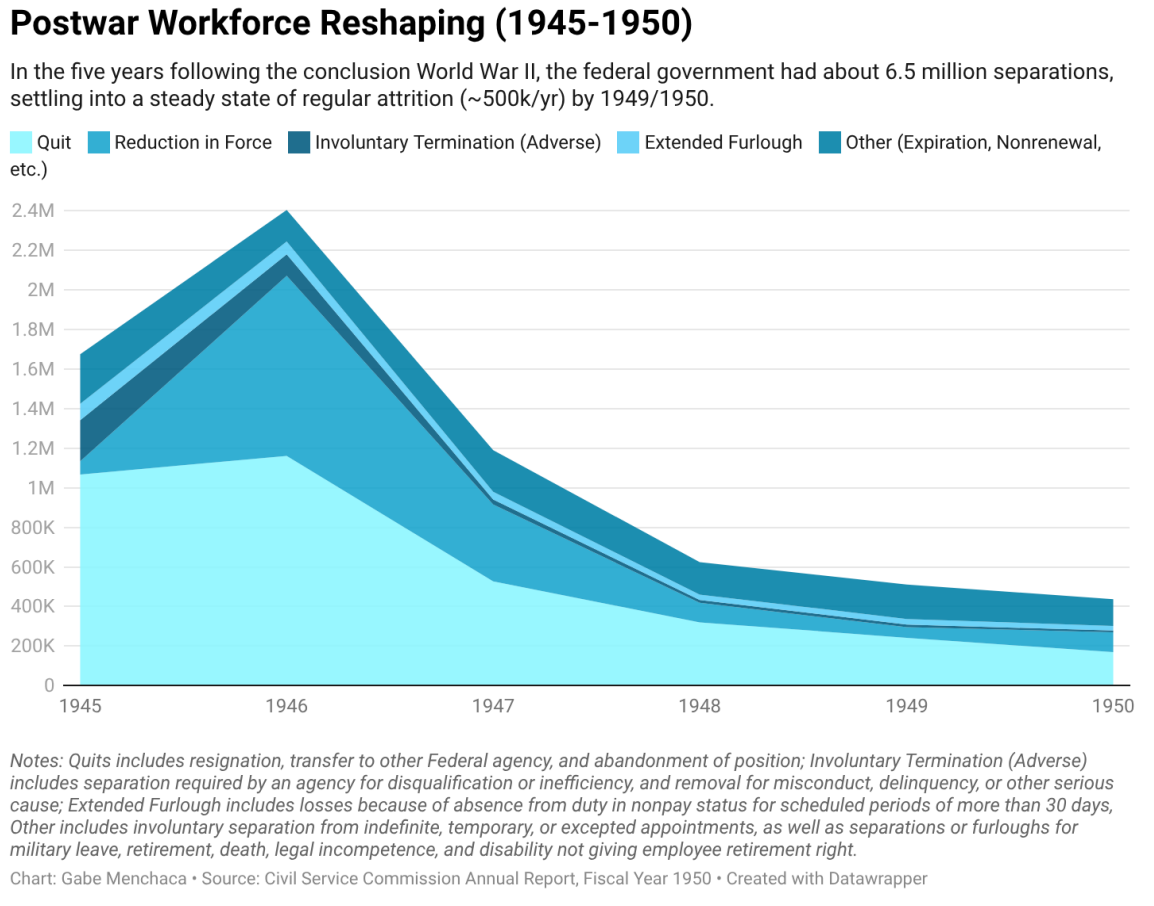
However, this apparent success came with significant costs that presaged problems we still face today. For one, the distributional effects were deeply unequal. Veterans received comprehensive support through the GI Bill—unemployment compensation, educational benefits, housing loan guarantees—while displaced civilian workers received almost nothing comparable. No formal severance packages existed for laid-off employees. No dedicated retraining programs helped them transition. Women, who had comprised 38% of the federal workforce at its wartime peak in 1945, saw their share drop to just 22% by 1950 as returning veterans exercised their legal right to reclaim their former jobs.
More relevant to today’s challenges, the RIF procedures themselves proved to be blunt instruments. The rigid, statutorily-mandated hierarchy meant that the most junior and least tenured staff were let go first, regardless of their skills or potential. A 1952 Senate report concluded that the system was too complicated and resulted in adverse selection: “Despite the intricate layoff formula, moreover, Government is often forced to separate its more experienced and efficient employees while retaining workers of lesser seniority and skill. Employee efficiency is of virtually no weight in selecting employees to be retained on the job.”23 In the estimation of the committee, this led to a reluctance on behalf of agencies to use RIFs when needed for workforce-shaping – managers knew that the rules were going to result in unintended negative outcomes. When agencies did go through with RIFs, the result was “widespread confusion, lowered morale, and insecurity among Federal employees” that resulted in the best employees leaving voluntarily rather than await the outcome because they might be dismissed despite high levels of performance merely by dint of their tenure and preference status.24
Unfortunately, despite this uneven experience, the rules established in the 1940s to manage demobilization remain largely in place today—and their limitations remain mostly unaddressed. For example, when Ronald Reagan sought to conduct RIFs in the 1980s, the bump and retreat rules meant that program specialists were reassigned to clerical jobs. “People who could be making major contributions are sitting there doing nonsensical things. And I don’t blame them. Otherwise they’d be on the streets,” one civil servant put it.25 By 1993, the Congressional Budget Office echoed the same concerns, writing that “[e]ven a casual reading of the procedures involved in a reduction in force makes clear the potential administrative burden and disruption they pose. The Office of Personnel Management estimates that at the Department of Defense, roughly two employees are adversely affected for every job abolished.”26
As a result, many subsequent efforts at large-scale workforce shaping have avoided this mechanism entirely, preferring voluntary programs over layoffs. However, these have their own limitations.
The long shadow of Clinton’s computerized ‘reinvention’
The next time a President attempted to reshape the federal workforce at a comparable scale was ~50 years later when the Clinton Administration again looked to downsize, this time at the end of the Cold War.
Interestingly, this shift in world politics also arrived at a particular moment in the decades-long transformation of government work by information technology. While federal agencies had been early adopters of mainframe computers in the 1970s, by the early 1990s computers were fundamentally changing what federal employees did in ways that went beyond merely augmenting clerical work. Where the federal offices of the 1940s were full of clerks pulling paper files from cabinets, processing actions using paper documents, and typing on typewriters, advances in technology had rendered much of this work obsolete. The proportion of federal workers in clerical occupations had already fallen from roughly three-quarters of white-collar employment in 1949 to under 20% by 1981, and the decline was accelerating.
It was against this backdrop that the administration launched the National Performance Review in Spring 1993.27 The NPR promised to save $108 billion28 through a smaller bureaucracy and program changes—initially targeting 252,000 positions, later raised to 272,900.29 Conscious of the many limitations of RIFs, they sought to avoid direct layoffs and rely instead on voluntary separations.30 Congress obliged their request31 for authorities to offer buyout payments up to $25,000 and modified early retirement rules via the overwhelmingly bipartisan Federal Workforce Restructuring Act of 1994.32 By the time the effort concluded, by the administration’s own count, 426,200 federal positions had been eliminated.33
Much like their mid-century predecessors, this effort was literally a success in the sense that they achieved the Administration’s goal of reducing the government’s total headcount. But the adverse selection caused by voluntary mechanisms was noticed almost immediately. For one, the administration’s stated goal of reducing “management control” positions that they viewed as unnecessary didn’t necessarily work. In a 1996 report, GAO noted that the poor targeting of buyouts meant that “agencies used buyouts more to meet [the Federal Workforce Restructuring Act’s] downsizing objectives than [the] Administration’s restructuring goals.”34 Agencies also reported that while “buyouts allowed them to avoid or reduce the number of RIFs” they also “said that downsizing itself had caused problems. Fifteen agencies cited the loss of corporate memory and expertise, and 11 reported work backlogs due to the loss of key personnel.”35 In all, because broad voluntary cuts are nonstrategic, agencies were left to pick up the pieces.
Some of the long-term effects of these cuts are still visible today, 30 years on. Most prominently, the voluntary strategy had a particularly corrosive effect on the workforce’s age distribution. Voluntary incentives disproportionately pushed out the most marketable employees while early retirement drained institutional knowledge by definition. Meanwhile, the positions most likely to be eliminated through attrition or restructuring were the junior clerical and administrative roles that had traditionally served as entry points into federal careers as agencies looked for roles they could outsource or do without. The share of federal workers under age 35 shrank from 26% in 1992 to under 17% in 2000, while the share over 50 jumped from 25% to over 36%.36 Those more junior jobs never came back, even as the federal workforce began to grow again during the Bush Administration; the federal government simply doesn’t have jobs for junior people today.
Perhaps most problematically, the government didn’t actually shrink because voluntary separations were not synced with policy changes. Agencies had to still do the same jobs, just with fewer people and holes randomly distributed throughout their workforce. They turned to contractors to fill the gaps. When agencies couldn’t hire enough qualified IT professionals at government pay scales to manage the transition to digital systems, they contracted for services. Today, government buildings are full of highly skilled young people; most just work for consulting firms and outsourcers rather than the federal workforce. This has contributed to well-documented challenges with service delivery in subsequent decades as the government has ceded much of its core governing capacity to contractors.37
- Gabe Menchaca, From Gore to DOGE: The Bipartisan History of Failed Workforce Reform
(2025), https://www.niskanencenter.org/from-gore-to-doge-the-bipartisan-history-of-failed-workforce-reform/. ↩︎ - Of note, a bill was recently introduced in the House of Representatives that would address some of
these challenges. See the Federal Workforce Early Separation Incentives Act (H.R.7256). ↩︎ - Evans Kasmai Kiptulon et al., “The Race to Retain Nursing Workforce in Healthcare: An
Umbrella Review of Effectiveness of Retention Interventions and Strategies,” BMC Health
Services Research 25 (October 2025): 1344, https://doi.org/10.1186/s12913-025-13365-6. ↩︎ - Donald Trump, “Hiring Freeze,” Presidential Memorandum, January 20, 2025,
https://www.whitehouse.gov/presidential-actions/2025/01/hiring-freeze/. ↩︎ - These are discussed at length in the “Additional Background Detail” section appended to this
letter. ↩︎ - Erich Wagner, “Congress Guarantees Furloughed Feds’ Back Pay despite Continued White
House Maneuvering,” Government Executive, February 3, 2026, https://www.govexec.com/pay-
benefits/2026/02/congress-guarantees-furloughed-feds-backpay-continued-white-house-maneuvering/411174/. ↩︎ - RIN 3206-AO88 “Managing Senior Professional Performance” [Docket ID: OPM-2025-0011] &
RIN 3206-AP06 “Performance Appraisal for General Schedule, Prevailing Rate, and Certain Other
Employees” [Docket ID: OPM-2025-0273] ↩︎ - Reduction-in-Force System in the Federal Government, 82nd Congress, 2nd Session, Rept. 2102 (U.S.
Senate, Committee on Post Office and Civil Service, 1952),
https://catalog.hathitrust.org/Record/102410064. 25-26 ↩︎ - Gabe Menchaca, “Comment from the Niskanen Center on OPM Proposed Rule ‘Performance Appraisal
for General Schedule, Prevailing Rate, and Certain Other Employees’ (OPM-2025-0273-0001),” March 26, 2026, https://www.regulations.gov/comment/OPM-2025-0273-0450. ↩︎ - Sean Michael Newhouse, “EEOC Workers Could Be Furloughed for One Day Due to Budget
Shortfall,” Government Executive, August 12, 2024,
https://www.govexec.com/management/2024/08/eeoc-workers-could-be-furloughed-one-day-due-budget-shortfall/398753/. ↩︎ - Sean Michael Newhouse, “EEOC Averts the Threat of a One-Day Furlough,” Government
Executive, August 20, 2024, https://www.govexec.com/management/2024/08/eeoc-averts-threat-one-day-furlough/398936/. ↩︎ - Sam Ogozalek, “Over 1,000 TSA Officers Have Quit amid Shutdown,” POLITICO, April 27,
2026, https://www.politico.com/live-updates/2026/04/27/congress/1100-tsa-officers-quit-shutdown-00893656. ↩︎ - Erich Wagner, “OPM Will Forego FEVS in 2025, despite Law Requiring It,” Government Executive,
August 20, 2025, https://www.govexec.com/oversight/2025/08/opm-will-forego-fevs-2025-despite-law-requiring-
it/407584/. ↩︎ - Shalanda D. Young “OMB Memorandum 23-15: Measuring, Monitoring, and Improving
Organizational Health and Organizational Performance in the Context of Evolving Agency Work
Environments,” to The Heads of Executive Departments and Agencies, April 13, 2023,
https://www.whitehouse.gov/wp-content/uploads/2023/04/M-23-15.pdf. ↩︎ - Daron Acemoglu and Simon Johnson, “Learning From Ricardo and Thompson: Machinery and Labor in the Early Industrial Revolution and in the Age of Artificial Intelligence,” Annual Review of Economics 16, no. 1 (2024): 597–621, https://doi.org/10.1146/annurev-economics-091823-025129. ↩︎
- “Executive Branch Civilian Employment Since 1940,” U.S. Office of Personnel Management, accessed March 10, 2025, https://www.opm.gov/policy-data-oversight/data-analysis-documentation/federal employment-reports/historical-tables/executive-branch-civilian-employment-since-1940/. ↩︎
- An Act Making Appropriations for the Legislative, Executive, and Judicial Expenses of the Government for the Year Ending June Thirtieth, Eighteen Hundred and Seventy-Seven, and for Other Purposes, 44 Stat 169 (1876). ↩︎
- Franklin D. Roosevelt, “Executive Order 9063: Authorizing the Civil Service Commission To Adopt Special Procedures Relating to Recruitment, Placement, and Changes in Status of Personnel for the Federal Service,” February 16, 1942, https://www.presidency.ucsb.edu/documents/executive-order 9063-authorizing-the-civil-service-commission-adopt-special-procedures. ↩︎
- Civil Service Commission, “Reduction in Force,” in Federal Register – Friday, August 6, 1943, vol. 8, No, 155 (1943), https://www.govinfo.gov/content/pkg/FR-1943-08-06/pdf/FR-1943-08-06.pdf. ↩︎
- Veterans’ Preference Act of 1944, Pub. L. Nos. 78–359, 58 Stat 387 (1944),
https://www.govinfo.gov/content/pkg/STATUTE-58/pdf/STATUTE-58-Pg387.pdf#page=1. ↩︎ - Civil Service Commission, “Reduction in Force Regulation,” in Federal Register – Tuesday, August 8, 1944, vol. 9, no. 157 (1944), https://www.govinfo.gov/content/pkg/FR-1944-08-08/pdf/FR-1944-08- 08.pdf. ↩︎
- Civil Service Commission, “Retention Preference Regulations for Use in Reduction in Force,” in Federal Register – November 16, 1944, vol. 9, no. 229 (Government Printing Office, 1944), https://www.govinfo.gov/content/pkg/FR-1944-11-16/pdf/FR-1944-11-16.pdf. ↩︎
- Reduction-in-Force System in the Federal Government, 7-8. ↩︎
- Id. ↩︎
- Lynn Rosellini, “Reagan RIF Effect Puts Bosses in Typing Pools,” New York Times (Washington), April 7, 1982, https://www.nytimes.com/1982/04/07/us/reagan-rif-effect-puts-bosses-in-typing-pools.html. ↩︎
- Reducing the Size of the Federal Civilian Work Force (Congressional Budget Office, 1993), https://www.cbo.gov/sites/default/files/103rd-congress-1993-1994/reports/1993_12_reducingsizeoffederalcivilian.pdf. ↩︎
- William J. Clinton, “Remarks Announcing the National Performance Review,” March 3, 1993, https://www.presidency.ucsb.edu/documents/remarks-announcing-the-national-performance-review. ↩︎
- The National Performance Review and Other Government Reform Initiatives: An Overview, 1993-2001 (Congressional Research Service, 2001), https://www.everycrsreport.com/files/20010604_RL30596_8f4af66aba0937c6bd45c4b8933f43353749e c02.pdf.
↩︎ - “A Brief History of the National Performance Review,” Vice President Gore’s National Partnership for Reinventing Government, February 1997,
https://govinfo.library.unt.edu/npr/library/papers/bkgrd/brief.html. ↩︎ - Charles S. Clark, “Reinventing Government — Two Decades Later,” Government Executive, April 26, 2013, https://www.govexec.com/management/2013/04/what-reinvention-wrought/62836/. ↩︎
- Stephen Barr, “Clinton Seeks ‘Buyouts’ to Cut Work Force,” Washington Post (Washington), October 1, 1993, https://www.washingtonpost.com/archive/politics/1993/10/02/clinton-seeks-buyouts-to-cut work-force/0abf3f3d-0607-4544-aa5c-4dcd82f6cd15/. ↩︎
- “Actions – H.R.3345 – 103rd Congress (1993-1994): Federal Workforce Restructuring Act of 1994,” Congress.Gov, 1993-10-22, accessed May 4, 2026, https://www.congress.gov/bill/103rd congress/house-bill/3345/all-actions. ↩︎
- “History of the National Partnership for Reinventing Government – Appendix F,” Vice President Gore’s National Partnership for Reinventing Government, January 12, 2001,
https://govinfo.library.unt.edu/npr/whoweare/appendixf.html. ↩︎ - Federal Downsizing: Better Workforce and Strategic Planning Could Have Made Buyouts More Effective, GAO/GGD-96-62 (Government Accountability Office, 1996),
https://govinfo.library.unt.edu/npr/library/gao/gg96062.pdf. ↩︎ - Id. ↩︎
- Menchaca, From Gore to DOGE: The bipartisan history of failed workforce reform ↩︎
- Matthew Burton, “Vendor Capture and the Limits of Fast Government Reform,” Niskanen Center, November 18, 2025, https://www.niskanencenter.org/vendor-capture-and-the-limits-of-fast government-reform/. ↩︎