
In 2025, Idaho made headlines when its government briefly considered removing all required ratios and seeing what safety tradeoffs the market would bear. That would have pushed it far beyond the norms of other states, all of which set maximum child-to-caregiver ratios for children in early childcare settings. After backlash, Idaho’s legislature amended the bill to loosen, rather than remove, child care staffing ratio requirements.
Improving the availability and affordability of childcare is a complex challenge. Childcare, unlike manufacturing, cannot achieve significant efficiency gains: No caregiver can change two diapers at once. Childcare faces an additional limitation: parents in need of childcare for their young children have limited purchasing power. They are likely more junior in their careers with lower savings reserves than when their children have aged out of expensive care.
States have a modest ability to increase the supply of childcare and drive down prices by examining the risk-benefit tradeoffs of regulations. Examining variations in regulations across states can shed light on opportunities to make better tradeoffs.
Labor is the major cost driver of providing childcare. Thus, staffing ratios are one of the most obvious places to examine the cost-benefit tradeoff of child care regulations. Wages and benefits make up 56 percent to 68 percent of costs of operating a child care center, with the highest percentage among centers serving younger children. Each additional child brought under a care center’s supervision without an accompanying staff addition increases the center’s revenue per employee. However, each additional child forces an employee to divide his or her attention, increasing the chance of a crisis.
Child care centers may choose to adopt more restrictive staffing ratios than their state requires as a way to distinguish themselves in the market. A center that seems safer and offers more individualized attention may be more attractive to high-income parents.
A center can also use a stricter staffing ratio as a way to compete for workers, who may prefer a working situation in which they are not spread so thin. State regulations vary significantly, suggesting that there is not a national consensus among policymakers on what constitutes a safe environment. Parents, employers, and regulators would benefit from more real-world data.
Where states agree and disagree on safe staffing ratios
The Washington-based Archbridge Institute compiled state-level childcare regulations across all 50 states and the District of Columbia. Its data is limited to licensed childcare centers, excluding in-home daycares and other options. States define in-home daycares differently for the purpose of regulation, which makes it difficult to directly compare their operating requirements. Hawaii prohibits children under the age of two from being placed in childcare centers, so they are excluded from analysis of this age range.
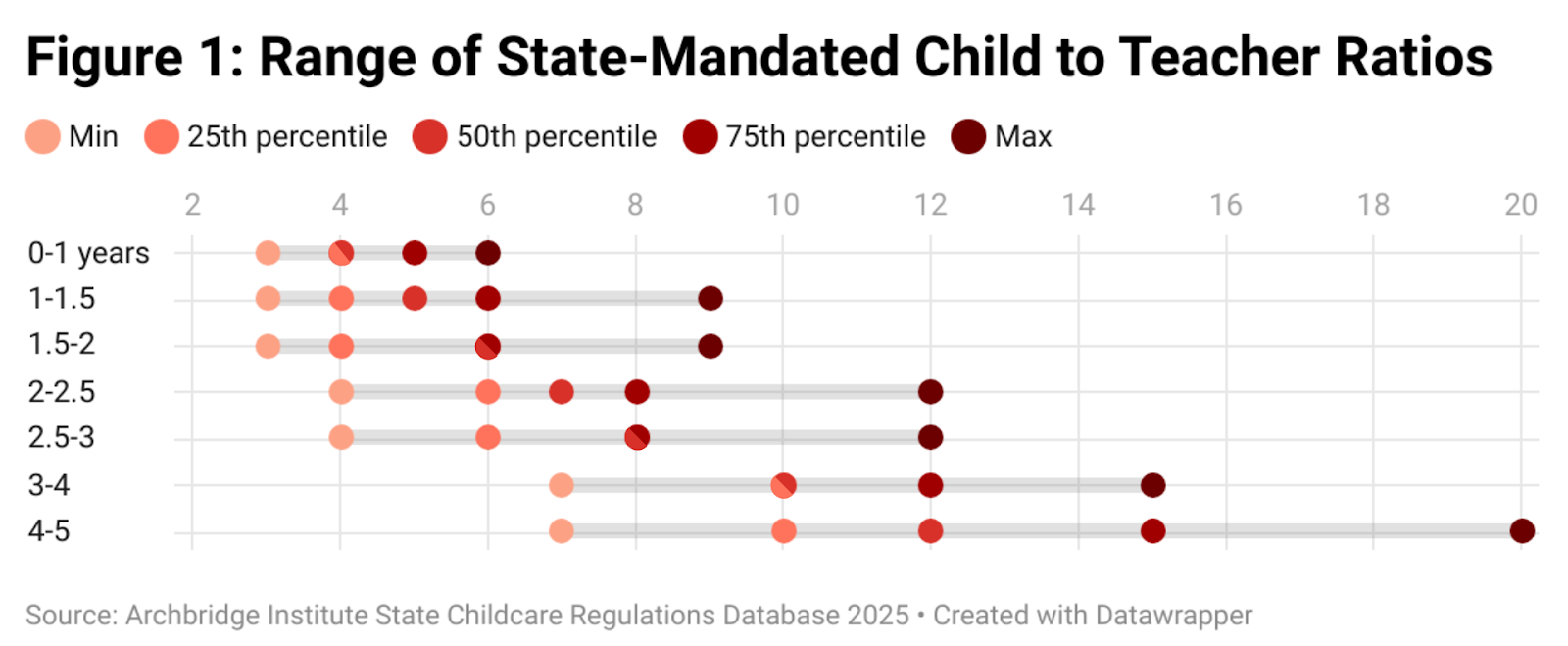
The degree of variation across states in permissible staffing ratios changes for different age groups (Figure 1), and states are much more closely aligned on what is required to safely supervise infants than older preschoolers. For the youngest children (six weeks to one year old), all states mandate ratios between three and six children per staff member. The vast majority of states (86 percent) cap the staffing ratio at either four or five children per caregiver.
The range among states varies much more at older ages. For preschoolers aged 4-5 years, North Dakota sets the most restrictive ratio cap (seven children per caregiver) while North Carolina and Florida set the least restrictive (20 children per caregiver). The states clustered at the top of the range allow nearly three times as many children per caregiver as the state at the bottom, giving them the chance of bringing in much more revenue per staffer.
While most states are tightly clustered around consensus figures for the youngest children, they are more variable in their regulations for older ones. The most permissive states allow two to three times the children-per-staff member of the most restrictive states (Figure 2). Because the minimum requirements increase with age, even for the most restrictive states this results in much larger numbers of students allowed in absolute terms.
Many states set maximum staffing ratios for older children that exceed those recommended by advocacy groups such as the National Association for the Education of Young Children (NAEYP) and the joint recommendations of the American Academy of Pediatrics (AAP) and the American Public Health Association (APHA). NAEYP recommends that children from age 2.5 to 5 years old be supervised at a ratio not exceeding 10:1– that is, no more than 10 children per caregiver. AAP and APHA set more conservative recommendations: 7:1 children per caregiver for 3 year olds and 8:1 for 4 and 5 year olds.
Only four states (Arkansas, Mississippi, Florida, and Texas) set more permissive ratios that NAEYP recommends for children aged 2.5 to 3 years, but 38 percent allow centers to operate at higher ratios for three to four year olds, and a majority (64 percent) allow more higher ratios than the NAEYP prefers for 4 to 5 year olds.
Only two states (New York and North Dakota) use ratios as restrictive as the AAP and APHA recommendations for 3 year olds, and just four (North Dakota, New York, Maine, and California) for 4 to 5 year olds.
The Buffet Early Childhood Institute at the University of Nebraska recently published an analysis of child care gaps for the years 2020 through 2025 by state, county, congressional districts, state senate districts, and by rural/urban areas. The Buffet Early Childhood analysis suggests that the most restrictive states could have a lot to gain from loosening staffing ratios and increasing slots. The Buffet Institute found that Maine is close to meeting its demand for child care, with more slots than children potentially in need. It is primarily limited by the geographic location of these slots, with 7.4 percent of need unmet. The gaps are much wider for North Dakota, California, and New York: 24 percent, 36 percent, and 42 percent of potential need unmet, respectively. These states have more to gain by considering whether they could adapt the regulations of less restrictive peers.
The costs and benefits of staffing caps
Intuitively, there is a point at which increasing the number of children per staffer lowers standards of care, but it is not obvious that states’ existing rules, even at the most permissive end, reach the point of danger. In a literature review from the Prenatal to 3 Policy Impact Center at Vanderbilt University’s Peabody College of Education and Human Development, meta-analyses of more restrictive caps provided only weak evidence for children’s cognitive development or social-emotional health. The best-supported benefit of smaller classes is reduced respiratory disease, since fewer children means fewer circulating illnesses.
When states set more restrictive regulations for childcare centers, they raise the floor for quality but constrain supply. In one analysis by V. Joseph Hotz and Mo Xiao, reducing the maximum number of infants per caregiver by one child (going from an average of 4.4 to 3.4 infants per caregiver) was expected to close between 9.2 percent and 10.8 percent of childcare centers in the market. This elasticity is particularly high for regulations that target the youngest children, since a one-child shift in the rules represents a high percentage of the revenue per worker. Effects would be more modest for older children.
When regulations prompt centers to close, the surviving centers are higher quality (and more easily achieve accreditation), but they also end up more heavily concentrated in higher-income neighborhoods. In the analysis of Hotz and Xiao, lower-income families are more likely to be displaced into in-home care and grey market childcare. These children can wind up in care environments that would fall short of the safety standards imposed on more official sources of care.
Loosening staffing ratios would not make childcare cheap. However, states setting the most restrictive standards for older children might benefit from consulting with their more permissive peers. Increasing the supply of childcare is not going to be achieved with a single stroke. Critically evaluating regulations and observing the results of other laboratories of democracy allow states to adopt rules that have been field tested elsewhere.