
Both excessive constraints, and insufficient constraints, limit executive power
This piece was originally published in Artificial Weights on May 6, 2026.
MAGA supporters often argue that President Trump’s willingness to flout legal, moral, and customary rules enhances his power. As Donald Trump Jr. recently put it, “what’s good about my father, and what’s unique about my father, is you don’t know what he’s going to do.” Trump’s willingness to bully members of Congress and allied countries, as well as to disregard legal constraints and abuse power—for example, by threatening federal funding and contracts for universities and law firms—they reason, enhances his power. They argue that President Trump has shown how much more a President and political movement can achieve if it has the stomach to break the rules, and to break prior commitments without fear.
But a more unconstrained President is not an inevitably more powerful President.
President Trump has already illustrated this. His inconsistency and refusal to heed constraints has limited his ability—despite Republican control of Congress—to craft durable legislative victories, rally allies to join military action, and even durably shift the behavior of the universities or law firms he targets.
In the first piece of this series, each piece of which will summarize one of the ideas of my article, I described how administrative procedure gone wrong has both stymied abundance and facilitated autocracy. In many cases, that reflects excessive constraints that impede government power and insufficient ones that fail to check abuses of power. In later pieces, I will discuss each of these topics in greater depth. But in this piece, I argue for an important insight from institutional economics: depending on the context, constraints on government action can limit its power or increase its power.
One way to understand this point is by looking back in time at a particularly clear case study. Specifically, North & Weingast (1989) showed how England, by constraining the power of the Crown, became powerful enough to win wars with France—setting the stage for England to become the most prosperous and powerful country in the world.
Party like it’s 16881
States in early modern Europe were frequently at war. The stakes of war, particularly in this era, were high. (They not infrequently ended with a monarch’s neck separated from their head.) So any sovereign at war was incentivized to take even the most costly actions if those actions would help secure wartime victory. For example, monarchs would commonly repudiate royal debts and seize private property in order to gather resources needed to win wars. But if the king inevitably confiscates property during a war, no one will bother to invest in the first place. Economic growth, in other words, was stymied by the lack of a credible commitment to not wield powers in certain ways that were in the short-term interest of the current ruler.
Such was the case in early 17th century England. As far back as 1215, the Magna Carta had restricted the Crown’s ability to raise certain taxes without the support of bishops, earls, and barons—what would become Parliament. Parliament, representing the interest of property owners, would generally seek to extract concessions from the Crown before agreeing to be taxed. But by the 1600s, Stuart monarchs had essentially seized control of public finance by funding regular state expenses without relying on taxes that required parliamentary assent, such as customs fees (tariffs, essentially).
The Stuarts had inherited large debts from Queen Elizabeth’s war with Spain, and increasingly spent more than they collected from standard sources of revenue in the 1600s; they had to find other sources to cover the difference. For example, the Crown secured loans through both voluntary and involuntary means (“forced loans”). Repayment was often incomplete and delayed:
In the forced loan of 1604/5 the Crown borrowed £111,891, nominally for one year; “although … ultimately repaid, £20,363 … was still due as late as December 1609.”
As time progressed, these “loans” began to approximate taxes; yet because they were stylized as loans, the Crown could impose them without Parliament’s support. The Crown also sold monopolies, peerages, hereditary titles, and exemptions from generally-binding laws; seized goods while paying below market value; and sometimes just seized property outright.
Both Parliament and the common law courts attempted to thwart the Crown’s efforts. For example, the 1624 Statute of Monopolies prohibited granting monopolies to existing businesses in exchange for revenue; indeed, courts had barred the Crown’s use of monopolies as revenue raisers at common law as far back as 1601. But the Crown was able to evade these restrictions by relying on the royal prerogative (essentially, the ability to issue legislative edicts without Parliament), the suspension and dispensation powers (granting exemptions from otherwise generally-binding laws), and enforcement in the prerogative courts (avoiding the common law court system). The ability of the Crown to remove judges who ruled against the Crown cemented the efficacy of this system.
Eventually, the Crown’s oppressive rule triggered the English Civil War and Glorious Revolution. Following the Glorious Revolution, parliamentary supremacy was established, with a special emphasis on control over fiscal matters. The royal prerogative powers were subordinated to statutes and the common law, and the prerogative courts were abolished. Judges could only be removed if convicted of a criminal offense, or by both houses of Parliament.
Punishments for undermining these changes were credible, and the changes were therefore durable. After all, the previous king had been removed from power, a clear threat to any new ruler. And going forward, increased economic power outside the Crown increased Parliament’s political power. Yet Parliament still relied on the Crown for the expenditure of funds and implementation of government programs, while Parliament’s plural composition created natural internal checks on any one faction’s ability to seize power. More importantly, both sides had reasons to stick to the bargain because each side gained from these changes. Parliament and elites external to the Crown gained economically and politically, by limiting the risk that their property would be seized. But the Crown also gained something critical: massive increases in fiscal capacity that allowed King William to launch, and win, a major war against France (1689–97).
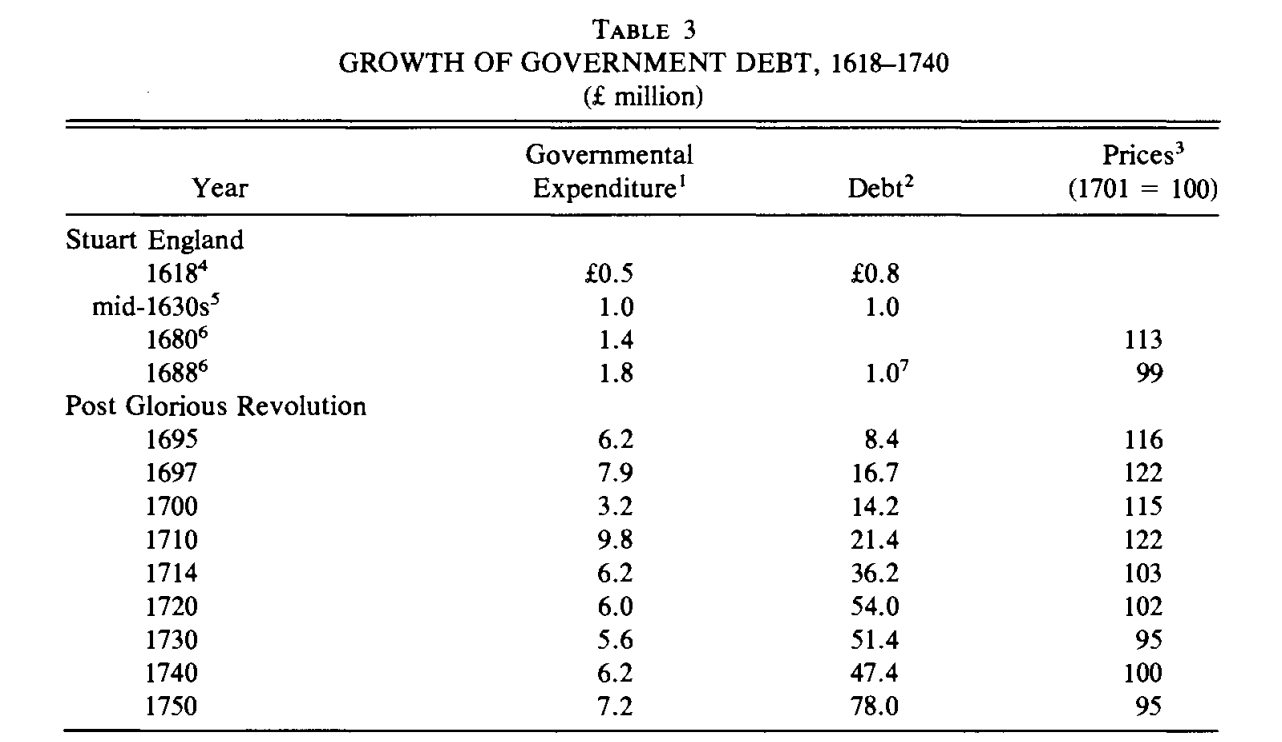
In summary: a politically independent judiciary meant that previously ignorable constraints on royal power became credible. The Crown could no longer renege on its agreements; but losing this particular power made the Crown more powerful in aggregate, particularly by increasing its fiscal capacity. For example, these constraints allowed the Crown to massively expand debt financing of expenditures:
And even as the amount that the government could raise through debt financing soared, certainty that loans would be repaid meant that the cost of financing that debt plummeted:
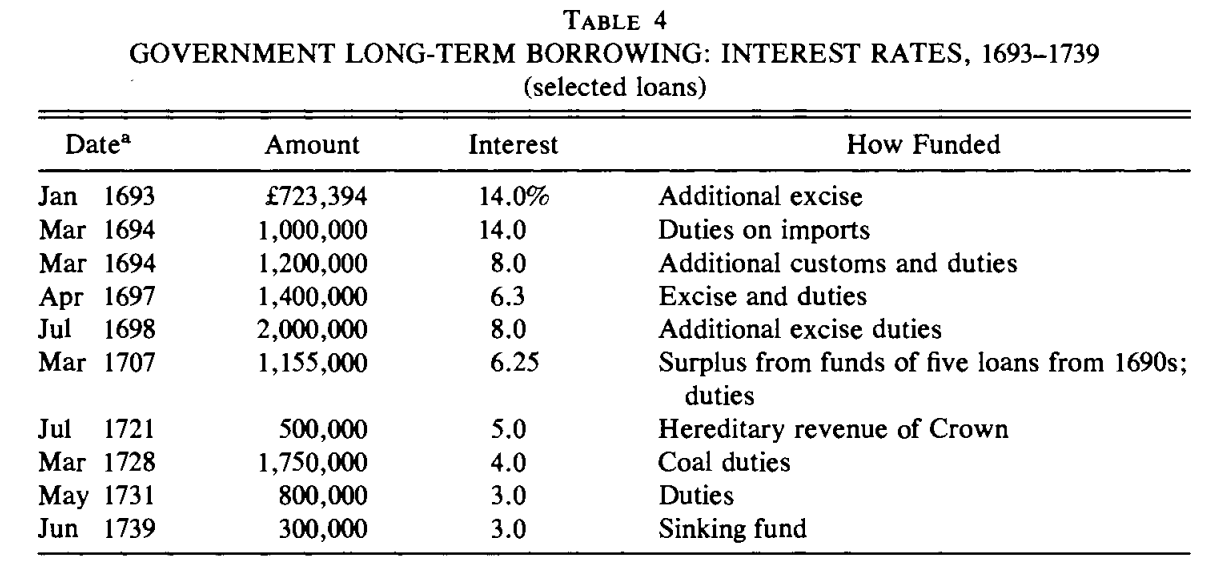
Obviously, the credible commitment of the English government to repay its debts was not the only reason for this boom in fiscal capacity. That commitment was part of a larger commitment to protect property rights, which in turn supported economic growth (and, in turn, increased the resources available to finance government expenditures). But the key point is that by tying its own hands, the English Crown became far more capable of pursuing its goals (for example, winning wars with France) than when it was more unconstrained.
Administrative procedure as a solution to a commitment problem
North and Weingast were by no means the only ones to recognize that constraints on state power can expand state capacity by solving a commitment problem.2 Democracy, with regular competitive elections for political office, is itself a solution to a fundamental commitment problem. Rights protections are also a solution to a commitment problem. Likewise, procedural constraints on the exercise of government power are another solution to the same general commitment problem. That is, those who set the rules for how power is exercised know that control of that power will rotate, and therefore can make themselves better off by locking in constraints that are more valuable to them when their opponents are in power than they are costly while they (or their allies) are in power.
While democracy is an incredibly important technology for both improving government capacity and reducing the scope of abuse of power, alone it creates suboptimally weak incentives. For example, state legislative electoral outcomes are remarkably unresponsive to voters’ opinions—even on salient issues. And even in a presidential election, it is likely that only the most salient policies and scandals will have any noticeable electoral effect. Rights protections and procedural constraints can improve upon raw majoritarian democracy by improving the incentives of those who hold office. If the costs of the procedures are lower than the benefits that flow from those improved incentives, society ends up better off with them in place.
Governments are people too, my friend
While English economic development and commitment problems from hundreds of years ago may be interesting in themselves, the basic point here remains common sense today.
Say you have two colleagues. The first is always honest and keeps her promises. Even when it is no longer to her short-term advantage to follow-through, she stands by her commitments. She is ethical, and is also forthright about her mistakes, even when she does not have to be. The second is totally unconstrained; promises are no more than loose predictions to her. She will break a promise as soon as it is to her short-term advantage for her to do so. She cares only for pursuing her own good, and will only share information when it is to her advantage to do so.
Obviously, the first colleague will incur some costs from her honesty and commitments. But she also gains many benefits. Say each colleague comes to you seeking to work together on a project. Which of the two would you want to partner with? Say each one is looking to hire a new team in your office. Which of the two would you want to work for? Say each one applies for a promotion. Which of the two would you want to promote? Say each one comes to you asking for a favor, and promising to pay it back in return. Which one of the two would you want to trade favors with? Even without external enforcement mechanisms, someone who is credible in their commitments can get more done—in the long run—than someone who is not trustworthy.3
Why this matters
The rest of this series will dive into big questions surrounding optimal administrative procedures, and how they can both reduce autocratic abuses of power and enhance effective governance. But it is important to not lose sight of how credible commitments through procedures matter to the everyday business of government. Consider this recent discussion from the Substack Factory Settings, about how the CHIPS office’s inability to tie their own hands more completely made it more difficult to do effective grantmaking:
Consistent with other federal grant agreements, our terms provided that CHIPS awards would be administered at “the discretion of the government.” But that language — which implied broad latitude — made some of our applicants very uneasy. In the event of a dispute under the contract, they wanted courts to hold the government to a “reasonableness” standard typical for commercial agreements.
But we couldn’t accommodate that request. The challenge was that the Administrative Procedure Act gives courts the ability to invalidate certain actions by government agencies (including withholding grants) if the court determines that they are “arbitrary and capricious.” Our legal team analyzed the APA and determined that it applied to our awards and that we didn’t have the authority to bind the government to a more constrained standard of review beyond the “arbitrary and capricious” test of the APA.
For future programs, Congress should consider specifying that agencies may commit to a more constrained standard of review than the APA provides in their commercial agreements.
Civil society reacts more strongly to policies that it anticipates to be more durable; durability is often downstream of constraint. Sometimes, by binding its own hands too tightly, the government becomes dysfunctional, and its capacity degrades. Sometimes, by leaving its hands too free, the government becomes untrustworthy, and its capacity again degrades. But by binding its own hands just enough—and in just the right ways—the government’s commitments become credible and society anticipates it to act more wisely, maximizing its own capacity in the present.
- This section relies on, and heavily quotes from, Douglass C. North & Barry R. Weingast, Constitutions and Commitment: The Evolution of Institutional Governing Public Choice in Seventeenth-Century England, 49 J. Econ. Hist. 803 (1989). Quotation marks and pin cites are omitted for readability, given the informal nature of this post. ↩︎
- While broader in scope, the comprehensive theory laid out in Acemoglu, Johnson, & Robinson (2005) is particularly excellent. ↩︎
- Obviously, in the short run, there is often an incentive to lie to get ahead; many untrustworthy people are successful. The point is that such strategies eventually perform sub-optimally in the long run. And government is a long-run game. ↩︎