Federal-level policies tend to garner the most attention when they pertain to the U.S. southern border. This can result in overlooking the importance of border towns in pioneering local responses to rapidly changing dynamics and demographics in southern-border migration. By looking more closely at the policies, practices, and rhetoric at the local level, we can gain valuable insights into which approaches are working (and which ones aren’t).
The approaches of two neighboring Arizona counties — Cochise and Santa Cruz — tell a compelling story about the role state and federal funding, the border wall, and local law enforcement play in the communities’ response to changing migration.

Cochise County has adopted an approach that heavily favors enforcement, including support of deterrent responses such as increased funding for a border wall. In contrast, smaller Santa Cruz County has emphasized the need for social services, cross-border relations, and efficiency in immigration processing. Despite these differences, both counties’ leaders share support for border policies that stimulate cross-border business opportunities and the local economy.
Location and demographics
The four counties of Yuma, Pima, Santa Cruz, and Cochise form the Arizona border with Mexico. Three of these counties — Pima, Santa Cruz, and Cochise Counties — constitute the U.S. Customs and Border
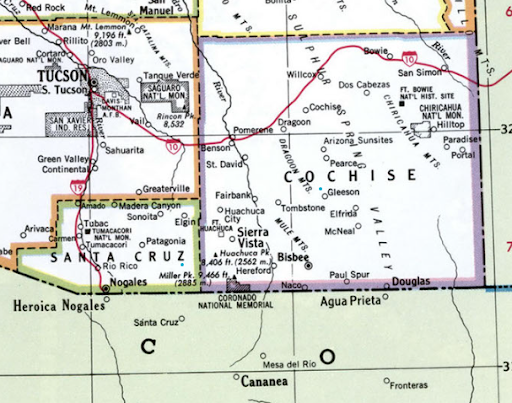
Source: https://us-canad.com/arizona-county.html
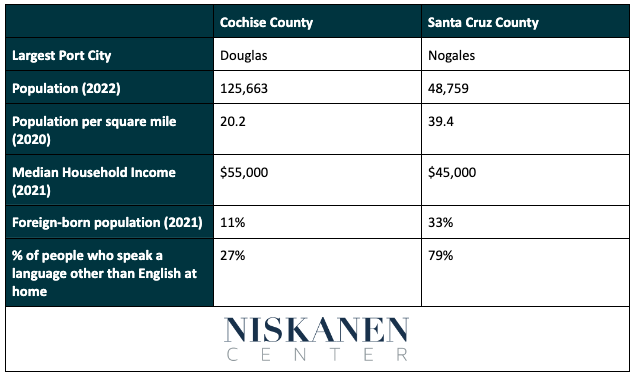
Cochise and Santa Cruz comprise a continuous 138-mile stretch of the U.S. and Mexico border ( 84 miles of Cochise County and 54 miles of Santa Cruz County border Mexico).The total land area is much higher in Cochise County, which encompasses 6,210 square miles compared to 1,236 square miles in Santa Cruz. The most significant border town in Cochise County is Douglas, with 16,513 people. In Santa Cruz County, Nogales is the largest town with a similar population of 19,766 people.
In 2022, Census data reported that Cochise County had an estimated population of 125,663 people, which equates to about 20.2 people per square mile, and Santa Cruz County had a population of 48,759 people at 39.4 people per square mile. The median household income in 2021 was $55,000 in Cochise County, compared to $45,000 in Santa Cruz County.
According to data collected in 2021, 32.6 percent of the population of Santa Cruz is foreign-born, compared to 10.75 percent in Cochise County. Unsurprisingly, 79 percent of the population of Santa Cruz speaks a language other than English at home, compared to about a third of the people in Cochise County.
Both communities rely heavily on cross-border trade. According to the Greater Nogales Santa Cruz County Port Authority, cross-border trade in Nogales is a multi-billion dollar industry. Visitors from Mexico spend $740 million annually in Douglas and smaller towns in Cochise County.
Migration trends in the Tucson Sector
Before assessing general migration positions, it is crucial to have a basic understanding of some of the migration trends within the two counties. Crucially, it’s impossible to analyze the CBP southwest border encounter data at the county level. Cochise County has three border patrol offices in Wilcox, Bisbee, and Douglas, Arizona, and Santa Cruz has two border patrol stations in Nogales and Sonoita. However, data from specific border patrol stations are unavailable. Data is only recorded at the sector level, necessitating an extrapolation from the Tucson sector data.
As of April this year, the Tucson sector has seen about 112,000 border encounters, the fourth busiest of the nine CBP southwest land border sectors. Additionally, we can look at other migration trends statistics, including port traffic, the return of Mexican nationals by port of reception, and what county law enforcement has reported.
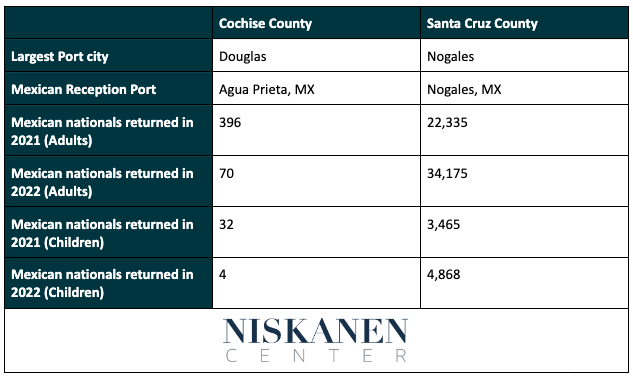
Despite similar population sizes, Nogales is a much busier port: in 2022, all traffic through the Nogales port was nearly triple that of Douglas. According to data from the Mexican government, Nogales also returns a much higher number of apprehended Mexican nationals to Nogales, Mexico than Douglas does to Agua Prieta, Mexico.
Between April and December 2022, the Cochise County Sheriff’s Office received 743 calls for border-related incidents. In 2022, cameras caught over 43,000 people illegally entering Cochise County from Mexico. Thirty-five percent were arrested, while 65 percent were considered “gotaways.” County Sheriff Mark J. Dannels also reported that his department spends $17,000 weekly helping federal officials catch car drivers who cartels hire to pick up migrants and transport them through the county. The Sheriff testified at a U.S. House Committee Judiciary hearing in February 2023 that 1,578 arrests for border-related crimes in 2022. However, only 78 people arrested were foreigners; 1,500 were Americans arrested for border-related crimes.
In contrast, the Santa Cruz County Sheriff’s Office has been less specific about irregular migration and border-related crimes but has remarked that “no invasion” is happening at the border. He has attributed inflated apprehension numbers to several factors, including Title 42 expulsions.
Federal and state funding for border and law enforcement programming
One marked difference between Cochise and Santa Cruz county policies has been their acceptance and utilization of state funds related to border security.
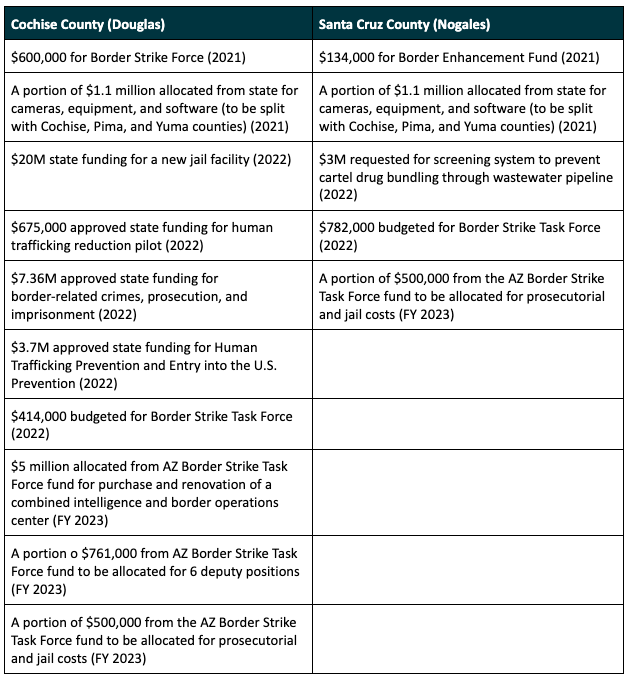

In 2021, then Arizona Governor Doug Ducey supported HB 2893, which created the Arizona Border Security Fund administered by the Department of Emergency and Military Affairs. In the same year, Senate Bill 1823 appropriated $55 million from the general fund to the border security fund, and $3.7 million was distributed to Cochise County for costs related to border security purposes. The Cochise County Sheriff’s Department received an additional $675,000 to pilot a program to reduce human trafficking.
The only funding allocated to the Santa Cruz County Sheriff’s Department was a portion of $1.1 million for cameras, equipment, and software for southern Arizona border region enforcement; the Cochise County Sheriff’s Department also received a portion of this funding.
Interestingly, Cochise County did not use the $675,000 allocated for the human trafficking pilot program or spend any of the $3.7 million allocated for broader border security purposes. Moreover, neither Cochise nor Santa Cruz County used their portion of the $1.1 million for cameras and related equipment.
However, deploying the Arizona national guard to the border cost the state $11.3 million and was controversial among a coalition of local sheriffs. In April 2021, sheriffs from Cochise and Santa Cruz countries signed a letter on behalf of the Arizona Border Counties Coalition to then-Governor Ducey, expressing disappointment that the Governor did not consult border counties regarding what they needed to address the situation at the border prior to involving the national guard. They remarked, “If you had asked, we would have requested assistance for transportation services” and “based on our experience, the Arizona National Guard is not needed for security or providing those tasks required of the federal government.” Shortly after, Cochise County seemingly changed its stance and began working with Arizona national guard members sent to help monitor cameras for irregular migration.
Despite minimal spending in 2021, former Governor Ducey supported HB2862 in 2022, which appropriated an additional $209.2 million to the Border Security Fund. $20 million was allocated to Cochise County to construct a new county jail facility. Nothing was specifically allocated to Santa Cruz County. In the same month, on June 30, 2022, Governor Ducey signed House Bill 2317, “Appropriating Monies to the Border Security Fund,” giving $335 million to the Border Security Fund to construct a physical border fence and for border technologies.
Cochise County and Santa Cruz County leadership have different approaches to the construction of new sectors of the border wall. Former mayor of Nogales, Mayor Arturo Garino, said funding allocated to a border wall might be helpful in other regions of the state but not as much in Nogales, which was “dealing with less people entering illegally and more drugs being smuggled through ports of entry.”
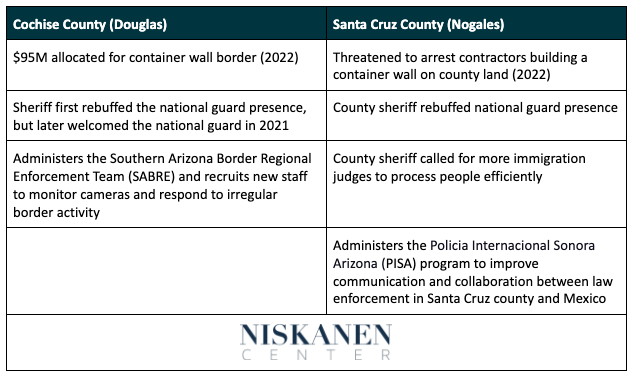
The Santa Cruz County Sheriff adamantly opposed efforts to build a container wall border, threatening to arrest and charge contractors hired by the Governor to build the container border wall. Instead of a wall, Sheriff Hathaway called for more immigration judges to process people more efficiently.
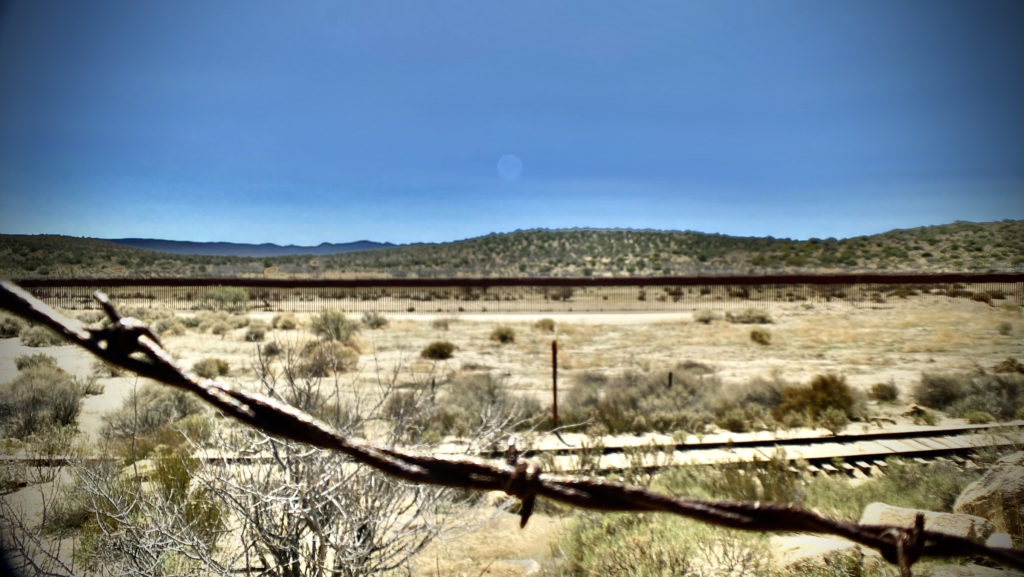
In contrast, Cochise County utilized $95 million to place 3,000 containers on a ten-mile stretch of its border with Mexico. The Sheriff supported the wall, stating the U.S. must send a strong message that the border is secure.
In February 2022, the Cochise County Board of Supervisors approved several state funds for the County Sheriff’s Office, including the $675,000 allocated to a pilot program to reduce human trafficking. Notably, the sheriffs in Santa Cruz, Pima, and Yuma counties yielded their funds to Cochise County, which administers the system. An additional $7.36 million was approved for border-related crimes, prosecution, and imprisonment, and $3.7 million for Human Trafficking Prevention and Entry into the United States Prevention. The county minutes noted that Customs and Border Patrol statistics show Cochise County leads the nation in getaways.
Santa Cruz County has utilized some funding from the Arizona Department of Public Safety regarding the Border Strike Taskforce. According to the Santa Cruz County Board of Supervisor minutes, the County entered into an MOU with the Arizona Department of Public Safety (AZDPS) on December 4, 2019, to secure $166,667 of funding for “expenses incurred from individuals charged with drug trafficking, human smuggling, illegal immigration, and other border-related crimes.”
During the 2020-2021 fiscal year, Santa Cruz County also budgeted about $523,000 for the AZDPS Border Enhancement Fund, which only used about $27,000. For the 2021-2022 fiscal year, Santa Cruz County budgeted over $700,000 for the AZDPS Border Enhancement Department and only used $134,000. However, they did show an increase of over $100,000 in the fund between fiscal years. As a result, they budgeted for about $782,000 for the 2022-2023 fiscal year.
Relatedly, Cochise County budgeted about $630,000 in 2021 for its Border Strike Taskforce fund; actual expenditures were about $600,000, and they budgeted for about $414,000 in 2022. Recently, there was speculation that the new Arizona Governor, Katie Hobbs, may reroute funding from the Border Strike taskforce to alternative efforts deemed more “purposeful” such as law enforcement patrol programs.
Allegedly, the Border Strike Task Force has not been fulfilling its intended purpose–records have shown that only half of the Border Strike Force’s cases occurred in the four Arizona border counties. That force personnel has taken credit for drug busts they were not involved in. The new proposal by Governor Hobbs provides funding for more general purposes and would give grants to local law enforcement in border communities “to conduct border-related activities.”
A Joint Legislative Budget Committee report showed that for FY2023, Cochise County had $5 million to purchase and renovate the Southeast Arizona Combined intelligence and Border Operations center. An apportion of $761,700 will also support six deputy positions in the Sheriff’s office. The only funding reported as being allocated to Santa Cruz County is a portion of $500,000 for prosecutorial and jail costs, to be split with Cochise County and Pima County.
Santa Cruz also requested $3 million to prevent drug bundling through its wastewater pipeline. In a 2022 county board of supervisors meeting, the County prioritized addressing a concern that drug cartels have dug tunnels into the major wastewater pipeline in Nogales for smuggling purposes.
Both county sheriff departments have engaged in various programmatic efforts related to the border. For example, the Cochise County Sheriff’s Office invests in its Southern Arizona Border Regional Enforcement Team (SABRE) by recruiting new officers. Sheriff Dannels started the program, which includes a virtual network of 500 motion-detecting game cameras to fill in gaps in the federal government’s current monitoring system that drug cartels previously exploited. Officers monitor the cameras for action via apps and coordinate responses when triggered.
Santa Cruz County Sheriff’s Office has employed a cross-border program called the Policia Internacional Sonora Arizona (PISA) program, which aims to improve international communication and collaboration between enforcement agencies on both sides of the border. Monthly round-up reports from the Sheriff’s Office show various actions to enhance cross-border law enforcement relations. In February 2021, Sheriff Hathaway reported meeting with the Chief of Police and Mayor of Santa Cruz, Sonora. In October, he met with new Mexican Consul Officer Victor Jimenez to discuss cross-border issues. In December 2021, Sheriff Hathaway met with the Director General de la Protección de Mexicanos en el Exterior to discuss search and rescue programs and prisoner handling in the county jail, the status of visa categories involving Mexican citizens and, in August 2021, met with Senator Mark Kelly to discuss “border infrastructure improvements to be made by the federal government.”
Title 42
Both counties have expressed concern about the strain the expiration of Title 42 will place on border community capacity, but have called for different solutions.
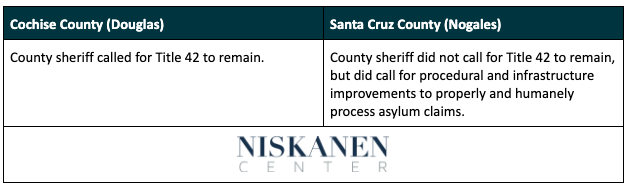
In an April 2022 letter from the National Sheriffs’ Association to political leaders, the Cochise County sheriff, among others, urged federal leaders to keep Title 42 in effect. Santa Cruz County Sheriff Hathaway called for “bolstered procedures and infrastructure to properly and humanely process all types of entry claims at the border,” including more immigration judges as a solution instead of relying on Title 42.
Still, the Santa Cruz County Board of Supervisors expressed concern about lifting Title 42 and the strain this would cause on enforcement activities and humanitarian relief for “those seeking to cross into our country.” Their drafted letter to U.S. senators emphasized the need for additional resources for border communities and migrants. It also called for more resources for the broader community, non-profit organizations, the principal enforcement and federal support agencies (including CBP), and the Department of Health and Human Services.
Conclusion
An examination of two neighboring counties covering 138 miles of the Arizona border with Mexico reveals differences in opinion and policy toward the situation at the U.S. southern border. Cochise County has liberally pursued and spent state funding, while Santa Cruz County has engaged minimally with state resources. A shipping container border wall was accepted ten miles from the Cochise County border, whereas next door, the Sheriff of Santa Cruz County threatened to arrest any contractors placing containers in his county.
Nevertheless, both county sheriff’s offices have actively pursued programming to address the border. The Cochise County Sheriff’s Office’s programmatic efforts have focused on enforcement, while the Santa Cruz County Sheriff’s Office’s programming centers on bilateral relationship building with law enforcement across the border in Mexico and improved processing.
National discourse about the southern border must account for the policies and experiences of border communities. While the more stringent approach adopted by Cochise County is understandable given their greater amount of migrant traffic, it is not clear that their greater use of funds on deterrent measures has led to better results. The lesson from these two Counties portrays a microcosm of what we’ve demonstrated before: At both the local and national level, resources should not be limited to or focused on deterrent measures and should instead encompass a wider range of border responses that include migrant processing, legal services, and specialist staffing.
Photo Credit: iStock