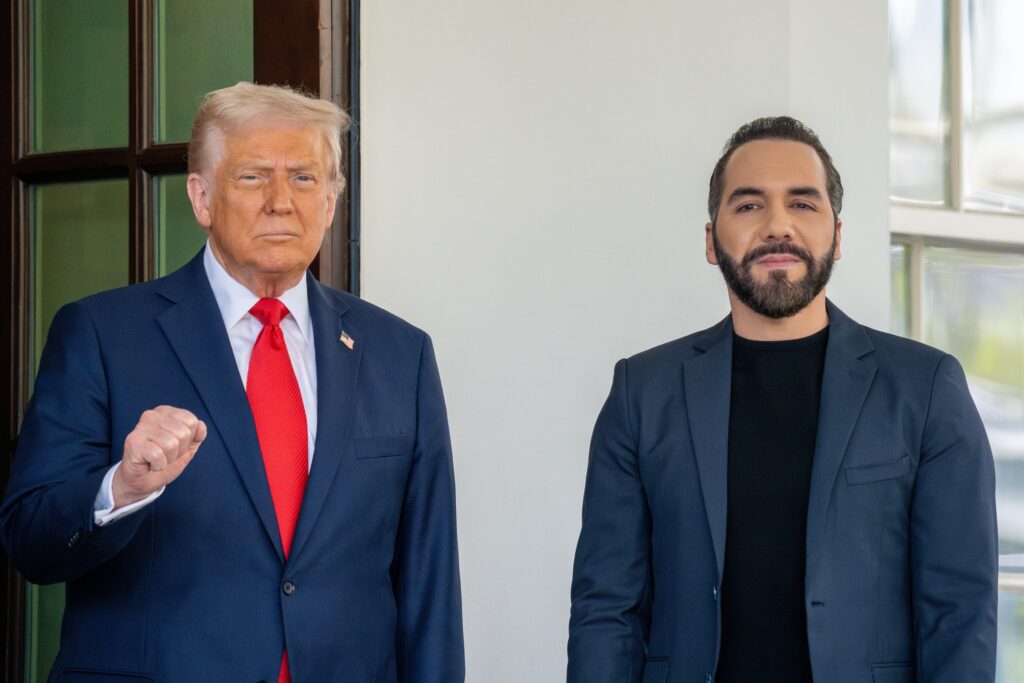
This article originally appeared in the Dispatch on August 5, 2025.
El Salvador’s president has finally secured the changes that will enable him to serve in office for life.
By a 57-3 margin, El Salvador’s Legislative Assembly last week approved constitutional amendments eliminating presidential term limits and extending presidential terms to six years while removing runoff election requirements. The changes, which modify five articles of the 1983 constitution, represent the culmination of President Nayib Bukele’s systematic institutional restructuring that began with his 2019 electoral victory and accelerated after his party gained a legislative supermajority in 2021.
Bukele’s consolidation of power comes as the United States is cooperating more closely with El Salvador on security and immigration issues than ever before. In February, Bukele agreed to accept deportees at his now-infamous CECOT prison in exchange for $6 million annually, and a new El Salvador Congressional Caucus was formed last year to further Salvadoran ties in the legislative branch.
Bukele’s controversial role in the Trump administration’s mass deportation push has cemented support for him from many Americans on the right, or at least provided a practical reason not to openly criticize his authoritarian tendencies. While the sympathies some conservatives have for Bukele is understandable, historical precedents from Venezuela and Nicaragua indicate that authoritarian consolidation—regardless of short-term security gains—will likely eventually generate the migratory pressures and anti-U.S. postures Bukele’s defenders seek to avoid.
From military rule to term limits.
Understanding the significance of these constitutional modifications requires examining El Salvador’s post-civil war electoral architecture and the central role that term limits played in preventing authoritarian consolidation. The prohibition on consecutive presidential reelection, originally enshrined in Article 152 of the 1983 Constitution, reflects bitter experience from El Salvador’s history with military rule and the civil conflict that began in 1979 and claimed over 75,000 lives, according to the United Nations-sanctioned Truth Commission of El Salvador.
This constitutional framework successfully facilitated peaceful transitions between ideologically opposing parties in the wake of a peace process. The conservative ARENA party governed from 1989 to 2009, followed by the leftist FMLN from 2009 to 2019. The ruling party’s legitimacy derived partly from the presidency’s five-year single-term structure, which constitutional framers designed to prevent the personalist rule that had characterized El Salvador’s authoritarian past.
In 2014, however, the section of the country’s Supreme Court dedicated to addressing constitutional questions known as the Constitutional Chamber issued a ruling that allowed presidents to seek non-consecutive terms if they sat out two terms while maintaining the core prohibition against consecutive reelection, creating interpretive ambiguity. This precedent established the legal foundation for future reelection debates that Bukele’s allies would later build on.
Bukele’s 2019 election, in which he captured 53 percent of the vote as a minor-party candidate after being expelled from the FMLN, reflected genuine democratic demand for change. His campaign effectively exploited widespread frustration with the failure of both traditional parties to address gang violence, corruption, and economic stagnation.
