Baltimore has spent much of the past 50 years with an infamous reputation as one of America’s most violent cities. In 2021, 337 people were killed in the city, the vast majority of them with guns. That year, the city’s homicide rate was 58.6 per 100,000 residents, more than eight times the national rate and roughly twice the rate in Chicago, another city that frequently draws public attention for its gun violence. Among large American cities, only St. Louis’s 68.2 homicides per 100,000 residents was higher.
Then something remarkable happened. Between 2022 and 2025, Baltimore’s homicide rate plunged by approximately 60 percent before falling another 10 percent through September 2026. While homicides declined in most large U.S. cities during this period, Baltimore’s decline was exceptional, outpacing every other major city in the United States.
What’s more, while the decline in homicides in most U.S. cities came on the heels of a steep increase in lethal violence during the COVID-19 pandemic — and thus may reflect, in large part, a reversion to the mean as life returned to normal — Baltimore was one of a handful of cities in which the number of homicides didn’t rise during the pandemic.
This means the dramatic drop in homicides in Baltimore after 2022 defies the usual explanations given for the recent fall in homicide elsewhere.
By 2025, Baltimore was no longer an outlier in the homicide distribution. The city that had experienced 337 homicides in 2021 had only 133 just four years later, a homicide rate on par with Chicago and Philadelphia in the years before the pandemic. As of October 1, 2026, Baltimore had experienced just 83 homicides for the year, on pace for a historic low: 2026 will likely have been the safest year in Baltimore in the last 60 years.
But there is an important qualification to this story. In Baltimore, while homicides declined, other violent crimes did not. In fact, the city’s rate of less serious violent crimes closely tracked comparable U.S. cities during this same period.
In other words, what happened in Baltimore was not simply a great crime decline or even a great assault decline. It was a great homicide decline.
Known entities
That distinction matters because homicide is an unusually concentrated form of crime. The individuals involved in shootings are not a random slice of the population. Instead, violence tends to be embedded in relatively small networks of very risky people who know one another, interact with one another, and sometimes find themselves involved in cycles of retaliatory violence. Importantly, many of these individuals are already known to law enforcement. In the Baltimore Police Department’s Western District, long known as one of the most violent areas of the city, we found that approximately 70 percent of homicides stemmed from interpersonal disputes involving members of gangs, drug trafficking organizations, robbery crews, and other criminally active groups. We identified just 18 criminally active groups — with an estimated 615 to 735 members total — comprising roughly 2 percent of the district’s population.
The empirical regularity that lethal violence is highly concentrated is potentially important for how cities try to prevent violence. If a relatively small number of people and groups are responsible for a disproportionate share of shootings, and if they can be identified ex ante, or before violence escalates, public officials may not need to increase police enforcement everywhere in order to meaningfully reduce the most serious violence. Instead, they can concentrate law enforcement and other resources on the individuals and networks that are most closely connected to the most serious violence.
This is the basic idea behind an approach to violence reduction known as focused deterrence. Rather than relying primarily on broad-based increases in police enforcement that widen the net of the justice system (and that tend to have modest impacts on public safety), focused deterrence is a framework designed to identify the small number of people and groups at highest risk of involvement in serious violence and to concentrate resources on them. The strategy is proactive rather than reactive, and attempts to change offender behavior by combining strategic enforcement with social services and community-based action. Individuals who are suspected of committing serious crimes are investigated. Those on the periphery are told that continued violence will bring focused law enforcement attention, but are also offered help to obtain better employment opportunities, a better housing situation, or other forms of assistance that are meant to fortify rather than punish.
The logic is straightforward. An individual who is involved in a violent group may perceive a relatively low risk of being caught for any given criminal action. But if police and prosecutors can credibly communicate that future violence will receive immediate and concentrated attention on the entire group, the individual’s perception of the consequences of criminal activity may change. At the same time, providing employment assistance, counseling, housing or relocation assistance, or other services can make it easier for someone who wants to leave a violent lifestyle to do so. Community members can play an additional role by delivering the message in a way that carries greater legitimacy than a message coming solely from law enforcement. This is very much a carrot-and-stick approach. And there is growing scientific evidence that it reduces crime.
The Group Violence Reduction Strategy
The Baltimore Group Violence Reduction Strategy (GVRS) is a collaboration among the mayor’s office, the Baltimore Police Department (BPD), local and state prosecutors, and several nonprofit and community organizations. Baltimore officials had attempted to implement GVRS in the late 1990s and again in 2014. While these pilot programs generated some promising initial results, both unraveled due to missing strategy components, fractured leadership, and poor coordination within and across partnering agencies. To avoid a repeat of these problems, Mayor Brandon Scott and other city leaders worked with the University of Pennsylvania’s Crime and Justice Policy Lab to design, implement, and scale up a comprehensive and sustainable strategy. From the outset, Mayor Scott placed a premium on building durable systems, ensuring sustained coordination among partnering agencies and increasing the prospects of creating deep institutional change.
The Western District was selected as the initial GVRS launch site in 2021. Problem analysis work focused on identifying the highest-risk places and people and developing a nuanced understanding of violent group dynamics that drove the bulk of the shootings in the district. As data collection and analysis proceeded, project leaders developed the core components of the strategy: enforcement, social service delivery, and communication with at-risk individuals. In parallel, they designed management accountability structures and invested resources to carry out the day-to-day activities needed to launch a powerful response to shooting outbreaks.
Despite intense political pressure from residents and local officials, the city did not implement GVRS until it was ready to do so. Launching a premature version of the strategy would not have been likely to generate the desired results, which would have undermined the credibility of the approach. Once the necessary components and systems were in place, Baltimore launched GVRS in the Western District in January 2022. Once again, there was immediate political pressure to expand the strategy. Mayor Scott, however, held firm to expanding the strategy to other districts only as operational capacity permitted.
Proceeding in three stages
GVRS activities generally proceed in three stages: identification, notification, and action. BPD holds weekly shooting review meetings with law enforcement partners to develop intelligence on recent shootings. A key goal of those meetings is to identify group members who are responsible for the shooting (who are then targeted for investigation) and those who are believed to be at high risk of committing a shooting or being shot. At a separate weekly coordination meeting, BPD, the Mayor’s Office of Neighborhood Safety and Engagement (MONSE), street outreach workers from the nonprofit organizations Roca and Youth Advocate Programs (YAP), and community partners determine the best way to communicate with and deliver services to their clients. A BPD detective, an outreach worker, and a community member customize antiviolence messages to convey to GVRS subjects that they are at great risk of being involved in a shooting; that continued violence will bring law enforcement consequences; that the community disapproves of their violent behavior and the harm it inflicts; and that services and opportunities are available to help them.
As important as these messages are, subsequent action is critical to their credibility. Roca and YAP workers connect with people at risk of violence during notifications, and continue to engage with them by helping them access a range of services including mentoring, cognitive behavioral therapy, education and vocational training, employment assistance, and emergency relocation services. Because the program also views the certainty of consequences as vital to its success, BPD holds monthly GVRS meetings to review which groups are most responsible for fueling violence in the city. For these groups, the GVRS meeting focuses on the progress of investigations tied to group members, and coordinates with state or federal prosecutors to ensure that consequences are imposed on those who are continuing to inflict violence on the community. These coordination meetings are supported by monthly performance reviews in which principal leaders in City Hall, BPD, and the state’s attorney’s office examine GVRS implementation data alongside trends and patterns in homicides and shootings. This management infrastructure created the capacity to scale GVRS from a promising pilot program operating in one district to a citywide violence reduction strategy.
The evidence
To measure the effect of GVRS on homicide and other violent crime, we compared these outcomes in the Western District before and after the program launched in 2022, using other parts of the city to control for crime changes that might have been happening across the entire city for reasons unrelated to GVRS. In basic terms, we examined changes to outcomes such as shootings that occurred in other parts of Baltimore, then subtracted that change from the change in violence that occurred in the Western District. To formalize this comparison, we used a method called synthetic difference-in-differences, which gives more weight to the areas of the city with homicide and violent crime trends before 2022 that most closely matched those of the Western District.
The results were striking. During the first 18 months after GVRS was introduced, the rate at which people were shot or killed in the Western District fell by roughly one-third relative to the synthetic comparison areas. Carjackings likewise fell by about 40 percent. In contrast, we found no detectable effect on more common forms of violence such as aggravated assaults or robberies. This pattern is consistent with the idea that the intervention affected the kinds of crime that are particularly concentrated among the small set of people and groups that GVRS targets rather than producing a general decline in every form of criminal activity.
Importantly, we did not find evidence that violence was simply pushed somewhere else in the city. There was no detectable increase in crime in neighboring areas or in parts of Baltimore with preexisting connections to the Western District groups GVRS targets. The decline therefore appears to represent a reduction in violence rather than merely a geographic relocation of it.
Also of note is that GVRS reduced homicides and shootings in the Western District without widening the net of the justice system. Arrests did not rise in the Western District after GVRS was implemented. Instead, the composition of police enforcement changed: Arrests for nonviolent offenses and drug offenses did not increase in the Western District, but arrests for serious violent crimes increased by approximately 81 percent, and the violent-crime clearance rate rose from about 8 percent to 10 percent. In other words, the police appear to have redirected enforcement toward serious violence rather than simply making more arrests across the board.
This is an important finding because one of the longstanding challenges in American policing is that increasing police activity can produce both benefits and costs. More enforcement can prevent crime, but intensive and broad-based enforcement also generates large numbers of low-level police contacts and arrests. Many of these arrests likely provide little public safety benefit and make life significantly harder for people who are already finding it difficult to remain on the straight and narrow.
How did GVRS achieve these historic improvements in public safety? The available evidence does not suggest that the effects can be explained by a single mechanism. Administrative records indicate that 110 GVRS subjects were arrested as part of the enforcement effort during the study period while 90 individuals took up services that were offered as part of GVRS. Interviews with people the program targeted indicate that many perceived a substantial increase in their risk of law enforcement apprehension and changed aspects of their behavior and social relationships as a result. Participants also described the importance of community members who could deliver the program’s message in a way that felt more legitimate than a purely police-led intervention.
Focused deterrence and Baltimore’s great homicide decline
A final question to ponder is the role that GVRS has played in explaining Baltimore’s great homicide decline since 2021. Any attempt to engage with this question merits some caution as several factors changed around the same time. As GVRS expanded beyond the Western District to other police districts in the city, a new state’s attorney espousing a “tough on crime” approach took office. It stands to reason that Baltimore is also likely benefiting from some of the same national forces that are pulling homicides down elsewhere.
Yet, when it comes to violent crime writ large, Baltimore has not outperformed its peers since 2021. While this could be consistent with a broader change in prosecutorial effectiveness and other social forces, the unique signature — a reduction in homicides but not in other violent or property crimes — is consistent with what we observed in the Western District and is therefore consistent with the expansion of focused deterrence throughout the city.
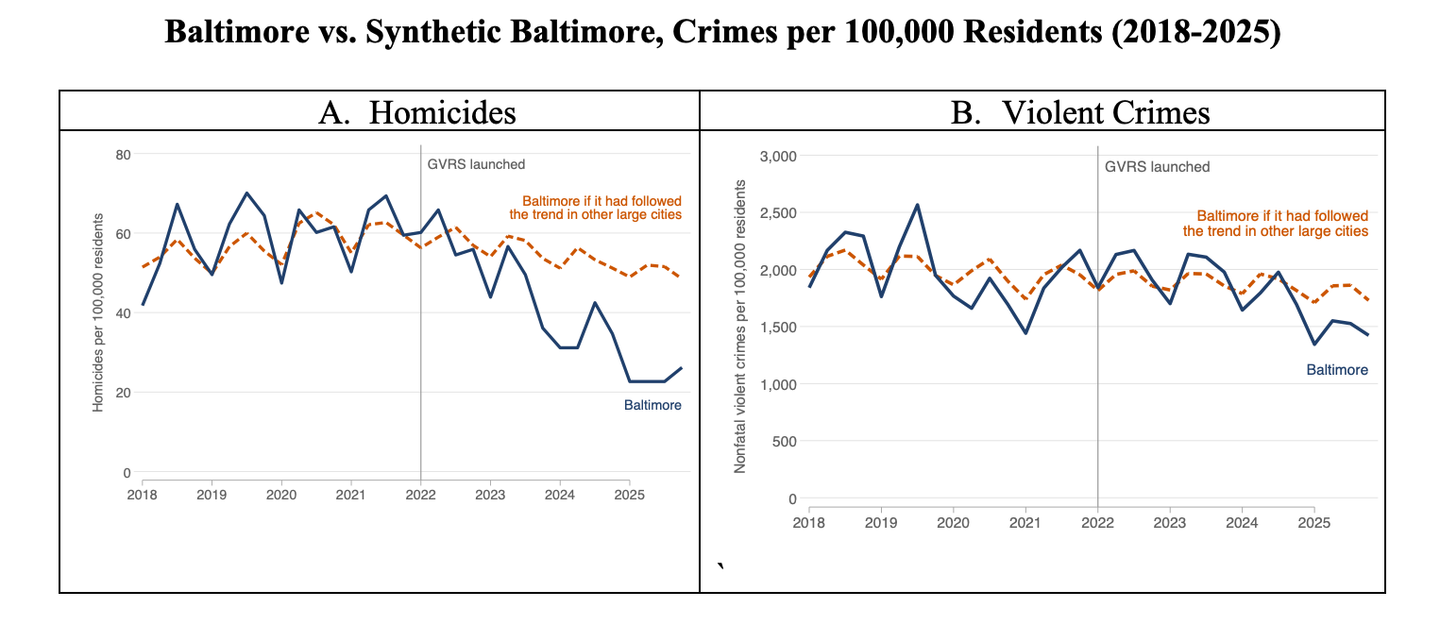
Source: Authors’ calculations using data from the Crime Index and Jacob Kaplan’s Uniform Crime Reporting data files.
Since 2021, Baltimore’s homicide rate has been 25 percent lower than its expected level based on the experience of other high-violence U.S. cities during the same period. How much of the decline in homicides could have been generated by GVRS? It is impossible to know what other factors the success of GVRS may have influenced — for instance, it may have inspired BPD officers to police with greater efficiency and purpose across the board. But taking a conservative approach, if we start with the fact that the Western District accounted for about 16 percent of Baltimore’s homicides prior to 2022, and if we assume that the GVRS effect on shootings and homicides that we estimated in the Western District also applied to the rest of the city, then GVRS would explain about one-fifth of the 25 percent drop in homicides that Baltimore experienced relative to other cities with similar homicide trends. GVRS has since expanded to other parts of the city, and so its contribution to the homicide decline could well be larger than this.
The combination of the within-city evaluation and the intercity evidence tells a coherent story: Concentrating resources on the people and groups most closely connected to serious violence can produce large reductions in shootings and homicides without requiring a broad expansion of police enforcement. Baltimore’s experience suggests that reducing gun violence at scale may not require policing more people. The 110 arrests made as part of GVRS’s enforcement arm represent approximately 0.2 percent of the Western District’s population, but those arrests, in combination with social services and any deterrence effects they generated, had a meaningful at-scale impact that has endured more than four years after GVRS launched.
The challenge, as ever, remains how to institutionalize GVRS’s changes to policing and social service outreach. If Baltimore can manage this, it may one day earn the title Professor Franklin Zimring gave New York: the “city that became safe.”
Jeremy Biddle is the Director of Violence Reduction Policy at the University of Pennsylvania Crime and Justice Policy Lab. Ben Struhl is Executive Director of the University of Pennsylvania Crime and Justice Policy Lab. Max Kapustin is an Assistant Professor of Economics and Public Policy at Cornell University. Aaron Chalfin is an Associate Professor of Criminology at the University of Pennsylvania. Anthony Braga is the Jerry Lee Professor of Criminology and Director of the Crime and Justice Policy Lab at the University of Pennsylvania.