
State capacity, trust, and the product model
State capacity is not an abstract policy concern. It is the government’s ability to turn law, funding, staff, data, technology, and authority into services people can use. When that capacity is weak, public programs can exist on paper while failing in practice. When it is strong, institutions can absorb new mandates, respond to crises, and deliver services with enough reliability that the public can trust them. That connection between delivery and trust begins with an agency’s mission. Its mission defines who it serves, what obligations it carries, and what services it is expected to provide. But a mission statement does not fulfill itself; it only becomes real when the people the agency serves can receive the care, benefit, decision, information, or support the institution was created to deliver.
It begins and ends with trust
Trust is not separate from mission performance. Trust is the public’s judgment about whether an institution can be relied on to do what it says it will do. In government, that judgment is formed through ordinary transactions: whether a user can file a claim, whether a patient can get an appointment, whether a family can understand eligibility, whether a person can find a record, whether an appeal can be tracked, whether an agency follows through when the law creates a new right. Trust is built or lost in those moments.
Trust is not only a reputational measure; it is an operational outcome. An agency that cannot deliver reliably cannot fully carry out its mission, even if its purpose is clear and its legal authority is strong. A promise made in statute still requires an operating system capable of keeping it. A budget appropriation still must become staffing, systems, workflows, data, policy, training, and service. Public trust depends on whether all those pieces work together at the point where a person needs government to act.
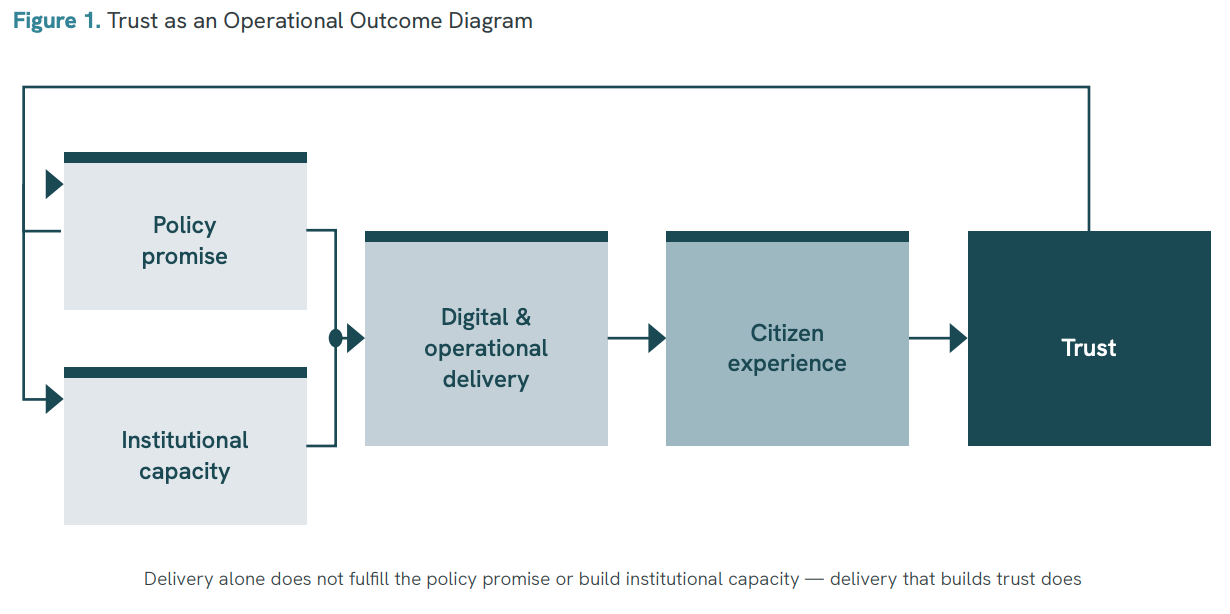
Digital modernization sits inside that larger chain. It is not the mission itself, but one of the principal ways modern agencies build the capacity to deliver their mission. Trust in public services now depends on data, identity and access, digital forms, service desks, analytics, cybersecurity, and cloud infrastructure in ways that have transformed how the government interacts with the general population. If those capabilities are fragmented, outdated, or poorly governed, the agency’s mission will be experienced as friction. If they are reliable, integrated, and designed around the people being served, the mission becomes more accessible.
Modernization alone is not enough
The government has repeatedly shown that new systems can reproduce old failure patterns when they are built through temporary projects, governed through compliance gates, funded in disconnected pieces, and measured by launch dates rather than service outcomes. A project can finish while the service remains confusing; a system can go live while users still cannot complete the task. To shift the paradigm of how operational success is measured and outcomes are truly achieved, a new model is required.
The product operating model organizes work around a product rather than a project. In the case of the Department of Veterans Affairs, the product is its operational capability to apply changes in law, evidence, and workflow to inform and support decisions in a way that can be continuously repeated and improved through cross-functional ownership; a focus on users’ needs; and measurable mission outcomes rather than on temporary projects or one-time technology launches. The core question changes from “Was the system delivered?” to “Does the service work for the person who needs it?” The model also dives deeper and asks: “Who owns the outcome, how is success measured, and how will the service improve as needs, laws, technologies, and demands change?”
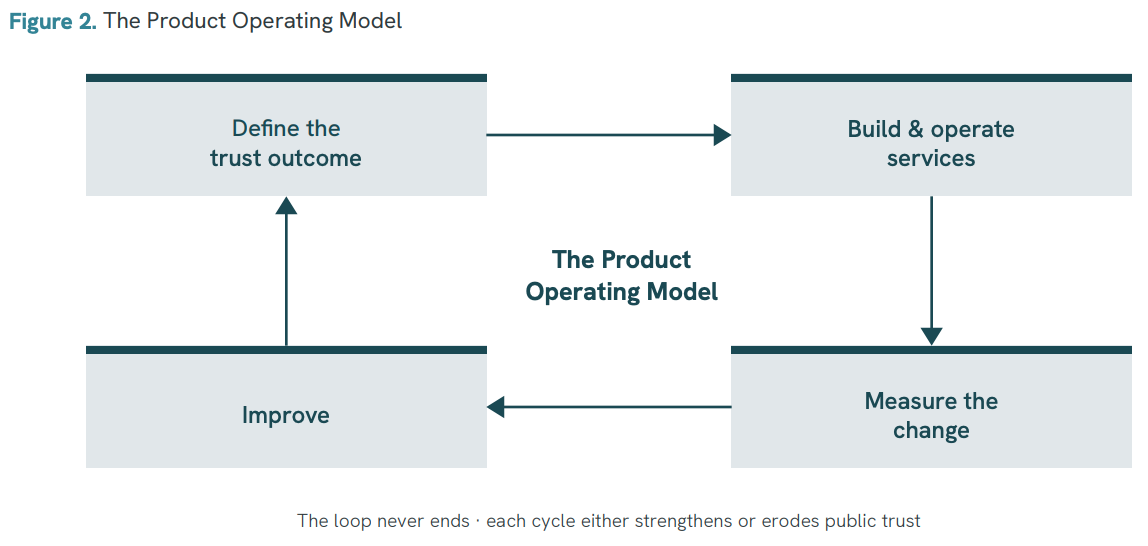
Product management is a trust mechanism: it creates trust by giving an agency a repeatable way to connect mission intent to user need, user need to service design, service design to technology delivery, technology delivery to operations, and operations back to measurable outcomes.
The model is circular: the agency defines the trust outcome it is trying to earn, builds and operates services based on that outcome, measures whether the public experience changed as a result, and then keeps improving. Trust and product reinforce each other because agencies must measure whether their operations produced the intended impact for the people they serve and keep iterating when they do not.
VA as a case study for change
The Department of Veterans Affairs (VA) is an instructive case for examining how state capacity is built, measured, and sustained through service delivery. Over the course of its transformation, VA’s challenge was not only to modernize technology but to align mission, trust, digital modernization, and service delivery within a more coherent operating discipline. The department began measuring whether veterans trusted VA to fulfill the country’s commitment to them, while also building the digital, operational, governance, and product capabilities needed to make that commitment more reliable in practice. In doing so, VA moved from fragmented systems and fractured trust toward an operating model increasingly organized around veteran-facing services.
Other agencies operate at an enormous scale, but VA combines many of the most difficult service delivery domains in one long-term relationship with the same population. That makes the agency a standout test of whether a product operating model can move beyond individual digital products and become a way of building government capacity. Beyond better websites and modernized systems overall, VA needed a way to connect veterans’ needs, statutory obligations, field operations, data, funding, technology, governance, and accountability into services that could keep working over time.
A product operating model approach focuses on clear outcomes. Throughout its decade of transformation, VA made trust a key outcome, asking veterans whether they agreed with the statement: “I trust VA to fulfill our country’s commitment to Veterans.” VA also tracked three related experience measures: ease, whether it was easy to get the care or service needed; effectiveness, whether the veteran got the care or service needed; and emotion, whether the veteran felt like a valued customer. With these trust measures providing a clear feedback loop to connect service delivery to outcomes, veteran trust increased 25 percent between April 2016 and December 2024.1
The evaluation of a delivery ecosystem over a decade
The evidence base for this study includes primary interviews with 23 senior leaders, IT practitioners, and external advisers who worked across VA’s transformation ecosystem from 2015 to 2025. Interviewees represented VA’s Office of Information and Technology (OIT), Veterans Health Administration (VHA), Veterans Benefits Administration (VBA), and National Cemetery Administration (NCA); the United States Digital Service (USDS); congressional staff; and external partners. They held leadership, delivery, field, product, design, oversight, and advisory roles and represented more than 200 combined years of VA and government technology experience.
The analysis also draws on veteran interviews as well as reviews of program materials, customer experience data, legislative timelines, and modernization documents. The findings reveal a decade of institutional change at VA, with uneven but measurable results. The findings track how VA repaired a fractured sense of trust among veterans by moving toward more reliable delivery of services; how it learned to measure and manage trust; how it tied digital modernization to mission outcomes; and how product thinking matured from isolated practices into a broader operating model. The same evidence also shows where the product model did not hold, and how the department used those failures to identify the operating conditions required for service delivery to become durable enough to earn trust.
VA’s transformation is best examined as a comprehensive delivery ecosystem encompassing the full range of its activities. That is because no single office, law, platform, or leader could determine whether the department kept its promises to veterans.
Congress is deeply invested in VA. Full Senate and House committees with subcommittees focus exclusively on VA, and the agency enjoys greater bipartisan support than most government agencies. But this does not put VA beyond comparison to any agency striving to build capacity. Congress shaped VA’s obligations and promises to stakeholders and determined the authorities, funding, and oversight mechanisms available to support its success. VA secretaries and senior leaders set direction and created pressure for enterprise-wide change. OIT built and governed the technology, data, infrastructure, security, acquisition, and product capabilities that made delivery possible. VHA, VBA, NCA, and field organizations translated those capabilities into care, benefits, memorial services, and daily operations. External partners, including the U.S. Digital Service (USDS), vendors, VSOs, and oversight bodies, added talent, pressure, accountability, and operational support.
The transformation advanced when those individuals formed feedback loops focused on veteran outcomes. It stalled when authority, funding, data, operations, or accountability became disconnected. Across the evidence, the pattern is clear: VA’s progress did not come from one reform, leader, platform, or law. It came from connected operating changes that made veterans’ experiences more visible, made enterprise delivery more executable, and made improvement more durable over time.
An instructional model for product delivery
Those operating changes form the building blocks of a product operating model at an agency scale. The model begins with a delivery design built to support what veterans are trying to do in their interactions with Veterans Affairs. It then requires enterprise IT capability strong enough to function across VA’s internal teams. Finally, it requires durability so that ownership, funding, strategy, and institutional knowledge remain attached to services after launch.
Together, the building blocks form a repeatable model for public sector service delivery. VA’s decision to measure trust turned veterans’ experiences into operational signals. Veteran-centered design helped it detect those signals more clearly. Enterprise platforms, governed data, shared language, and operational discipline expanded VA’s capacity to respond. Product ownership, capability-based budgeting, and institutional knowledge gave it a way to continue responding over time. Trust functioned as an ongoing metric that forced the department to ask whether services were getting easier to use and more effective, and whether the institution was becoming more reliable in the eyes of the people it served.
The most important source of this evidence came from veterans themselves. Veterans carried the burden of navigating systems that had not yet been designed around their full lives or needs. They entered VA through hospitals, benefits offices, claims processes, call centers, websites, mobile tools, appeals, survivor services, and field offices. Their experiences revealed where the institution was fragmented, where service delivery failed, and where trust had been damaged. Through their feedback, persistence, and continued engagement with VA, veterans became the clearest measure of whether the department was fulfilling its mission. Their experiences became the evidence base for building a more responsive institution for the future.
The building blocks offer more than a retrospective explanation. They show how trust can be built operationally through a system that continuously listens, responds, measures, and improves. The building blocks also show how state capacity can be strengthened through durable teams, shared platforms, governed data, disciplined prioritization, modern technical practices, field execution, and a constant focus on whether the institution is actually working for the people it exists to serve.
For organizations pursuing a similar transformation, the accompanying playbook offers practical ways to adapt the product operating model to their own mission, constraints, and service environment.
- U.S. Department of Veterans Affairs. Veteran Trust in VA ↩︎