How broken administrative procedures cause both problems
This piece was originally published in Artificial Weights on May 6, 2026.
Policy discourse in the United States today has a split personality. Many condemn how procedural rules thwart not only efforts to build—housing, energy, and more—but more generally keep presidents from achieving their policy ambitions and worsen our “vetocracy.” Yet others lament how presidents are left too free to pursue their policy aims lawlessly or abusively. These concerns are often raised by the same commentators. Even though these discourses are largely about the same topic—the administrative procedures that constrain government action and govern judicial challenges to it—the two have proceeded almost entirely in parallel. The result is a bizarre discourse superposition, where the executive branch is simultaneously excessively and insufficiently constrained.
How can the presidency be simultaneously so powerful that it risks lapsing into autocracy and yet still be so sclerotic that it cannot effectuate its top policy priorities? As I explain in a forthcoming article, the answer is that the right administrative procedures are already in place—they’re just distributed unequally.1
First, executive sclerosis. As explored in popular works like Abundance and academic ones like Adversarial Legalism, the executive branch has been increasingly hamstrung by excessive procedure and litigation alleging procedural violations. These problems are most visible when the executive tries to make changes in the physical world:
- Offshore wind farms were stalled for more than a decade by lawsuits alleging trivial violations of procedural statutes, brought by a coalition of Kennedys and Kochs.
- President Obama sought to fund “shovel-ready” projects in 2009, only to learn that “there’s no such thing as shovel-ready projects” because of the procedural hoops that all federal projects must jump through.
- The first Trump administration’s efforts to build oil and gas pipelines led to few actually getting built because their (admittedly sloppy) work was thrown out in court for violating procedural requirements.
- Prescribed burns that are delayed by procedural requirements keep causing more wildfires in the interim.
- California high-speed rail was approved in 2008, yet a tangle of procedural requirements have led the program to produce no rideable trains to date.
Such problems are by no means exclusive to the physical world. Impediments to rulemaking, adjudication, and other forms of agency action have thwarted many presidential ambitions; just ask any veteran of the Trump or Biden administrations.
At the same time, there is increasing agreement that presidential power poses an autocratic threat.2 The executive is sometimes underconstrained by procedure, leaving it free to act in abusive and illegal ways without judicial check. For example:
- Legislation that was unanimously upheld by the Supreme Court required the ownership of TikTok to divest or have the app be banned. Yet the Trump administration—and the Biden administration before it—disregarded this law without consequence.
- The Trump administration pulled funds from the Second Avenue subway and Hudson River Tunnel projects in New York in an act of political retribution, adding months of expense and delay to these important projects.
- The Trump administration cancelled renewable energy projects like Esmeralda 7, which would have produced enough solar power to power nearly two million homes.
- Not to mention the Trump administration’s attacks on universities, law firms, and the press.
While wildly larger in scope, much of this is not new: for example, the Obama administration also spent billions that it did not have the authority to spend.
The hostile turn and the ad hoc exceptions
Procedure, when properly designed, improves policymaking and checks autocracy. After all, liberal democracy—which imposes fundamental procedural constraints on political power— generates economic prosperity and economic prosperity generates support for liberal democracy. The tragedy is that two shifts over the last 60 years have led our system of administrative procedures to become worse at both tasks.
The first shift is what I call the “hostile turn”: a series of statutory enactments, beginning in the 1960s, that wrapped the government in a straitjacket of red tape beyond the basic requirements of the Administrative Procedure Act (APA).3 There is an entire alphabet soup of statutes—NEPA, NHPA, UMRA, SBREFA, and more—that were enacted as part of this hostile turn, as well as statutory provisions that require certain trial-type proceedings or various kinds of additional actions before a rulemaking or adjudication can be completed. While the details vary, the procedures of the hostile turn generally require (on top of the APA’s requirements) either additional analysis (beyond the APA’s requirement to justify the merits of the action) or additional public input (beyond the cases where the APA requires public comment). Proponents of these laws assumed that requiring ever-more community input and bespoke analyses would produce better policymaking and prevent corruption. But that assumption was wrong.
The procedures of the hostile turn made it enormously more costly and time-consuming for the government to do anything. Again, it is easiest to see this when studying where the government needs to make changes to the physical world. The evidence indicates that these hostile turn procedures led to the cost of interstate highway construction to spike. Building new highway lanes (triggering procedural constraints) has gotten much more expensive than input costs, whereas repaving highway lanes has not. More generally, evidence keeps piling up that construction productivity not only stopped improving around 1970: it started going backwards. That makes sense: the hostile turn imposed high costs and diseconomies of scale on construction firms.
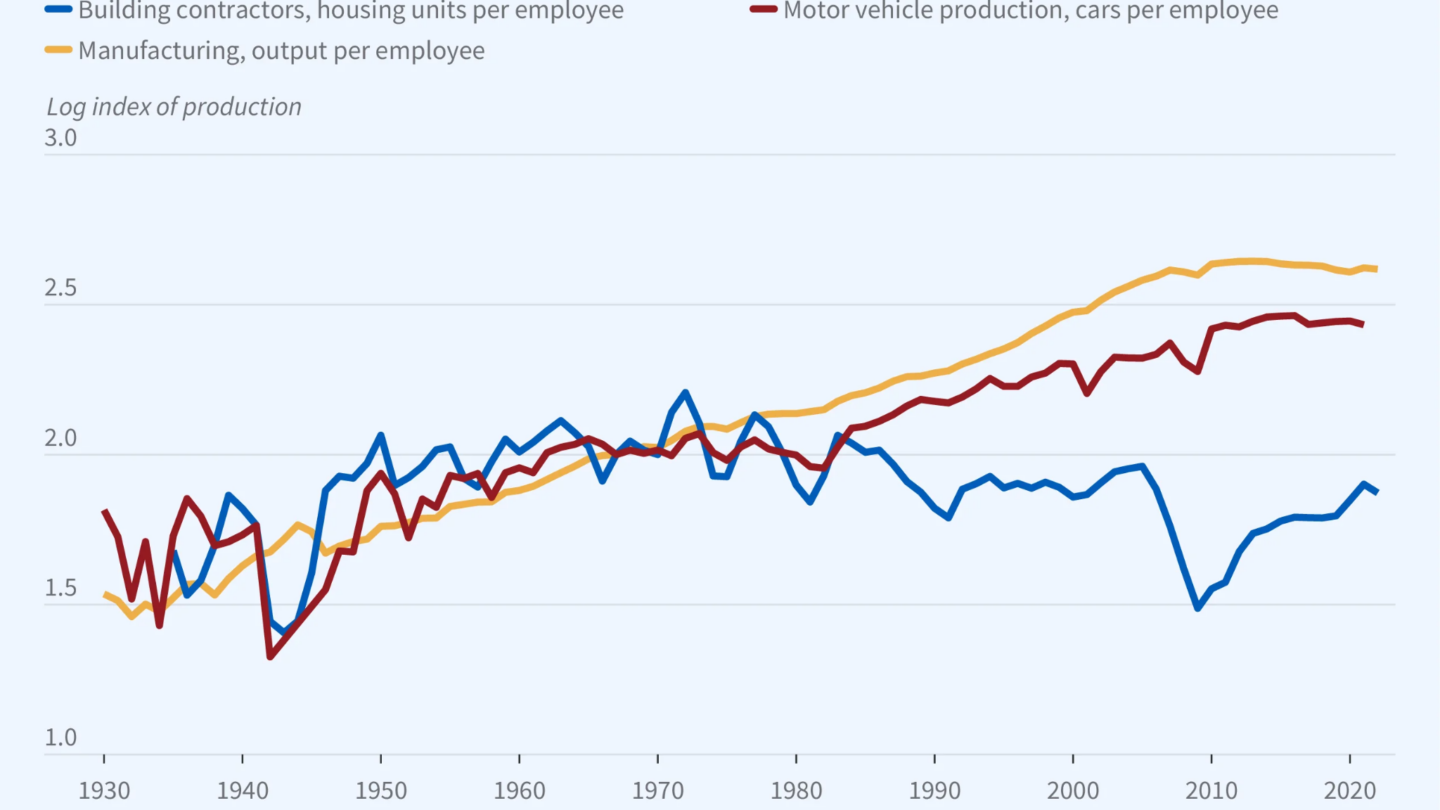
Source: https://www.nber.org/digest/202502/stagnation-us-construction-productivity
These effects in the physical world are just the tip of the iceberg. As noted previously, administrative procedure affects far more than infrastructure projects and the construction industry. Indeed, it touches nearly everything that the government does. There is no reason to think that every other action that agencies take—affecting all sectors of the economy, and a great deal of non-economic activity as well—is not similarly impacted. Consider the FTC’s “click-to-cancel” rule, which took over five years to go through an advanced notice of proposed rulemaking, a proposed rule, three oral hearings (replete with supplemental briefings and cross-examination of witnesses), and a final rule accompanied by a benefit-cost analysis—before being judicially vacated for failure to comply with an early-stage analytical procedural requirement. Quantitative evidence in the domains of physical infrastructure and construction is merely more readily available than in the domains of economic or social regulation.
Not only are the costs of the hostile turn high; the benefits of the hostile turn are tiny,4 doing little to produce better policy or prevent corruption.5 It is the APA, not the procedures of the hostile turn, that ensures that harmed parties can challenge government action that is unconstitutional, exceeds the bounds of statutory authority, or is arbitrary or capricious. These constraints have enabled the bulk of judicial checks on the Trump administration’s abuses of power, as well as those of its predecessors.
The Trump administration’s effort to stop construction of a wind farm that was already 80% complete? Ruled to be “the height of arbitrary and capricious action,” and swiftly blocked just one month later.6 Its attempt to block New York City’s congestion pricing scheme? A judge held that it “exemplifies arbitrary and capricious” action, and vacated it. The administration’s cap on indirect cost reimbursement rates for research grants? Blocked in an APA suit. The attempted removal of Guatemalan children at risk of being killed or trafficked in their home country? Challengers forgot to cite the APA, but that was legally irrelevant, and they won before a Trump-appointed judge anyway.
Yet as the hostile turn has taken shape, a second—and largely overlooked—shift has also taken place. I call it the “ad hoc exceptions”: some little-known changes to the law (primarily driven by the Supreme Court) that have left gaping holes in the APA’s protections, particularly in the areas of presidential action and discretionary spending. Wrongly believing that constraints in these domains were unnecessary and counterproductive, the judiciary created a situation in which whole domains of lawless and autocratic actions became unconstrained by any procedural rules.
First, presidential action. In 1992 the Supreme Court (“out of respect for … the President”) ruled that the President was not subject to the APA. That might not have mattered much, if there were other effective ways to sue the President for violating the law, as the Supreme Court hinted in 1994. But the Supreme Court has continued to narrow these non-APA (“ultra vires”) challenges, leaving presidents free to use and abuse an enormous range of statutory authorities largely free from any judicial check; for example, exempting politically connected firms from tariffs.
Second, courts used to check abuses related to discretionary spending, just like other types of government action. But the Supreme Court went the other way in 1993, arguing that Congress was better positioned to check lawless or unreasonable executive action in this domain than the courts. Without the ability to check arbitrary actions relating to discretionary spending—and with a Congress incentivized to not check the President—an unrestrained executive can leverage grantmaking and related powers to abusive or autocratic ends.
We can do better
Many dysfunctions that the “abundance” movement is focused on are downstream of excessive and low-value procedures. But the solution is not a government free of all constraints, bristling with the potential to wield power in autocratic and corrupt fashion. Rather, our current regime of administrative procedure can be improved in ways that would both enhance the government’s ability to realize its policy ambitions and better constrain autocratic abuses of power. We can and should replace bad procedures with better ones.
Too often, those correctly attacking the “procedure fetish” have been exclusively negative, providing reasons to relax or remove procedural constraints. But to ask if there is “too much” or “too little” procedure is the wrong question. The benefits and costs of any particular procedural constraint depend on the others that exist alongside it. The question is what system of procedure is collectively optimal. And when stepping back to design that system, the evidence is clear that we do not have to choose between a government that can accomplish its goals and a government that is not autocratic.
How to fix administrative procedure
Fortunately, both the left and right want the government to effectively implement valuable policies while constraining abusive or lawless action. (They just emphasize the former when they hold the presidency, and the latter when they do not.)
Three reforms would make progress towards both goals:
First, the hostile turn procedures generally force agencies to receive some form of special input, or to conduct some kind of bespoke study, before acting—on top of the public comment and reasoned action requirements of the APA. These additional procedures do almost nothing to stop corrupt or autocratic action, but cost agencies enormous amounts of time and money. That is a bad deal: they should be repealed immediately.
Of course, it is worth putting extra requirements on the government before it takes certain kinds of actions, because of their importance. Fortunately, with more low-value procedures swept away, there would be room to require that a small set of particularly important decisions be based on a rigorous benefit-cost analysis. Unlike special input or bespoke study requirements, which lack any strong evidence of efficacy, there is some rigorous evidence that benefit-cost analyses help to reduce cognitive and partisan biases.
Second, there have been proposals from some in the abundance movement to cut through the procedural thicket by simply making those procedures judicially unenforceable. This is a bad idea. Barring the courthouse doors hits all procedures equally, valuable and counterproductive alike. In instances where judicial checks have been entirely eliminated—such as the previously-discussed discretionary spending actions and presidential actions, as well as border barrier construction—there has been a great deal of poor decisionmaking and executive overreach.
That said, it is important to constrain rogue judges. Judge and forum shopping empower the most extreme judges in the country to be the limiting factor on executive action; simple reforms could end these tactics. The judicial review loopholes that administrations have exploited around spending and presidential action should be closed as well.
Third, and finally, while those in Washington, D.C. love to fixate on the federal government, state and local governments are often far more important contributors to sclerosis in the physical world that abundance proponents focus on. If state and local impediments to building national priorities are left unchecked, even an ideal set of federal reforms are not going to solve the housing crisis, bring energy prices down, or realize any high-speed rail dreams.
Fortunately, the federal government can ensure that obstruction without a valid basis is thwarted without displacing the appropriate role for state and local governments. We can learn from prior successes in solving similar problems, such as the limited preemption approach that facilitated the buildout of cell phone towers, to tackle the problems of today.
In future writing, I will dive much deeper into each part of the argument in my forthcoming article. These pieces will get into the details regarding how procedural reform can do more to create abundance and constrain autocracy; subscribe to my Substack, Artificial Weights, to get alerted when each comes out. And if you have questions or disagreements, I would be happy to address them in future pieces, so fire away!
- With apologies to William Gibson.
↩︎ - Although commentators are not consistent regarding which president is the would-be autocrat.
↩︎ - The APA, enacted in 1946, largely codified procedural requirements that had developed over the first half of the twentieth century, with only a few innovations.
↩︎ - The benefits of substantive constraints—the Clean Air Act, Clean Water Act, National Traffic and Motor Vehicle Safety Act, Highway Safety Act, Occupational Health and Safety Act, etc.—are enormous, and should not be conflated with the value of the procedural constraints of the hostile turn.
↩︎ - To the best of my knowledge, the sole case during the second Trump administration where any of the hostile turn statutes constrained an alleged abuse of power blocked the conversion of a warehouse into an immigrant detention center. (While there was also a NEPA challenge to “Alligator Alcatraz,” the district court’s opinion was overturned on appeal less than two weeks later.)
↩︎ - When the Trump administration tried again to halt five more offshore wind projects, they went 0-5, with all five efforts rejected within six weeks.
↩︎