This explainer is part of the Niskanen Center’s ongoing series on HVDC’s role in the nation’s electrical grid. The series aims to equip policymakers with clear, accessible information and ideas on how to modernize the grid to meet the country’s current and future energy needs.
Since the turn of the 20th century, alternating current (AC) transmission lines have formed the backbone of the U.S. electric grid. But as the need for the grid to move larger volumes of electricity across longer distances grows, direct current (DC) transmission is emerging as an increasingly important tool. AC remains well-suited for many applications, including powering our homes, but DC offers distinct advantages for long-distance power delivery, including greater efficiency. Understanding the physics behind why DC electricity performs so well over extended distances is essential to designing a grid capable of meeting our growing energy needs.
A brief foray into (some very simple) physics: Current and voltage
To understand how transmission lines can send power over long distances, we first need to understand some fundamentals of electricity.
Current is the rate at which the electric charge flows in a system, while voltage is the force that drives the electric charge in a direction. The amount of power that flows over a transmission line is a product of its current and voltage. Some power is always lost to heat as a result of this flow, and the losses increase with the distance and the rate at which power travels along the line. When power is transmitted over long distances, the only way to control losses is to lower the current and increase the voltage to maintain the desired level of power flow.
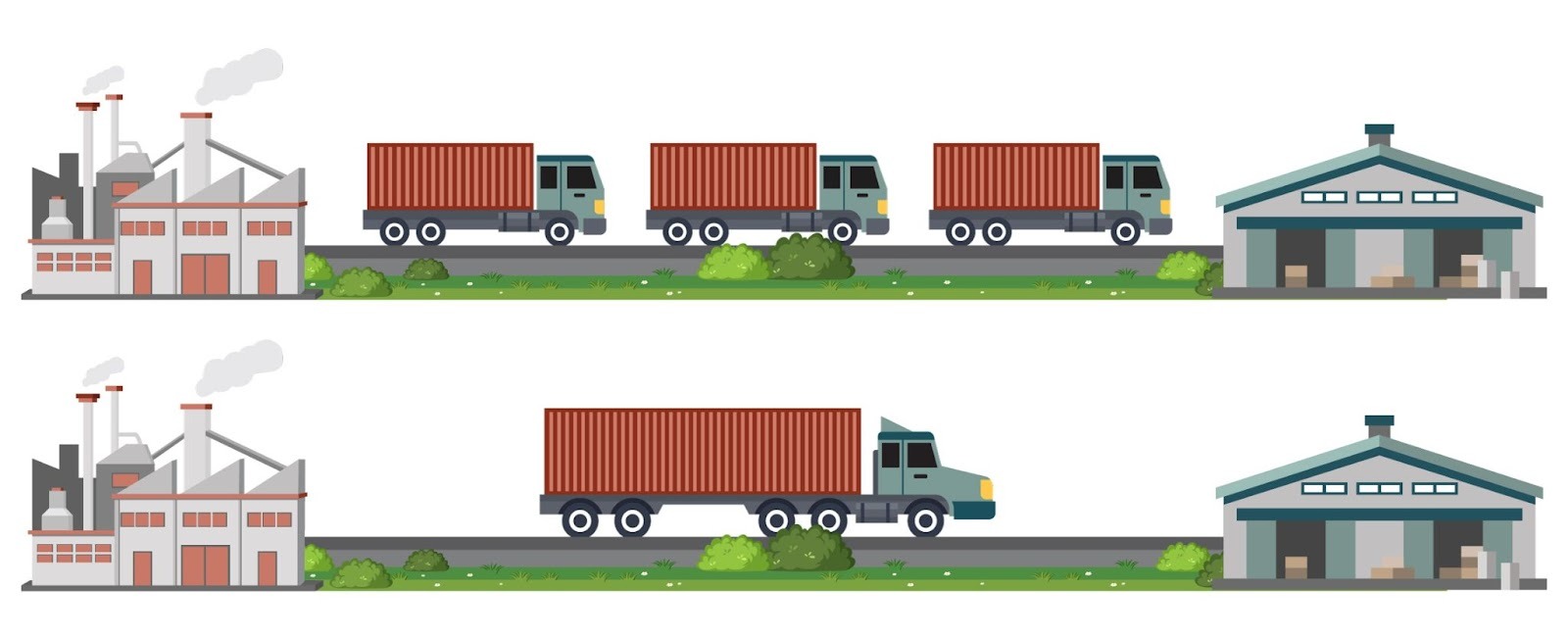
High voltage, low current systems are the most efficient way to transmit power over long distances. Like a package delivery system, it is far more efficient to load all the packages into one truck and drive them a long distance to an endpoint, instead of loading them into multiple trucks that will all go to the same place anyway.
Practical benefits of direct current power
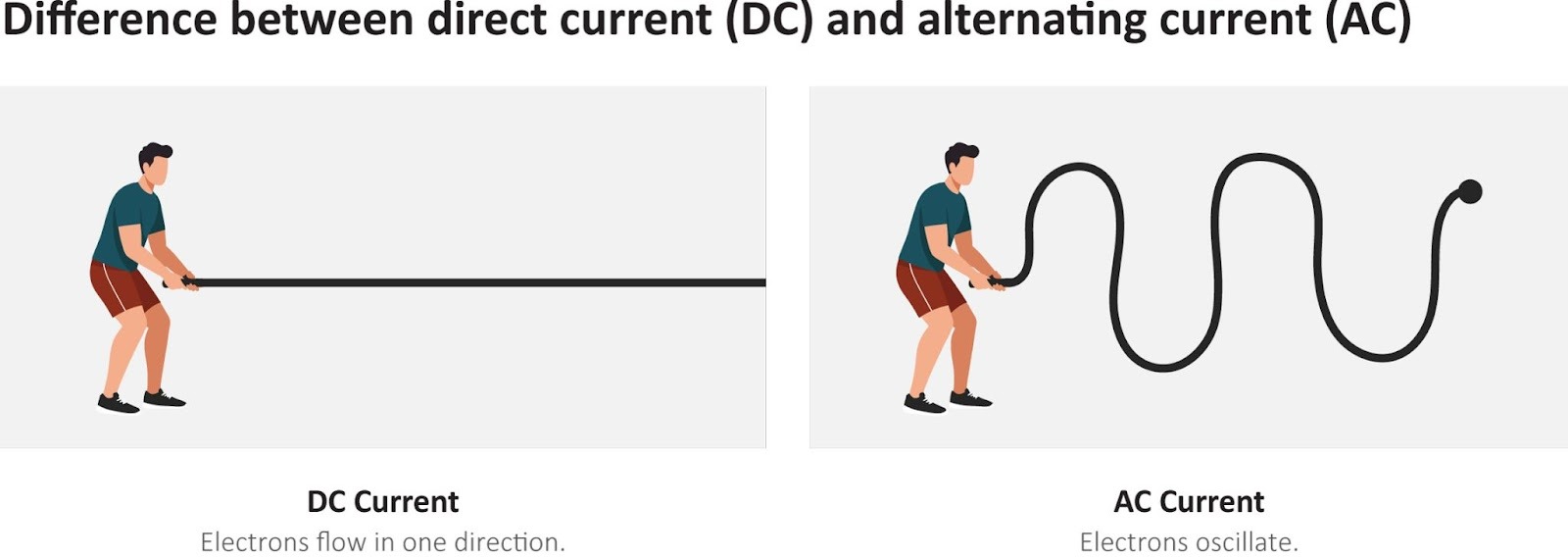
Electrons move differently in AC versus DC power, and serve a distinct role in power transmission. In DC systems, electrons move in unison in one direction, creating a direct current. In AC systems, the electrons oscillate as they move, creating an alternating current.
Imagine using a rope to mimic the flow of the electrons in each case. Direct current is easiest to start and to maintain: simply pick up the rope and hold it. Alternating current is a lot more work: picking up a rope and making it wave is itself a workout routine. And the longer the rope is, the harder it is to start and maintain those waves. The same concept is true in electric transmission. Since there’s no waving involved, DC systems are easier to start and maintain at long distances.
But the question remains: If DC electricity is so easy to use, why isn’t everything powered with DC? The answer is simple: the U.S. grid was not built for it. Even though both AC and DC power were developed in the late 19th century, the so-called War of the Currents that followed determined that the makeup of the grid would be AC, which is why grid operators need to convert electricity from DC back to AC to make it usable today.
Implementing direct current
Since DC power does not directly power our homes and businesses, the power must be converted to AC before use. This is the easiest way to take advantage of the stability DC power has to offer when it is sent long distances using high voltage low current transmission lines. The converter stations that are responsible for converting the power from DC to AC are very expensive to build, so typically only specific applications or very long DC transmission lines can justify the cost.
Transmission owners in the U.S. currently operate nearly 2,400 miles of HVDC transmission lines, demonstrating that the technology is viable at grid scale. Yet this total pales in comparison with the extensive HVDC networks abroad; China alone has over 7,000 miles, even though the two countries are about the same size. In the U.S., regulatory and market barriers, not technical limitations, have been the biggest constraint on broader HVDC deployment, and regulatory and legislative reforms could unlock significantly greater adoption. AC transmission will continue to serve as the foundation of the electric grid, but the physical realities of long-distance power delivery make HVDC an increasingly valuable complement. As demand grows and system complexity increases, HVDC can play a key role in enhancing efficiency and system stability.