
The federal Centers for Medicare and Medicaid Services (CMS) last week released No Surprises Act (NSA) payment data for the last half of 2025, providing the public’s first complete look at how the law performed on important cost indicators over the last full calendar year. The data reveal troubling patterns: the volume of billing disputes between medical providers and insurers continues to climb, arbitration awards keep speeding past benchmarks Congress established in the law, and the program itself now costs nearly $3 billion a year.
Without reform, patients will continue to bear these costs — not through the surprise bills the law was designed to eliminate, but through the higher premiums and slower wage growth that follow when insurers pass their higher costs to customers.
For the first time since the law went into effect in January 2022, CMS has called out these high awards, telling The Wall Street Journal that “the system is being gamed.” Driving this gaming is an arbitration structure that fails to anchor awards to a reasonable benchmark, allowing providers an opening to pitch — and win — higher amounts year after year. Our analysis of the data shows that specialties such as neurology and surgery are typically pulling in awards 15 to 25 times the statutory in-network benchmarks.
The No Surprises Act sought to protect patients from surprise medical bills for out-of-network care. To resolve out-of-network payment disputes between insurers and providers, Congress established an independent dispute resolution (IDR) program in which third-party arbitrators choose between competing payment offers from providers and insurers, taking the patient out of the process entirely. More than four years later, consumers are protected from these unexpected medical bills, an accomplishment that should be lauded.
However, mounting evidence shows that the NSA IDR program is not working as Congress intended, and the unintended consequences are costly.
Costs continue to climb each quarter
The 2025 data reveal an almost 75 percent increase in the number of disputes initiated from the year before, with more than 2.5 million disputes initiated and nearly 2.2 million payment determinations decided. This is in stark contrast to the federal government’s original estimate that the IDR program would receive about 17,000 cases a year. Consistent with our previous findings, providers are winning the vast majority of disputes (Figure 1). The share of decisions favoring providers grew throughout 2025 before dipping slightly in the last two quarters of the year.
Figure 1. Providers are still winning the vast majority of disputes
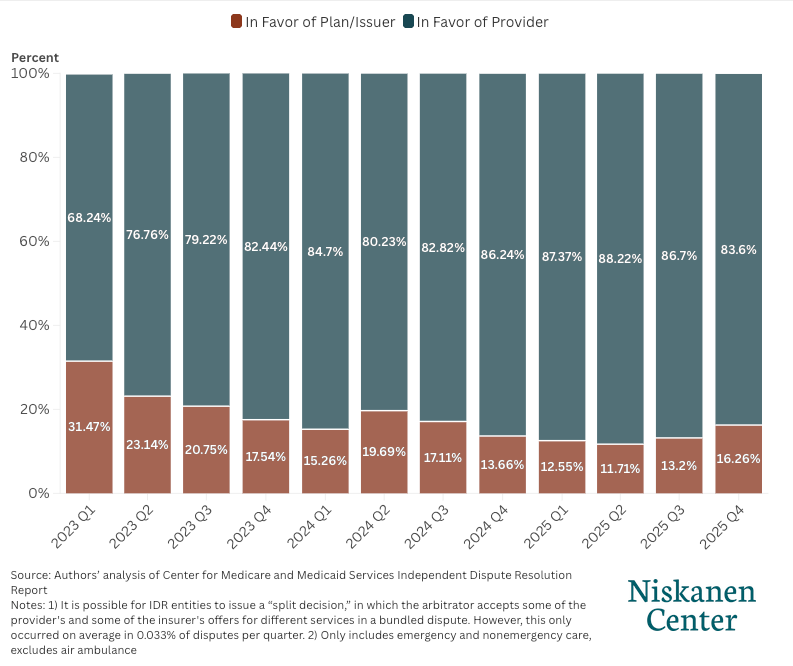
To resolve out-of-network bills, the IDR program requires billing disputes between medical providers and health plans to go before an arbitrator. Each side submits a single offer along with any supporting evidence and an arbitrator selects one or the other. To guide those decisions, Congress established a baseline qualifying payment amount (QPA), which is the median in-network rate that the insurance company in a given dispute pays for that service.
But arbitrators have consistently ruled in favor of providers. Encouraged by their success, providers have steadily driven up the median winning offer to where it is now four times the QPAs that Congress established (Figure 2). In contrast, insurer offers have remained at the QPA.
Figure 2. High provider offers continue to drive IDR awards far above median in-network rates
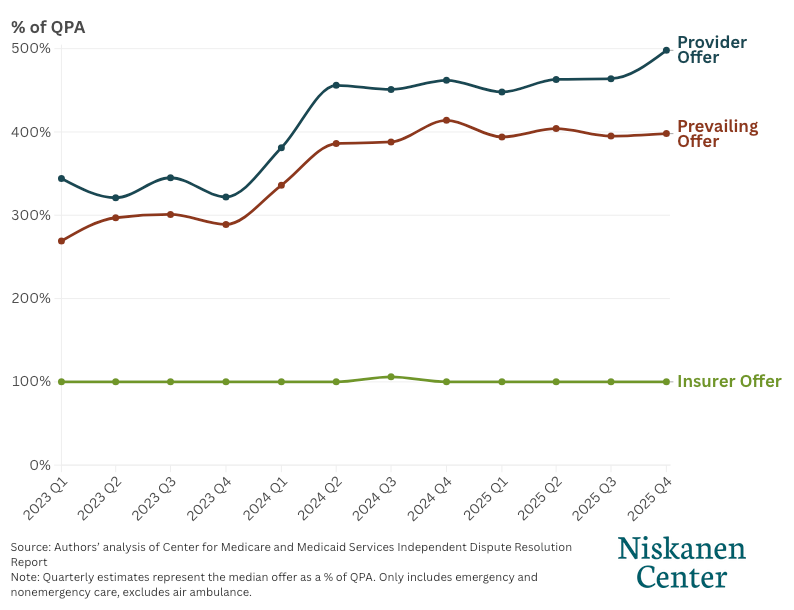
These analyses use public-use files and supplemental tables released by CMS. We acknowledge that there are some implausibly high award amounts in the data. To temper this, we use the median prevailing offer as a percent of the QPA, which is not impacted by extreme outlier awards. And even after winsorizing the prevailing offer data at the 90% level, the medians and broad trends remain the same.
In the final quarter of 2025, the median provider offer jumped sharply to five times the QPA. The new data emerge against the backdrop of several media accounts of eye-popping awards to providers for routine services and procedures. One plastic surgeon practicing in New York and Florida, for example, reportedly earned $440,000 for a breast reduction surgery decided through arbitration, a procedure advertised as costing between $15,000 and $25,000 on average. According to data from Turquoise Health, a healthcare transparency platform, out-of-network providers are earning $34,000 for a common spine surgery — 24 times the median price of $1,400.
Primary surgeons are not the only ones who appear to be cashing in. Recent reporting from The New York Times demonstrates that, in some cases, out-of-network surgical assistants, who typically help surgeons with such tasks as stitching up patients postsurgery and handling equipment, are earning orders of magnitude more than in-network surgeons for common procedures. For example, an in-network surgeon in Texas was paid $1,843 for a prostate-removal surgery for which an out-of-network assistant was paid $50,456, more than 27 times higher.
The trend defies the conventional logic of compensating highly skilled surgeons more than mid-level providers for their services.
Taken together, this data and media reporting suggest that some providers may be abusing the IDR system for financial gain. While many of the most common claims like emergency services, anesthesia, and imaging are seeing similar payout levels, consistent over time, our analysis reveals two notable exceptions among the top five specialties by volume: neurology and surgery.
Figure 3. Neurology and surgery are driving high winning offers
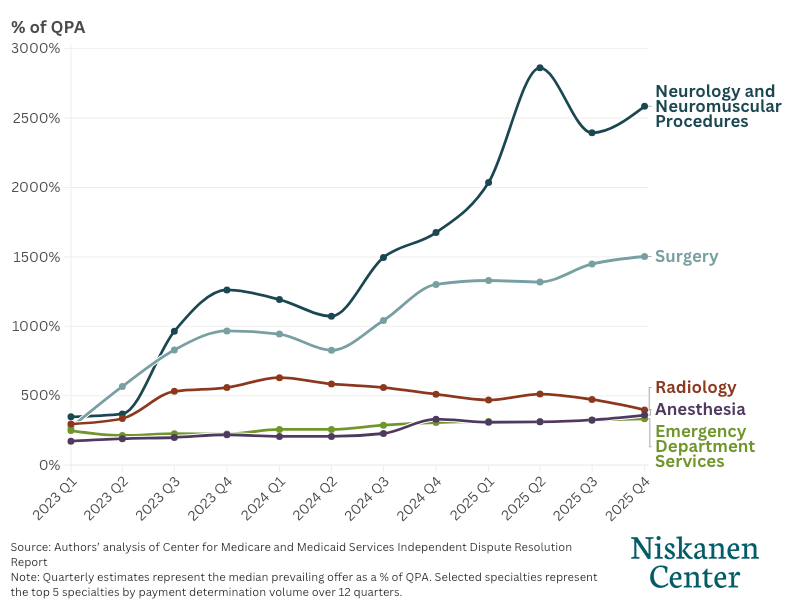
The median prevailing offer for neurology and neuromuscular procedures has increased sharply over time, reaching nearly 30 times the QPA in the second quarter of 2025. Surgery offers have also increased over time, ending 2025 with a median prevailing offer reaching roughly 15 times the QPA.
Notably, emergency department service disputes account for more than half (nearly 54%) of the volume among the top five highest-volume specialties, followed by radiology (19.6%), anesthesia (9.6%), surgery (9.3%), and neurology and neuromuscular procedures (7.6%). Although surgery and neurology account for relatively lower volume among the highest-volume specialties, their prevailing offers are so far above the QPA that even a modest share of disputes translates into an outsized share of total award amounts.
Administrative waste grew in 2025
The high volume of cases in arbitration has resulted in significant administrative and legal cost growth over time. We found that by the end of 2025, total costs imposed by the IDR program now surpass $2.8 billion. If these trends continue, the total costs of IDR, combined with large award amounts, could eclipse the savings that the Congressional Budget Office projected the program would save. The majority of these costs are driven by payments to the arbitrators, followed by administrative fees and federal expenditures.
Figure 4. As disputes increase above expected levels, so do program and administrative costs
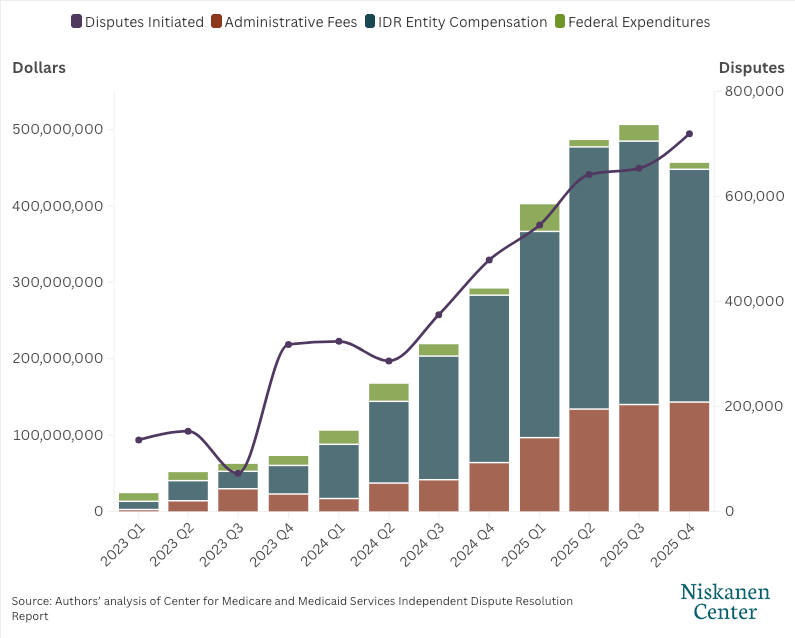
Evidence increasingly demonstrates that the NSA created a lucrative market for companies that specialize in navigating IDR. In 2025, Independent Dispute Resolution Entities (IDREs), the arbitrators, received over $1.2 billion in compensation from the system. In addition to arbitrators themselves, a cottage industry of companies who help manage and file disputes has developed, with one such company, Texas-based HaloMD, bringing in over $1 billion a year on their own. The payments HaloMD and similar IDR management companies receive are not reflected in Figure 4, as CMS only reports compensation directly to arbitrators, not third-parties. But based on reporting, it seems that providers are spending well over $1 billion annually to manage their IDR disputes.
Our analysis shows that in 2025 HaloMD filed more disputes than any other group in the country (19%), followed by private equity-backed provider groups including Team Health (12%), SCP Health (10%), and Radiology Partners (7%). Together, these four companies accounted for nearly half of all disputes initiated in 2025, suggesting that these businesses have successfully discovered how to flood the system and win consistently.
Moreover, each of these provider groups and organizations secured median rates far above the QPA. HaloMD appears to be an outlier among outliers, securing median awards of 920 percent and 835 percent of QPA in each of the first two quarters of 2025. Relative to other providers, private equity-backed provider groups are well-positioned to take advantage of financial incentives embedded in IDR: They are highly motivated to generate quick revenue to meet debt obligations; they have the financial capacity to absorb arbitration fees; and after engaging with IDR for several years, they have the economies of scale to navigate the system efficiently, effectively, and profitably.
Snowballing costs and administrative waste are a symptom of the flawed market incentives underpinning the IDR program. Outsized award amounts, skewed heavily in favor of providers, will ultimately affect healthcare markets and prices. Providers may decide that being out of network is too profitable to pass up, further shrinking patients’ access to affordable medical care.
Indeed, new research from health economists at Brown University warn that the NSA creates an “outside option” for providers to win higher award amounts without the friction from traditional bargaining tactics wielded by insurers. States are already feeling the pain of the high costs from IDR, with New York estimating in its FY 2027 budget that abuses of the program have cost the state over $200 million. State officials cited additional claim payments as a “primary contributor” to increases in premiums.
Patients ultimately bear the financial burden of IDR through higher premiums and higher prices. Without action, the very population that Congress intended to insulate from high costs may be made worse-off.
Recent attempts to address ignore the core issue
Both Congress and CMS have put forward some changes to the IDR system, but neither are focused on the core problem of outsized awards.
On May 28, the Trump administration published a final rule that seeks to increase efficiency and transparency in arbitration while decreasing costs, primarily by trying to reduce the number of ineligible disputes entering the system. The final rule requires payers to use standardized claim codes for out-of-network services to reduce confusion and subsequent ineligible disputes. It also lowers the administrative fee per party from $115 to $15, as CMS is required to match the fee to the costs of the program. The original $115 fee was set when volume was expected to be much lower, and CMS clearly believes that it no longer needs that high of a fee per dispute due to the high volume.
While some supporters of the final rule applaud operational changes that promise to make IDR more efficient, critics argue that it doesn’t go far enough to deter waves of ineligible submissions. Additionally, some experts argue that lowering the administrative fee could actually induce more submissions, incentivizing further abuse of IDR. And the final rule ultimately does not address the exorbitant IDR payment decisions, nor does it treat the system-wide cost burdens stemming from these high awards.
In Congress, the only bill that would amend the No Surprises Act (the No Surprises Act Enforcement Act) would fine insurers who do not make payment to providers within the 30-day statutory deadline and would require increased public reporting on NSA violations and enforcement actions. But no aspect of this legislation attempts to address the high and outsized payments that IDR arbitrators are awarding providers. While it’s reasonable to take action to ensure the NSA is enforced as intended, any action to reform this process should focus squarely on patient-level costs which requires downward pressure on the high and escalating payments currently coming out of the system.
Why are arbitrators making these decisions?
Rather than benchmarking to the QPA, CMS found that “while health plans and issuers often benchmarked their offers to the QPA, providers, facilities, and providers of air ambulance services often benchmarked their offers to past [out-of-network] payment amounts with the disputing plan or issuers and past in-network rates with either the disputing plan or issuer, or with a different plan or issuer in the same state.” Essentially, providers are basing their offers off of old out-of-network payments and the previously high rates they received in contracts with insurers, including other insurers not party to the dispute. Providers are largely ignoring the one benchmark Congress built into the process, and arbitrators are consistently rewarding them for it.
In a new paper, the arbitrators themselves argue why this isn’t a problem. The Coalition of Independent Dispute Resolution Entities (CIDRE), newly created to defend the IDR system, argue that high awards are not the product of the NSA but rather a reflection of “the health care landscape […] at large” where out-of-network providers have greater leverage in a market where patients cannot choose their physician. They add that the QPA, the congressionally set award benchmarks, should be treated “more cautiously” with respect to out-of-network bills, the very claims the NSA’s IDR process was designed to resolve. As health policy scholar Ben Ippolito notes, it’s surprising to see the entities tasked with resolving these disputes downplay the one statutory tool Congress built to keep awards in check.
There are two main problems with the arbitrators’ argument:
First, arbitrators are wrong about the costs of these services. Many of the payments coming out of IDR are significantly higher than pre-NSA allowable out-of-network amounts, even after adjusting for inflation. According to a Brookings analysis of 2024 IDR data, this holds for the very service CIDRE uses as its example: emergency care, where the mean IDR decision landed reasonably close to pre-NSA out-of-network allowed amounts. But it breaks down elsewhere. For imaging, the mean IDR decision comes in at 2 to 2.4 times the pre-NSA out-of-network allowable amount and 1.7 times for neonatal and pediatric critical care.
Second, arbitrators are side-stepping statutory guidance. The statutory payment benchmark in the NSA is based on in-network rates, not out-of-network ones, which cuts against CIDRE’s own framing that payments coming out of IDR do and should reflect high out-of-network prices. Congress went further still, explicitly barring arbitrators from considering usual and customary charges or the amount a provider would have billed absent the law’s protections, the closest analogues to the historical out-of-network payments arbitrators now cite to justify these awards.
It’s important to keep in mind the financial incentives at play. Arbitrators benefit from high dispute volume, and because providers and facilities are initiating 99.9 percent of disputes (as of 2025 Q4), CIDRE has reason to maintain the status quo. But it is not inevitable that this law serves as an active amplifier of pre-NSA market dysfunction — Congress and the administration can and should intervene to fix this program.
Recommendations: The road ahead
Providers and insurers will undoubtedly continue to point fingers and litigate who is at fault. But this IDR dilemma is a new symptom of a much larger, familiar problem: Patients are shielded from the high prices driving their health costs, whether it is in-network, out-of-network, or arbitrated. It’s incumbent upon Congress to root out these abuses and put downward pressure on the awards coming out of IDR. Without change, the No Surprises Act will increase prices, accelerating unaffordability in the healthcare sector for patients.
But both Congress and the administration have levers at their disposal to intervene and reduce dispute volume and overall award amounts, by forcing arbitrators to center the statutory benchmark of in-network rates and by tightening the eligibility screening that allows so many disputes through the system.
There is one, very clear first-best solution:
- Replace IDR with rate benchmarking. This was the original proposal in 2019, when both the Senate HELP and House Energy & Commerce committees initially proposed that insurers pay the out-of-network provider their median in-network rate for that service (the QPA). Establishing a fair, market-based payment standard (either the QPA or a new benchmark) for out-of-network care would not only prevent unnecessary price inflation, it will also reduce the unnecessary bureaucracy and legal costs that come with IDR.
There are other statutory reforms that could better center the QPA in the arbitrators’ decision-making matrix:
- Congress can amend the No Surprises Act to prohibit arbitrators from considering any previous in-network or out-of-network rates a plan or issuer has previously paid for a given service. As this piece has shown, providers continue to benchmark their offers to past out-of-network payment amounts and past in-network rates with other insurers rather than the QPA, and arbitrators continue to reward them for it. Removing that payment and rate history from consideration would push arbitrators toward decisions closer to the QPA — the benchmark Congress actually built into the statute.
Or Congress can amend the No Surprises Act to make the QPA the primary factor in arbitrators’ decisions, bringing final payments closer to the median in-network rate. A 2021 HHS rule that attempted this was struck down by a federal judge who found it conflicted with the statute’s text. A statutory change, rather than a regulatory one, would close that legal vulnerability.
Congress is not the only one with a role. While CMS does not have legal authority to change the substantive factors arbitrators weigh in their decision, it can change IDR’s procedural and eligibility mechanisms to contain the number of disputes shuttled into its law.
Certified IDR entities are paid a flat fee per case. That fee only gets paid when the IDR entity renders a determination, which means IDR entities have a financial incentive to process as many disputes as possible. But arbitrators are also the ones responsible for determining whether a claim is eligible for arbitration, and eligibility is a significant part of this volume problem. Non-initiating parties (typically insurers) challenged the eligibility of 42 percent of all disputes brought against them in the second half of 2025, up from 40 percent in the first half of the year. Every ineligible dispute that enters the system still costs money to process, in IDR entity time and administrative fees.
- CMS should expand automatic eligibility screening earlier in the process, before a dispute ever reaches a certified IDR entity. Screening out ineligible claims on the front end, rather than relying on IDR entities that have no financial incentive to turn work away, would meaningfully reduce the volume of disputes flooding the system.
Without Congress or CMS stepping in to meaningfully reduce the final awards coming out of IDR, the No Surprises Act will continue to serve as a price-inflation machine of its own making, both driving up costs in the short-run and pushing up commercial sector prices in the long-run.
What’s next
The evidence cannot be ignored: The NSA IDR program is driving high healthcare spending through exorbitant award amounts and snowballing administrative costs. At a time when policymakers are dually focused on healthcare affordability and rooting out waste, fraud, and abuse in public programs, reforms to the NSA provide a unique window of opportunity to address both aims and deliver relief to the American people. Although patients cannot see this fight over arbitration awards, without reform from policymakers, they will feel it in higher premiums and lost wages. Before this system gets worse, policymakers should act to rein in runaway costs by reducing both the size of arbitration awards and the volume of disputes.