
The Centers for Medicare and Medicaid Services (CMS) is taking the next step to reduce Medicare’s unnecessary spending in high-cost hospital settings.
Medicare’s payment policies have profound impacts on the supply of healthcare — where, when, and how services are provided to patients across the country. Existing payment policies disconnect the value of healthcare services from their costs. And because much of the healthcare system uses Medicare prices as a baseline for payment, the ripple effects of these distortions spread far beyond into the private market as well.
Through the inpatient only list (IPO), Medicare determines which procedures can’t be performed in lower-cost outpatient settings such as ambulatory surgery centers (ASCs). Medicare also pays hospital clinics more than physician offices for many of the same services — known as site-of-service pricing differentials — even though there is thin evidence of a difference in quality. These price differentials drive vertical consolidation, incentivizing hospitals to buy up independent physician practices to extract higher rates for the same services. Evidence shows that prices are higher in consolidated markets.
In its proposed Outpatient Prospective Payment System (OPPS) rule, CMS attacks these distortions head on by expanding site-neutral payment for imaging services without contrast and further narrowing the IPO list. The proposed rule would also significantly change the 340B program — which requires drug manufacturers to provide steeply discounted drugs to hospitals that serve low-income patients — by more accurately aligning drug reimbursement with the true acquisition costs for hospitals. CMS is building toward the simple principle that Medicare should not pay more for the same care because of who owns the building where it is delivered. Niskanen submitted a public comment supporting several provisions of the proposed rule in August.
Same scan, different prices
CMS’s proposal would implement site-neutral payment for imaging services without contrast such as MRIs, CT scans, and other diagnostic tests in “excepted” off-campus provider-based departments (PBDs). This would ensure that Medicare payments for imaging services are the same regardless of where they’re performed. The agency estimates that this change will reduce Medicare Part B expenditures by $260 million in the first year alone, with $190 million in Part B savings and $70 million in reduced premiums. Because Medicare beneficiaries are subject to a 20 percent coinsurance for services, CMS estimates another $70 million in savings for patients through reduced cost-sharing.
Niskanen’s analysis of 2026 rates for selected imaging services not currently subject to site-neutral payment demonstrates the need for intervention on behalf of beneficiaries and taxpayers (Figure 1).
Figure 1. Hospital clinic prices exceed physician office prices for every service
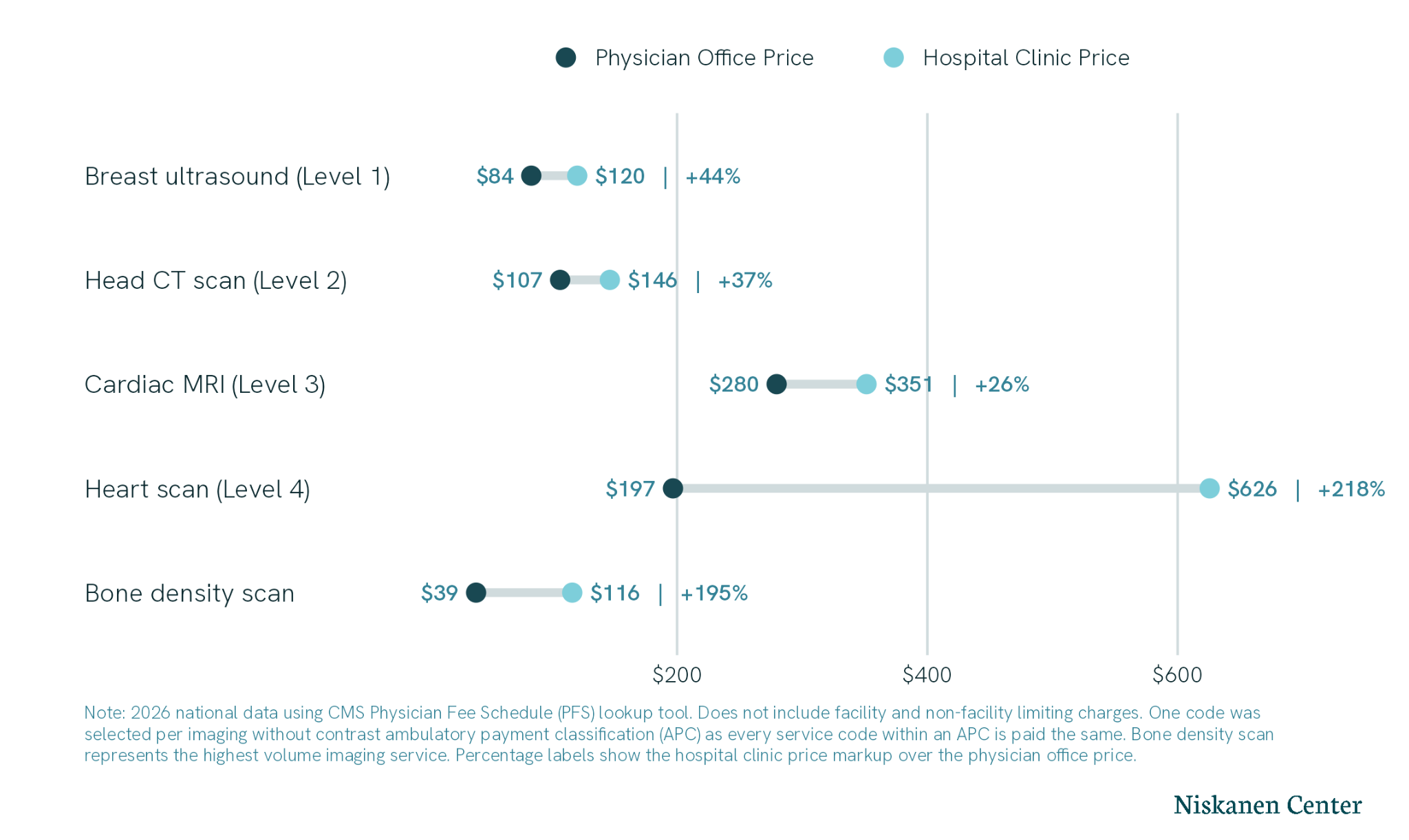
Across different service codes, hospital clinic prices exceed physician office prices for every imaging service. The price of a breast ultrasound performed in a hospital facility is $120, compared with $84 in a physician’s office. The highest volume imaging service in the targeted category — a bone density scan to diagnose osteoporosis — is nearly 3 times more expensive in a hospital clinic than in a physician’s office. A heart scan — a higher-complexity imaging service — is $429 more in a hospital clinic than in a physician’s office.
These price differentials reflect the hospital’s overhead charges, otherwise known as “facility fees,” which do not necessarily cover costs specific to the setting or the patient being treated, just the higher overhead costs for the hospital or health system that owns the facility.
There is no evidence that hospital ownership improves imaging quality, despite substantially higher prices. In its 2023 report to Congress, the Medicare Payment Advisory Commission, an independent congressional agency, identified imaging services as a candidate for “payment rate alignment across ambulatory settings,” suggesting that these services could be provided in physician offices with the same quality but lower cost. CMS appears to be taking these recommendations into account by chipping away at services that can be appropriately provided in a more affordable and efficient setting.
With sharpened public and policymaker focus on the costs of consolidation of the healthcare industry, there is growing recognition of how site-of-service pricing differentials incentivize and influence large hospital systems’ business decisions. There is mounting evidence that large hospital systems are buying up independent physician practices, with an eye toward the profits to be had from higher-fee imaging services. For example, one study finds that changes in hospital and health system ownership of physician practices was associated with more than a $40 million increase in Medicare spending for five common imaging services over the study period, only a fraction of the universe of all imaging services billed to Medicare.
Nor are price concerns limited to Medicare: One recent analysis of the commercial insurance market found that hospital-employed radiologists receive professional rates 43 percent higher than those of independent radiologists. Imposing site-neutral payments for imaging services could curb hospital acquisition of freestanding imaging clinics by eliminating the financial incentive to consolidate, preserving a competitive market and keeping prices down.
Critics of site-neutral payment believe that reimbursement should be higher for hospital outpatient departments (HOPDs) due to their complex patient caseload. But research suggests that the difference in patient complexity across HOPD and physician office settings is small — and CMS is explicitly proposing site-neutral for imaging services without contrast, which are generally lower complexity than imaging with contrast.
Opponents also contend that the broad application of site-neutral payments would further strain hospitals that are already under financial stress, particularly in rural and impoverished areas. But Medicare does not pay critical access hospitals through the OPPS — which make up more than half of rural hospitals — placing them outside the reach of this policy entirely. CMS then exempts rural sole community hospitals, ensuring that the vast majority of rural hospitals are insulated from this change. The hospitals that remain are therefore unlikely to be rural and financially strained, because having a separate HOPD implies sufficient revenue and capital to acquire or build such facilities.
This builds on CMS’s earlier expansion of site-neutral payment for drug administration services in the 2026 OPPS final rule, which Niskanen Center research showed could be saving certain cancer patients over $1,000 in out-of-pocket costs this year. That effort followed the implementation of site-neutral payment for clinic visits provided in excepted off-campus HOPDs after the 2019 OPPS final rule.
In Congress, site-neutrality efforts have been more diffuse. Most recently, the Consolidated Appropriations Act of 2026 mandated that hospitals bill with a unique national provider identifier (NPI) for every off-campus hospital outpatient department in order to be paid under OPPS, providing a useful lever to facilitate enforcement of site-neutral policies by allowing analysts to get a clearer view of where care is actually being provided. That’s why Niskanen supports CMS’s efforts to codify and implement these new NPI requirements in the 2027 OPPS proposed rule, paving the way for fairer billing in the Medicare program. The Bipartisan Budget Act of 2015 implemented site-neutral payments for all services at nonexcepted off-campus hospital outpatient departments. Several additional site-neutral bills and frameworks have been introduced in recent years, though none have been successful to date. In the absence of comprehensive congressional action, CMS should continue to use its regulatory authority to expand site-neutral payment to additional ambulatory services.
A long goodbye to the inpatient only list
CMS is also demonstrating its commitment to expanding high-value care by phasing out the IPO list over a three-year period. The IPO list has historically blocked providers from performing certain procedures in outpatient facilities, which are lower-cost than inpatient hospital departments. Across outpatient settings, ambulatory surgery centers emerge as particularly high-value, providing care at a lower-cost and similar quality to HOPDs.
Following on 2026 efforts — in year two of the phaseout — CMS is proposing to eliminate an additional 637 procedures, representing roughly 37 percent of the original IPO list. These procedures range across a variety of clinical families, and according to our analysis, the largest categories include abdominal, peritoneal, and biliary procedures; urological procedures; and ear, nose, throat, head, and neck (ENT) procedures.
CMS would add the vast majority of the procedures described above to the ambulatory surgery center covered procedures list (ASC CPL), giving providers the flexibility to use their clinical expertise to decide the appropriate setting for care. While it is unclear just how much volume will shift to the ASC setting, CMS is clearing the path for certain procedures to be performed in higher-value settings—a win for patients and taxpayers alike.
Taking aim at 340B drug payments
CMS is continuing the thread of promoting care in high-value settings and cracking down on perverse incentives for consolidation by targeting the market distortions intrinsic in the 340B program.
Established in 1992, the 340B drug program allows healthcare providers serving low-income and uninsured patients to purchase drugs at a discount. Over time, the program has grown substantially: In 2025, aggregate 340B purchases surpassed $100 billion in covered outpatient drugs. Consistent with the statute, CMS reimburses 340B entities for drug purchases at the average sales price (ASP) plus 6 percent, despite the fact that 340B covered entities are acquiring drugs at a steep discount.
The statute does not require 340B covered entities to pass the discounts directly to patients, nor does it mandate that savings be used explicitly for safety-net care or community benefits. Notably, hospitals are not currently required by federal law to report where the savings go. The 340B program creates incentives for providers to pocket the drug discounts without providing benefit to the communities it was designed to serve. These market distortions are primarily driven by spread pricing, where 340B hospitals buy drugs at a low cost and dispense them at a high cost to generate revenue. Further evidence suggests that these revenues may encourage large hospital systems to acquire independent physician practices and pharmacies to convert them to 340B entities to maximize arbitrage opportunities.
CMS proposes to more accurately align payment with actual hospital acquisition costs by adjusting Medicare reimbursement for 340B drugs to ASP minus 33 percent. The proposed policy attempts to target specific covered entities by exempting children’s hospitals and certain cancer hospitals, as well as critical access hospitals and rural emergency hospitals that are not subject to the OPPS. Analysts find that safety-net and large urban hospitals would face a net reduction in revenues, while for-profit and rural sole-community hospitals would face a net increase in revenues. Disparate impacts do not indicate arbitrary targeting by CMS, but rather reflect which hospitals are more outpatient drug-reliant versus those that are more service-reliant.
CMS estimates this change would reduce Medicare spending by $4.55 billion and beneficiary drug payments by $1.15 billion in the first year. But these savings are blunted by the budget neutrality requirement, which stipulates that any reduction in spending must be matched by a requisite increase in spending elsewhere in the OPPS. The proposal will therefore increase payments for nondrug services by an equivalent amount, translating to an increase in beneficiary cost-sharing for those services. In other words, a hypothetical patient may have a lower co-payment on their 340B drugs in real terms but a higher co-payment on nondrug services relative to the status quo.
The OPPS proposal emerges alongside a flurry of proposed federal reforms to the 340B program. To improve transparency and prevent duplicate and ineligible discounts, the Trump administration is rolling out a revised pilot program that provides rebates, rather than upfront discounts, for selected 340B drugs. Congress is also taking aim at the program, with the bipartisan SECURE 340B Act and the Tax Exempt Hospital Transparency Act in the House as well as the bipartisan 340B working group’s bill and a 340B reform discussion draft that Sen. Bill Cassidy (R–LA.) is circulating in the Senate.
Meaningful reforms to the 340B program must address its inherent market distortions — namely, the incentive hospitals have to pocket revenues from spread pricing without assisting underserved and low-income patients as the law intended. The CMS proposal attempts to narrow the spread, but it does not fully eliminate it. The Supreme Court thwarted the agency’s last attempt at this policy in American Hospital Association v. Becerra, striking down the rate increase because CMS did not conduct a statutorily-required acquisition cost survey. The 2027 proposed cut is based on survey results, but hospitals could still find another path to challenge the provision. Ultimately, comprehensive statutory reform to the 340B program, without the hamstring of a budget neutrality requirement — is the most promising pathway to lasting change and government savings.
Looking ahead
We commend CMS for policies that reduce market distortions in the Medicare program by prioritizing high-value, low-cost care in the right setting. Expansion of site-neutral payments and the continued phase-out of the IPO list, in particular, have the potential to achieve three often elusive healthcare policy goals: reduce federal spending, lower patient cost-sharing, and increase competition in the healthcare system. As the public comment period winds down, we hope that CMS finalizes the new site-neutral payments and the phase-out of the IPO list and continues to address misaligned financial incentives in the Medicare program in the years to come.