This explainer is part of the Niskanen Center’s ongoing series on HVDC’s role in the nation’s electrical grid. The series aims to equip policymakers with clear, accessible information and ideas on how to modernize the grid to meet the country’s current and future energy needs.
From 1956 to 1992, the United States built the Interstate Highway System, significantly reducing transportation costs and increasing economic growth. The greatest gains often came from connecting previously isolated regions. Today’s high voltage electric grid shares a similar characteristic with the pre-Interstate transportation network: It is highly fragmented, due to technical constraints — such as bodies of water and electrically asynchronous regions — and institutional barriers — such as limited interregional planning. Siloed grids trap excess energy that could otherwise be used, raising consumer costs. Transmission lines could bridge these silos and lower electricity prices. Recent research suggests the greatest “affordability bang for the buck” comes not from standard U.S. high-voltage alternating current (HVAC) lines, but from modern high-voltage direct current (HVDC) lines— more widely deployed in Asia and Europe.
This paper describes how HVDC transmission can lower electricity costs and identifies the project types most likely to provide the greatest savings.
Too little transmission is built for economic reasons
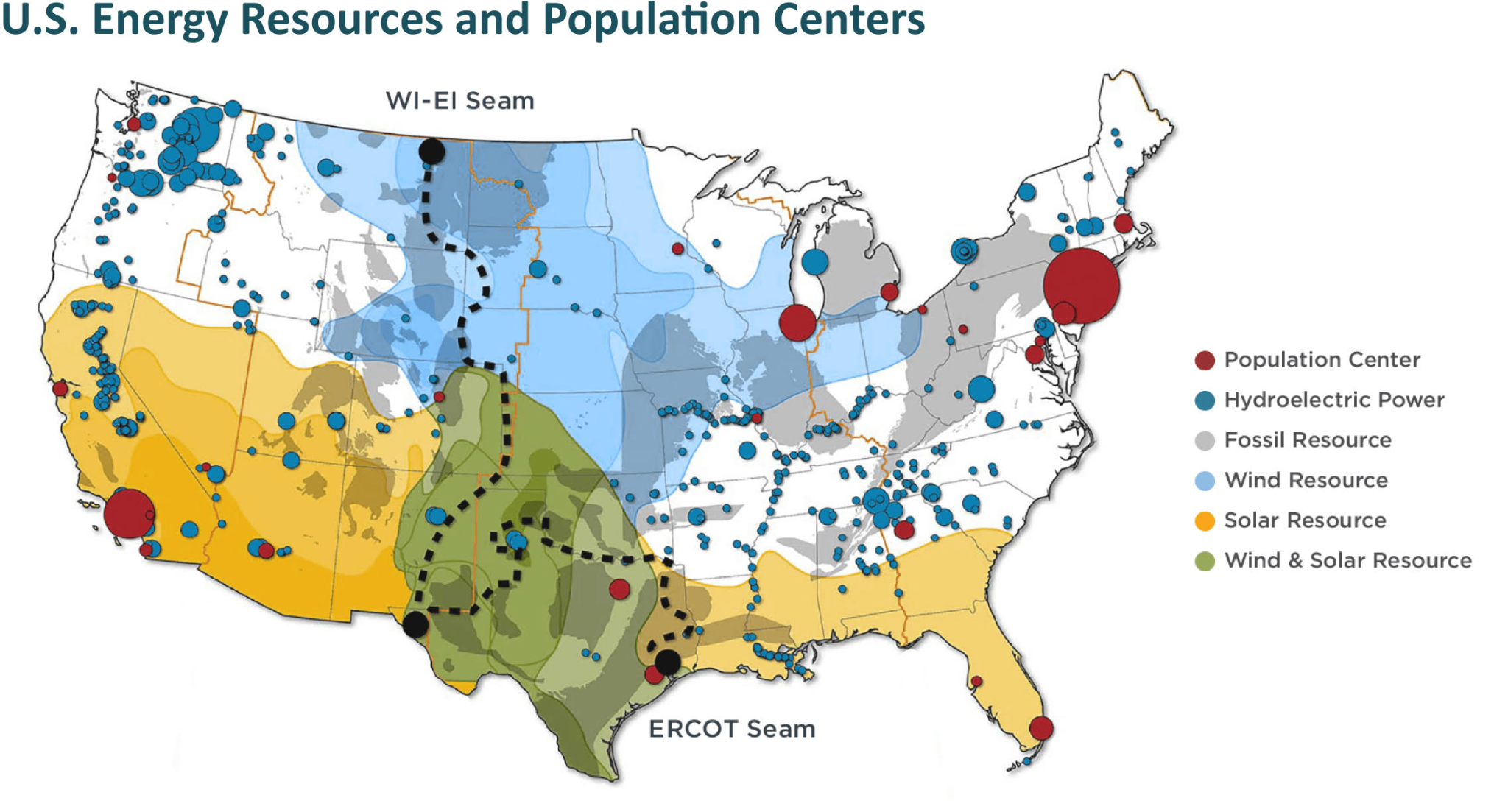
Transmission can lower power costs when it moves electricity from places where it is cheap and plentiful to places where it is more expensive and in higher demand. Figure 1, adapted from a 2018 NLR map shows that, with few exceptions, the nation’s highest quality electric fuel resources — such as coal, natural gas, wind and solar — lie distant from major demand centers. Electricity fuel resources in the U.S. are also unevenly distributed: Five states are responsible for over 70 percent of U.S. natural gas production, the strongest wind resources are in the Great Plains, and solar irradiance is highest in the Southwest.
When compounded with significant regional differences in weather patterns and time zones, it is no surprise that the U.S. experiences regular mismatches in power supply and demand, causing price spikes — and creating economic opportunity. Multiple studies confirm a substantial buildout of long-distance transmission lines would be financially beneficial to ratepayers.1
Figure 1. Uneven Distribution of Electric Fuel Resources and Population
Despite the clear financial benefit of building long-distance transmission lines, the United States has seen few transmission investments that facilitate efficient economic transfers. In the last 30 years, 90 percent of the transmission lines built were justified solely on reliability needs — that is, ensuring the power stays on. The resulting projects were often low voltage and local, with about 50 percent of spending contained within a single utility’s service area, entrenching the siloed nature of the grid. HVDC is rarely if ever included in these plans. The map in Figure 2 shows the very few HVDC lines currently operating or under construction in the United States.
Figure 2. Very few HVDC lines operating or under construction in the U.S.
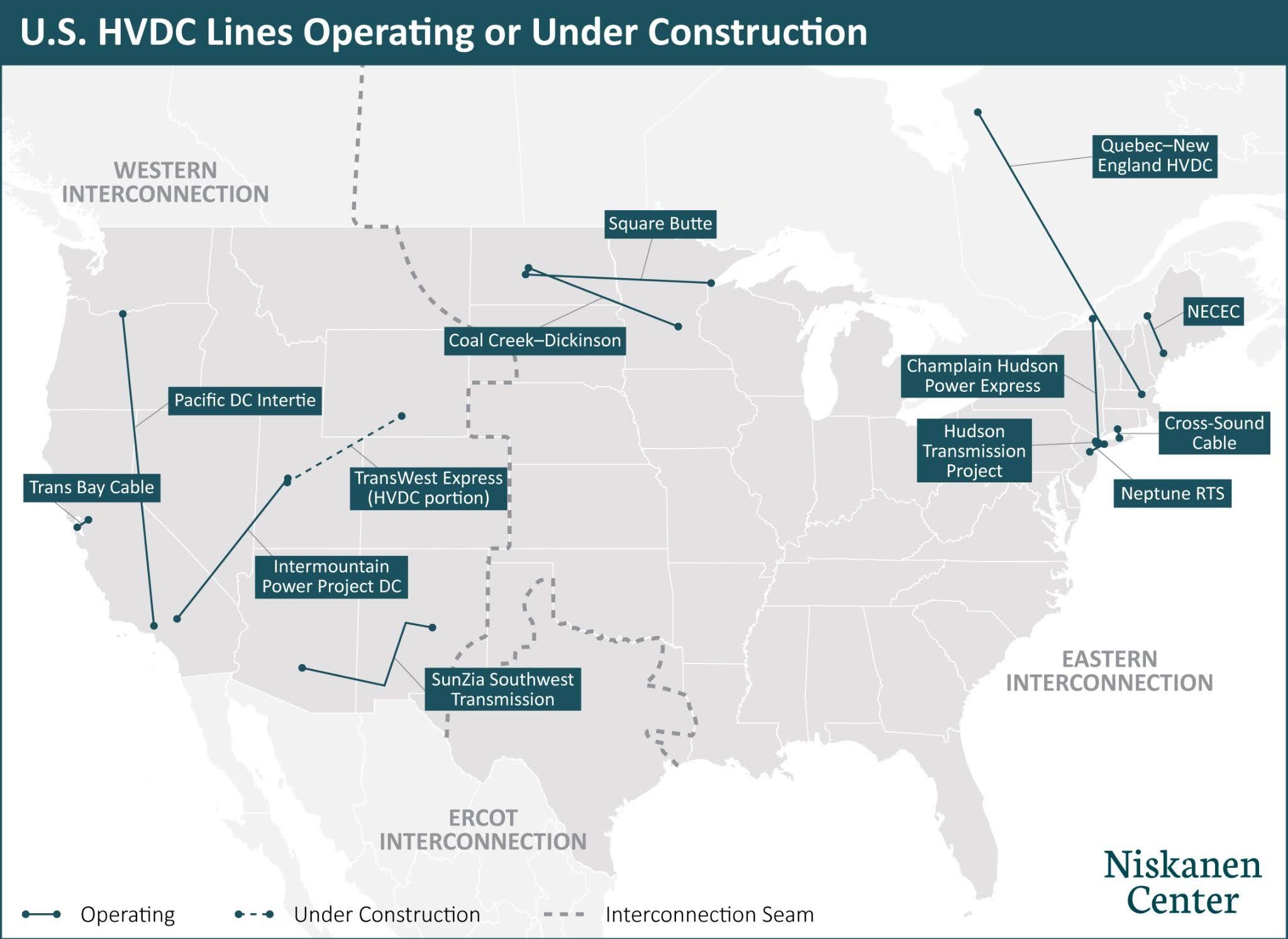
Source: Adapted from a map by James McCalley, Iowa State University.
HVDC’s unique benefits
Under certain conditions, HVDC is the best — and sometimes the only — transmission option. HVDC plays a unique role in three situations:
1. Connecting asynchronous grids
The contiguous U.S. is divided into three separate grids, or “interconnections”: the Eastern Interconnection (essentially east of the Rockies except most of Texas); the Western Interconnection (the Western states); and the Electric Reliability Council of Texas, or ERCOT (encompassing most of Texas). They operate somewhat independently from one another. Within an interconnection, generators and transmission lines are electrically synchronized at essentially the same frequency: A disturbance in one place can affect the rest of the interconnection. Because the interconnections’ oscillations are not synchronized with one another, power can move between them only through HVDC converter stations, which convert AC power to DC and then back to AC at the receiving grid.
2. Point-to-point high-capacity transfers between grid operators within a single interconnection
Transmission connecting two grid operators within a single interconnection is termed “interregional transmission.” Within a single interconnection, AC interregional transfers are possible, but AC power spreads across many paths, often making large transfers of power across a region hard to control for grid operators. HVDC avoids this problem by keeping flows on a precise, point-to-point path.
3. Making connections that are impractical with AC transmission line
HVDC is often the only practical option for certain applications, including long underground or submarine routes (underground/submarine transmission lines must be insulated, making voltage control increasingly difficult as HVAC cable length increases); and very long-distance transmission (typically beyond ~350 miles), where AC becomes less efficient or technically constrained (with higher AC transmission distances, power transfers become constrained by voltage control, reactive power requirements, and system stability limits).
New HVDC connections would provide the highest value to consumers
A 2025 LBNL study of transmission value found that cross-interconnection transmission, the type of transmission requiring HVDC technology, delivers the largest affordability gains compared with interregional transmission and within-region lines (aka intraregional lines). The second-best affordability option was interregional lines, for which HVDC is not required but is often well suited. The weakest affordability option was for intraregional lines.
The LBNL study estimated the value of building each kind of transmission based on actual average 2012–2022 electricity prices and compared it with annualized average transmission cost estimates.2 The results were striking: all cross-interconnection projects had a more than 4:1 value-to-cost ratio; interregional lines had a median value-to-cost ratio of 1.6:1, with every project exceeding 1:1; while within-region links had the lowest value-to-cost ratios, with four of 11 falling below 1:1 and the remaining seven only modestly above. Yet, within-region links are the most common high-voltage transmission lines built.
If price-to-cost ratios seem abstract, recent events make the stakes clear. During the 2026 winter storm Fern, the Southwest Power Pool (SPP), the grid operator covering much of the Great Plains, had abundant wind and solar but too little transmission capacity to deliver it, leaving it stranded. The Midcontinent Independent System Operator (MISO), the grid operator spanning the Upper Midwest to the Gulf, could have saved nearly $37 million with sufficient transfer capacity to access that cheaper interregional power. Similarly, energy consultancy Grid Strategies finds that a 1-gigawatt cross-interconnection link between ERCOT and TVA during 2022’s Winter Storm Elliott would have delivered about $95 million in value, while a 1-gigawatt cross-interconnection link between ERCOT and the Southeast during Winter Storm Uri could have saved Texas consumers nearly $1 billion.
The LBNL findings indicate that HVDC wires, rather than HVAC, can more practically provide affordable watts by linking across interconnections. In the case of interregional transmission, a key technical difference between the Eastern and Western interconnections impacts the practical viability of HVAC or HVDC as the best solution. A highway analogy illustrates the point. The Eastern Interconnection resembles a dense network of highways and local roads: When traffic increases on interstate highways (the highway equivalent of high-capacity transmission lines), flows spill onto state and arterial roads and complicate local traffic. Think of being rerouted from I-95 to US 1. The same is true for transmission: The dense network of lines makes the grid harder to control. As a result, most AC ties between regions remain relatively small to avoid spillover and interference with the ability of grid operators to control the flow of power in their service area. HVDC can act like an express lane, minimizing the need for off-ramps to accommodate spillover and allowing grid operators to control over where power can enter its grid.
In the Western Interconnection the network is typically less meshed, so major “highways” are less tightly coupled to smaller lines. This allows HVAC to support larger interregional transfers with less spillover and less disruption to local grid control.3,4 However, even with a less meshed grid, HVDC can be a preferred choice for long distances.
HVDC improves affordability; reducing barriers could unlock more benefits
Due to technical hurdles and institutional barriers, the grid is siloed into many regions and consumers foot the bill for more expensive watts. HVDC wires can efficiently connect these regions in ways that HVAC wires technically or practically cannot, and lower consumer costs by doing so. HVDC is especially strong for cross-interconnection and interregional ties; but cross-interconnection and interregional have no transmission planning structures to drive these projects forward.5 Reducing barriers to the HVDC buildout could unlock some of the largest opportunities to lower electricity costs. A significant expansion in the US HVDC capacity, and the resulting lowering of prices, would be an important contribution to maintaining US leadership in artificial intelligence and to restoring our domestic strategic manufacturing base.
- E.g. RMI’s 2025 “High Voltage, High Reward Transmission” study, DOE’s 2024 “National Transmission Planning Study,”and a 2020 national lab report “The Value of Increased HVDC Capacity Between Eastern and Western U.S. Grids: The Interconnections Seam Study.” ↩︎
- In the LBNL study, no monetary value was placed on non-price factors such as emissions reductions; cost estimates were based on expenditures for geographically similar projects. ↩︎
- For example, the HVAC Ten West (125 miles, Arizona–California) and Southline (280 miles, New Mexico–Arizona) projects; and the HVDC SunZia (550 miles, New Mexico–Arizona) and the HVDC segment of TransWest Express (405 miles, Wyoming–Colorado–Utah. ↩︎
- In ERCOT, interregional transmission is not applicable because the system consists of a single RTO. ↩︎
- A paper co-authored with Niskanen senior transmission policy analyst Rachel Levine provides more detail. ↩︎