This explainer is part of the Niskanen Center’s ongoing series on HVDC’s role in the nation’s electrical grid. The series aims to equip policymakers with clear, accessible information and ideas on how to modernize the grid to meet the country’s current and future energy needs.
High voltage direct current (HVDC) technology can do more than just move electricity. It can also help keep the lights on and prices affordable by stabilizing the grid and ensuring there’s enough power available to meet demand over the long term.
There’s just one problem: existing markets fail to value what HVDC can provide.
Existing regulatory and market frameworks were largely designed around traditional power plants and do not adequately recognize or compensate HVDC transmission projects. That leaves a powerful resource underused and the grid unnecessarily vulnerable to blackouts and higher prices. To understand why this compensation gap matters, it’s important to understand the types of services HVDC brings to the table to keep the power system reliable.
HVDC can provide critical grid services
In order for the grid to function properly, it needs more than real-time power availability. Electricity supply and demand must match at every single moment. That’s where ancillary and capacity grid services come into play.
Ancillary services support the grid by helping it withstand or recover from fluctuations in supply and demand. For example, HVDC lines can regulate and stabilize the system to correct for short-term changes in power availability or voltage fluctuations. Unlike conventional transmission, HVDC systems can be actively controlled to behave like a large reliability resource that grid operators can use to balance supply and demand in real time.
Capacity services, on the other hand, support the grid by ensuring there’s enough power available to meet future demand. While local power plants can provide this power, HVDC can bring in critical energy that may not be available locally when it is needed most, often at lower cost than building and maintaining redundant local power plant capacity.
Grid operators have traditionally relied on power plants and other generation technologies to provide ancillary and capacity services. But severe weather events can disrupt these resources or take them offline. When that happens, the grid is left short not just on power, but on the stability services needed to keep it running smoothly.
Winter Storm Fern highlighted this dynamic. Plunging temperatures caused significant power price disparities as the storm moved eastward. Importantly, prices did not rise in different regions at the same time, meaning that capacity services from a neighboring region could have balanced the price spikes if power could have been transferred between lower-priced and higher-priced regions. HVDC lines can provide power sharing across regions to achieve “a grid bigger than the weather.”
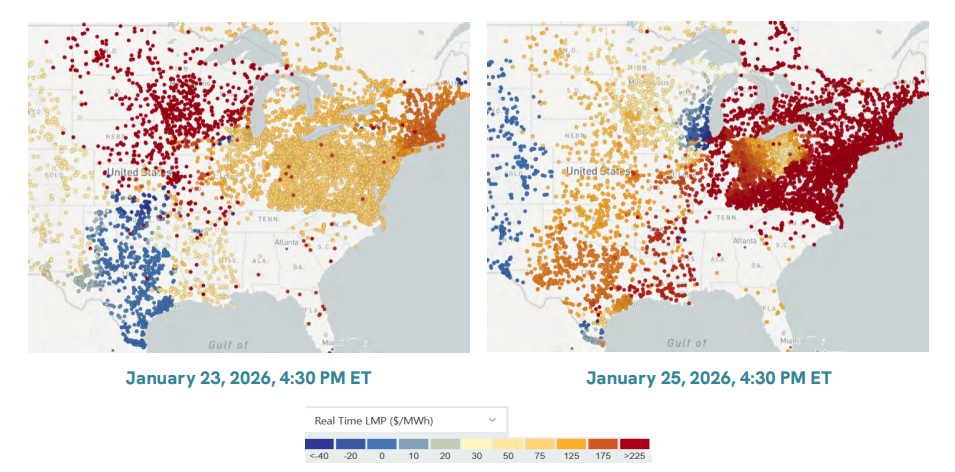
Differences in power prices during Winter Storm Fern
This means that HVDC can strengthen the grid’s resilience by helping it withstand or recover from outages and reduce energy prices during times of stress. Together, these capabilities enhance both reliability and affordability.
Forging a path forward on compensation
Grid operators use resource adequacy assessments to determine how much power supply their systems need to maintain reliability under stress and prevent outages. Historically, nearby power plants have been the only resources available to maintain reliability. Transmission can also promote reliability, but is generally overlooked or undervalued in these assessments, leading to underinvestment in infrastructure that can reduce systemwide costs. This dynamic shapes how HVDC projects are financed in practice.
Today, most HVDC transmission projects in the U.S. are developed by independent transmission providers, who finance construction through long-term power-purchase agreements between power producers and power users. Creating more opportunities for developers to finance these HVDC projects by giving them access to ancillary and capacity services markets would foster innovation and help lower escalating electricity costs.
Some operators, such as the Midcontinent Independent System Operator (MISO), have begun exploring how to credit the capacity benefits of HVDC and integrate the technology into energy and ancillary services markets. But this is just the first step, and translating findings into market reforms can take years.
Congress can accelerate this work by directing the Federal Energy Regulatory Commission to instruct all grid operators to identify and value ancillary and capacity services from HVDC transmission, enabling full participation in competitive markets nationwide. With these reforms, HVDC infrastructure can make the grid more resilient, ensuring power flows where it’s needed most during grid disturbances.