This explainer is part of the Niskanen Center’s ongoing series on HVDC’s role in the nation’s electrical grid. The series aims to equip policymakers with clear, accessible information and ideas on how to modernize the grid to meet the country’s current and future energy needs.
High-voltage direct current (HVDC) technology is widely recognized as the preferred solution for long-distance power transmission, but it also plays a critical role in “back to back” connections that transfer power between neighboring grids. Electricity sharing among the nation’s three grid interconnections relies entirely on these back-to-back facilities, but most were built decades ago and have limited transfer capability. Upgrading these HVDC back-to-backs is an opportunity to help meet the nation’s rapidly rising demand for energy.
Back-to-back fundamentals
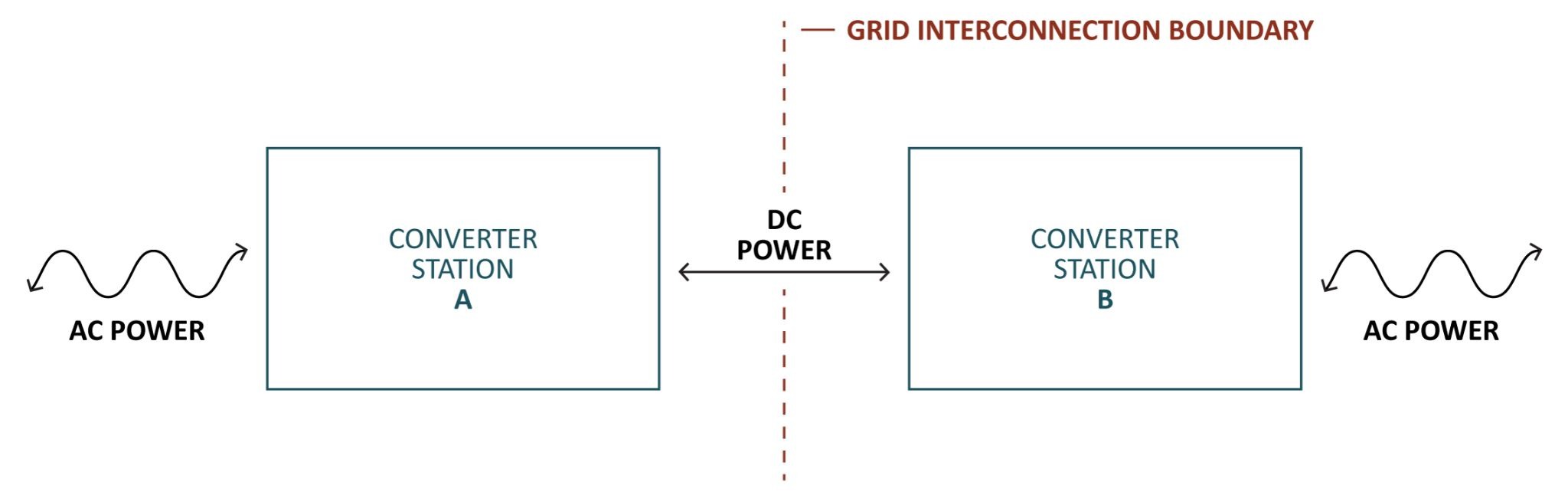
HVDC back-to-back facilities enable power transfers between asynchronous grid interconnections. Unlike traditional HVDC transmission lines, which move electricity over long distances, back-to-back systems are compact facilities with a small footprint. They consist of two co-located converter stations, which convert alternating current (AC) electricity to direct current (DC) and then back to AC, allowing power to flow in a controlled manner between otherwise incompatible grid systems.
There are nine back-to-back HVDC stations in the Great Plains and Texas that enable domestic energy transfers, as shown in the table below. These systems were built mainly to serve such operational needs as linking utility service territories that span more than one grid interconnection.
| Location | Interconnects Bridged | Owner(s)* | Ownership Type(s)° | Date Constructed |
|---|---|---|---|---|
| Miles City, Mont. | Eastern/Western | Western Area Power Administration (WAPA), Basin Electric Power Cooperative | Federal, co-op | 1985 |
| Rapid City, S.D. | Eastern/Western | Basin Electric Power Cooperative, Black Hills Power Inc. | Co-op, investor-owned | 2003 |
| Stegall, Neb. | Eastern/Western | Tri-State Generation & Transmission Assn. Inc. | Co-op | 1977 |
| Sidney, NEx | Eastern/Western | WAPA | Federal | 1988 |
| Lamar, CO | Eastern/Western | Public Service Company of Colorado | Investor-owned | 2005 |
| Clovis, N.M. | Eastern/Western | Public Service Company of New Mexico | Investor-owned | 1985 |
| Artesia, NM | Eastern/Western | El Paso Electric Company / Public Service Company of New Mexico | Investor-owned | 1983 |
| Oklaunion, Texasex | ERCOT/Eastern | Public Service Company of Oklahoma, AEP Texas | Investor-owned | 2014 (replaced 1984 system) |
| Titus County, Texas | ERCOT/Eastern | Southern Electric Power Company, AEP Texas, Oncor, CenterPoint | Investor-owned | 1995 |
*Public Service Company of Oklahoma and Southern Electric Power Company are AEP subsidiaries, while Public Service Company of Colorado is a subsidiary of Xcel Energy.
°Some seams are co-owned by multiple entities, each with a percentage “share” of ownership.
xCurrently out of service
The back-to-back stations can cumulatively support only about 2 Gigawatts (GW) of power transfer — the equivalent of about 0.15 percent of the total power-generation capacity of the U.S. grid — and the need for additional power transfer capability is growing. The North American Electric Reliability Corporation (NERC), a regulatory body that ensures grid reliability and security, has stated that the U.S. urgently needs 35 GW of additional power-transfer capability to ensure grid reliability. Upgrading the back-to-backs with modern technology can help meet NERC’s target and the nation’s needs.
Converter station design matters
The back-to-back facilities’ functionality is dependent on converter station technology. HVDC converters fall into one of two types: line-communicated converters (LCCs) and voltage-source converters (VSCs). Most of the nine back-to-back facilities rely on LCC technology, reflecting the state of HVDC engineering when these installations were originally built. Newer HVDC projects are increasingly being designed with VSCs, with the first built at grid scale in 1997.
VSC upgrades could significantly improve the functionality of aging back-to-back facilities built with legacy LCC technology. LCCs rely on the stability of the surrounding AC grid to maintain operation and to reverse the direction of power flow effectively, making for a more resilient system. VSC’s operating characteristics, on the other hand, mean they can easily enable bidirectional current flow while functioning independently of the conditions of the surrounding grid. In other words, VSCs can not only more effectively connect grid regions, but are also the only type of converter station that can operate during AC grid blackouts and assist in recovery.
Looking forward
As data centers and industrial manufacturing centers expand, the resiliency that VSCs provide will be critical. The HVDC back-to-backs are geographically well-positioned to keep power flowing between grids and keep the grids reliable amid rising demand and severe weather, but only if they can be upgraded to accommodate future needs.
The biggest barrier is neither technology nor regulation, but cost, since converter stations are one of the most expensive components of HVDC systems. Policymakers can take several key steps to overcome these barriers. Failing to do so could leave valuable interconnection capacity and flexibility underused at a time when the grid increasingly needs more ways to move power to where it is needed most.