
More than 92 millions Americans live in a federally designated primary care shortage area. That’s about 1 in 4 patients whose demand for primary care exceeds the supply of physicians that can provide it. And this shortage will only get worse without significant changes to how primary care providers (PCPs) are paid.
Thankfully, Congress now has a chance to address the poor payment incentives at the root of the primary care shortage. Senators Sheldon Whitehouse (D-RI) and Bill Cassidy (R-LA) recently reintroduced the Pay PCPs Act. The bill would transform how and how much Medicare pays PCPs, boosting incentives for aspiring physicians to enter the field and helping to address America’s shortage of PCPs.
For decades, Medicare has structurally undervalued — and therefore underpaid — primary care through its reimbursement system. Payment disparities have compounded over time, deepening the problem. Put simply: If we want more PCPs, we need to pay for them.
This bipartisan legislation would tackle the PCP shortage through two important levers. In the medium term, the bill would authorize a new hybrid payment model to ensure that PCPs are appropriately paid for all of the care they provide to patients, including cognitive, patient-centered care that fits poorly into Medicare’s fee-for-service (FFS) payment regime.
More foundationally, it takes aim at how Medicare values physician services by establishing a technical advisory committee to counsel the Centers for Medicare & Medicaid Services (CMS) on physician payment rates. This panel would offer CMS a first-of-its-kind independent source of technical expertise beyond the American Medical Association’s fee-related committee, whose subjective, survey-based estimates of physician time and effort have long neglected the cognitive work of primary care.
Together, these reforms could incentivize aspiring physicians to choose primary care, improve the financial viability of primary care practice, and increase access to preventive care for patients across the country.
The roots of the primary care shortage
Primary care sits at the heart of modern medicine. PCPs guide their patients through prevention and care, helping them to stay healthy. Their roles as not just providers but caretakers make them crucial to societal well-being. Increased supply of primary care physicians is associated with improved health measures, including increased life expectancy.
Unfortunately, aspiring physicians are driven away from primary care due to relatively lower salaries and a high administrative burden that reduces time spent with real patients. Medical students, shouldering higher student loan debts over time, increasingly opt for far more lucrative specialty practices over primary care for the same or similar amount of schooling and less administrative work.
In 2025, the 20 specialties with the highest annual average compensation were surgical and procedural specialties, while the 20 specialties with the lowest compensation were pediatric and primary care specialties. In fact, PCPs earn about half as much as specialists on average (Figure 1).
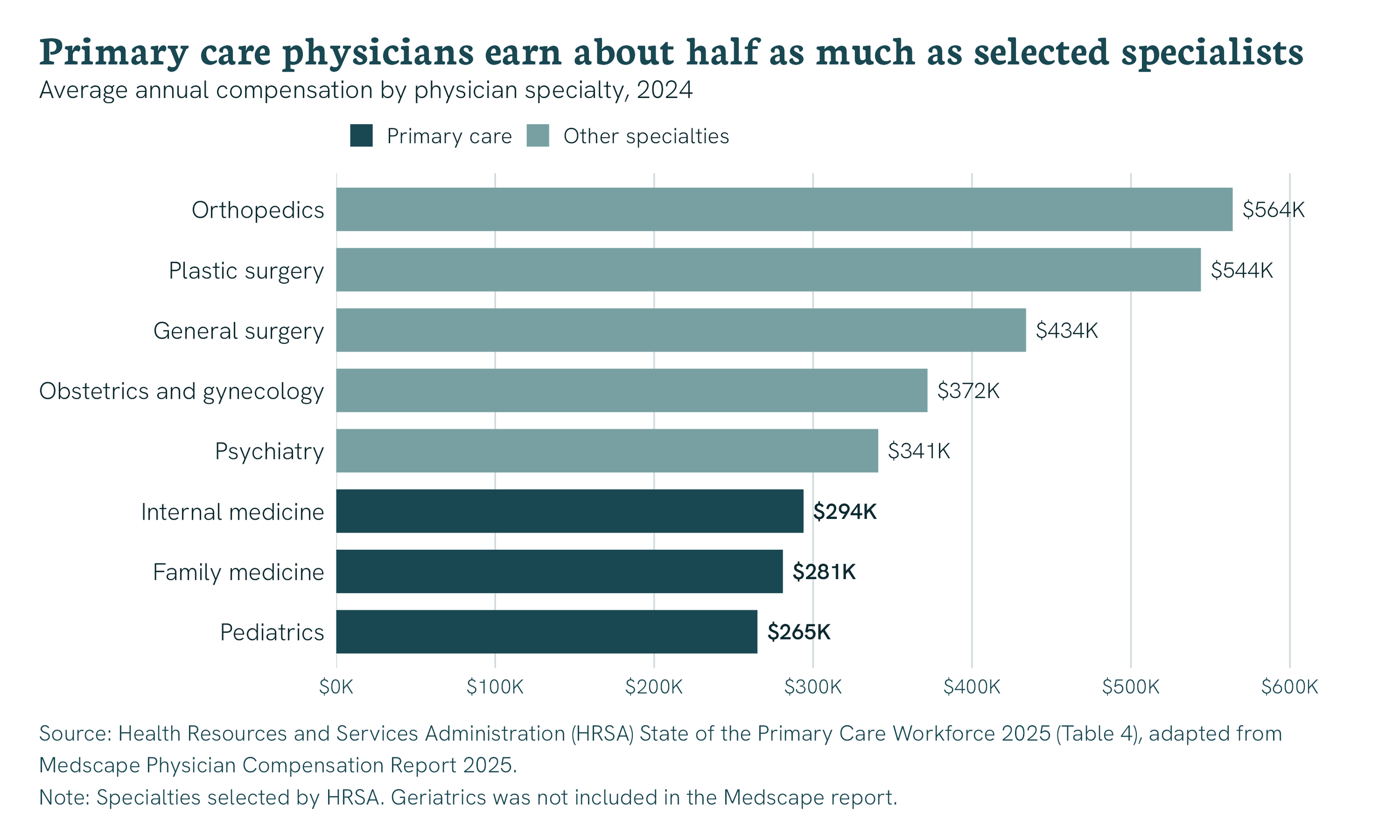
Additionally, the nature of primary care has also changed, becoming more arduous over time. Rather than spending their time speaking with patients, the work of today’s PCPs is increasingly dominated by bureaucratic tasks like the maintenance of electronic health records, which has been directly linked to lower job satisfaction and burnout for these physicians. These factors, understandably, correspond with decreasing numbers of PCPs over time; today, only 25 percent of American physicians work in primary care, a share that has steadily decreased over time.
This shortage of primary care physicians exacerbates existing access problems for rural and impoverished communities. In 2023, roughly 100 million Americans were estimated to lack regular access to primary care, and over half of these individuals had incomes below 200 percent of the federal poverty level. In rural communities, over 40 million Americans face primary care shortages, with 45 percent of rural counties having just five or fewer PCPs. Access to primary care directly correlates with mortality reduction, increases in lifespan, and a higher likelihood that patients will continue to seek care. Communities lacking this essential care face worse outcomes as a result. Closing these gaps will require more physicians to choose primary care, and how Medicare values primary care work plays a central role in that decision.
How the Physician Fee Schedule and the RUC shortchange primary care
Medicare’s physician fee schedule (PFS) standardizes reimbursement fees for specific services. Each service is given a set number of relative value units (RVUs) to reflect physician time and effort for each service. CMS updates the values each year by changing their conversion factor (CF), a fixed dollar multiplier that converts a service’s RVU into a reimbursement amount.
But the system greatly undervalues primary care. Relative to procedure-based specialty care, modern primary care requires many intangible services that PCPs must provide for patients that fall out of the PFS’s purview. PCPs often communicate with patients outside the office by text, phone, or the MyChart app. Moreover, the PFS is ill-suited to support multidisciplinary, team-based care, in which nurse practitioners, physician assistants, nutritionists, and other clinicians work alongside PCPs to coordinate care and manage chronic disease. By leaving these aspects of primary care uncompensated, the PFS shortchanges the consultative, patient-centered work of PCPs.
Primary care providers also receive lower PFS payments compared to specialists, due largely to the influence of the American Medical Association’s Specialty Society RVS Update Committee (known as the RUC) on the relative-valuation process. The RUC is a volunteer, nongovernmental, and unchartered committee whose nonbinding advice heavily influences CMS’s payment decisions. CMS accepts around 87 percent of the committee’s recommendations, setting 91 percent of rates at or above the RUC’s recommended levels in 2025.
Given the fact that the RUC’s membership skews heavily toward specialists rather than PCPs and other providers — PCPs hold only 19 percent of RUC seats despite handling 35 percent of all patient visits — numerous organizations, including MedPAC and the Government Accountability Office (GAO), have raised concerns about conflicts of interest. Moreover, the RUC bases its recommendations on flawed survey data; CMS itself notes that the surveys suffer from small sample sizes, low response rates, measurement errors, and incomplete submissions, all of which threaten the reliability and accuracy of RUC recommendations. Finally, as a nongovernmental organization, the RUC is not required to abide by federal standards of transparency, operating behind closed doors and leaving room for self-interest from its members.
In order to close the gap between primary care and specialist payments and to bring more physicians into primary care, we must reconsider the RUC’s role in shaping Medicare payments.
The Pay PCPs Act could revitalize primary care
On both of these fronts, the Pay PCPs Act proposes meaningful reforms for fixing how PCPs are paid. Originally introduced in 2024 and reintroduced in 2026, the act proposes a new hybrid payment model for providers, split between the PFS and a system of prospective, per-member-per-month payments that encompasses unrepresented aspects of primary care in the PFS. Rather than only being paid for certain services, PCPs would also receive fixed monthly amounts per patient. The bill proposes using these monthly per-patient payments to cover communications with patients outside of visits; care management; multidisciplinary team-based care coordination; behavioral health integration services; and office-based evaluation and management visits. All else would remain covered by the PFS. With this hybrid system in place, PCPs would be better reimbursed for the true nature of their work. While some have raised concerns that reimbursing these services may result in patient financial burden, the bill accounts for that by establishing a 50 percent cost-sharing reduction for primary care services reimbursed through the new hybrid payments.
Importantly, the bill also proposes a new CMS committee to advise on RVU calculations and curb the RUC’s influence on payment rates. It would establish a technical advisory committee of 13 members, all appointed by the secretary and chaired by a CMS official, who would both chair the development of RVUs and investigate new valuation systems for improving the reimbursements’ accuracy. This committee would be staffed by both technical experts and providers with experience in healthcare payment policy. Rather than allowing the specialist-dominated RUC to continue pushing inflated rates, this new committee would neutrally advise on payment rates without raising questions about financial self-interest.
Due to the PFS’s budget neutrality requirement, changes to physician payment are often seen as an ugly, zero-sum game, with specialists and primary care providers fighting for a bigger slice of the pie. The Pay PCPs Act would help allay these concerns by creating the hybrid payment model and the $10 billion investment in new funding for primary care — keeping FFS in place for the majority of services and expanding the size of the pie. Investing more in primary care could actually help specialists do their job more effectively. The status quo primary care system allows patients to fall through the cracks. Primary care concerns, when not addressed in a timely fashion, can fall upon specialists. A robust primary care system could reduce wait times to see a specialist and enable specialists to spend their days using their expert training on patients who actually need specialty care. A crucial step toward bolstering the primary care system is paying PCPs more.
Looking ahead
Revived legislative momentum in the Senate offers a renewed vision for primary care—this time, addressing earlier concerns by appropriating new money for the hybrid payment model rather than funding coming out of other PFS services.
Through the hybrid payment model and new technical advisory committee to advise on physician payment, the Pay PCPs Act would begin to remedy the undervaluation of primary care and incentivize more aspiring physicians to choose it in the long run. Congress should seize this bipartisan opportunity to revitalize primary care and invest in the very bedrock of our healthcare system before it’s too late.