
Key takeaways
- Childbirth hits family finances as a predictable shock: Household earnings begin falling two quarters before birth and bottom out in the quarter of childbirth, falling as much as 42% from the year prior for low-income working mothers. This is happening just as new expenses start piling up.
- Infant care is uniquely expensive and hard to find: At roughly $14,000 a year on average, center-based infant care is one of the most expensive forms of childcare, yet thin or negative profit margins make it a money-losing service for providers compared with childcare for other ages.
- Parents want to stay home with their newborn, but few can: About half of parents with young children say they’d prefer to stay home if they could afford to. Yet the U.S. has no federal paid parental leave law, leaving parents to rely on a patchwork of state programs and employer benefits that vary widely and often do not cover all populations.
- State-administered At-Home Infant Care (AHIC) programs are the easiest fix available today: Establishing and reviving AHIC programs across the nation can complement existing family leave policies without new federal legislation or funding. It can also give eligible parents time-limited support to stay home to bond with their infant if they choose to do so.
- States can use federal TANF block grant funds to finance AHIC programs: Program finance has long been AHIC’s Achilles’ heel. By structuring programs to align with TANF’s non-recurring short term benefit rules, states can tap into federal funds to help finance the program in a sustainable manner.
- AHIC programs offer a fiscally responsible alternative to welfare and traditional childcare: By saving states money relative to childcare subsidies and providing more parents with the resources they need to balance work and family, AHIC programs support families through one of the most demanding — and most consequential — periods of a child’s life, and provide a foundation on which to build broader reform that strengthens families and communities and equips children for success.
Introduction
The birth of a child and the months that follow mark a special period in a family’s life. While it is a joyous occasion, it can also be a time of acute stress on family finances. The cost of baby supplies and childcare can significantly increase a family’s spending while household income declines over the same period.1 This financial dynamic is nearly universal, impacting parents whether they are single, cohabiting, or married.
In the months following birth, families generally have two options for care: either they return to work and rely on external childcare, or they stay at home to care for their infant, which is possible only if new parents can afford to do it. States provide childcare subsidies to low-income families, but income support for bonding in those crucial first months is, at best, spotty. Research suggests that a parent who stays at home during their child’s infancy can have a better impact than external childcare on a child’s long-term physical and mental development. At the same time, childcare for infants is costly to operate, and often loses money given the business model.
These factors point to the need for better investments in infant care infrastructure. A program that provides financial support to help parents to stay at home with their child for the first few months following birth could ease pressure on center-based childcare, and promote in-home care instead.
This report makes the case for reviving At-Home Infant Care (AHIC) programs at the state level. Initially launched in the early 2000s, AHIC programs allowed low-income parents, who would otherwise be eligible for state childcare subsidies, to receive time-limited state payments to stay home with their newborn. While successful, states struggled to consistently fund them without federal support. We outline how states can implement such a program within existing federal laws. By structuring programs to align with non-recurring short term (NRST) benefit rules under Temporary Assistance for Needy Families (TANF), states can tap into existing federal block grants to sustainably fund AHIC programs.
The case for keeping infants at home
The question of whether at least one parent should stay at home with children has become enmeshed in broader cultural debates over the role of two-earner families and stay-at-home parents. However, there are several reasons to differentiate between infants under 1 and young children more generally. This includes developmental, preferential, and economic factors that suggest infants are much better off with family in the months after birth.
Science says infants are better off at home. There is growing scientific evidence of a meaningful link between how infants are cared for and their cognitive and physical development over the long run. Parental presence during infancy appears to support better mental and physical health outcomes than time spent in center-based care. One study associated parental absence to low academic scores and high depression rates, and another concluded that every incremental five hours that an infant spent in a center-based care facility instead of at home with a parent increased their likelihood of obesity in the first decade of their life by 9 percent.2 Combined, the evidence on these developmental outcomes points to real value in supporting parents who choose to stay home with their infant.
Parents prefer to stay home with their newborns. Two recent surveys found that about half of all parents with young children would prefer to stay home to care for them if possible. Parental preferences for any type of childcare tend to start low and rise with the child’s age, with only 41 percent of parents with children under 2 expressing any interest in using childcare in one survey and 18 percent of parents with children under 1 expressing a preference for not working at all during that crucial first year.3 This is reflected in data on maternal labor force participation, which shows it is lowest for mothers with children under 1.4
There is a growing recognition of a broader mismatch between parental preferences for infants and the support the current system offers them. A more pluralistic approach would better meet the needs of parents based on where they are in family life.5 This includes supporting parents’ ability to stay home and bond with newborns while still offering an array of childcare choices for toddlers, be it friends, family, and neighbor care, home-based care, or center-based care.
Childcare providers prefer not to have infants. The economics of childcare put providers in a difficult position. Labor costs make up the majority of their expenditures, but safety standards limit the extent to which they are able to spread those costs across multiple children. First, infants cost more to serve because they require more supplies and individual attention. Second, providers must maintain a higher staff-to-child ratio compared with other age groups.6 The median cost of center-based infant care is about $14,000 per year with little opportunity to reduce those costs.7
The expansion of public preschool in recent years has added immense financial pressure on childcare providers by removing 4- and 5-year-olds, for whom profit margins are the largest, from the childcare system.8 On the other end, center-based infant care faces such unique challenges that providers often call it a “loss leader” due to very small or negative profit margins. Providers often want to do right by families and care for infants, but cost constraints make it exceedingly difficult. To the extent that public policy can shift infants to other care options, it would reduce pressure on providers and free up capacity for other age groups.
In sum, the parents of newborns face unique challenges and needs that cannot be addressed adequately by the existing childcare system. Supporting parental efforts to stay at home with infants is ideal but requires better policies to make it a reality.
Existing policies for supporting new parents fall short
Parents’ use of childcare for infants is far less common in other OECD countries, largely because they have access to paid parental leave with durations that allow parents to stay home over the course of their baby’s first year.9 In Canada, for example, only 14 percent of infants are in any type of childcare arrangement. Instead, the majority (57 percent) are home with parents who are using paid leave.10
Despite recent efforts to expand access to paid parental leave in the United States, it remains a patchwork, varying by state and employer. One recent analysis estimates that only about a third of workers have access through state-paid leave programs, a fourth have access through their employer, and about two-fifths of workers have access to paid leave through state temporary disability insurance programs.11 The federal government guarantees unpaid, job-protected leave for all eligible workers nationwide through the Family and Medical Leave Act (FMLA). FMLA requires all public agencies, schools, and private-sector companies with more than 50 employees to offer job-protected leave to their employees for family care or medical absence.
Ideally, state policymakers would expand access to paid parental leave as part of a broader strategy to allow parents to stay home with infants, but even the best designed programs, which generally include work history requirements, would leave some families out. Our recent analysis estimates that about a quarter of working-age residents of states with comprehensive paid leave programs would not be eligible for benefits for this reason.12 Parents of newborns who do not have access to or are not eligible for paid parental leave, or are not eligible for job-protected unpaid parental leave through FMLA, often turn to state welfare programs, according to a growing body of literature.
Among workers taking leave under FMLA, about 15 percent who had only partial or no paid leave reported using public assistance as a source of income.13 Research shows less use of Temporary Assistance for Needy Families (TANF) among lower-income mothers of newborns when paid leave is available at the state level.14 Evidence is mixed on whether access to state TANF programs for these mothers reduces material hardship.15 This is not unexpected given the variation in benefit amounts, earnings disregards, and work exemptions. Consistent with the evidence on child development discussed earlier, reduced access to TANF for mothers with infants is associated with a negative impact on cognitive development as well as more time spent in nonparental childcare through their life.16
Mothers of newborns account for about one-third of all new TANF entrants. Relative to other TANF beneficiaries, “new mothers have more education and work experience, fewer and shorter TANF spells, and greater earnings and income in the year following TANF entry compared to other participants.” More generally, the work history of new mothers prior to TANF entry is the best predictor of returning to work in the year following birth.17
States have the ability to waive TANF’s normal work requirements for new parents using the age of youngest child (AYC) exemption. Shorter AYC exemptions, which in most states range between three and 12 months, tend to see more welfare dependency as new mothers struggle to balance work and family life, leading to less stable and consistent work attachments that affect long-run employment. On the other hand, comparatively longer exemptions let new mothers return to work more gradually and consistently.18
But traditional TANF, which most parents find stigmatizing, was never meant to be a program for supporting new parents.19 This gap points to the need for a broader, more diverse set of policies to support new parents and infants alike. A few states have already experimented with AHIC programs. Although promising, these programs sputtered out due to a lack of stable funding. Reviving them could be the key to offering new parents a nonstigmatizing alternative to going on welfare.
AHIC’s long lost history
Minnesota and Montana pioneered the first AHIC programs over two decades ago.20
Minnesota’s program traces its origin to Rep. Richard Mulder, a Republican member of the state legislature and rural physician who saw the benefits of infants staying home with one of their parents for as long as possible.21 More widely, the state’s early childhood community was increasingly concerned about the limited availability of childcare options for infants while research was pointing to infancy as a crucial period for brain development. Initially established as a pilot program in 1997 and made permanent in 2004, Minnesota’s AHIC program, the first in the nation, allowed eligible low-income parents who were working, studying, or looking for work to receive direct payments to stay home with their infant. In Minnesota’s pilot program, the payments were worth up to 75 percent (later raised to 90 percent) of what the beneficiary’s county would normally pay family childcare providers as an indirect childcare subsidy for up to one year.22
In 2001, Montana Gov. Judy Martz authorized a similar pilot program, which was made permanent in 2003. Montana modeled its AHIC program on Minnesota’s, using childcare subsidy eligibility criteria, but it differed in key aspects. Montana parents could receive direct payments equal to 100 percent of the state’s childcare subsidy amount (versus 90 percent in Minnesota) and for a longer potential total period (two years versus one year) over the course of their lifetime.23
Case Study: Minnesota’s successful AHIC
As part of the pilot, Minnesota’s legislature required what is now known as the Department of Children, Families, and Learning to evaluate the AHIC program after a year. The evaluation report found that the program served a diverse cross-section of low-income working families, was time-limited as expected, and resulted in significant savings for the state.
Whereas single parents made up 85 percent of all households receiving childcare subsidies , participants were much closer to the demographic makeup of working parents generally. Analysis from the program’s first year found that 45 percent of beneficiaries were two-parent households and 55 percent were single parents.
All families were engaged in some authorized activity prior to participation. This includes 94 percent in work and 8 percent in school, with some overlap. Average household income prior to participation was 40 percent of the state median income, or about $22,000 at the time.
Despite families being eligible for up to 12 months of participation, the vast majority of durations were much shorter. Sixty-seven percent participated for less than three months and 21 percent participated for three to five months. The authors estimated cost savings per family over the five-month average duration. Fifty-five percent of families were receiving childcare subsidies prior to participating in AHIC, leading to average savings for the state of between $690 and $2,380 per family. Among the 24 percent of families participating with their first child, the state saved an average of $420 per family. The authors were not able to estimate cost savings among the 21 percent of families who already had children but were not previously receiving childcare subsidies because it was unclear whether they would have used childcare subsidies in the absence of AHIC participation.
Feedback from parents who participated in the program included “glowing statements about the benefits of being able to stay home with an infant for part or all of the baby’s first year.”
Both states relied on general state appropriations to fund their programs, which proved to be unsustainable in the long run, and eventually both states were left with unfunded programs.24 Although AHIC is a childcare program, states cannot use federal childcare funds to finance it. Similarly, many experts thought at the time that states could use TANF funds for their AHIC program, but doing so would trigger penalties in their work participation rate.25
Given these constraints, several federal proposals emerged to help states fund AHIC programs. In 2004, U.S. Sen. Max Baucus (D–Mont.) proposed creating federal grants for states to pilot AHIC programs. In the House in the same year, Rep. Rosa DeLauro (D–Conn.) introduced a bill that would have allowed states to use Childcare and Development Block Grant (CCDBG) funds for AHIC programs.26 Both failed to gain traction. Most recently, in 2021, House Ways and Means Republicans proposed allowing states to tap into federal Childcare Entitlement to States (CCES) funds.27 Under that proposal, benefit amounts would have to at least match what the state already pays as its average infant-care childcare subsidy. As with most state paid leave programs, benefits would be capped at 12 weeks and an applicant would only be eligible if they do not receive benefits from any other state-run contributory paid leave program or from an employer-provided paid leave plan.
There are lessons in this history. First, the availability of time-limited direct support for parents to care for their newborns has been popular among parents and policymakers across the political spectrum. Republicans spearheaded AHIC programs at the state level while congressional Democrats and Republicans have both led efforts to introduce federal support for state programs. Second, Minnesota’s experience shows that AHIC programs can help relieve pressure on state childcare systems and budgets by shifting infants from external childcare providers to in-home care with parents. Third, its Achilles’ heel has been states’ inability to tap into federal funding streams to pay for the program.
Identifying a sustainable fiscal foundation for state AHIC programs is the key to reviving this promising program.
A blueprint for reviving state AHIC programs
AHIC programs can act as a source of direct support for parents who do not receive paid family leave from their employers and who would otherwise be eligible for state childcare subsidies. While the program is not a substitute for paid family leave, it can be an important supplement for many low-income parents of newborns for up to four months. AHIC programs would be most effectively administered at the state level, consistent with childcare policy generally. For states to create such a program, policymakers must think about the basic parameters including funding, eligible population, benefit amounts, and interaction with other state rules and benefit programs.
Funding AHIC programs with TANF block grant funds
The funding failures in Minnesota and Montana point to the core problem: Both states funded their AHIC programs through general revenue rather than through dedicated, ongoing funding. Whereas statutory limitations prevent states from using CCDBG funds unless all available parents in the household are working or are attending job training or educational program, states have more flexibility with TANF funds, of which a major goal is to “provide assistance to needy families so that children can be cared for in their own homes or in the homes of relatives.” The TANF block grant presents a prime opportunity for funding AHIC given that states have accumulated almost $10 billion in unspent reserves in recent years.28
States still need a mechanism that would allow them to use TANF funds to pay out AHIC benefits without triggering work-participation penalties. They can do this by structuring them as non-recurring short-term (NRST) benefits.29 An NRST benefit is a limited payment for certain qualifying financial hardship events, and federal rules exempt these payments from TANF work-requirement calculations. States must show the payment meets three specific criteria:
- It’s designed to deal with a specific crisis situation or episode of need.
- It’s not intended to meet recurrent or ongoing needs.
- It won’t go beyond 4 months.
By structuring AHIC benefits this way, states can fund their programs without jeopardizing their federal work-participation rates. The definition of an NRST benefit explicitly states that such a benefit can only be offered to assist with a specific one-time financial crisis. The birth of a child is a unique financial hardship event for a family that fits the NRST definition.
Childbirth is a verifiable episode of need. Many hardships develop gradually and are difficult to date. But a birth happens on a documented date and the financial disruption around it follows a predictable timeline. Household earnings among low-income working mothers stay stable during early pregnancy, then begin slipping two quarters before birth, falling as much as 42 percent by the time the child is born. Most hardship events impact one side of a household budget: Income or expenses. Childbirth hits both sides at once: Earnings fall when new mothers are unable to continue working in the period leading up and following birth, while the household gains a new member and new costs, such as diapers and other baby supplies and medical care. Among working mothers who went on to receive SNAP or TANF benefits after the birth of their child, average annual household earnings fell by $2,097 in the year following birth.
The shock is sharper for families with no prior connection to public assistance. Among parents who received neither SNAP nor TANF benefits in the six months prior to birth, average household earnings fell by approximately 23 percent. Specifically, maternal earnings begin declining during pregnancy and do not recover to prepregnancy levels within the first 12 months after birth.30 This is a clearly bounded crisis window, the kind of “specific episode of need” the NRST rules contemplate.
The need is short-term, not recurrent. This is the heart of the NRST test, and the nature of birth as a qualifying episode supports it directly. Families only require this assistance for the period immediately following birth to stay at home with their infant and provide care. Families who would rely on such a benefit have some attachment to the workforce. Nearly three-quarters of parents who received SNAP or TANF benefits after birth had been employed in the year before, and 90 percent returned to work. On average, they spent between three and six months outside the workforce. Parents who were first-time recipients returned to work within an average of 2.3 months. Receipt of public assistance after childbirth reflects temporary financial hardship that quickly pushes most parents back to work, not into long-term dependency.31
Childbirth is a predictable, dated, temporary crisis in which a family’s income falls just as its costs rise, and in which the safety net is weakest at the worst moment. AHIC benefits can prove to be an important flexible cash benefit lasting up to four months after birth to fill the gap in timing and funding that the current system leaves open. That is exactly the purpose NRST benefits exist to serve.
Eligibility and benefit amounts
Who would be eligible?
The program’s target population is parents of infants who do not have access to income support to stay home with their newborn and would otherwise face pressure to enroll their baby in a childcare program while they work.32 Based on what we know from the Minnesota and Montana experiences, most beneficiaries are likely to already be receiving or on the waiting list for childcare subsidies.
Eligible beneficiaries would be primary caregivers seeking to stay home with their infant on a temporary full-time basis. The caretaker must be at least 18 years old and the child must be under 1. In line with historical precedent, eligibility would be limited to those who have not previously received more than 12 months of assistance under the program. If states set maximum AHIC at four months, for example, a family would be able to participate for up to three post-birth periods.
States could set work activity and income eligibility as they do for their childcare subsidy programs. Federal law requires parents to be working or engaged in job training or educational programs, but states have broad authority to determine what counts, including job search activities.33 The stringency for the timeframe for meeting these requirements has varied widely in past laws and proposals. Minnesota required engagement in these activities at some point in the nine months prior to participation. Montana and the 2004 DeLauro proposal required meeting minimum hours for at least one of three months prior to participation. The 2021 Ways and Means Committee proposal required meeting state minimum work activities for four consecutive quarters prior to participation.
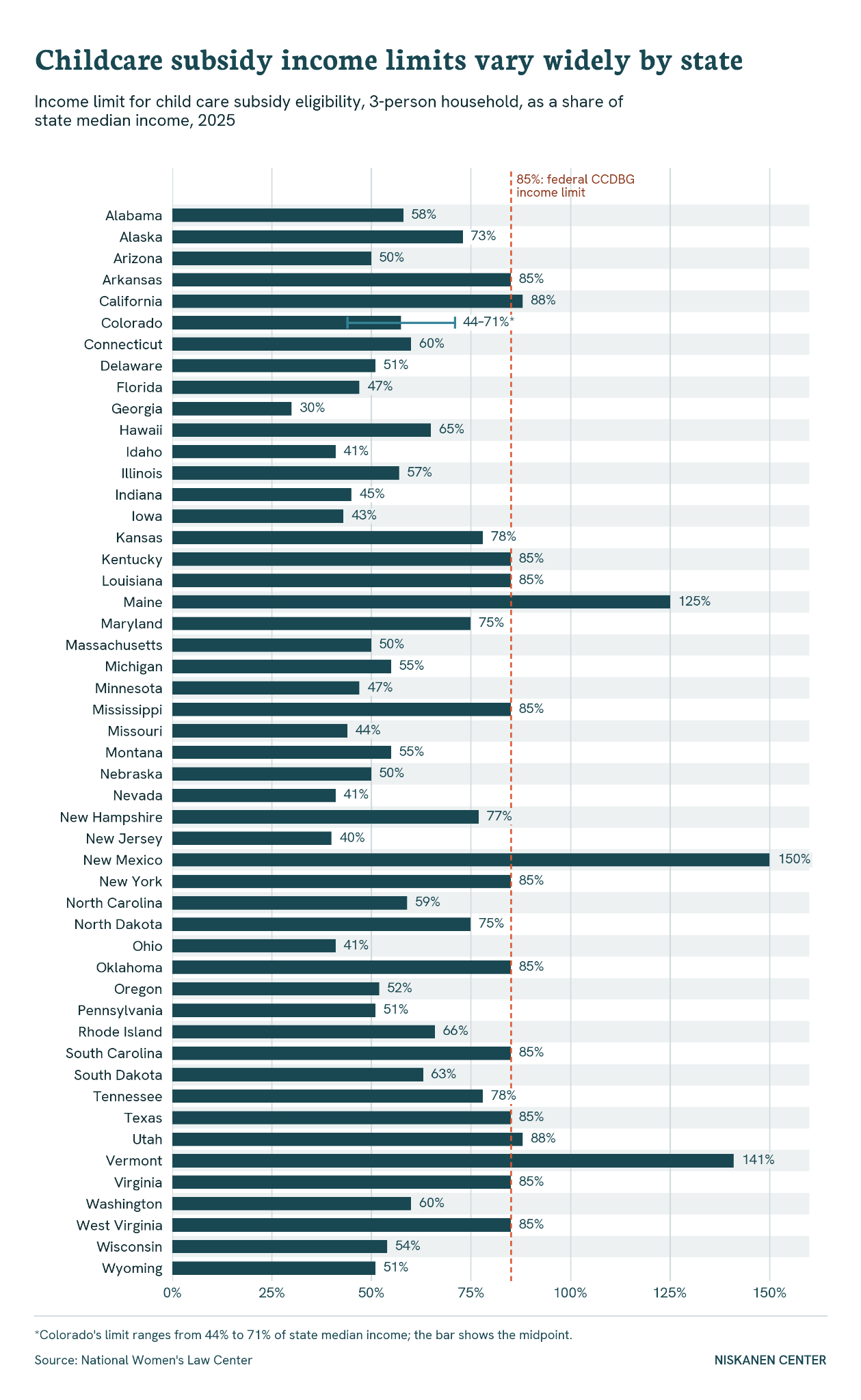
Income eligibility for existing childcare subsidies ranges from 30 percent of the state median income for a three-person household in Georgia to 150 percent of the state median income in New Mexico (see Figure 1).34 AHIC programs would be broadly inclusive of working families under these circumstances.
Figure 1: Income eligibility for childcare subsidies by state, 2025
Because AHIC payments are made in lieu of childcare assistance, beneficiaries would be ineligible to receive childcare subsidies while at home. Additionally, payments are in lieu of other cash support, so families receiving social assistance (TANF, Supplemental Security Income, or general assistance) or social insurance (paid family and medical leave, unemployment insurance) benefits would not be eligible.
A key question is whether AHIC payments would reduce a family’s other benefits. Structured correctly, these payments should not count as taxable income or against Medicaid eligibility. SNAP and housing assistance are less certain and depend on whether the payout is a non-recurring benefit. To avoid a scenario in which participating families become ineligible for other benefits, states should carefully examine how receipt of AHIC benefits would interact with other programs. States’ classification of the AHIC benefit is key here, and it will further determine eligibility for any other state programs.
- Taxation: Because AHIC benefits are short-term, non-recurring, and paid using TANF dollars, states can classify them as a “nonassistance” payout instead of earned income. Doing so would mean that an NRST payment made from TANF dollars would not be considered assistance, and hence may be excluded from the classification of earned income. In states that adopt this classification, AHIC benefits would not be taxed.
- SNAP: States that choose to exclude AHIC benefits from taxation will also be excluding the payout from SNAP eligibility calculations. SNAP counts the NRST benefit as a resource for the month in which it is received, but not as income. Additionally, states may, at their discretion, exclude from SNAP eligibility calculations any amount already excluded from TANF income eligibility calculations, provided that amount is not a recurring payment from a public source. NRST rules explicitly classify such payments as “non-recurring” and so states would be able to exclude these amounts from eligibility calculations.35
- Housing: The Department of Housing and Urban Development excludes non-recurring income from a family’s annual income when calculating eligibility for housing assistance.36 As long as AHIC benefits are paid as an NRST payment and classified as non-recurring, they can be excluded from eligibility calculations for housing assistance.
- Medicaid: Medicaid determines eligibility based on population groups that fall into two categories: Modified Adjusted Gross Income (MAGI) and non-MAGI. Parents and caregivers of children under 19 fall under the MAGI category, whose eligibility calculations only include taxable income. If states exclude AHIC benefits from taxable income, Medicaid would not count them toward eligibility either.
One final consideration is what impact participation in an AHIC program would have on a family’s eligibility for childcare subsidies while they are at home and when they return to work. The most significant risk is losing a family’s place on their state’s childcare subsidy waitlist. States use childcare waitlists when demand among eligible families outpaces available funding, using them to prioritize the families most in need — often, it’s those with infants, for whom childcare is most expensive.37 As of this year, 23 states and the District of Columbia had active waitlists for their childcare programs, with wait times varying by state.38
In a world without AHIC, parents already receiving childcare subsidies or new parents returning to work soon after their child’s birth often enroll in their state’s childcare waitlist to secure a spot for infant care. If these families lose their place on a waitlist while receiving AHIC benefits, they could exit the program with no subsidized care to turn to, and no feasible care option at all. States can close this gap by letting AHIC participants join and retain their position on a childcare waitlist while enrolled in an AHIC program, then re-enter the waitlist at the same position after they exit. Montana did this: Parents enrolled in its AHIC program could keep their place on the state’s childcare waitlist. This would turn AHIC into a ramp toward rather than a detour from subsidized childcare, letting parents bond with their newborn without losing their spot for a childcare slot they need to return to work afterward.
Crucially, this arrangement doesn’t crowd out other families, because a family on AHIC isn’t drawing on any childcare capacity in the first place. Waitlists ration a scarce source — open subsidized childcare spots — and a family at home with their infant is not occupying one of these slots. Preserving their place in line doesn’t move them ahead of anyone or grant them early access; it only ensures they aren’t pushed to the back of the line they were already on.
This is, in effect, the same principle that already underlies paid parental leave. Recipients of paid parental leave can enroll in their state’s childcare waitlist — provided they meet the eligibility criteria — during their leave, based on expected wait time, and time their application so that subsidized care begins just as they return to work.39 A family supplementing job-protected unpaid leave with AHIC benefits deserves the same equal footing with families who receive paid leave through their employer or state.
How much would eligible families receive?
The primary goal of the program is to provide new parents who lack access to paid parental leave an alternative to TANF so that they can stay home with their infant. A secondary goal is to save states money on childcare subsidies for infants.
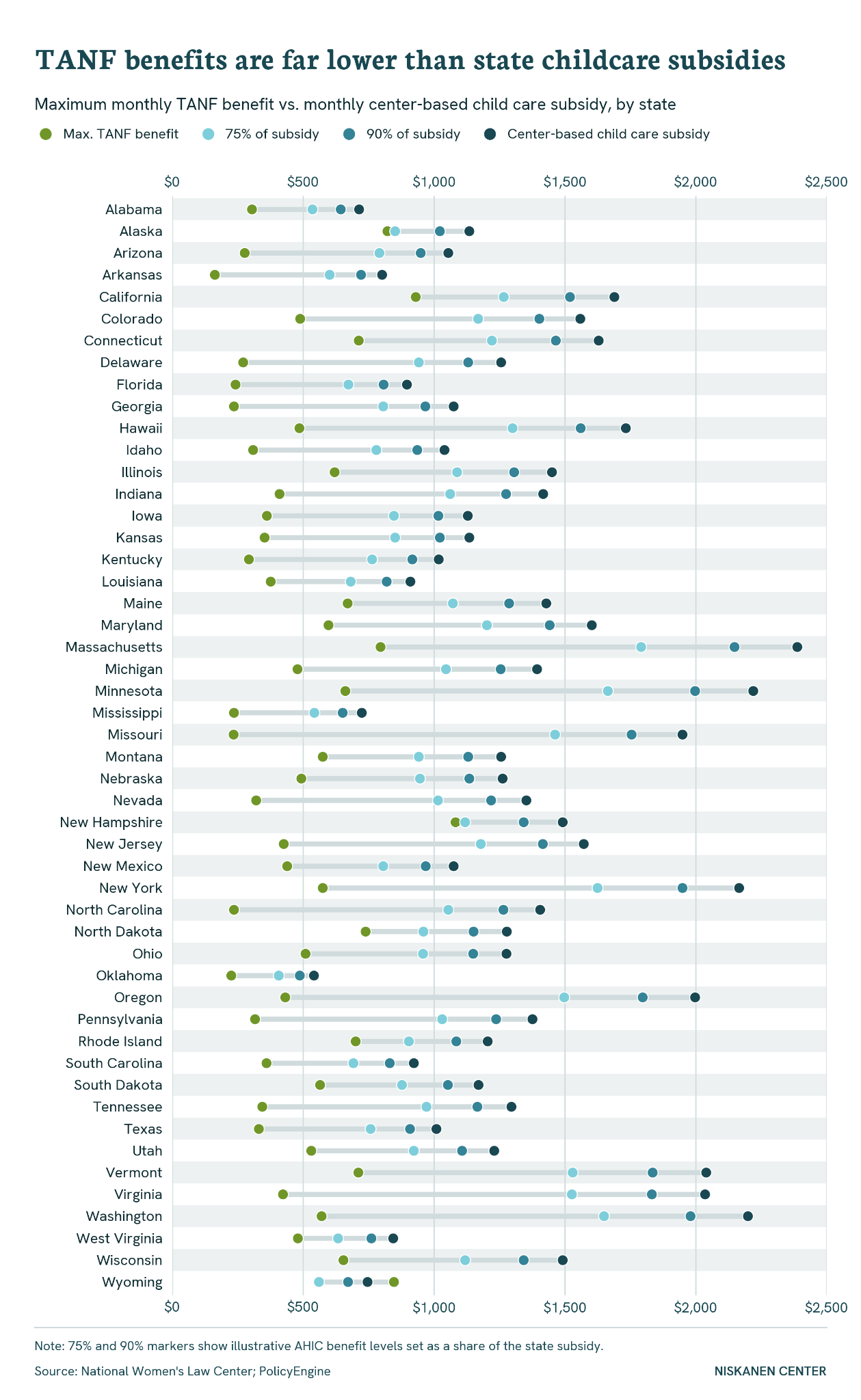
As Figure 2 shows, center-based infant care subsidies are significantly higher than the maximum TANF benefit a household can receive in every state except Wyoming. Ideally, states could set maximum AHIC benefit levels as a proportion of these existing center-based infant care subsidies. This includes providing partial benefits for two-parent households in which one parent is working but earning relatively low wages.
For example, if Utah were to provide up to 75 percent of its childcare subsidy amount as an AHIC benefit, a family would receive a monthly benefit of up to $923, about $392 more than they would receive in TANF benefits. As a result, parents would receive a higher benefit, while the state could spend approximately $308/month less per family than it would on the full childcare subsidy.40
Under NRST rules, states could provide AHIC benefits to parents for up to four months after birth. They could also provide them for shorter durations if that better fits state needs and preferences. By providing a proportion of this subsidy to parents for a maximum of four months, states could support new parents in a fiscally responsible manner.
Together, this fiscal advantage and the supply-side challenges of providing infant childcare make AHIC programs a natural fit for states. AHIC programs let parents bond with their infants at home and support their child’s development, while also easing demand-side pressure on center-based childcare.
Figure 2: TANF benefits are far lower than state childcare subsidies
Conclusion
An infancy is a distinct period in a family’s life, and there is a strong case for treating it differently from other periods in early childhood. The developmental, preferential, and economic evidence in this report all point toward the same conclusion: Policy should make it as easy as possible for parents to stay home with their newborns. Today’s patchwork of paid leave and the stigma built into TANF leave many families without a real option to do so. The history of AHIC programs in Minnesota and Montana shows us the way forward by offering a targeted alternative to support families across states.
Reviving and expanding AHIC programs nationwide by putting them on a firm fiscal foundation using TANF funds can offer parents time-limited, nonstigmatizing support during their child’s infancy. When structured properly, the program could cost states less than their existing childcare subsidies, while giving parents a real choice about how to care for their newborn.
AHIC can be a sturdy building block for America’s larger childcare structure — one that offers states a workable, fiscally responsible way to support families through one of the most demanding — and most consequential — periods of a child’s life. It also lays a foundation that broader reform, such as expanded paid leave, can build on in the years ahead.
About the authors
Sanya Bahal is a Social Policy Analyst at the Niskanen Center, where she focuses on work and family policy. Prior to joining Niskanen, Bahal worked as an analyst at the Bipartisan Policy Center on a range of economic issues, including fiscal, retirement, and tax policy. Before that, she worked as a research assistant and analyzed equity in higher education debt financing.
Bahal earned a master’s degree in public policy from the McCourt School of Public Policy at Georgetown University, and a bachelor’s degree in economics from Delhi University.
Joshua McCabe is the Director of Social Policy at the Niskanen Center. He focuses on issues related to child poverty and household stability. McCabe previously worked as an Assistant Professor of Sociology and Assistant Dean for Social Sciences at Endicott College. McCabe’s work has been featured in the Washington Post, National Review, The Hill, and other outlets. McCabe earned a bachelor’s degree in political science from Emmanuel College; a master’s degree in regional economic and social development from the University of Massachusetts Lowell; and a doctorate in sociology from the State University of New York at Albany.
- Alexandra B. Stanczyk, “The Dynamics of U.S. Household Economic Circumstances Around a Birth,” Demography 57, no. 4 (August 2020): 1271–1296.; HChristal Hamilton et al., “Experiences of Poverty Around the Time of a Birth: A Research Note,” Demography 60, no. 4 (August 2023): 965–976. ↩︎
- Jiafei Yang et al., “Effect of Parental Absence During Infancy and Early Childhood on Cognition and Depression in Later Life: A National Household Longitudinal Study,” Journal of Affective Disorders 319 (2022): 562-569.; Marie-Claude Geoffroy et al. “Childcare and Overweight or Obesity over 10 Years of Follow-Up,” The Journal of Pediatrics 162 (2012)753-758.; Younjo Im and Tyler Vanderweele, “Role of First-Year Maternal Employment and Parental Involvement in Behavioral and Cognitive Development of Young Children,” Infant Mental Health Journal 39 (2018): 449-465.; Marie Kopp et al., “Association Between Maternal Employment and the Child’s Mental Health: a Systematic Review with Meta‑analysis,” European Child & Adolescent Psychiatry 33 (2024): 3025-3042.; Madeline Dixon Whitney et al., “Length of Maternity Leave Impact on Mental and Physical Health of Mothers and Infants, a Systematic Review and Meta-analysis,” Maternal and Child Health Journal 27 (2023): 1308-1323. ↩︎
- Curran McSwiggan, “Understanding Childcare in America,” Third Way, 2026.; Alyson Silkowski, Kelly Bidwell, and Amira Choueiki Boland, “What Parents of Young Kids Want: Insights from the 2026 National Parent Survey,” New America, May 2026. ↩︎
- Laura Valle Gutierrez, Julie Kashen, and Sarah Jane Glynn, “Who Are America’s Stay-at-Home Moms?,” The Century Foundation, April 2026. ↩︎
- Patrick Brown, “Child Care Pluralism: Supporting Working Families in Their Full Diversity,” Niskanen Center, June 2021.; Elliot Haspel, “The Mismatch Between Childcare Policy and Parental Preferences,” The 74, July 2026. ↩︎
- Rebecca Daugherty, “The Child Care Business Model, Explained,” Bipartisan Policy Center, April 2026.; Kendra Hurley, “The Biggest Obstacle to Universal Child Care: Babies,” The Atlantic, September, 2026. ↩︎
- Susan Shane, “Why Is Child Care So Expensive?,” New York Times, 15 April, 2026. ↩︎
- Jill Hoiting et al., “Examining the Role of Public Pre-K Expansions in the Changing Supply of Childcare in Wisconsin,” Social Service Review 99 (2025): 172-196.; Jessica Brown, “Does Public Pre-K Have Unintended Consequences on the Childcare Market for Infants and Toddlers?,” Princeton University Industrial Relations Section Working Paper 626. ↩︎
- Elliot Haspel, “Uniting Paid Parental Leave and Childcare,” Capita, August 2025. ↩︎
- Statistics Canada, “Survey on Early Learning and Child Care Arrangements, 2022,” Government of Canada, 2022. ↩︎
- Rebecca Jack, Daniel Tannenbaum, and Brenden Timpe, “The Landscape of Parental Leave-Taking in the United States,” Federal Reserve Bank of Minneapolis working paper, March 2026. ↩︎
- Joshua McCabe and David Trimmer, “Left Out: A Framework for Non-contributory Paid Parental Leave,” Niskanen Center, January 2024. ↩︎
- Pamela Winston, “Work-Family Supports for Low-Income Families: Key Research Findings and Policy Trends,” Office of the Assistant Secretary for Planning and Evaluation, February 2014. ↩︎
- Heather Hill, “Welfare as Maternity Leave? Exemptions from Welfare Work Requirements and Maternal Employment,” Social Service Review 86 (2012): 3767.; Ji Young Kang, “The Effect of Paid Maternity Leave on Low-income Families’ Welfare Use in the US,” Social Policy & Administration 54 (2020): 952-970.; David Rothwell,” Temporary Aid for Needy Families as Family Policy for First Time Mothers,” Journal of Marriage and Family 87 (2025): 1265-1289. ↩︎
- Marci Ybarra, Alexandra Stanczyk, Yoonsook Ha, “Paid Leave, Welfare, and Material Hardship After a Birth,” Family Relations 68 (2019): 85-103. ↩︎
- Chris Herbst, “Are Parental Welfare Work Requirements Good for Disadvantaged Children? Evidence From Age-of-Youngest-Child Exemptions,” Journal of Policy Analysis and Management 36 (2017): 327-357. ↩︎
- Marci Ybarra, “Implications of Paid Family Leave for Welfare Participants,” Social Work Research 37 (2013) : 375-387; Marci Ybarra and Jennifer Noyes, “Program and Economic Outcomes by TANF Work Exemption Status,” Journal of the Society for Social Work and Research 10 (2019): 97-125. ↩︎
- Jiyoon Kim, “The Timing of Exemptions From Welfare Work Requirements and its Effects on Mothers’ Work and Welfare Receipt Around Childbirth,” Economic Inquiry 56 (2018): 317-342. ↩︎
- Jennifer Stuber and Karl Kronebusch, “Stigma and Other Determinants of Participation in TANF and Medicaid,” Journal of Policy Analysis and Management 23 (2014): 509-530. ↩︎
- There were also pilot programs in New Mexico but no permanent program was ever enacted. ↩︎
- Melissa Healy, “Mothers Do It All for Love–but Money Helps,” Los Angeles Times, 22 August 1999 ↩︎
- Christopher Beem, “Restoring the Civic Value of Care in a Post–Welfare Reform Society,” in Welfare Reform and Political Theory. Russell Sage Foundation, 2005.; Minn. Stat. § 142E.05 (as amended, 2024). ↩︎
- Beem (2005); 52 Mont. Code § 2-710 (as amended, 2019). ↩︎
- HB 835, which sought to reform and refund Montana’s AHIC, was introduced in 2025 but did not pass during the legislative session. ↩︎
- Helga Niesz, “States that Pay Mothers to Care for Their Own Children,” Connecticut Office of Legislative Research Report 2002-R-0883, November 2002. ↩︎
- Congressional Record–Senate S3379, 108th Cong., 2nd sess., March 30, 2004; H.R. 3595, 108th Cong. (2003) (At-Home Infant Care Act of 2004). ↩︎
- U.S. House of Representatives, Committee on Ways and Means. Protecting Worker Paychecks and Family Choice Act [Discussion draft], 27 May 2021. ↩︎
- Gene Falk, Temporary Assistance for Needy Families (TANF block grant: A primer, Congressional Research Service, 2026. Office of Family Assistance, TANF and MOE Spending and Transfers by Activity, FY 2024. 10 February 2026. ↩︎
- Office of Family Assistance, Examples: Non-Recurrent Short-Term Benefits. 31 August 2026. ↩︎
- Colleen Heflin et al., “The Glass Is Half Full: The Safety Net For Low-Income Women Around Childbirth,” Demography 63, no. 4 (2026): 1347-1374; Also see Stanczyk (2020); Hamilton et al (2023); Kang et al (2026) How first-time mothers bundle work and safety nets, Working Paper. ↩︎
- Colleen Heflin et al., “The Glass Is Half Full: The Safety Net For Low-Income Women Around Childbirth,” Demography 63, no. 4 (2026): 1347-1374. ↩︎
- Although we have not seen any evidence in the historical record we want to note that families who are not eligible for FMLA benefits or protected by their state laws may face the risk of losing their job if they participate in an AHIC program to stay home with their infant. This overlap between AHIC and FMLA points to a broader need for expanded FMLA coverage. If more parents have access to job-protected parental leave, a greater population could avail AHIC benefits without risking their job to do so. ↩︎
- Urban Institute, “CCDF Policies Database,” accessed October 2, 2026. ↩︎
- Karen Schulman, “Warning Signs: State Child Care Assistance Policies 2025,” National Women’s Law Center, May 2026. ↩︎
- 7 C.F.R. § 273.9. ↩︎
- 24 C.F.R. § 5.609. ↩︎
- Eve Mefferd et al., “What DC’s New Child Care Subsidy Waitlist Could Mean for the City’s Infants and Toddlers,” Urban Institute, March 2026. ↩︎
- Moriah Balingit and Lauren Coffey, “Hundreds Of Thousands Of Eligible Kids Are Waiting For Childcare Assistance,” AP News, September 2026. ↩︎
- Because paid parental leave laws offer eligible parents temporary income assistance and job protection, families on leave are likely to meet the work and income requirements of their state’s childcare program, which lets them join the program’s waitlist. ↩︎
- This example assumes AHIC benefits are calculated on a per family basis. However, states may also choose to payout AHIC benefits on a per child basis. Montana’s program rules, for example, allow parents to receive AHIC payments based on the number of children eligible for such a benefit. A pregnant mother may receive AHIC benefits for twins – actual or Irish – after giving birth, provided she meets the eligibility requirements. ↩︎